Key takeaways
- Finseo is a capable prompt-tracking tool, but its pricing (€84-€479/mo plus a slow jump to custom Enterprise) and 3-model cap on lower tiers push a lot of buyers to compare alternatives before committing.
- Otterly.AI ($29/mo) and LLMrefs ($79/mo flat) are the cheapest entry points if you just want daily prompt tracking without a big contract.
- Profound and Scrunch AI lean enterprise, with custom pricing, SOC 2, and agentic "AI Marketer" features, but neither publishes a mid-tier self-serve plan anymore.
- Promptwatch is the pick if you want the tracking data connected to actual fixes: crawler logs, content gap analysis, and an agent that writes and publishes AEO content straight to your CMS.
- Don't pick a tool on model-count alone. Check whether it shows you the sources cited (not just whether you were mentioned) and whether it maps to a task you'll actually do every week.
Why people go looking for Finseo alternatives in the first place
Finseo tracks brand prompts across ChatGPT, Claude, Perplexity, Gemini, and Google AI Mode, and it bundles in a managed-service option for bigger accounts. It's a reasonable product. But three things keep sending people to comparison pages: the Starter plan only lets you pick 3 models even though Finseo supports up to 11, the price jumps hard between tiers (€84 to €210 to €479), and the "agent credits" system that gates content generation adds a layer of complexity a lot of buyers don't want to manage.
That's not a knock on Finseo specifically. Almost every AI visibility tool in this category structures pricing around prompts tracked and models included, and almost every one of them makes you trade off breadth for cost. The real question isn't "is Finseo good" but "does its specific trade-off match what my team actually needs to do every week." Below are 10 tools that make a different trade-off, plus enough pricing and feature detail to figure out which one fits.
Quick comparison table
| Tool | Starting price | Models tracked (top tier) | Standout feature | Best for |
|---|---|---|---|---|
| Promptwatch | $95/mo (Essential) | 12+ incl. AI Overviews, AI Mode, Copilot, Reddit/YouTube citations | Crawler logs + automated content agents that publish to your CMS | Teams that want tracking AND fixes, not just dashboards |
| Profound | Free trial / custom Enterprise | 9 engines | Agentic "AI Marketer," SOC 2, unlimited domains | Large enterprises with budget for custom pricing |
| Scrunch AI | $250/mo (Core) | 9 engines (Enterprise) | Query Fan-out analysis, site audits included | Agencies managing multiple brand workspaces |
| Peec AI | €70/mo (annual) | Multiple, geo-priced | Unlimited countries/seats on every plan | European agencies tracking local markets |
| Otterly.AI | $29/mo (Lite) | 4 by default, more as add-ons | Cheapest credible entry point, 1,000 GEO audits/mo | Small teams or solo marketers on a budget |
| KIME | €99/mo (Explorer) | Up to 9 | Agentic executions, MCP, API from entry tier | Teams that want automation without enterprise pricing |
| AthenaHQ | Free tier / $295/mo (Starter) | 11-model visibility | GA4/GSC integration baked in | Teams that want visibility tied to analytics |
| Searchable | $125/mo (Pro) | Core 3 + paid add-ons | 20 articles/mo included at entry tier | Teams that want content generation bundled in |
| Semrush AI Toolkit | $99/mo add-on (needs Semrush Pro+) | 4 (ChatGPT, Google AI, Gemini, Perplexity) | Sits inside an SEO suite you may already pay for | Teams already deep in the Semrush ecosystem |
| LLMrefs | $79/mo flat | ChatGPT, Perplexity, and others | One plan, no tier games, cancel anytime | Freelancers and small agencies who hate pricing pages |
The 10 alternatives, in detail
1. Promptwatch
Promptwatch is built around a different question than most of this list. Instead of just answering "was my brand mentioned," it tries to answer "how do I grow AI-driven revenue," and it backs that up with tooling most competitors don't have at all: real-time AI crawler logs (ChatGPTBot, ClaudeBot, PerplexityBot, GoogleOther, and 400+ others), citation trend analysis broken into 22 content types, Reddit and YouTube citation reports, and a ChatGPT Shopping and Ads Radar.

What separates it from a pure tracker is the action layer. Content Agents plan, write, and publish GEO-optimized content directly to Webflow, Framer, or WordPress on a schedule you set, and Unified Actions turns your visibility, citation, and crawler data into a prioritized to-do list rather than leaving you to interpret a dashboard. Agent Chat lets you ask plain-language questions about your data (in the app or in Slack) and get charts back, not just numbers.
Pricing starts at $95/mo for Essential (1 site, 50 prompts, all LLM tracking, 5 AEO articles), scaling to $245/mo for Professional (150 prompts, 25M crawler logs, automated content generation, shopping insights) and $579/mo for Business. Agencies get dedicated Kick-off/Growth/Scale tiers starting at $199/mo with unlimited projects. It's used by 1,840+ brands and agencies including Duolingo, Yelp, and Typeform, and it's rated 4.7/5 on G2. If you want the full breakdown against 20 other GEO platforms, Promptwatch publishes its own comparison at promptwatch.com/best-geo-and-ai-visibility-platforms-compared-2026.
2. Profound

Profound raised a $180M Series D in 2026 and has repositioned itself less as a tracker and more as an "AI Marketer" platform. Its free trial covers 50 prompts/day for a week across ChatGPT, Gemini, and Google AI Overviews, but the real product lives in its custom Enterprise tier: up to 9 answer engines (including Exa Search and DeepSeek), unlimited seats, SSO/SAML, SOC 2 compliance, and ChatGPT Shopping tracking. There's no published self-serve mid-tier anymore, which is the single biggest complaint in reviews like the LinkedIn roundup on Searchable alternatives that flags Profound as "one of the strongest alternatives worth considering" for enterprise-level AI search reporting. If your procurement team is fine with a sales call, it's a strong option. If you want to self-serve and see a price before talking to anyone, it isn't.
3. Scrunch AI
Scrunch's Core plan is a flat $250/mo whether you're a brand or an agency, covering 125 prompts, 5,000 responses/month, and 4 LLMs (ChatGPT, Perplexity, Google AIO, Copilot). It includes 5 site audits and 1 page optimization per month baked into the entry tier, which is more hands-on than most competitors at this price. The catch: one pricing tracker (thatmarketingbuddy.com) pegs Scrunch's entry price at roughly 192% above the category median of $85.50/mo. Enterprise unlocks full Query Fan-out analysis, 9 LLMs, and a Query API/CLI, but that's custom pricing again. Scrunch makes sense if you need the site-audit layer bundled in and don't mind paying a premium for it.
4. Peec AI

Peec restructured its pricing on August 14, 2026, moving from USD to EUR and making annual billing the only way to get the lowest advertised price. Current tiers run €70/mo (Starter, annual), €180/mo (Pro), and €360/mo (Advanced), with unlimited countries and seats on every plan, even the cheapest. That last point matters if you're tracking a brand across multiple markets; a lot of competitors charge per-country add-ons. KIME's own comparison page ranks Peec as the pick for European agencies, and the unlimited-geography structure is why.
5. Otterly.AI

At $29/mo, Otterly's Lite plan is genuinely the cheapest credible option in this category: 15 prompts, 4 engines by default (ChatGPT, AI Overviews, Perplexity, Copilot), and 1,000 GEO URL audits a month. The problem shows up when you outgrow it. Standard jumps to $189/mo, a 6.5x increase with no mid-tier to soften the landing. Claude and Google AI Mode/Gemini are paid add-ons on top of every plan ($9-$149/mo depending on tier). If you're a solo operator or small team just trying to see whether AI visibility is worth investing in before committing budget, Lite is a fine way to find out. Just budget for the jump if it works.
6. KIME
KIME prices in EUR, USD, DKK, or GBP and starts at €99/mo (Explorer), jumping to €399/mo for Core (effectively ~€339/mo on annual billing). What's notable is that KIME puts agentic executions, an MCP server, and API access on its entry tier rather than gating them behind Enterprise, which is unusual in this space. It tracks up to 9 AI engines at the top tier. Worth checking: G2 lists a $459/mo figure for Core that doesn't match the official €399 price, likely a stale USD conversion, so confirm current pricing directly before budgeting.
7. AthenaHQ

AthenaHQ has a genuine free tier (a $25 credit, 300 credits, 5 models), then jumps to $295/mo billed monthly or $245/mo annually for Starter, which covers unlimited topics and 11-model visibility plus GA4/GSC integration. That analytics tie-in is the differentiator: a lot of visibility tools stop at "were we mentioned," and AthenaHQ at least tries to connect that to your existing traffic data. One real caveat from a third-party review (cintra.run): the 3,600 monthly credits on Starter reportedly burn through in about 14 days under real monitoring load, so read the credit math carefully before committing to a plan.
8. Searchable
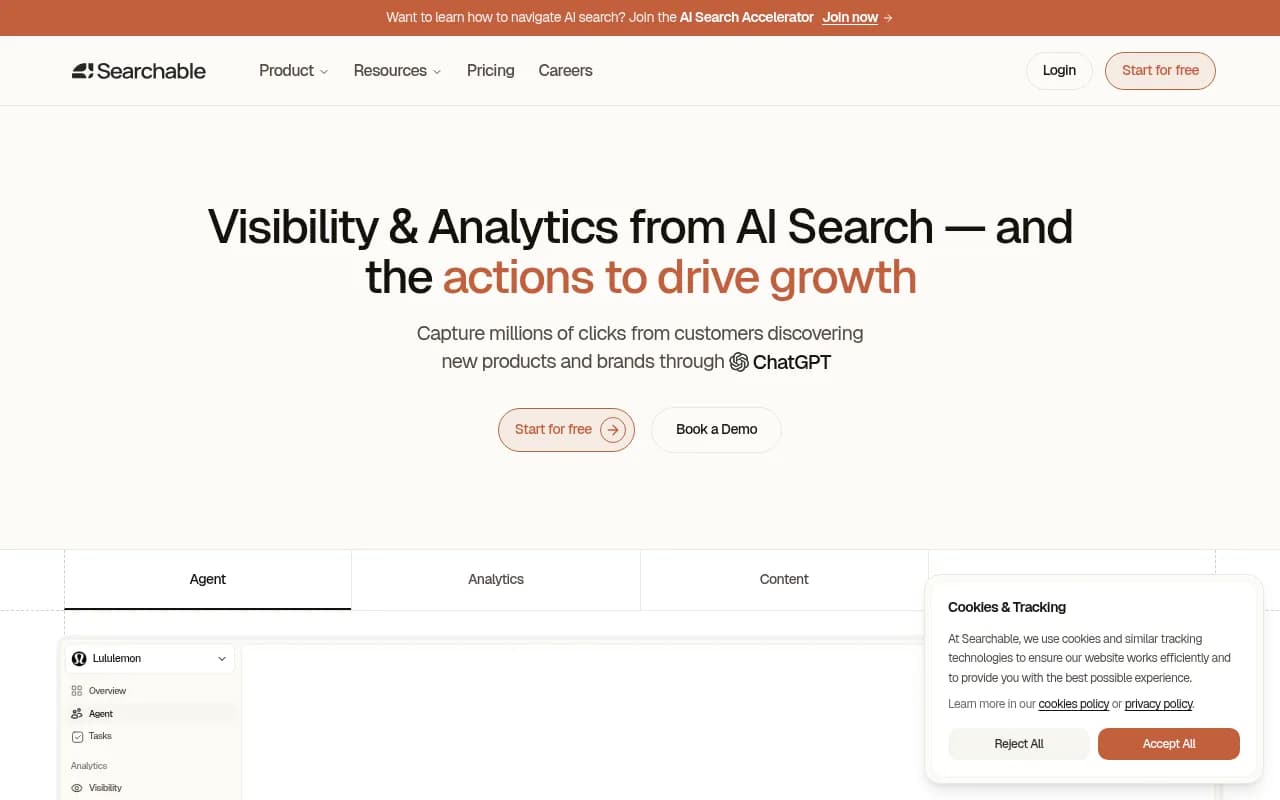
Searchable's Pro tier at $125/mo bundles in 20 articles a month alongside 100 prompts and 9,000 AI answers, which makes it one of the few tools on this list that treats content generation as core rather than an upsell. Scale, at $400/mo, is the most popular tier per Searchable's own pricing page, adding white-label reports and a dedicated account specialist. Extra models (Copilot, DeepSeek, Google AI Mode, Gemini, Grok, Claude) are paid add-ons across every tier, so the headline price understates what full multi-model coverage actually costs.
9. Semrush AI Toolkit
This isn't a standalone product. The AI Visibility add-on is $99/mo per domain and requires an active Semrush SEO subscription (Pro starts around $139.95/mo). For that you get 25 custom prompts, mentions tracking across ChatGPT, Google AI, Gemini, and Perplexity, and an AI-readiness audit covering up to 100 pages. If you're already paying for Semrush for keyword research and site audits, bolting this on is the path of least resistance. If you're not, it's an expensive way to get a fairly shallow slice of AI visibility data. One agency CMO quoted in a Rankability review put it bluntly: "I can't say this tool is worth $99/month... not for a startup and not for a big brand either."
10. LLMrefs
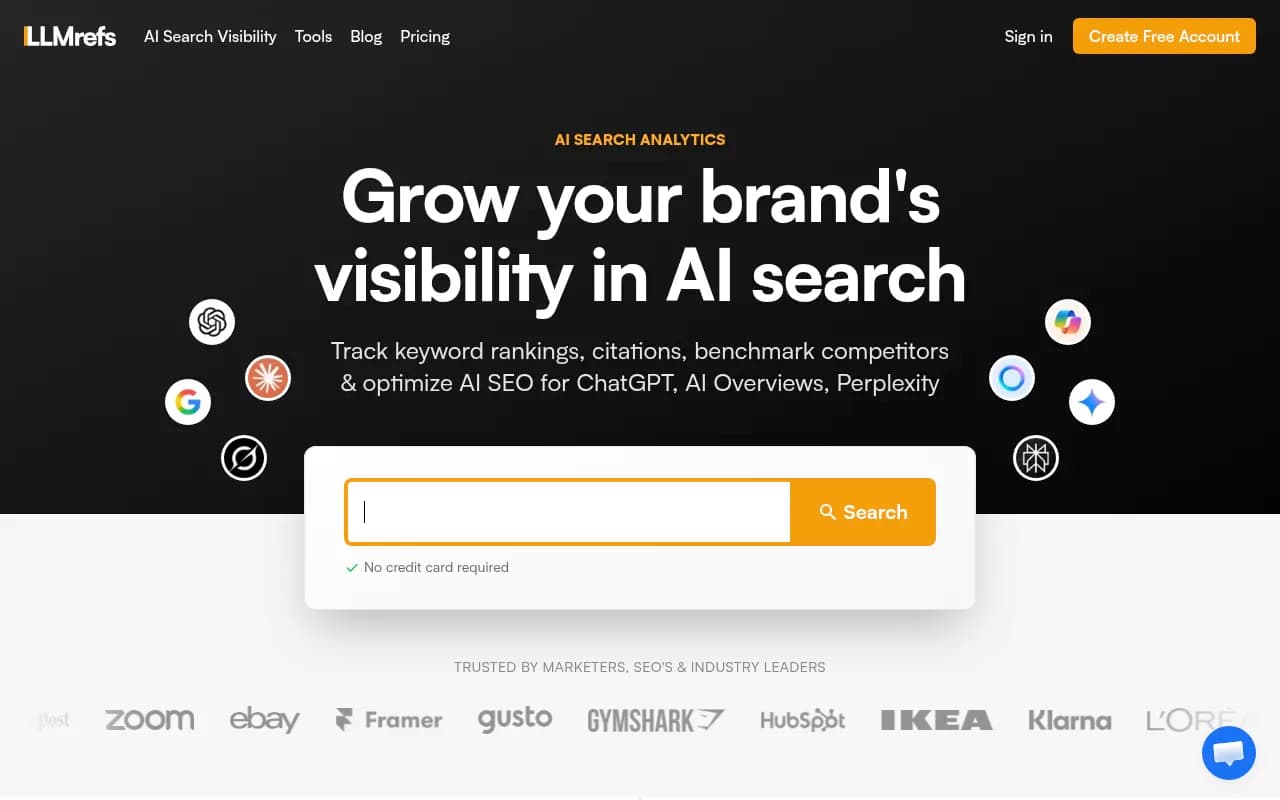
LLMrefs keeps things deliberately simple: one plan, $79/mo, cancel anytime, tracking your brand across ChatGPT, Perplexity, and other major engines. No tiers, no credit systems, no add-on pricing for extra models. That flatness is the whole pitch. It won't have the crawler logs or content-generation depth of Promptwatch or the enterprise compliance checkboxes of Profound, but for a freelancer or small agency that just wants a number to check weekly without decoding a pricing page, it's the lowest-friction option here.
What actually matters when you're comparing these tools
Most buyers start by counting how many AI models a tool tracks, but that number is a weak signal on its own. ChatGPT cites roughly 5 sources per web-search response, the tightest inventory of any major engine, while Google AI Overviews and Perplexity each cite closer to 10, according to Promptwatch's data on average sources per response. Microsoft Copilot is still the wildcard: its citation count has swung from under 2 to nearly 17 sources per response within a few weeks as Microsoft keeps re-architecting its retrieval system. A tool that tracks Copilot "as one of 9 engines" but doesn't explain that volatility is giving you a number without context.
A few more things worth checking before you sign up for anything:
- Does it show which domains actually get cited, broken down by authority? Promptwatch's citation-share-by-domain-rank data for August 2026 found that domains in the DR 46-90 range captured roughly 42% of ChatGPT citations all month, while top-tier DR 91-100 domains fell from about 7% to 3% share over the same period. If a tool only tells you your mention count and not who's beating you and why, you're missing the half of the picture that tells you what to fix.
- Does it track Reddit citations, and does it know they're dropping? Reddit's share of ChatGPT Search citations collapsed from roughly 4% to 0.5% in a single day (August 14, 2026), per Promptwatch's Reddit citation data. A tool still weighting Reddit heavily in its recommendations is working off stale assumptions.
- Does it log AI crawler traffic, not just chatbot answers? OpenAI's crawlers still made up about 80% of verified AI crawler requests as of early September 2026, down from roughly 95% in June, per Promptwatch's AI crawler traffic mix data. That shift matters for your robots.txt and CDN rules; blocking the wrong bot can quietly remove you from an engine's index.
- What does content type performance look like on the engine you care about most? Product pages led ChatGPT citations at roughly 29% in August 2026, but How-To content more than doubled its share over the same month, per Promptwatch's citation content type breakdown. If a tool can't tell you which content type is gaining ground in your category, its recommendations are guesswork.
A realistic budget range
Pricing across this category ranges from $20/mo (Rankscale AI's Essentials tier) to $3,000+/mo for enterprise contracts, and one industry benchmark puts the average price across 30+ tools studied at around $337/mo. For most small-to-mid teams, $79-$249/mo covers a legitimate multi-model tool with room to act on the data, not just watch it. Premium tiers above $300/mo generally only make sense if you're managing multiple client brands, need white-label reporting, or are hitting heavy API usage.
One more practical note: don't expect results in a month. Teams that abandon a GEO strategy after 4-6 weeks are giving up before the data has time to compound; a realistic window to see movement in citation share is 3-6 months, which is worth keeping in mind regardless of which tool you pick.
Which one should you actually pick
If you want the cheapest way to start measuring, Otterly.AI or LLMrefs will get you a real answer for under $80/mo. If you're an enterprise with compliance requirements and budget for custom pricing, Profound or Scrunch's Enterprise tier are built for that conversation. If you already live inside Semrush, the AI Toolkit add-on is the path of least resistance even if it's the shallowest data set on this list.
If you want one tool that tracks where you stand and then actually does something about it, closing the loop between monitoring and fixing content, Promptwatch is the one built for that specific job, with crawler-level visibility and content agents that publish straight to your CMS rather than leaving the writing to you. For a broader look at the category, the GEO software directory at bestgeosoftware.com is a good next stop, and if you're deciding between AI rank trackers specifically, ai-rank-tools.com breaks down that narrower slice in more detail.