Key takeaways
- Most AI visibility tools are monitoring dashboards -- they show you where you're invisible but don't help you do anything about it.
- The tools worth paying for in 2026 go beyond coverage metrics: they track prompt-level citations, show competitor gaps, and ideally help you create content that gets cited.
- Coverage (how many LLMs a tool monitors) matters less than depth -- prompt volume data, page-level citation tracking, and content gap analysis separate the leaders from the dashboards.
- A handful of platforms have built the full loop: find gaps, generate content, track results. Most haven't.
- If you're serious about AI search visibility, the evaluation criteria in this guide will save you from paying for a tool that just tells you what you already suspect.
There's a pattern that keeps showing up in 2026: a brand discovers that ChatGPT or Perplexity barely mentions them, buys an AI visibility tool, and then... stares at a dashboard. The tool confirms the problem. It doesn't help solve it.
That's the gap this guide is trying to address. Coverage -- how many AI models a tool monitors -- has become table stakes. What separates useful platforms from expensive dashboards is depth: do they tell you why you're invisible, which specific content is missing, and what to do next?
Let's get into it.
Why "coverage" is the wrong thing to optimize for
When AI visibility tools first appeared, the main selling point was breadth. Does it track ChatGPT? Perplexity? Gemini? Claude? That made sense early on -- brands needed to know the basics.
But in 2026, almost every tool in this space monitors at least five or six LLMs. Checking that box no longer differentiates anything. The real question is what happens after you see the data.
Consider what you actually need to know:
- Which specific prompts are your competitors being cited for that you're not?
- Which of your pages are AI models actually reading and citing -- and how often?
- What content would close the gap between your visibility and a competitor's?
- Is there a traffic signal connecting AI citations to actual website visits?
Most tools answer none of these. They show you a visibility score, maybe a mention count, and leave the rest to you. That's not optimization -- it's observation.
The five things that actually matter in a visibility tracker
Before getting to specific tools, here's the framework I'd use to evaluate any platform in this space:
1. Prompt-level granularity. Can you see individual prompts and how your brand performs on each one? Or just an aggregate score? Aggregate scores are nearly useless for action.
2. Competitor gap analysis. Does the tool show you prompts where competitors appear but you don't? This is the single most actionable data point in AI visibility.
3. Page-level citation tracking. Which specific URLs on your site are being cited by which models? This tells you what's working and what needs work.
4. Content creation or optimization support. Does the platform help you produce content that's likely to get cited, or does it just show you the problem?
5. Traffic attribution. Can you connect AI citations to actual visits and conversions? Without this, you're measuring visibility in a vacuum.
Tools that nail all five are rare. Most do one or two well.
The platforms worth knowing about
Promptwatch -- the full loop
Promptwatch is the platform that comes closest to closing the full loop. It monitors 10 AI models (ChatGPT, Claude, Perplexity, Gemini, Grok, DeepSeek, Copilot, Meta AI, Mistral, and Google AI Overviews), but the monitoring is almost secondary to what comes next.
The Answer Gap Analysis shows you exactly which prompts competitors rank for that you don't -- not as a vague category but as specific questions with prompt volume estimates and difficulty scores. You can see the actual content gap and prioritize which prompts are worth going after.
From there, a built-in AI writing agent generates content grounded in citation data from 880M+ citations analyzed. It's not generic content -- it's engineered around what AI models actually cite. Then page-level tracking shows whether the new content gets picked up.
It also has AI crawler logs (real-time logs of ChatGPT, Claude, and Perplexity bots hitting your site), Reddit and YouTube citation tracking, and ChatGPT Shopping monitoring. Traffic attribution connects the dots to revenue via a code snippet, GSC integration, or server log analysis.
Pricing starts at $99/month for one site and 50 prompts. Professional is $249/month, Business $579/month.

Profound -- strong enterprise feature set
Profound tracks brand visibility across major AI models with solid depth on the monitoring side. It's particularly well-regarded for competitive benchmarking and has a cleaner UI than many enterprise tools. The price point is higher than most, which makes it better suited to teams with dedicated GEO budgets. It doesn't have the content generation layer that Promptwatch has, so you'll still need a separate workflow to act on what you find.

AthenaHQ -- monitoring-focused with good breadth
AthenaHQ covers eight or more AI engines and does a reasonable job of tracking brand mentions and sentiment across them. The interface is clean and the setup is fast. Where it falls short is the action layer -- it's primarily a monitoring tool, so finding a gap and fixing it requires work outside the platform.

Otterly.AI -- affordable entry point
Otterly.AI is one of the more accessible options for smaller teams. It tracks brand mentions across the main LLMs and gives you a basic visibility score. The tradeoff is depth -- no crawler logs, no content gap analysis, no traffic attribution. If you're just starting to understand your AI visibility and want a low-cost way to get oriented, it's fine. If you need to act on the data, you'll outgrow it quickly.

Peec.ai -- multi-language tracking
Peec.ai's standout feature is multi-language and multi-region monitoring, which makes it genuinely useful for brands operating across markets. It handles the basics of LLM mention tracking well. Like Otterly, it's more of a monitoring tool than an optimization platform -- no content generation, limited gap analysis.

SE Visible -- user-friendly for SEO teams
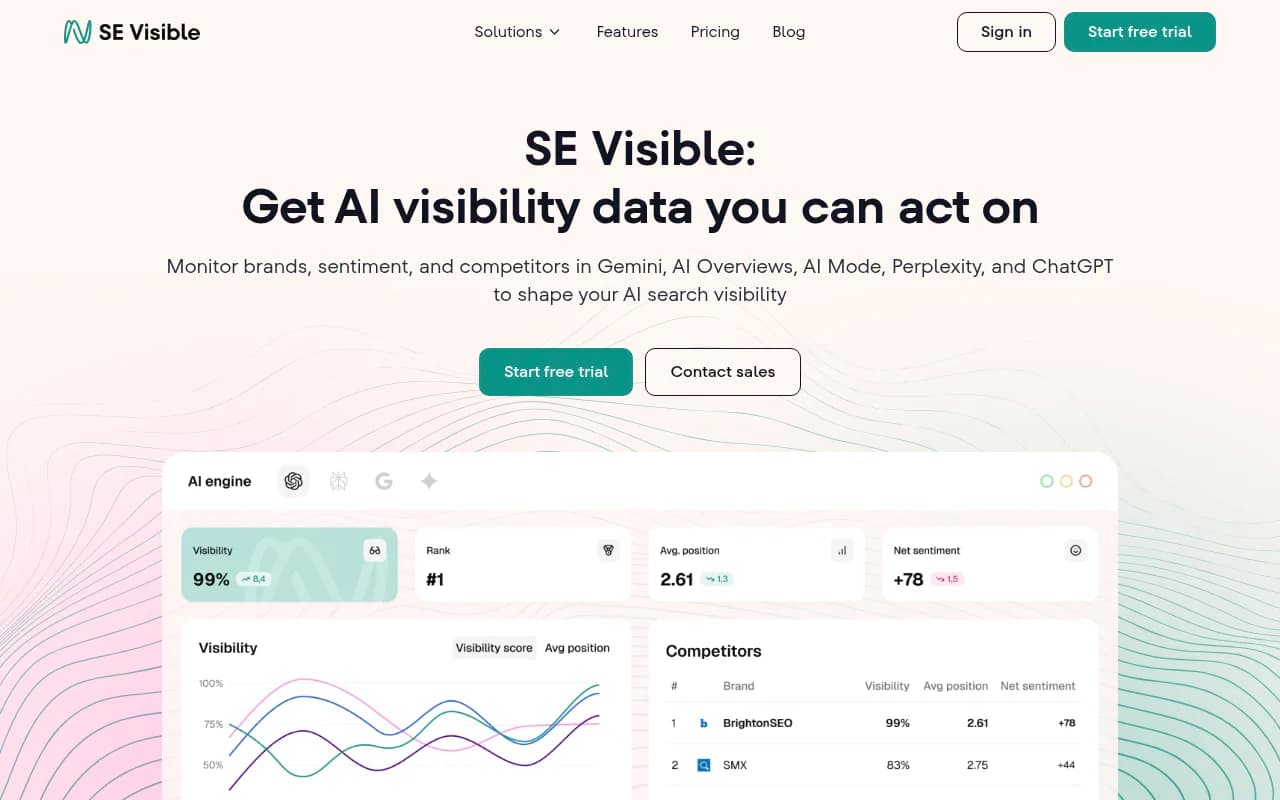
SE Ranking's AI visibility product (SE Visible) is a natural fit for teams already in the SE Ranking ecosystem. It tracks AI Overview appearances and LLM mentions, and the interface will feel familiar to anyone who's used traditional rank trackers. The integration with broader SEO data is useful for teams that want AI visibility alongside conventional keyword tracking.
Rankshift -- prompt-level LLM tracking
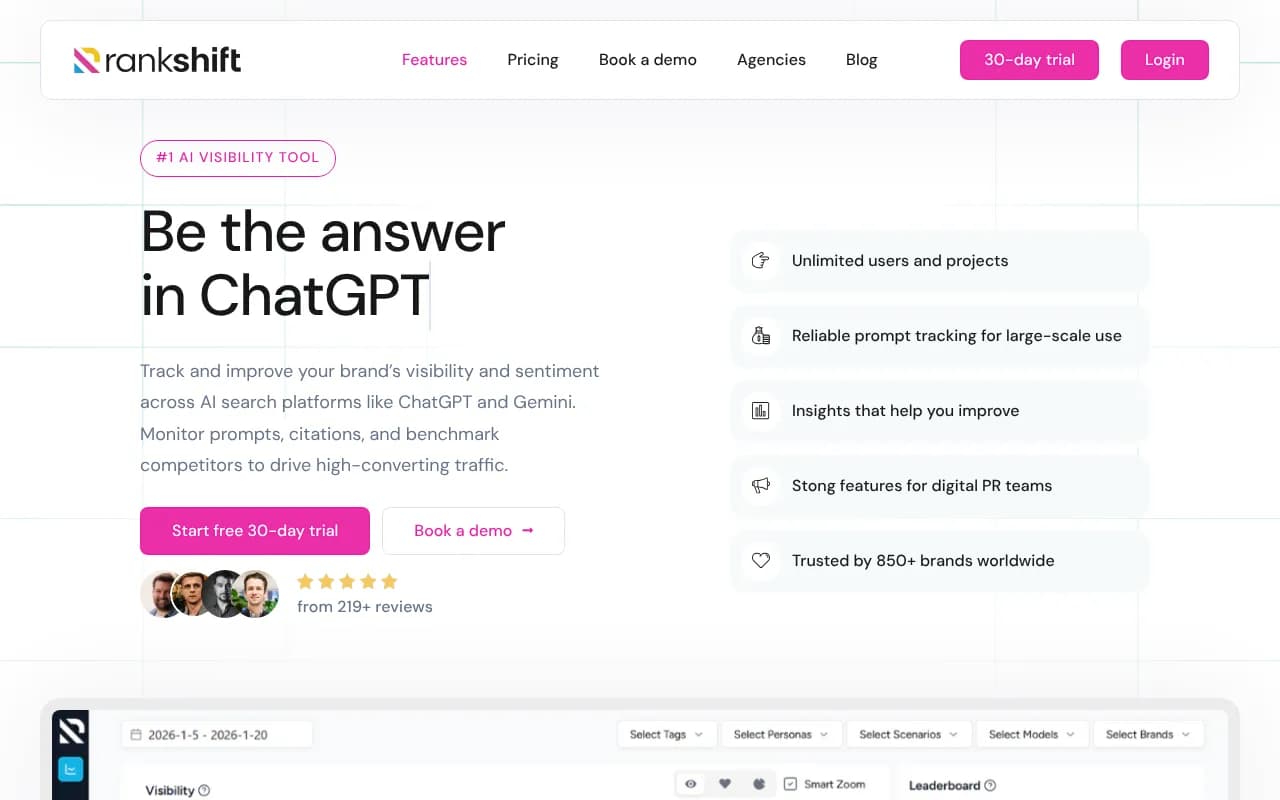
Rankshift is built specifically for tracking visibility at the prompt level across ChatGPT and Gemini. The granularity is better than most entry-level tools, and it's positioned for GEO practitioners who want to get into the details. Still primarily a tracking tool, but a more detailed one than the basic monitoring dashboards.
Scrunch AI -- brand-focused tracking
Scrunch AI focuses on brand mention tracking across AI search engines with a reasonably clean reporting interface. It's a solid choice for brand teams that want to monitor how they're being described in AI responses, though it lacks the deeper optimization capabilities of the top-tier platforms.
Brandlight -- AI-powered brand monitoring
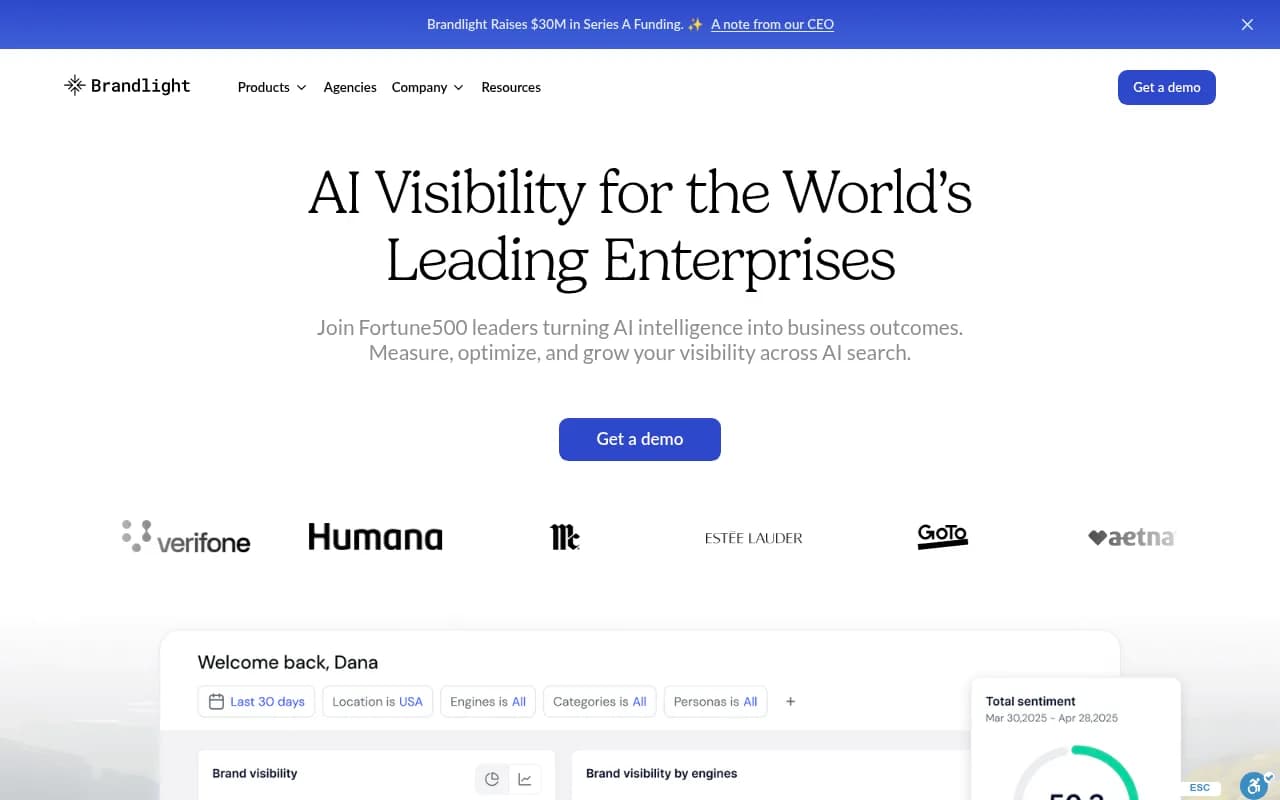
Brandlight takes a brand reputation angle on AI visibility -- tracking not just whether you're mentioned but how you're being described. Useful for brand teams worried about AI models saying something inaccurate or unflattering about them. Less focused on the content optimization side.
Evertune -- enterprise GEO
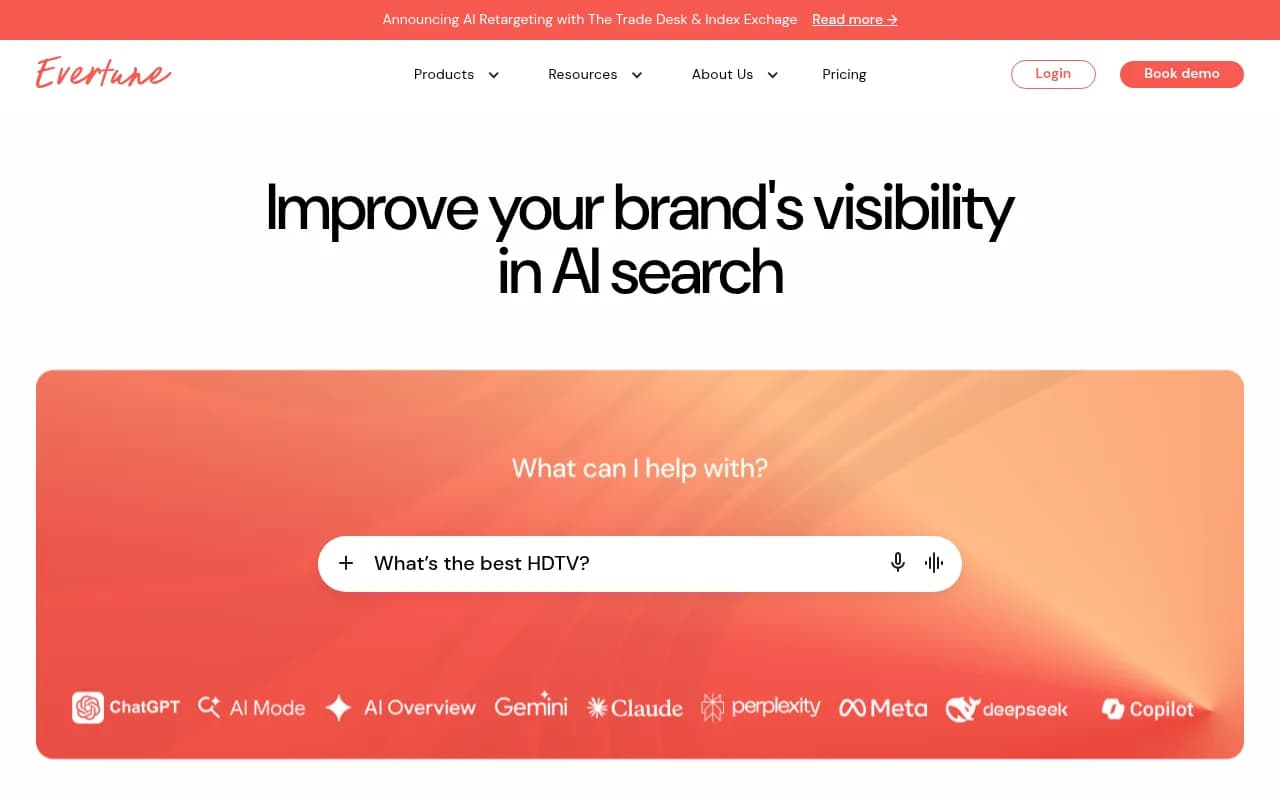
Evertune is positioned at the enterprise end of the market, with a focus on Fortune 500 brands. It covers the major AI models and has solid competitive benchmarking. The enterprise positioning means the price and onboarding complexity reflect that -- it's not the right fit for most mid-market teams.
Ahrefs Brand Radar -- familiar but limited
Ahrefs added AI brand monitoring to its existing platform, which is convenient for teams already paying for Ahrefs. The limitation is that prompts are fixed (you can't customize them), and there's no AI traffic attribution. It's a reasonable add-on if you're already an Ahrefs customer, but it's not a standalone AI visibility solution.
Semrush -- traditional SEO with AI monitoring added
Semrush has added AI visibility features to its platform, but the approach is similar to Ahrefs -- fixed prompts, limited customization, no content gap analysis built around AI citation data. Useful as a supplement to an existing Semrush workflow, not as a primary GEO tool.
How the tools compare
Here's a direct comparison across the dimensions that actually matter:
| Tool | LLMs monitored | Prompt-level data | Competitor gap analysis | Content generation | Traffic attribution | Crawler logs | Starting price |
|---|---|---|---|---|---|---|---|
| Promptwatch | 10 | Yes | Yes (Answer Gap Analysis) | Yes (built-in AI writer) | Yes (GSC, snippet, logs) | Yes | $99/mo |
| Profound | 6+ | Yes | Partial | No | No | No | Higher |
| AthenaHQ | 8+ | Yes | Partial | No | No | No | Mid-range |
| Evertune | 5+ | Partial | Yes | No | No | No | Enterprise |
| SE Visible | 4+ | Partial | No | No | No | No | Low |
| Otterly.AI | 5+ | No | No | No | No | No | Low |
| Peec.ai | 5+ | Partial | No | No | No | No | Low |
| Rankshift | 2 | Yes | No | No | No | No | Low |
| Ahrefs Brand Radar | 3+ | No (fixed prompts) | No | No | No | No | Bundled |
| Semrush | 3+ | No (fixed prompts) | No | No | No | No | Bundled |
The pattern is clear: most tools cluster at the monitoring end. The gap between "shows you the problem" and "helps you fix it" is wide, and very few platforms have crossed it.
What to look for if you're evaluating tools right now
A few practical filters:
If you're an agency managing multiple clients, you need multi-site support, white-label reporting, and ideally an API. Promptwatch has agency/enterprise pricing with custom configurations. Most entry-level tools cap out at one or two sites.
If you're a mid-market brand with a content team, the content gap analysis and AI writing features matter more than the monitoring breadth. A tool that finds 50 gaps and helps you fill them is worth more than one that finds 200 gaps and leaves you stuck.
If you're just getting started, a lower-cost monitoring tool like Otterly.AI or SE Visible can help you understand the basics. Just go in knowing you'll need a separate workflow to act on what you find.
If you're in a multi-language market, Peec.ai's regional monitoring is worth a look, though you'll still need to handle content optimization separately.
If you're at enterprise scale, Evertune and Profound are the main options, though both come with enterprise pricing and complexity. Promptwatch's Business and Agency tiers cover a lot of the same ground at a lower price point.
The tools that go deeper on specific use cases
Beyond the main platforms, a few specialized tools are worth knowing about:
LLM Clicks focuses specifically on citation tracking -- understanding which sources AI models pull from and how often. Useful for publishers and content teams trying to understand what's getting cited.
GetCito combines visibility tracking with optimization guidance, with a focus on helping teams understand what content changes would improve their citation rate.
Ranksmith is positioned around actionable insights -- it tries to move beyond raw data to tell you what to do next, which puts it a step ahead of pure monitoring tools.
Trakkr.ai covers ChatGPT, Claude, and Perplexity with a clean interface and is a reasonable option for teams that want straightforward tracking without a lot of complexity.
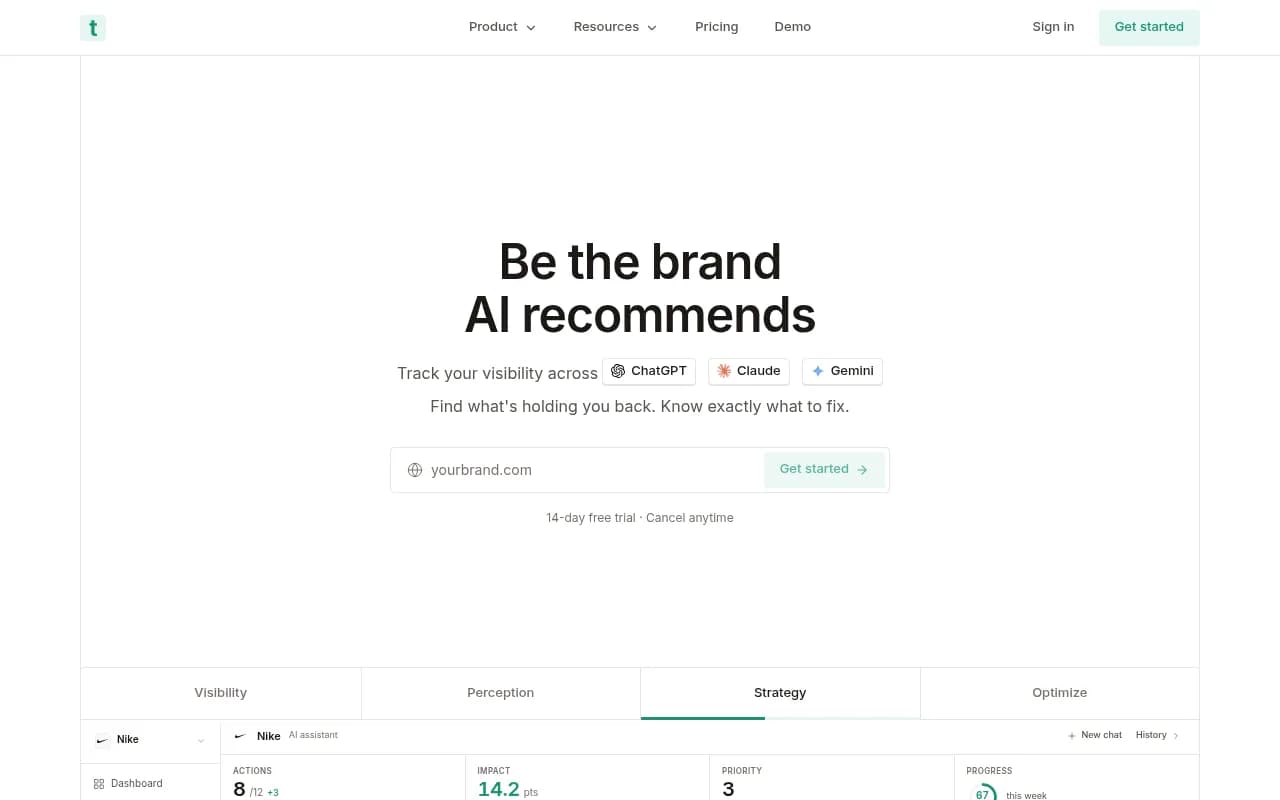
ZipTie offers deep analysis for AI search visibility, with a focus on understanding citation patterns across models.
The honest take on where this market is heading
The AI visibility tool market in 2026 is where traditional rank tracking was around 2015 -- a lot of tools doing roughly the same thing, with differentiation starting to emerge around depth and workflow integration.
The monitoring-only tools will face pressure as brands realize that knowing you're invisible doesn't make you visible. The platforms that survive and grow will be the ones that close the loop between data and action.
Content generation grounded in citation data is the obvious next step, and it's where the most interesting development is happening. Tools that can tell you "here's the exact question ChatGPT is answering for your competitor but not for you, and here's a draft article that would fill that gap" are genuinely useful in a way that a visibility score isn't.
The other area to watch is traffic attribution. Right now, most brands have no idea whether their AI visibility improvements are actually driving visits or revenue. The platforms that solve this -- connecting AI citations to real business outcomes -- will have a much stronger argument for their value.
If you're evaluating tools today, the question to ask every vendor is simple: "After you show me a gap, what does your platform do to help me close it?" The answer will tell you everything.