Key takeaways
- AirOps is a content-execution platform first. Its own comparison pages admit it, and independent reviewers agree: "Profound shows visibility. AirOps turns insights into content" is AirOps' own framing of itself.
- The Solo plan (~$199-200/mo) only tracks ChatGPT. Multi-engine coverage (Google AI Overviews, AI Mode, Perplexity) requires the Pro tier, which jumps to roughly $2,000/month with no mid-tier in between.
- Even on Pro, you're capped at 250 tracked prompts and pages, which gets thin fast once you're reporting across five or six client accounts with distinct personas and markets.
- Multiple agency-focused comparisons (Rankability, Yotpo, Profound's own roundup) score AirOps as having no SKU-level data, narrow engine coverage, and output that "usually needs cleanup."
- The common pattern among agencies that use AirOps successfully is pairing it with a dedicated monitoring tool for white-label, per-client, multi-engine reporting, rather than asking AirOps to do both jobs.
What AirOps actually is
AirOps calls itself a content engineering platform for AI search discovery, and that description is more accurate than "AI visibility tool." The core of the product is Grids and Power Agents, a spreadsheet-style workflow builder that runs content generation across 20+ models with conditional logic and human review, then publishes to seven-plus CMS platforms. If you've ever wanted an editorial calendar that can actually execute the calendar, that's what AirOps is chasing.
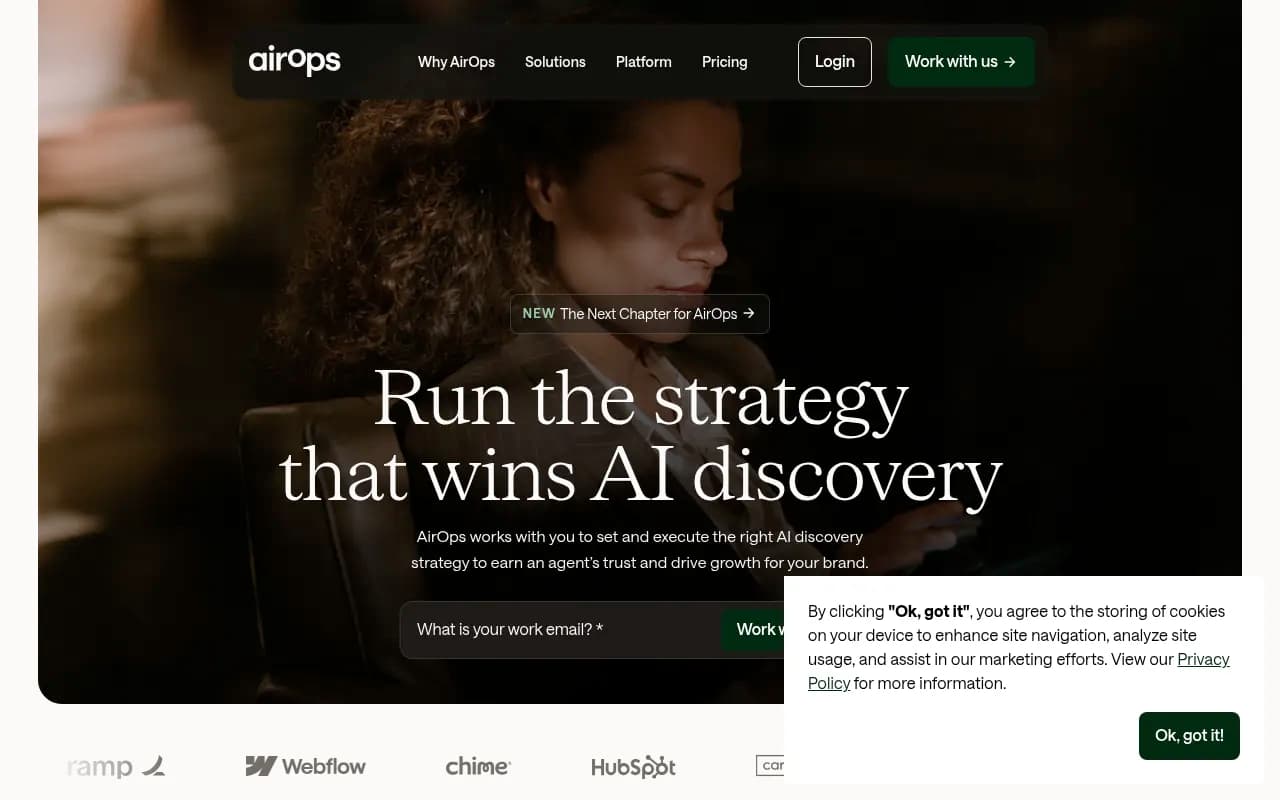
Its Page360 dashboard bundles AI citation tracking with Google Search Console rankings and GA4 conversions in one view, which is genuinely useful if you want a single screen that shows organic and AI performance side by side. AirOps also cites case numbers worth noting: Chime went from being recommended in 24 priority questions to 68 (a 3x jump in AI citations), Docebo captured a 25% share-of-voice lead, and Webflow saw a 6% lift in AI-attributed signups while 5x'ing content refresh velocity.
Those are real results. But they're results from using AirOps to produce and ship content against visibility gaps, not from AirOps being the system of record for how visible a client is across the AI ecosystem.
Where AirOps runs thin for agency reporting
Agencies have a different job than in-house teams. You're tracking visibility across every client account simultaneously, auditing a prospect's AI presence the night before a pitch, and explaining share-of-answers to a CMO who wants a clean number, not a workflow tool. Three specific gaps show up when you try to make AirOps carry that load alone.
The pricing cliff
AirOps' pricing has a documented gap that several independent teardowns flag as a real buying risk. Solo sits around $199-200/month but only tracks ChatGPT, with 100 tracked prompts and pages and single-user access. Pro jumps straight to roughly $2,000/month base (plus overage around $6 per 1,000 tasks) before you get multi-engine coverage, weekly reports, unlimited seats, and CMS integrations. There's no $500 or $800 tier in between. For an agency running three or four small retainers, that's either underpowered ChatGPT-only monitoring or a jump to enterprise-grade spend before the retainer justifies it.
Prompt and engine ceilings
Even on Pro, you're capped at 250 tracked prompts and pages across all clients combined. Split that across six accounts and you're at roughly 40 prompts per client, thin coverage once you factor in multiple personas, regions, or languages per brand. AirOps itself doesn't offer a data-warehouse connection (no BigQuery or Snowflake) in its Workflows product, a gap it acknowledges directly in its own comparison against Searchable.
Monitoring depth that third parties consistently ding
Across several independent agency-tool roundups, the scoring is consistent. One comparison matrix lists AirOps with "None" for SKU-level data, API-based data sourcing, and output that "usually needs cleanup." Another flags a steep learning curve and notes that "prompt popularity is an estimate, not real user demand." Rankability's review is blunter: AirOps "won't guarantee rankings, it just accelerates what you're already good at," and pricing is "opaque beyond the free tier."
None of this makes AirOps a bad product. It makes it a specialized one. If your agency already knows what content to produce and mainly needs the machinery to produce it at volume, AirOps does that job well. If you need to prove to a client, in a clean and defensible way, exactly where they stand across ChatGPT, Perplexity, Gemini, and Google AI Overviews this month versus last month, that's a different tool.
Why the monitoring gap matters more in 2026
The citation environment AirOps' content is trying to win a spot in keeps shifting underneath agencies, often within a single month. Promptwatch's data on ChatGPT citation types in August 2026 shows product pages falling from about 30% to 25% of citations by month's end while how-to content more than doubled, from roughly 4.3% up to 9-10% share, and social posts collapsed from 4.4% to under 1% after August 14, coinciding with a broader Reddit citation drop that Promptwatch's Reddit citation data also documented.
That kind of volatility, within weeks, not quarters, is exactly the signal a pure content-execution platform won't surface on its own. It requires continuous, dedicated citation-type monitoring that updates daily, not a monthly content sprint retrofitted around last quarter's assumptions.
There's also a structural constraint worth knowing before you build a client report around any single engine. Promptwatch's average sources per response data shows ChatGPT typically cites only about five sources per web-search answer, roughly half what Google AI Overviews (around ten) and Perplexity (also consistently near ten) include. Microsoft Copilot is the wildcard, swinging from under two sources to nearly seventeen within weeks. With only five ChatGPT slots per answer, granular per-prompt tracking matters more than an aggregate visibility score, because "pretty relevant" content misses the cut when the inventory is that tight.
How competing and complementary tools stack up
Here's how AirOps compares against the tools agencies most often pair it with, or replace it with, for the reporting layer specifically.
| Tool | Starting price (2026) | Engine coverage | Content execution | Best agency fit |
|---|---|---|---|---|
| AirOps | ~$199/mo (ChatGPT only); ~$2,000/mo for multi-engine | 7+ engines on Pro tier | Strong (Grids, Power Agents, multi-CMS publishing) | Agencies that already know what to produce and need volume execution |
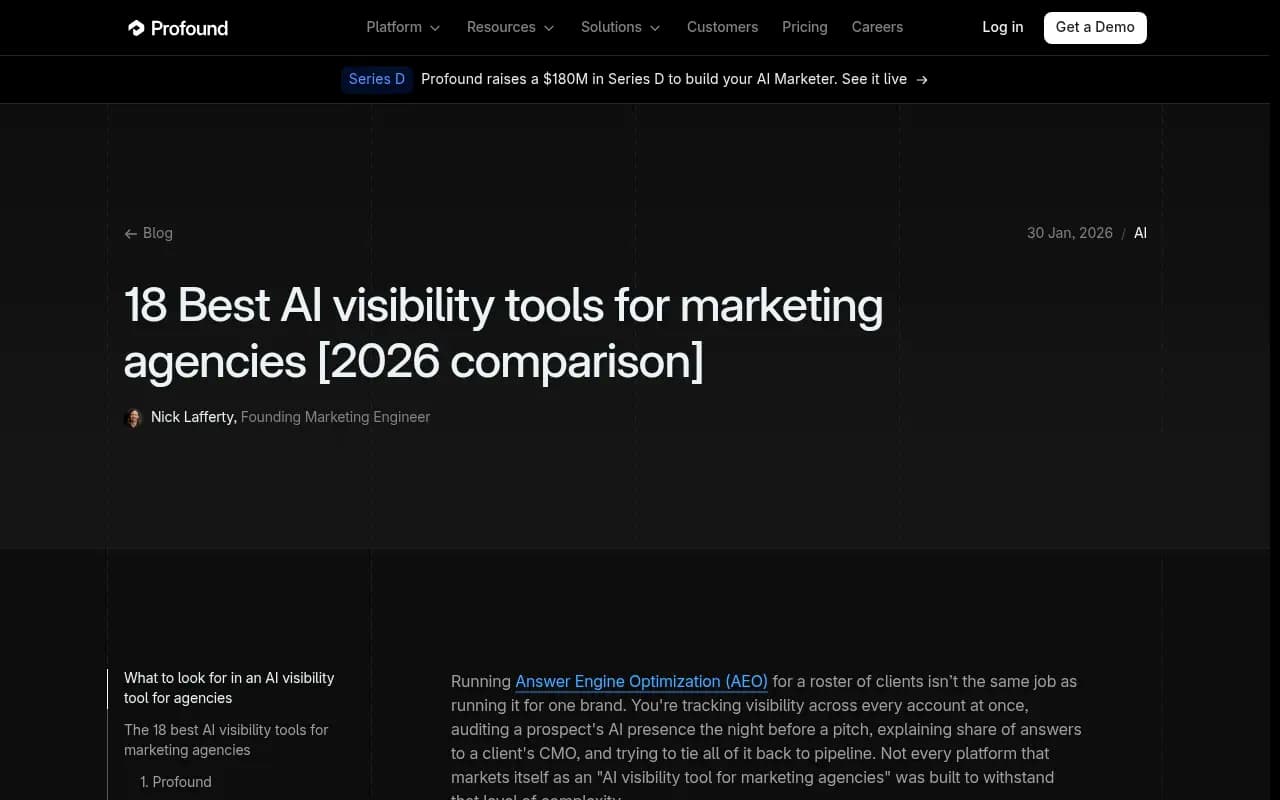
| Profound | Agency Growth from ~$99 + $399/client workspace | Up to 9 engines on Enterprise | Growing, via Agents and Sheets | Agencies running AEO as a scaled service with pitch workspaces |
| Searchable | ~$100-125/mo | Up to 9 engines | Limited | Agencies that need presentable white-label visibility reports first |
| Scrunch | $250/mo Core; $500/mo Agency | 4 LLMs (~31 unique queries) | None yet | Agencies prioritizing referral economics and AXP-served pages |
| Promptwatch | $95/mo Essential; $245/mo Professional | ChatGPT, Gemini, Claude, Perplexity, Grok, Copilot, AI Overviews, AI Mode, and more | Content Agents with CMS publishing, Unified Actions, Agent Chat | Agencies that want crawler logs, citation trends, and automated content generation in one platform |
A few of these deserve a closer look, since "which tool" isn't really the right question, it's "which combination."
Profound

Profound restructured its pricing materially after a $180M Series D in mid-September 2026, dropping its self-serve Starter and Growth plans entirely. What's left is a Trial, an Agency Growth tier that bundles a base fee plus a per-client workspace add-on, and a custom Enterprise tier covering up to nine engines with API access and SOC 2 compliance. That Agency Growth tier includes pitch and prospect-audit workspaces, useful specifically for the moment before you've won a client, which AirOps doesn't really address.
Searchable
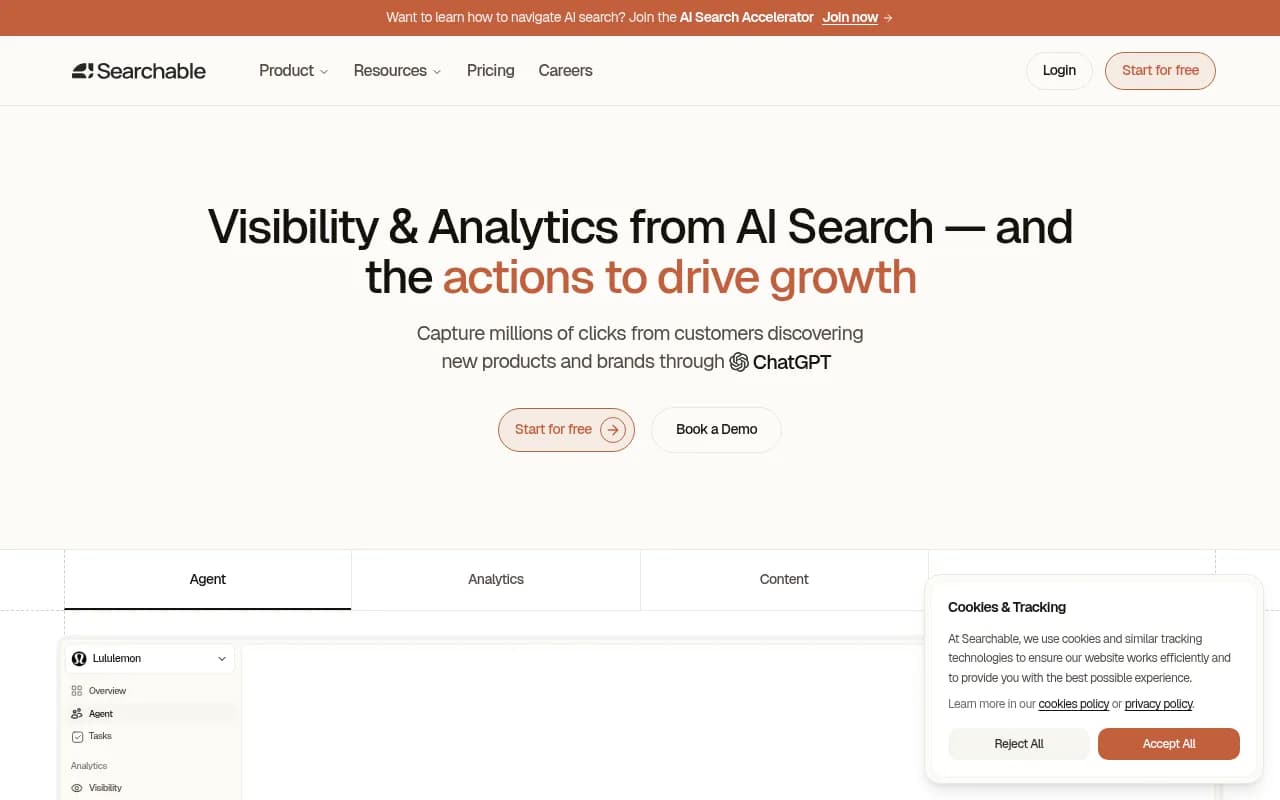
AirOps' own comparison against Searchable is refreshingly candid: it positions Searchable as the better fit specifically for agencies needing presentable white-label visibility reports, while AirOps suits agencies needing governed content execution across many clients. That's about as direct an admission as you'll get from a vendor about where its own product stops.
Scrunch
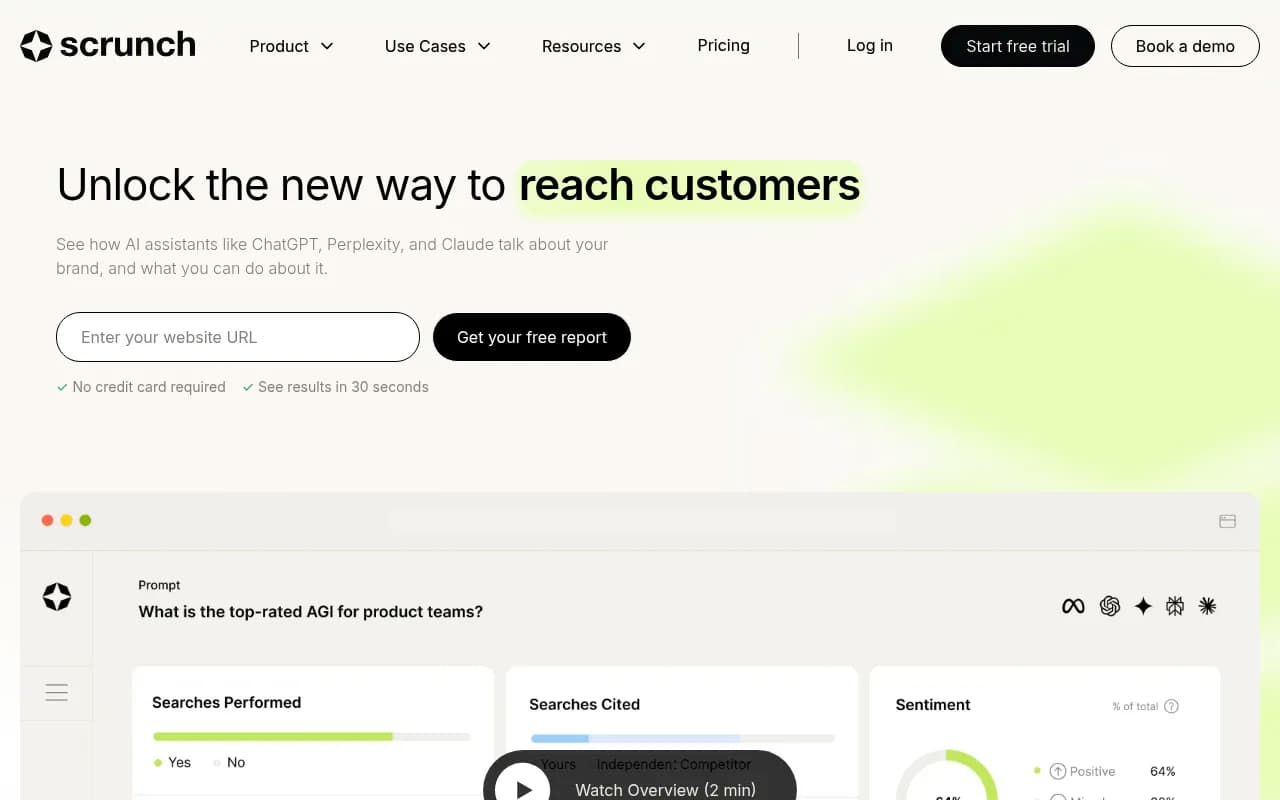
Scrunch's pitch is a differentiated AXP (answer experience platform) that serves AI-optimized pages directly to crawlers, plus a referral program agencies like for economics. It doesn't generate content and its prompt volumes are configured rather than pulled from live user data, so it's monitoring-adjacent more than monitoring-complete.
Promptwatch
Promptwatch takes a different angle than any of the above: instead of choosing between "monitor well" and "produce content," it tries to do both in one stack. Crawler logs (Agent Analytics) show which AI bots actually hit a client's pages and what they found, citation analytics break down where content gets cited across Reddit, YouTube, and offsite mentions, and Content Agents plan, write, and publish GEO-optimized articles straight to Webflow, Framer, or WordPress on a schedule, with a review inbox if you don't want it fully automated. Agencies get a white-label dashboard and client portal, which matters when you're reporting to six accounts at once rather than running one brand.

For an agency already using AirOps for content production, Promptwatch's value isn't replacing the execution layer, it's filling the reporting gap: per-prompt volume and difficulty scoring, query fan-outs, sentiment tracking, and a Unified Actions list that turns citation and crawler data into a prioritized to-do list you can hand a client. Crisp, one of Promptwatch's customers, scaled to five to ten published articles a day and saw twice the conversion rate from AI traffic compared to traditional channels, using the Answer Gap Report to plan what to produce next.
A practical decision framework
Run through these questions before deciding whether AirOps alone covers your agency's reporting needs:
- How many clients need multi-engine tracking (not just ChatGPT)? If it's more than one or two, the AirOps Pro jump to ~$2,000/month starts looking expensive relative to dedicated trackers priced per seat or per prompt.
- Do you need white-label, client-facing dashboards today, or is internal reporting enough for now? AirOps' own materials point you toward Searchable or similar tools specifically for presentable client reports.
- Does your reporting need to explain why a client is or isn't visible, not just that they are? Crawler-log data (who's actually reading the site, and where they hit errors) is the piece that answers "why," and it's largely absent from AirOps' current feature set.
- Is your team already strong on SEO fundamentals? Rankability's review notes AirOps isn't built for beginners without those fundamentals in place. If your team is newer, a tool with more guided recommendations (Otterly, Searchable) might reduce the cleanup work AirOps output tends to need.
The bottom line
AirOps earns its reputation as a content-operations engine. If your agency's bottleneck is turning visibility insight into published pages at volume, especially across many client URLs at once via Grids, it's a legitimate pick, and one AirOps itself, Rankability, and Profound's own comparison roundup all converge on describing the same way: strong on execution, thinner on dedicated monitoring.
What it isn't, by its own admission and by the consistent scoring of third-party agency-tool comparisons, is a standalone AI visibility reporting platform for multi-client agency work. The ChatGPT-only Solo tier, the pricing cliff into five-figure annual spend for multi-engine coverage, and the 250-prompt ceiling on Pro all point the same direction: pair it with something built specifically for citation tracking, crawler logs, and white-label client reporting, rather than stretching one tool to cover both jobs. For a broader look at how the GEO software category is shaking out this year, the directory at bestgeosoftware.com is worth a scan before you commit to a second tool.