Summary
- AI search is local now: Over 60% of local searches happen in AI engines like ChatGPT, Perplexity, and Google AI Overviews -- if your business isn't mentioned, you don't exist to those customers
- Geographic precision matters: Generic brand tracking misses the reality that AI models recommend different businesses based on the user's city or state -- you need location-specific monitoring
- The action gap: Most AI visibility tools only show you the data; platforms like Promptwatch close the loop by identifying content gaps and generating optimized articles that actually get cited
- Hybrid stack required: No single tool tracks everything; local businesses typically need a monitoring platform (for visibility data) + a local SEO tool (for review/listing management) + an optimization platform (to fix what's broken)
- Zero-click dominance: Traditional traffic metrics are misleading when 60%+ of searches end without a click -- visibility and citation frequency are the new KPIs
Why local businesses need AI visibility tracking in 2026
A customer in Austin searches ChatGPT for "best HVAC repair near me." The AI model responds with three recommendations. Your company has 4.8 stars on Google, a well-optimized website, and years of local SEO work behind it. But you're not in that list. The customer books with someone else before ever visiting your site.
This scenario plays out thousands of times per day across every local vertical. AI search engines have become the new front door for local discovery, and traditional rank tracking tools can't see what's happening inside them. You might rank #1 on Google for "Austin HVAC repair" but if ChatGPT, Perplexity, and Claude are recommending your competitors, that ranking is worth less than it used to be.
The shift is structural. Google's own data shows that AI Overviews now appear in over 40% of searches, and third-party AI engines like Perplexity and ChatGPT handle billions of queries monthly. For local businesses, the stakes are higher because these tools explicitly recommend specific providers based on location, reviews, and perceived authority -- and you have no visibility into the decision-making process unless you're actively monitoring it.
What makes local AI visibility different from brand monitoring
Tracking AI mentions for a local business is not the same as tracking a national brand. The core difference is geographic precision. When someone in Denver asks ChatGPT for a plumber, the AI model doesn't just look at your overall brand authority -- it evaluates your presence in Denver specifically. That means:
- City-level prompts matter more than generic ones: "Best plumber in Denver" is a different query than "best plumber," and AI models return completely different results for each
- State and regional variations exist: A business visible in Texas might be invisible in California, even if both states are in your service area
- Neighborhood-level nuance: Some AI models (especially Google AI Overviews) factor in hyper-local signals like proximity, neighborhood reputation, and even demographic fit
Most AI visibility tools were built for SaaS companies and national brands. They track prompts like "best project management software" or "top CRM tools" -- broad, location-agnostic queries. Local businesses need tools that can simulate searches from specific cities, track mentions at the state level, and surface the exact prompts that drive local customer decisions.
Promptwatch, for example, supports multi-region and multi-language tracking with customizable personas that match how real customers in specific locations prompt AI engines. This is critical because a generic "best dentist" query won't tell you if you're visible to someone searching in your actual service area.

Key features to look for in a local AI visibility tool
Not all AI monitoring platforms are built for local businesses. Here's what actually matters:
Geographic targeting and city/state-level tracking
The tool must let you specify locations -- not just "United States" but "Austin, Texas" or "Orange County, California." You need to see how your business appears in AI responses when the user is searching from your target markets. Without this, you're flying blind.
Multi-model coverage
Your customers aren't loyal to one AI engine. They use ChatGPT, Perplexity, Google AI Overviews, Claude, and Gemini interchangeably. A good tool tracks all of them. Platforms like Promptwatch monitor 10+ AI models simultaneously, giving you a complete picture of where you're visible and where you're not.
Prompt volume and difficulty scoring
Not all prompts are created equal. "Best pizza near me" gets searched 10,000 times per month; "best gluten-free pizza delivery in Brooklyn" gets searched 50 times. You need to know which prompts are high-value and winnable. Tools that surface prompt volumes and difficulty scores (like Promptwatch's Prompt Intelligence feature) let you prioritize the queries that actually drive revenue.
Citation and source analysis
When an AI model recommends your competitor, where is it pulling that information from? Is it citing a Yelp review? A local news article? A Reddit thread? Citation analysis shows you the exact sources AI engines trust, so you know where to focus your content and PR efforts.
Content gap identification
This is the difference between a monitoring tool and an optimization platform. Monitoring tells you what's happening; optimization tells you what to fix. Answer Gap Analysis (a feature in Promptwatch) shows you the specific prompts your competitors are visible for but you're not, then identifies the missing content on your website that would close those gaps.
Review and reputation integration
AI models heavily weight reviews when making local recommendations. A tool that integrates review data from Google, Yelp, and other platforms gives you context for why you're being cited (or not). Some tools like BrightLocal specialize in this.
Traffic attribution
Visibility is great, but revenue is better. The best tools let you connect AI visibility to actual traffic and conversions. Promptwatch offers traffic attribution via code snippet, Google Search Console integration, or server log analysis, so you can prove ROI.
Top AI visibility tools for local businesses in 2026
Here's a breakdown of the platforms that actually work for local businesses, organized by use case.
| Tool | Best for | City/state tracking | AI models covered | Starting price |
|---|---|---|---|---|
| Promptwatch | End-to-end optimization (monitoring + content generation + traffic attribution) | Yes (multi-region, customizable personas) | 10+ (ChatGPT, Perplexity, Claude, Gemini, Google AI, etc.) | $99/mo |
| BrightLocal | Local SEO + review management + basic AI tracking | Yes (neighborhood-level in some markets) | Limited (Google AI Overviews focus) | $39/mo |
| SE Visible | Simple AI visibility dashboards for small teams | Limited (country-level only) | 5+ (Google AI, ChatGPT, Perplexity, Gemini, Claude) | $49/mo |
| Peec AI | Clean dashboards + competitor tracking | Yes (city-level) | 6+ (ChatGPT, Perplexity, Claude, Gemini, Copilot, Google AI) | $99/mo |
| Otterly.AI | Budget-friendly starter monitoring | No (generic tracking only) | 4+ (ChatGPT, Perplexity, Gemini, Claude) | $49/mo |
| Profound | Enterprise teams with large budgets | Yes (advanced geo-targeting) | 8+ (most major LLMs) | Custom pricing |
Promptwatch: Best for local businesses that want to take action
Most AI visibility tools stop at showing you the data. Promptwatch is built around the action loop: find the gaps, create content that ranks in AI, track the results.
Here's how it works for a local business:
-
Find the gaps: Answer Gap Analysis shows you the exact prompts competitors are visible for but you're not. For a local HVAC company, this might surface prompts like "emergency AC repair in Phoenix" or "best HVAC maintenance plans in Scottsdale" -- queries where competitors are getting cited but you're invisible.
-
Create content that ranks: The built-in AI writing agent generates articles, service pages, and FAQ content grounded in real citation data (880M+ citations analyzed), prompt volumes, and competitor analysis. This isn't generic SEO filler -- it's content engineered to get cited by ChatGPT, Perplexity, and other AI models.
-
Track the results: See your visibility scores improve as AI models start citing your new content. Page-level tracking shows exactly which pages are being cited, how often, and by which models. Close the loop with traffic attribution to connect visibility to actual revenue.
Promptwatch also offers:
- AI Crawler Logs: Real-time logs of AI crawlers (ChatGPT, Claude, Perplexity, etc.) hitting your website -- which pages they read, errors they encounter, how often they return. Fix indexing issues before they hurt your visibility.
- Reddit & YouTube Insights: Surface discussions that directly influence AI recommendations -- a channel most competitors ignore entirely. For local businesses, this means finding Reddit threads where people ask for recommendations in your city.
- ChatGPT Shopping Tracking: Monitor when your brand appears in ChatGPT's product recommendations and shopping carousels (relevant for local retail and service businesses with e-commerce components).
- Multi-language & Multi-region: Track AI responses in any language, from any country, with customizable personas that match how your actual customers prompt.
Pricing: Essential $99/mo (1 site, 50 prompts, 5 articles), Professional $249/mo (2 sites, 150 prompts, 15 articles, crawler logs, state/city tracking), Business $579/mo (5 sites, 350 prompts, 30 articles). Agency/Enterprise custom pricing available.
BrightLocal: Best for local SEO + basic AI tracking
BrightLocal has been the standard for local SEO monitoring for years, and in 2026 they added AI visibility features focused on Google AI Overviews. The platform excels at review management, local listing audits, and citation tracking -- all of which indirectly influence AI visibility.
The AI tracking component is more limited than specialized platforms like Promptwatch. BrightLocal focuses primarily on Google AI Overviews and doesn't cover third-party engines like ChatGPT or Perplexity in depth. But if you're already using BrightLocal for local SEO and want basic AI visibility data in one dashboard, it's a reasonable option.
Best for: Local businesses that prioritize Google AI Overviews and want an all-in-one local SEO platform.
Pricing: Starts at $39/mo.
SE Visible: Best for simple dashboards and small teams
SE Visible (formerly SE Ranking's AI visibility toolkit) offers clean, user-friendly dashboards that show your brand's visibility across ChatGPT, Perplexity, Gemini, Claude, and Google AI Overviews. The interface is intuitive and the data is easy to interpret, which makes it a good fit for small teams without dedicated SEO resources.
The downside: geographic targeting is limited to country-level tracking. You can't drill down to city or state, which is a dealbreaker for many local businesses. If you operate in multiple cities and need to see how visibility varies by location, SE Visible won't give you the granularity you need.
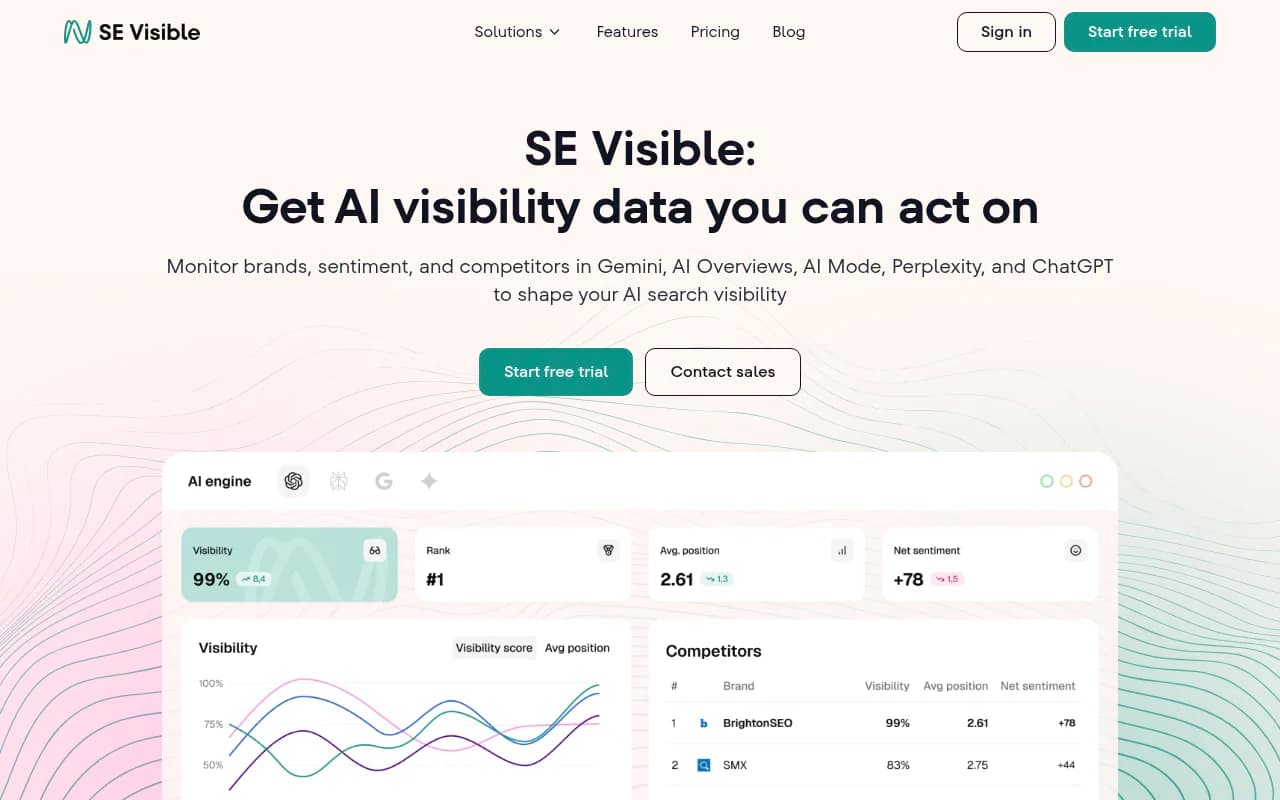
Best for: Small businesses with a single location or businesses that only care about national-level visibility.
Pricing: Starts at $49/mo.
Peec AI: Best for clean dashboards + competitor tracking
Peec AI offers city-level tracking and a strong competitor analysis feature that shows you how your visibility stacks up against other businesses in your market. The dashboards are clean and the data is actionable.
What it lacks: content optimization features. Peec AI tells you where you're invisible but doesn't help you fix it. You'll need to pair it with a content creation tool or hire a writer to close the gaps.

Best for: Local businesses that want competitor benchmarking and have in-house content resources.
Pricing: Starts at $99/mo.
Otterly.AI: Best budget-friendly starter tool
Otterly.AI is one of the most affordable AI visibility tools on the market, starting at $49/mo. It tracks ChatGPT, Perplexity, Gemini, and Claude, and provides basic visibility metrics.
The tradeoff: no geographic targeting, no content optimization, and limited prompt coverage. It's a monitoring-only tool that works for businesses just getting started with AI visibility tracking but will quickly become limiting as you scale.

Best for: Local businesses on a tight budget who want to dip their toes into AI visibility tracking.
Pricing: Starts at $49/mo.
Profound: Best for enterprise teams with large budgets
Profound is a high-end AI visibility platform with advanced geo-targeting, deep citation analysis, and enterprise-grade reporting. It tracks 8+ AI models and offers custom integrations for large teams.
The catch: pricing is custom and typically starts in the thousands per month. This is overkill for most local businesses unless you're a multi-location franchise or a large regional brand.

Best for: Enterprise teams and multi-location brands with dedicated SEO budgets.
Pricing: Custom (typically $2,000+/mo).
How to build a local AI visibility stack
No single tool does everything. Most local businesses need a hybrid stack that combines:
- An AI visibility platform (Promptwatch, Peec AI, or SE Visible) to track mentions across AI engines and identify content gaps
- A local SEO tool (BrightLocal, Moz Local, or Whitespark) to manage reviews, citations, and local listings
- A content optimization platform (Promptwatch's AI writing agent, Clearscope, or Surfer SEO) to create content that actually gets cited by AI models
Here's what that looks like in practice:
- Monitoring: Use Promptwatch to track your visibility across ChatGPT, Perplexity, Claude, Gemini, and Google AI Overviews. Set up city-level tracking for each of your target markets (e.g. Austin, Dallas, Houston if you're a Texas-based business).
- Local SEO: Use BrightLocal to manage your Google Business Profile, monitor reviews, and audit local citations. These signals indirectly influence AI visibility because AI models pull data from Google, Yelp, and other review platforms.
- Content creation: Use Promptwatch's Answer Gap Analysis to identify the prompts you're missing, then use the AI writing agent to generate optimized content. Publish it to your website and track how visibility improves over time.
Real-world example: How a local HVAC company improved AI visibility
A Phoenix-based HVAC company was ranking well on Google but invisible in ChatGPT and Perplexity. Customers searching "best AC repair in Phoenix" were getting competitor recommendations, and the company had no idea why.
Here's what they did:
-
Baseline tracking: Set up Promptwatch to monitor 50 high-value prompts related to HVAC services in Phoenix, Scottsdale, and Tempe. Initial visibility score: 12% (meaning they appeared in only 12% of AI responses).
-
Gap analysis: Used Answer Gap Analysis to identify 23 prompts where competitors were visible but they weren't. The missing content included: emergency repair guides, seasonal maintenance tips, and cost comparison articles.
-
Content generation: Used Promptwatch's AI writing agent to create 15 articles targeting those gaps. Published them to the company blog and service pages.
-
Crawler optimization: Reviewed AI Crawler Logs and discovered that ChatGPT was hitting their site but encountering 404 errors on several service pages. Fixed the errors and submitted an updated sitemap.
-
Results: After 8 weeks, visibility score increased to 47%. ChatGPT and Perplexity started citing the new articles in responses to local HVAC queries. Traffic from AI referrals (tracked via Promptwatch's attribution code) increased by 340%.
The key insight: monitoring alone wouldn't have moved the needle. The company needed to identify the gaps, create the missing content, and fix technical issues that were blocking AI crawlers.
Common mistakes local businesses make with AI visibility tracking
Tracking generic prompts instead of local ones
Tracking "best HVAC company" won't tell you if you're visible to customers in your city. You need to track "best HVAC company in Phoenix" and "emergency AC repair Scottsdale" -- the prompts people actually use when they're ready to hire.
Ignoring Reddit and YouTube
AI models heavily cite Reddit threads and YouTube videos when answering local questions. If there's a Reddit thread titled "Best plumbers in Denver?" and your business isn't mentioned, you're missing a huge opportunity. Tools like Promptwatch surface these discussions so you can engage or create content that gets linked.
Focusing only on Google AI Overviews
Google AI Overviews are important, but they're not the whole story. ChatGPT, Perplexity, and Claude are all major players in local search. If you only track Google, you're missing 50%+ of the AI search landscape.
Not connecting visibility to revenue
Visibility metrics are meaningless if you can't tie them to actual business outcomes. Use traffic attribution (via Promptwatch, Google Analytics, or server logs) to see which AI-driven visitors convert into leads and customers.
Treating AI visibility as a one-time project
AI models update constantly. A prompt that drives visibility today might be irrelevant next month. Set up ongoing monitoring and refresh your content quarterly to stay ahead.
The future of local AI visibility: What's coming in 2026 and beyond
AI search is evolving fast. Here's what local businesses should watch:
- Hyper-local personas: AI models are getting better at understanding neighborhood-level nuance. A search for "best coffee shop in Brooklyn" might return different results depending on whether the user is in Williamsburg or Park Slope. Tools that support hyper-local tracking will become essential.
- Voice search integration: As voice assistants (Alexa, Siri, Google Assistant) integrate more deeply with AI engines, voice-optimized content will drive visibility. This means conversational, question-based content that matches how people actually speak.
- Real-time attribution: The gap between visibility and revenue tracking is closing. Expect more tools to offer real-time attribution that shows exactly which AI-driven visits convert into sales.
- AI-native review platforms: New platforms are emerging that aggregate reviews specifically for AI consumption. Businesses that optimize for these platforms early will have a visibility advantage.
Final thoughts: Why local businesses can't afford to ignore AI visibility
The shift to AI search isn't hypothetical. It's happening now, and local businesses that aren't monitoring their visibility are losing customers to competitors who are. Traditional SEO still matters, but it's no longer sufficient. You need to know how AI engines perceive your business, which prompts you're missing, and what content will close the gaps.
The good news: the tools exist, and the process is straightforward. Start with a platform like Promptwatch that combines monitoring, content optimization, and traffic attribution. Set up city-level tracking for your target markets. Identify the gaps. Create the missing content. Track the results. Repeat.
The businesses that win in 2026 won't be the ones with the best traditional SEO. They'll be the ones that show up when a customer asks ChatGPT, Perplexity, or Claude for a recommendation -- and that starts with visibility tracking.