Key takeaways
- MCP servers for AI visibility split into two camps: free, bring-your-own-key tools that call provider APIs directly (like Cited MCP), and hosted MCP endpoints bolted onto paid platforms (Profound, Surfer, LLM Pulse) that expose already-tracked dashboard data to any MCP client.
- ChatGPT, Perplexity, and Gemini don't support MCP the same way. ChatGPT gates custom connectors behind Developer Mode (not available on the free tier), Perplexity requires a specific metadata file most community servers skip, and Gemini's MCP story runs mostly through Google Cloud and Workspace rather than the consumer app.
- API responses are not the same thing as what a logged-in person sees in the ChatGPT, Perplexity, or Gemini apps. Different default models, grounding setups, and personalization mean an MCP check is an approximation, not a mirror.
- Run-to-run volatility is real and documented: one open-source MCP tool's own benchmark found only 11% average overlap in named businesses across two identical runs of the same 12 prompts, with zero overlap on half of them.
- If you need a defensible, continuously updated view of citation share rather than a one-off spot check, a dedicated monitoring platform like Promptwatch with its own MCP and API access is a better fit than wiring up a DIY server for daily use.
What people actually mean by "AI visibility MCP server"
I'll be upfront: this phrase gets used for two pretty different things, and mixing them up is how people end up disappointed with whatever they installed.
The first category is a standalone MCP tool you run yourself, pointing it at your own API keys for OpenAI, Perplexity, and Google. It makes a live call, gets an answer, and hands it back through the Model Context Protocol to whatever client you're using, Claude Desktop, Cursor, Claude Code, that sort of thing. Cited MCP is the clearest example of this. No subscription. You pay the AI providers directly, and the costs are small.
The second category is a hosted MCP endpoint attached to a paid AI-visibility dashboard you already have an account with. Profound's hosted server at mcp.tryprofound.com is the cleanest example here. It doesn't make live calls to ChatGPT or Perplexity when you query it. It reads from Profound's own tracked history, the same data populating your dashboard, and surfaces it to an MCP-compatible agent so you can ask questions in natural language instead of clicking through charts.
Those are not competing for the same job. One is a quick, cheap snapshot tool. The other is a query interface over a continuously running monitoring system. Testing them "side by side" on coverage only makes sense if you're honest about which bucket each one falls into.
Live-check MCP tools: what Cited MCP actually does per engine
Cited MCP exposes a single tool, check_ai_visibility, that takes a business name, optional website and category, a handful of natural-language questions, and a list of engines to hit. Here's the part that matters for a coverage comparison: it isn't calling the consumer chat interface for any of the three engines. It's calling:
- ChatGPT, via OpenAI's Responses API with the
web_searchtool attached, defaulting togpt-5.4-mini - Perplexity, via the Sonar API, defaulting to the
sonarmodel (search is built in, no separate tool call needed) - Gemini, via Grounding with Google Search, defaulting to
gemini-3.5-flash-lite
Each model is overridable through an environment variable, so you can swap in a heavier model if you want, at a higher per-call cost. For each question and engine, it reports whether your business was named, where it landed in any list, whether your own website got cited, which competitors came up, and which domains were cited as sources.
Cost-wise this is genuinely cheap. A default run of five questions across three engines is fifteen calls, and the vendor's own estimate puts that well under a dollar. You're not buying a subscription, you're paying OpenAI, Perplexity, and Google by the token and by the call.
Coverage differences that actually show up in testing
Here's where it gets interesting, and where the "tested side by side" framing earns its keep. Perplexity bakes search into the base model, so every Sonar call is grounded by default. Gemini needs the explicit Grounding with Google Search feature turned on, or you just get the model's training data with no live lookup. ChatGPT needs the web_search tool attached to the Responses API call; skip that and you get an ungrounded chat completion that won't cite anything current.
That means a poorly configured MCP call can silently fail to ground on one engine while succeeding on the other two, and you'd have no obvious signal that happened unless you check the response for citations. Perplexity's design makes this mistake harder to make. ChatGPT and Gemini both require you to remember an extra flag.
The citation-inventory problem
Promptwatch's own data on average sources per response is worth sitting with here. Across its tracked dataset, ChatGPT's web-search-triggered responses cite around five sources on average. Google AI Overviews and Perplexity both sit closer to ten. That's not a small gap, it's roughly double. (Promptwatch Data: Average Sources Per Response)
What that means practically: if you're running an MCP check across ChatGPT and Perplexity with the same question, ChatGPT simply has fewer citation slots available before your brand even gets a shot at one. A "miss" on ChatGPT and a "miss" on Perplexity are not the same kind of miss. One is competing for a spot in a pool of five, the other in a pool of ten. Any coverage comparison that doesn't account for this is comparing apples to a smaller, more contested apple.
Why the API answer isn't the app answer
This is the single biggest gotcha in this whole category, and it's worth being blunt about it. When Cited MCP (or any similar tool) calls the OpenAI Responses API, the Perplexity Sonar API, or Gemini's Grounding API, it is not reproducing what a person sees when they type the same question into chatgpt.com, perplexity.ai, or gemini.google.com.
The default models differ. The personalization signals differ, your logged-in ChatGPT account has memory and location context that an API call from a server somewhere doesn't have. Location grounding behaves differently depending on whether it's inferred from your IP, your account settings, or passed as an explicit parameter. None of this is a bug in the MCP tooling. It's just a structural fact about how these products are built: the consumer app and the developer API are related but not identical products.
The vendor behind Cited MCP says this plainly in their own documentation: "API is not the app." I appreciate the honesty, but it also means you should treat any MCP-based visibility check as a reasonable proxy, not a guarantee that it matches what a real customer typing the same question would see.
Run-to-run volatility: the other thing people underestimate
Even setting the API-vs-app gap aside, these answers move around a lot between identical runs. Voreli AI, the team behind Cited MCP, ran their own benchmark asking ChatGPT the same twelve questions twice. Average overlap in named businesses across the two runs was just 11%. Six of the twelve questions shared zero businesses between runs. Separately, SparkToro's research across 2,961 queries found the exact same brand recommendation list appeared less than 1% of the time, even with identical prompts.
The practical upshot: a single MCP call is a snapshot, not a score. If you run check_ai_visibility once and your brand doesn't show up, that tells you almost nothing about whether you show up "usually." You'd need to run it repeatedly over days or weeks and look at the pattern, which is exactly the job a continuous monitoring platform is built for and a one-off MCP call isn't.
How ChatGPT, Perplexity, and Gemini actually support MCP as platforms
Separate from the live-check tooling, it's worth knowing how each engine treats MCP as a protocol, because the access friction differs a lot and affects which hosted MCP servers you can even connect.
| Engine | MCP access model | Who can use it | Notable friction |
|---|---|---|---|
| ChatGPT | Built-in Apps (one-click) plus custom MCP connectors via remote HTTPS URL | Developer Mode on Plus, Pro, Business, Enterprise, Edu; not on Free | Requires manual confirmation before every write action, every conversation; local stdio servers need a tunnel |
| Perplexity | Local and remote MCP via Custom Connectors | Supports enterprise network options like Cloudflare Access, AWS PrivateLink | Needs a /.well-known/mcp-connector.json metadata endpoint many community servers haven't implemented, causing real install failures |
| Gemini | Official remote MCP servers via Google Cloud and Workspace; community tools for Gemini CLI/AI Studio | Enterprise-leaning, tied to Google Cloud and Workspace accounts | Less of a consumer-app story; most access runs through Cloud or CLI tooling rather than gemini.google.com directly |
| Claude | Formal MCP connectors marketplace, separate from native web_search tool | Available broadly | Manual per-query approval for web search; third-party data flagged as leaving Anthropic's trust boundary |
The asymmetry matters if you're trying to set up a repeatable workflow. ChatGPT's Developer Mode gate means anyone testing on a free account simply can't use custom connectors at all. Perplexity's metadata requirement has caused documented install failures for servers that work fine elsewhere. Gemini's MCP story is mostly an enterprise and developer-tooling story, not something the average consumer-app user touches.
Hosted MCP servers from visibility platforms: Profound, Surfer, and LLM Pulse
Once you move past DIY checks, the question becomes: which paid platform's MCP server gives you the most useful read access to data you're already paying for?
Profound's hosted server is read-only by design, every tool carries readOnlyHint: true. That's a deliberate choice, no destructive actions, idempotent calls. It exposes visibility reports, sentiment analysis (comparing tone in the AI answer itself versus tone on the cited source), citation reports, shopping reports for ChatGPT's shopping surfaces, and agent analytics on bot and referral traffic. Profound separately tracks nine engines including ChatGPT, Perplexity, Claude, Copilot, and Google's AI Overviews, AI Mode, and Gemini, and its own REST API, SDKs, and MCP server are part of the paid platform, per Profound's documentation.

Surfer announced an MCP beta in August 2026, exposing its AI Tracker data (brand mentions, mention gap, tracked prompts, sources, time series) to Claude, ChatGPT, and other MCP-compatible agents. One third-party review notes MCP and API access sits behind Pro or higher on Surfer's plans.
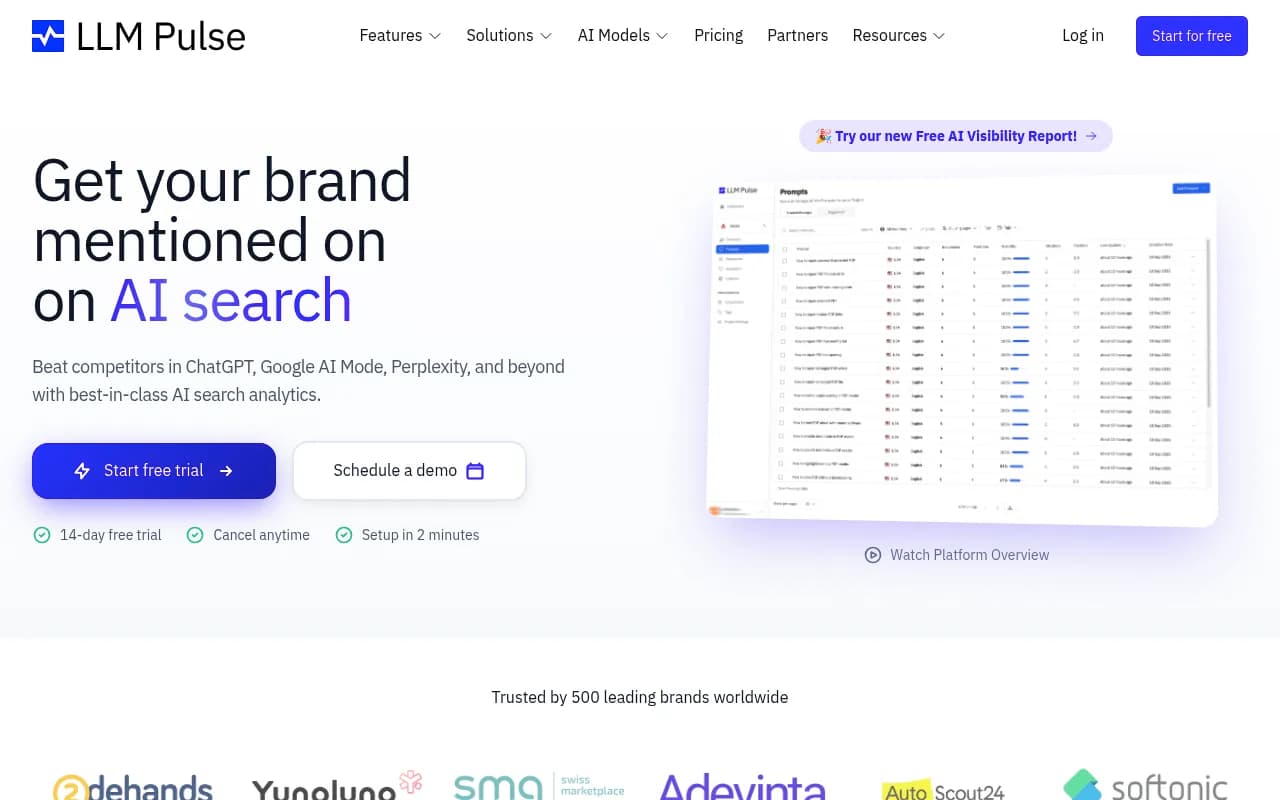
LLM Pulse takes the more generous route on access: its hosted MCP endpoint supports OAuth sign-in with no API key required, and around 90 tools are available on every plan including the 14-day trial, covering projects, competitors, model-level visibility breakdowns, prompts and responses, citations, sentiment, and recommendations. That's a meaningfully lower barrier than gating MCP behind a higher tier.
| Platform | MCP access tier | Live calls or cached dashboard data | Read-only or read/write | Engines covered |
|---|---|---|---|---|
| Cited MCP (open source) | Free, bring your own API keys | Live calls per request | Read-only reporting | ChatGPT, Perplexity, Gemini |
| Profound | Included on paid plans | Cached tracked history | Read-only (separate Agent tools can act) | 9 engines incl. ChatGPT, Perplexity, Gemini |
| Surfer SEO | Pro plan or higher | Cached dashboard data | Read-only | ChatGPT, Gemini, AI Overviews, and more |
| LLM Pulse | Free on every plan, incl. trial | Cached dashboard data | Read and action tools | ChatGPT, Perplexity, Gemini, AI Mode, AI Overviews |
So which one actually covers ChatGPT, Perplexity, and Gemini best?
If what you want is a quick, nearly-free gut check, Cited MCP covers all three engines and costs pennies per run, but you have to accept the volatility problem and the API-vs-app gap as the price of entry. It's a tool for curiosity, not a tool for reporting to a client.
If you want coverage that's actually continuous, with sentiment, named-competitor tracking, and citation-level detail you can query through MCP without re-running anything yourself, you're looking at a paid platform. LLM Pulse's low access tier is notably friendlier than Surfer's Pro-gated access if budget is the deciding factor. Profound's nine-engine coverage and read-only safety model suit teams that want to plug visibility data into agent workflows without worrying about an agent accidentally triggering a write action.
And if the goal isn't just measurement but actually fixing what the measurement turns up, that's the gap most of these tools leave open. Promptwatch approaches this from the other end: rather than a dashboard you still have to act on, its Content Agents and Unified Actions turn citation gaps and crawler data into a prioritized to-do list, and can draft and publish fixes straight to your CMS. It also has its own MCP server and API access, so the same agent-querying pattern works, just with an execution layer attached.

A practical way to think about this
Don't treat "MCP coverage" as a single number. The real question is whether you're trying to answer "was I mentioned just now" or "am I reliably visible over time, and what do I do about the gaps." The first question is what a free MCP tool answers cheaply and imperfectly. The second question needs a platform that's been sampling continuously, which is also the only way to get past the 11% overlap problem documented in Cited MCP's own benchmark.
If you're evaluating AI visibility platforms more broadly rather than just their MCP layer, the GEO software directory at bestgeosoftware.com is a reasonable starting point for comparing the dashboards these MCP servers sit on top of.
One last practical note: whichever route you pick, check whether the engine you care about most actually supports the MCP connection cleanly today. Perplexity's metadata requirement and ChatGPT's Developer Mode gate aren't going away just because a tool's marketing page says "works with ChatGPT, Perplexity, and Gemini." Test the connection yourself before building a workflow around it.