Summary
- AI search has fundamentally changed client discovery: ChatGPT ads launched in January 2026, Google made Gemini 3 the default for AI Overviews, and click-through rates dropped 61% for queries with AI summaries. Professional services firms that aren't visible in AI responses are losing clients before conversations even start.
- Professional services adoption hit critical mass: 40% of professional services organizations now use AI organization-wide (doubled from 2025), but only 18% track ROI and most clients don't know if their firms are using AI on their matters.
- The action loop matters more than monitoring: Tracking where you're invisible is step one. The firms winning in 2026 are the ones that identify content gaps, generate AI-optimized content, and measure the impact on citations and traffic.
- Entity authority and structured answers win: AI engines prioritize firms with consistent NAP data, strong local signals, authoritative mentions, review velocity, and content that directly answers client questions in extractable formats.
The professional services visibility crisis
You can be the best lawyer, consultant, or agency in your market and still lose every prospect before they ever contact you. Not because your work isn't excellent. Because when someone types "employment lawyer wrongful termination" or "management consultant digital transformation" into ChatGPT, Perplexity, or Google, your firm doesn't appear in the answer.
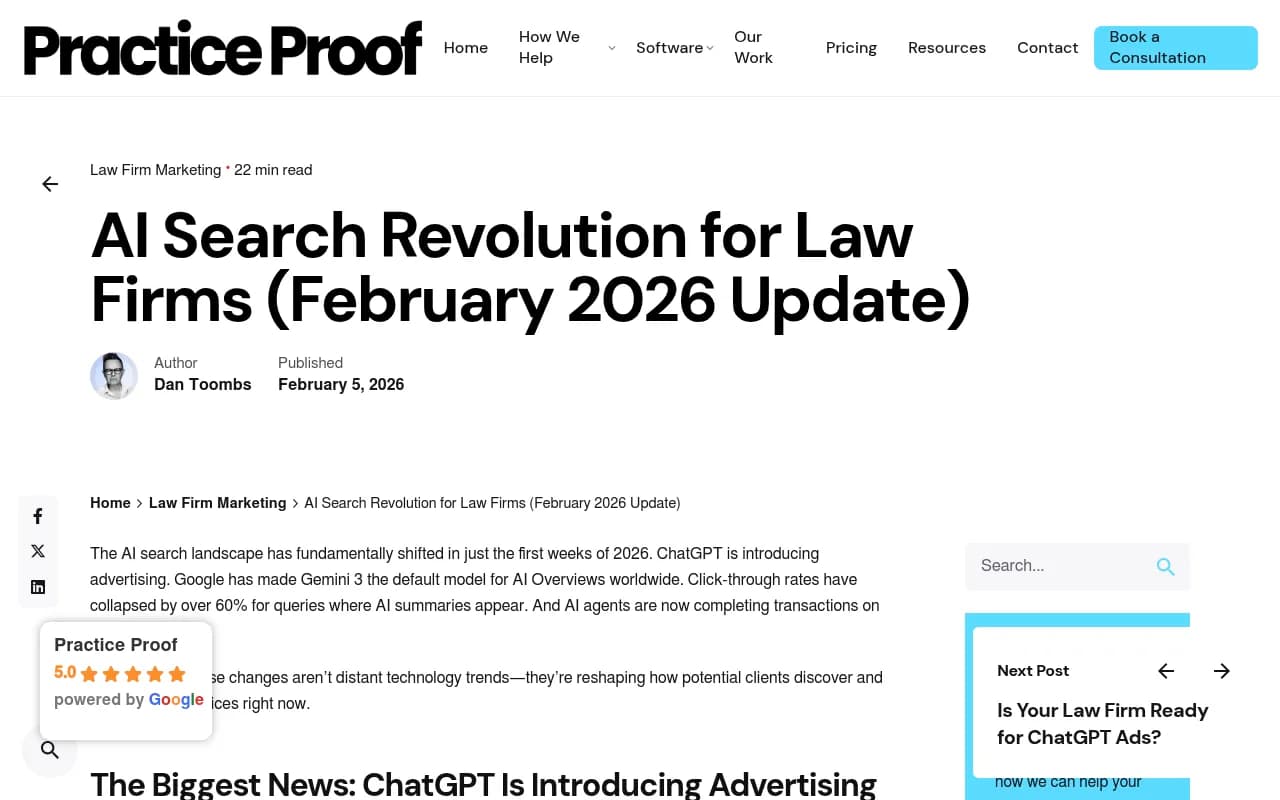
The numbers are stark. According to PracticeProof's February 2026 analysis, click-through rates have collapsed by over 61% for queries where AI summaries appear. ChatGPT introduced advertising on January 16, 2026, creating an entirely new paid channel with 800 million weekly active users. Google made Gemini 3 the default model for AI Overviews worldwide. And AI agents are now completing transactions on behalf of users -- including initial legal consultations and agency vetting.
For professional services, this isn't a future trend. It's the present reality. When a potential client asks an AI engine for help, the firms that appear in the response get the inquiry. The firms that don't exist in AI's knowledge base simply don't exist to that client.
Why professional services are uniquely vulnerable
Professional services firms face a specific set of challenges in AI search:
High-intent, low-frequency queries: Someone searching for "divorce lawyer" or "fractional CFO" is usually ready to hire. But they search once, choose quickly, and the decision is high-stakes. There's no second chance to appear in the answer.
Trust signals matter more than features: Unlike product searches where specs and pricing dominate, professional services selection depends on credibility markers: credentials, case results, client testimonials, authoritative mentions, and demonstrated expertise. AI engines surface these signals when they exist and are structured correctly.
Local + expertise intersection: Most professional services operate in specific geographies (law firms licensed in certain states, consultants serving regional markets, agencies with local client bases). AI engines need to understand both your location and your specialization to recommend you appropriately.
Complex, evolving service descriptions: What you do isn't always obvious from a single keyword. "Business immigration lawyer" vs "family-based immigration lawyer" vs "deportation defense lawyer" -- these distinctions matter to clients but are hard for AI to parse if your content doesn't make them explicit.
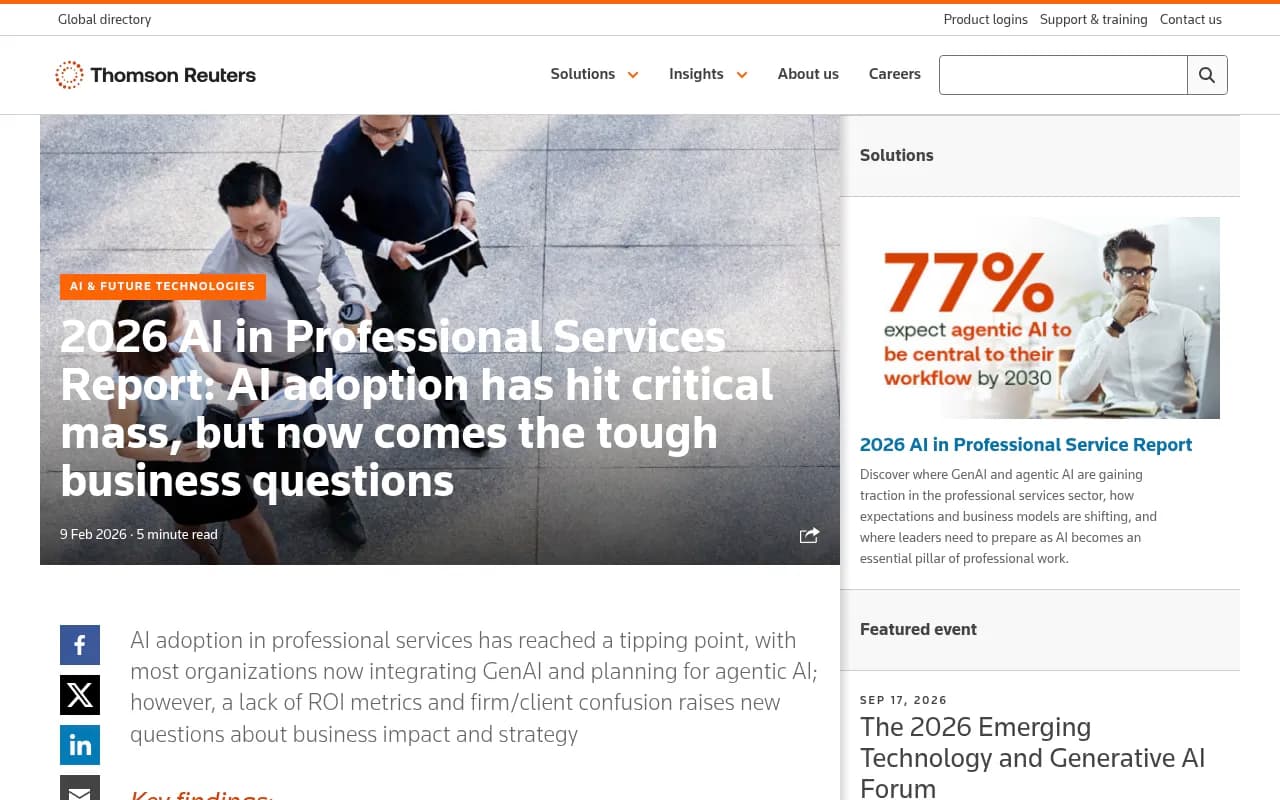
According to the Thomson Reuters 2026 AI in Professional Services Report, AI adoption in professional services has reached critical mass: 40% of organizations now use AI organization-wide, almost double the 2025 figure. But the same report shows only 18% track ROI of AI tools, and communication around AI use remains inconsistent. Most corporate departments want their outside firms to use AI on client matters, but less than one-third know whether their firms actually are.
This creates a gap: firms are adopting AI internally but aren't thinking strategically about how AI engines perceive and recommend them externally.
The three-layer visibility system
Layer 1: Entity foundation
AI engines don't just crawl your website. They build entity graphs -- structured knowledge about who you are, what you do, where you operate, and how authoritative you are. If your entity data is inconsistent or incomplete, you won't appear in AI responses even if your website content is excellent.
What you need:
- Consistent NAP (name, address, phone) across every citation: Google Business Profile, legal directories (Avvo, Martindale, Justia for lawyers; Clutch, G2 for agencies; industry associations for consultants), social profiles, and your website footer
- Accurate practice area/service categorization in Google Business Profile and directory listings
- Schema markup on your website (LocalBusiness, ProfessionalService, Attorney, Organization) so AI crawlers can extract structured data
- A claimed and optimized knowledge panel (Google, Bing) with correct information
Why it matters: When someone asks ChatGPT "employment lawyer in Austin," the model queries its knowledge graph for entities matching those criteria. If your firm's entity data says "general practice" or has three different addresses, you're filtered out before content quality even matters.
Layer 2: Authority signals
AI engines use the same trust signals humans do, but they process them algorithmically:
Review velocity and recency: 50 five-star reviews from 2019 signal less than 15 reviews from the past six months. AI models weight recent validation heavily.
Authoritative mentions: Being cited in legal publications (Law360, ABA Journal), industry reports (Gartner, Forrester for consultants), or reputable local news builds entity authority. AI engines treat mentions from high-authority domains as endorsement signals.
Consistent cross-platform presence: If your firm has active profiles on LinkedIn, a regularly updated blog, contributions to industry publications, and speaking engagements listed on your site, AI models interpret this as "established, active entity." Dormant profiles or thin content suggest the opposite.
Credential verification: Bar admissions, certifications, awards, case results (for lawyers), client logos (for agencies), published research (for consultants) -- these need to be explicitly stated and structured so AI can extract them.
Layer 3: Answer-optimized content
This is where most firms fail. They write content for Google's traditional algorithm (keyword density, backlinks, technical SEO) but don't structure it for AI extraction.
What AI engines need:
- Direct answers to specific questions in H2/H3 headings: "How long do I have to file a wrongful termination claim in California?" not "Understanding Employment Law Timelines"
- Structured takeaways: bulleted lists, numbered steps, comparison tables that AI can extract and reformat
- Jurisdiction-specific language: "In Texas, non-compete agreements are enforceable if..." not vague generalities
- Clear expertise demonstration: case examples, specific outcomes, process explanations that show you've handled this exact situation
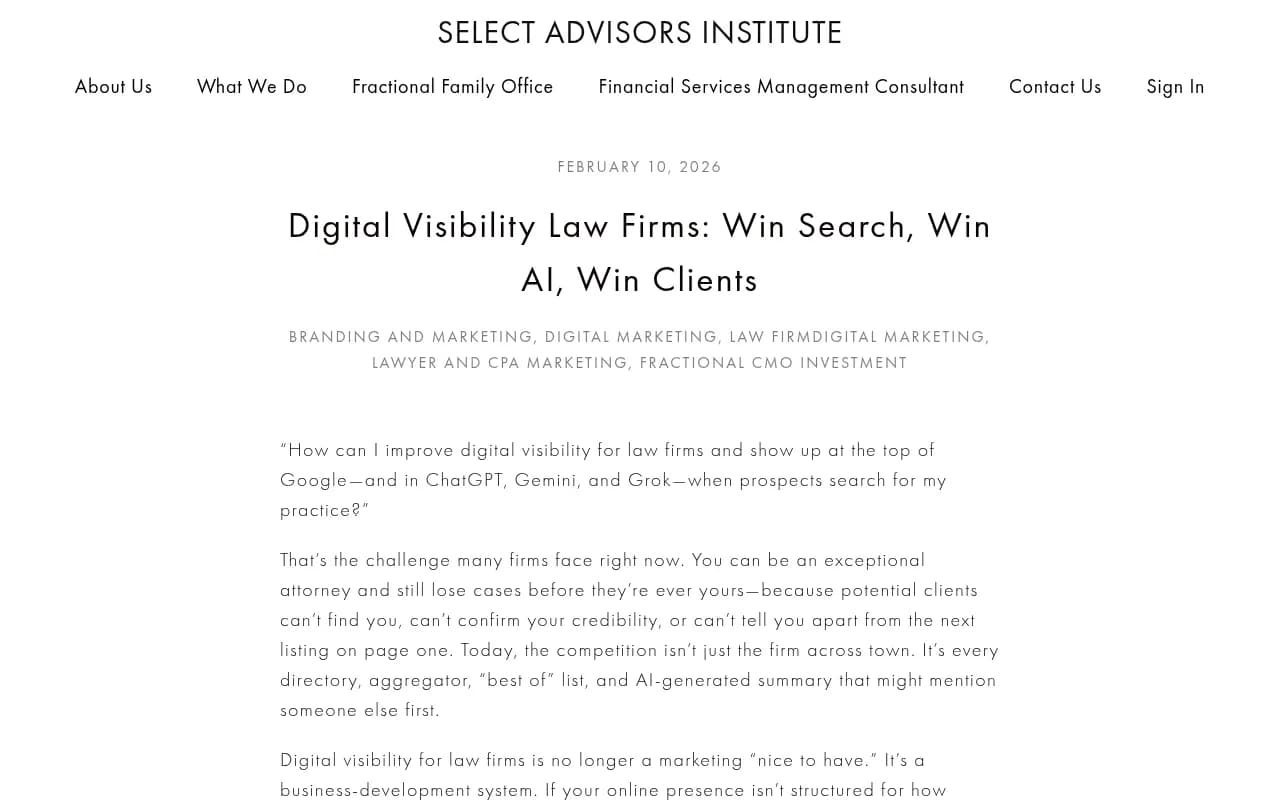
According to Select Advisors Institute's analysis, digital visibility for law firms now includes being referenced in ChatGPT-style answers, Gemini summaries, and other AI-generated responses. The firms winning this game structure content around client questions, not lawyer keywords.
How to track your AI search visibility
You can't optimize what you don't measure. AI search visibility tracking is different from traditional SEO rank tracking because:
- AI responses are non-deterministic: the same prompt can generate different answers based on user context, conversation history, and model updates
- Citations matter more than rankings: being mentioned third with a direct quote and link is more valuable than being listed first in a generic list
- Multiple models matter: ChatGPT, Claude, Perplexity, Gemini, and Google AI Overviews all have different knowledge bases and citation patterns
The core metrics to track:
Citation frequency: How often does your firm appear in AI responses for your target prompts? Track this across models (ChatGPT, Claude, Perplexity, Gemini) and prompt variations.
Citation quality: Are you mentioned by name with a direct quote and link, or just listed in a generic directory-style response? Direct citations with attribution are 10x more valuable.
Prompt coverage: What percentage of relevant prompts in your practice area/service category include your firm in the response? If competitors appear for 40 prompts and you appear for 8, you have a 20% coverage rate.
Source attribution: Which of your pages, articles, or external mentions are AI models citing? This tells you what content is working and what gaps exist.
Competitor comparison: How does your visibility compare to direct competitors for the same prompt set?
Tools for tracking AI visibility
Several platforms now specialize in AI search visibility monitoring. Promptwatch is the market-leading platform used by 6,700+ brands and agencies including Booking.com and Center Parcs. It tracks 10 AI models (ChatGPT, Perplexity, Google AI Overviews, Claude, Gemini, Meta AI, DeepSeek, Grok, Mistral, Copilot) and provides the full action loop: find content gaps, generate AI-optimized content, and track citation improvements.

Other options include:




| Platform | Models tracked | Content generation | Crawler logs | Starting price |
|---|---|---|---|---|
| Promptwatch | 10 (ChatGPT, Claude, Perplexity, Gemini, etc.) | Yes (AI writing agent) | Yes | $99/mo |
| AthenaHQ | 8+ | No | No | $149/mo |
| Otterly.AI | 5 | No | No | $49/mo |
| Profound | 6 | No | No | $299/mo |
| Peec.ai | 7 | No | No | $99/mo |
The key differentiator: most tools are monitoring-only dashboards. They show you where you're invisible but leave you stuck. Platforms like Promptwatch close the loop by showing you exactly which content is missing, then helping you create it with an AI writing agent trained on 880M+ citations.
The content gap problem
Here's the pattern we see across hundreds of professional services firms:
- You track your AI visibility and discover you're cited for 12% of relevant prompts in your practice area
- Competitors appear for prompts like "how to respond to EEOC charge" or "fractional CMO vs marketing agency" but you don't
- You check your website and realize you don't have content answering those specific questions
- You try to create content but it's generic, doesn't match how clients actually ask questions, and doesn't get cited
This is the content gap: the specific topics, angles, and questions AI models want answers to but can't find on your site.
Answer Gap Analysis (available in platforms like Promptwatch) solves this by showing you:
- Which prompts competitors are visible for but you're not
- What content your website is missing
- Prompt volumes and difficulty scores so you can prioritize high-value, winnable queries
- Query fan-outs that show how one prompt branches into sub-queries
Then the built-in AI writing agent generates articles, listicles, and comparisons grounded in real citation data, prompt volumes, persona targeting, and competitor analysis. This isn't generic SEO filler -- it's content engineered to get cited by ChatGPT, Claude, and Perplexity.
ChatGPT advertising: the new paid channel
On January 16, 2026, OpenAI announced advertising is coming to ChatGPT. This is a watershed moment for professional services marketing.
How it works:
- Ads appear at the bottom of ChatGPT answers when there's a relevant sponsored product or service
- Contextually targeted based on conversation content, not keywords
- Pay-per-impression (PPM) model, not pay-per-click
- Only shown to free users and ChatGPT Go subscribers ($8/mo), not Plus/Pro/Enterprise accounts
- No self-serve platform yet -- early testing involves advertisers committing under $1M each
What this means for professional services:
When someone discusses a legal issue, workplace problem, or business challenge in ChatGPT, relevant legal/consulting/agency ads could appear. This creates an entirely new channel to reach potential clients at moments of genuine need.
But paid visibility doesn't replace organic visibility. The firms that will win are the ones that combine both: strong organic citations in AI responses (trust and authority) plus strategic paid placements (reach and targeting).
Reddit and YouTube: the hidden citation sources
AI models don't just cite official websites. They pull heavily from Reddit discussions and YouTube videos -- sources most professional services firms completely ignore.
When someone asks ChatGPT "is it worth hiring an employment lawyer for wrongful termination," the model often cites Reddit threads where real people discuss their experiences. When someone asks Claude "how to choose a management consultant," it references YouTube videos explaining the selection process.
What to do:
- Monitor which Reddit threads and YouTube videos AI models cite in your practice area
- Participate authentically in relevant subreddits (r/legaladvice, r/consulting, r/marketing for agencies) by answering questions and providing genuine value
- Create YouTube content that directly answers common client questions
- Track when your Reddit comments or YouTube videos get cited by AI models
Platforms like Promptwatch include Reddit and YouTube insights as part of their citation analysis -- showing you exactly which discussions influence AI recommendations in your space.
Local visibility for professional services
Most professional services operate in specific geographies. A personal injury lawyer in Miami can't help someone in Seattle. A management consultant focused on the Northeast can't serve a client in Texas.
AI engines understand this, but only if your local signals are strong:
Google Business Profile optimization: Complete profile with accurate categories, service areas, hours, photos, posts, and regular review responses. This is the foundation of local entity authority.
State/city-specific content: Don't write "How to file a personal injury claim" -- write "How to file a personal injury claim in Florida" with state-specific statutes, deadlines, and procedures.
Local citations: Consistent NAP across local directories, chamber of commerce listings, local news mentions, and community involvement.
Multi-location structure: If you have multiple offices, each location needs its own landing page with unique content, separate Google Business Profile, and location-specific service descriptions.
Platforms like Promptwatch (Professional and Business tiers) support state/city-level tracking so you can monitor AI visibility by geography.
AI crawler logs: understanding how AI engines see your site
Most firms have no idea how often AI crawlers visit their website, which pages they read, or what errors they encounter. This is like running a restaurant without knowing if customers can find the entrance.
AI crawler logs (available in platforms like Promptwatch) show:
- Real-time logs of ChatGPT, Claude, Perplexity, and other AI crawlers hitting your website
- Which pages they read and how often they return
- Errors they encounter (404s, blocked pages, slow load times)
- How AI engines discover your content and what they prioritize
If AI crawlers can't access your case results page because it's behind a contact form, or they're hitting 404s on your blog, you won't get cited no matter how good your content is.
The action loop: find gaps, create content, track results
Here's the process that actually works:
Step 1: Find the gaps Run Answer Gap Analysis to see which prompts competitors are visible for but you're not. Identify the specific content your website is missing.
Step 2: Create content that ranks in AI Use an AI writing agent (like Promptwatch's built-in tool) to generate articles, listicles, and comparisons grounded in real citation data, prompt volumes, and competitor analysis. Structure content with:
- Direct question-based H2 headings
- Bulleted takeaways and comparison tables
- Jurisdiction-specific details
- Clear expertise demonstration
Step 3: Track the results Monitor your visibility scores as AI models start citing your new content. Use page-level tracking to see exactly which pages are being cited, how often, and by which models. Connect visibility to actual traffic with attribution (code snippet, Google Search Console integration, or server log analysis).
Step 4: Iterate Double down on what's working. If your "How to respond to an EEOC charge" article is getting cited frequently, create related content on EEOC investigation timelines, settlement strategies, and retaliation claims.
This cycle -- find gaps, generate content, track results -- is what makes AI visibility an optimization discipline, not just another monitoring dashboard.
Multi-language and multi-region considerations
If you serve clients in multiple languages or regions, AI visibility gets more complex:
Language-specific content: AI models trained in Spanish, French, German, etc. have different knowledge bases than English models. You need content in the target language, not just translated versions.
Regional prompt variations: How someone asks about employment law in California differs from how they ask in New York. "Wrongful termination" vs "at-will employment" vs "constructive dismissal" -- regional terminology matters.
Persona customization: A small business owner asking about HR compliance uses different language than an in-house counsel researching the same topic. Track visibility by persona, not just keyword.
Platforms like Promptwatch and Peec.ai support multi-language and multi-region tracking with customizable personas that match how your actual clients prompt.
Competitive intelligence: who's winning and why
Competitor heatmaps show your AI visibility vs competitors across models and prompts. This reveals:
- Which competitors dominate specific practice areas or service categories
- What content they have that you don't
- Which AI models favor them and why
- Gaps where no one is visible (opportunity zones)
Example: You're a management consultant focused on digital transformation. Competitor A appears in 60% of ChatGPT responses for "digital transformation consultant" but only 10% of Claude responses. Competitor B dominates Perplexity but is invisible in Gemini. You appear in 15% of responses across all models.
This tells you:
- Competitor A has strong OpenAI-indexed content (likely recent blog posts or case studies)
- Competitor B has strong Perplexity-indexed content (likely authoritative external mentions or Reddit discussions)
- You have consistent but weak coverage -- you need to create more high-authority content and get more external mentions
Common mistakes professional services firms make
Mistake 1: Writing for lawyers/consultants, not clients Your content uses industry jargon and assumes knowledge clients don't have. AI models can't extract useful answers from dense, technical prose.
Mistake 2: Generic practice area pages "We handle employment law" doesn't help AI engines understand what specific problems you solve. "We represent employees in wrongful termination, discrimination, and retaliation cases in California" does.
Mistake 3: Ignoring local signals Your website says "serving clients nationwide" but you're licensed in three states. AI models don't know where you actually practice.
Mistake 4: No review strategy You have 8 reviews from 2022. Competitors have 40 reviews from the past year. AI models weight recency and volume.
Mistake 5: Monitoring without action You track your AI visibility, see you're invisible for 70% of relevant prompts, and... do nothing. Monitoring is useless without the content creation and optimization loop.
The 2026 professional services visibility playbook
Q1 2026: Audit and baseline
- Set up AI visibility tracking across ChatGPT, Claude, Perplexity, Gemini, and Google AI Overviews
- Run Answer Gap Analysis to identify content gaps
- Audit entity data (NAP consistency, schema markup, knowledge panel)
- Review competitor visibility and identify opportunity zones
Q2 2026: Content creation sprint
- Create 15-20 high-priority articles answering specific client questions
- Structure content for AI extraction (question-based headings, bulleted takeaways, jurisdiction-specific details)
- Optimize existing high-traffic pages with better structure and clearer expertise signals
- Set up AI crawler log monitoring to ensure content is being indexed
Q3 2026: Authority building
- Launch systematic review generation campaign (email sequences, in-person requests, follow-up automation)
- Secure 3-5 authoritative mentions (industry publications, local news, guest posts on high-authority sites)
- Participate in relevant Reddit discussions and create YouTube content answering common questions
- Update all directory listings with consistent NAP and current practice areas
Q4 2026: Optimization and scale
- Analyze which content is getting cited most frequently and create related pieces
- A/B test different content structures (comparison tables vs listicles vs deep-dive guides)
- Expand to additional practice areas or service categories with proven content frameworks
- Connect AI visibility to revenue with traffic attribution and lead tracking
The future: agentic AI and automated transactions
AI agents are already completing transactions on behalf of users. In 2026, this includes:
- Initial legal consultations scheduled directly by AI assistants
- Agency vetting and shortlist creation
- Consultant screening based on expertise and availability
The firms that will win in this environment are the ones with:
- Structured data AI agents can parse (services, pricing, availability, credentials)
- Clear differentiation AI agents can explain to users
- Strong trust signals AI agents can verify (reviews, case results, client testimonials)
- Content that answers the specific questions AI agents ask when evaluating options
This isn't speculative. It's happening now. The question is whether your firm will be visible when AI agents make recommendations.
Conclusion
AI search visibility for professional services isn't a marketing tactic. It's a business development system. The firms that understand this -- that invest in entity authority, answer-optimized content, and systematic tracking -- will capture the majority of high-intent prospects in 2026 and beyond.
The firms that ignore it will watch competitors appear in every AI response while they remain invisible.
The tools exist. The playbook is clear. The only question is whether you'll act before your competitors do.