Key takeaways
- Searchlab's March 2026 report says 72% of Dutch marketers use AI, up from 45% in 2024. Treat that as a directional signal, not audited fact.
- Adoption of AI for making content is far ahead of adoption of AI search as a channel. Most teams use ChatGPT to write, not to be found.
- No solid Dutch-specific data exists yet on how often AI answers send clicks to Dutch sites. Global data is the best evidence available, and you should say so when you use it.
- Plan for two languages: Dutch for consumer topics, English for B2B and tech.
- Start with crawler access, a prompt set in both languages, and a measurement baseline before you spend on content.
What we actually know about Dutch AI adoption
Let me start with the caveat, because most articles on this topic skip it. There is a lot of confident-sounding material about AI in the Netherlands, and much of it is thin. Some of the pages ranking for terms like "ai search nederland" cite "over 60% of Dutch internet users" and attribute it to Eurostat and CBS without linking a specific table. Another claims click-through rates drop 15 to 30% when an AI Overview appears, sourced to "early 2026 clickstream data". I would not put either number in a board deck until you have traced it to a primary source.
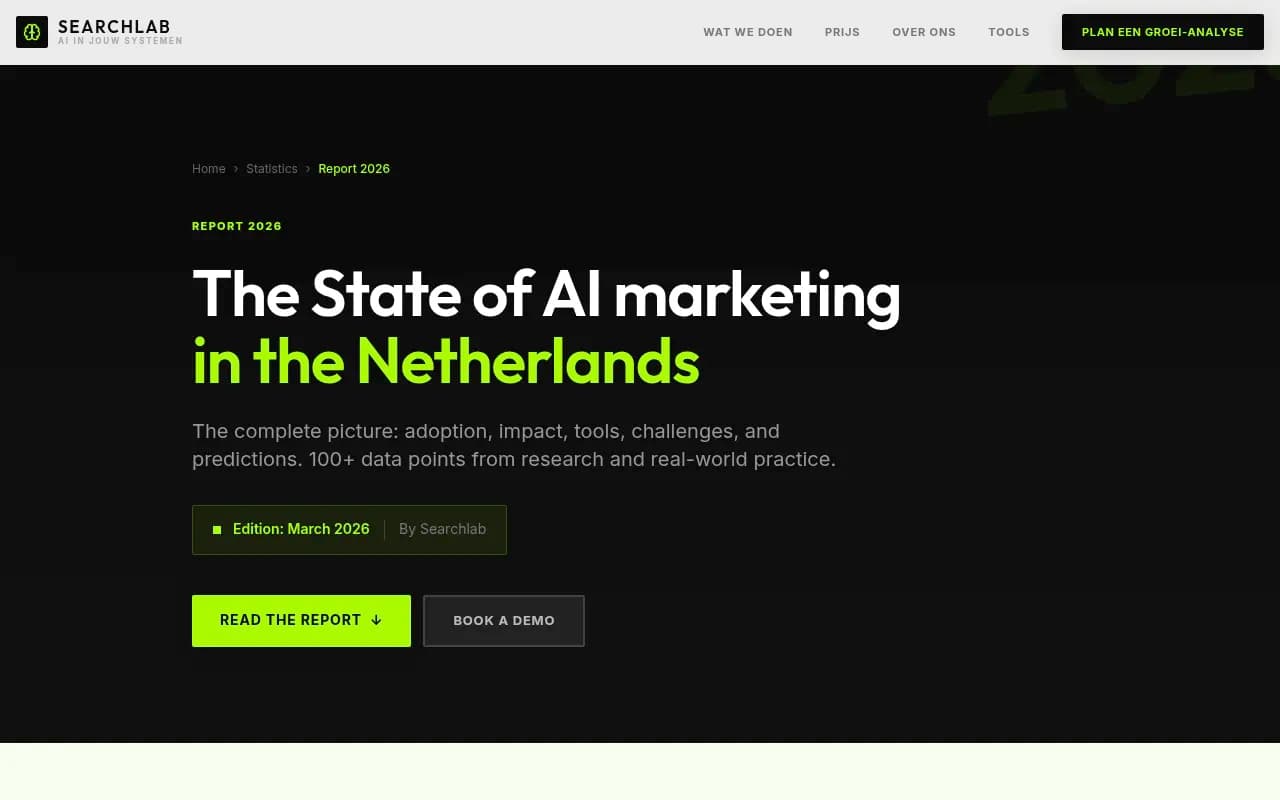
What is better sourced is marketer behavior. Searchlab's AI Marketing in the Netherlands 2026 report (March 2026 edition) puts the headline figures like this:
| Metric | Figure |
|---|---|
| Dutch marketers using AI | 72% (45% in 2024) |
| Enterprise (250+) adoption | 86% |
| Midmarket (50-250) | 74% |
| SMB (10-50) | 68% |
| Small business (under 10) | 52% (22% in 2024) |
| Marketers planning bigger AI budgets in 2027 | 89% |
| Biggest barrier | Lack of knowledge (54%), ahead of budget (32%) |
Searchlab is an agency selling AI marketing services, so read the numbers with that in mind. I have not verified them independently. Still, the direction matches what most Dutch teams will tell you over coffee: the tools are in daily use, and the knowledge to use them well is the bottleneck.
Which tools Dutch marketers use
According to the same report, ChatGPT leads at 78%, followed by Microsoft Copilot (34%), Google Gemini (28%), Anthropic Claude (22%) and Midjourney (18%). Marketers use several tools side by side.
That spread matters for search. If your buyers use ChatGPT and Copilot at work and Gemini and Google's AI Overviews at home, there is no single place to be visible. You are being evaluated by several systems with different habits.
Adoption by function
Content creation is the most AI-adopted function at 68%, followed by data analysis and reporting at 52% and email at 45%. The report says SEO and paid advertising lag behind. That fits my experience: teams use AI to produce pages faster, while far fewer have asked how AI systems find, read and cite those pages.
Using AI is not the same as being found by AI
This is the distinction Dutch marketers should plan around. The 72% figure measures how many marketers use AI tools. It says nothing about how many Dutch consumers get recommendations from AI assistants, or whether your brand appears in them.
The second-hand reports describe some plausible behavior: Dutch users query in Dutch for consumer topics such as travel, health, recipes and local services, but often switch to English for B2B, tech, finance and career topics. Mobile dominates. People ask longer, conversational questions. These claims come from the lower-quality sources in my research, so I would treat them as hypotheses to test against your own data rather than facts.
They are cheap to test, though. Your analytics, Search Console and AI referral data will show you quickly whether English-language queries bring in meaningful Dutch traffic.
The language question
If the English-for-B2B pattern holds for your market, you need coverage in both languages. A Dutch SaaS company selling to Dutch buyers may find that AI assistants answer in English and cite English sources, which means your Dutch-only site is invisible for those prompts.
A practical way to handle it:
- Keep separate prompt lists for Dutch consumer-style queries and English professional queries within the same topic.
- Write both versions for scanning: put the direct answer in the first two sentences.
- Check whether your English pages exist at all for the topics you want to own.
What global AI search data tells you (with limits)
Promptwatch's published research is global, not Dutch. None of the figures below are Dutch numbers. They are useful because they describe how the systems behave, and those systems serve Dutch users too.
Crawlers decide whether you are even eligible
In Promptwatch Data's AI crawler traffic report (June 8 to September 6, 2026), OpenAI accounted for 79.8% of IP-verified AI crawler requests in the week of August 31 to September 6, down from 94.8% in the week of June 8. The mix is shifting toward Anthropic, Google, Perplexity and Mistral. The report's advice is simple: compare your own crawler logs to that mix, and if a provider is big in the report but near zero in your logs, you are probably blocked.
For Dutch sites this is a common failure. Hosting setups with aggressive WAF rules or a copied robots.txt can quietly block exactly the bots you want.
Social platforms matter differently by engine
Promptwatch's social citation data for September 28 to October 4, 2026 shows how uneven this is:
| Engine | Share of citations from social platforms | Notes |
|---|---|---|
| ChatGPT | 0.46% | LinkedIn the top social platform at 0.3%; Reddit fell to 0.09% |
| Google AI Overviews | 12.2% | YouTube 4.28%, Facebook 2.38%, Reddit 2.15% |
| Perplexity | 2.7% | LinkedIn and Reddit tied at 0.86% |
The takeaway for planning: if your Dutch buyers lean on Google, YouTube and well-kept Facebook and Instagram profiles are worth more than a Reddit strategy. For ChatGPT, own-site content and third-party editorial sources carry the weight. The related Reddit citation drop report shows reddit.com's share of ChatGPT citations falling from about 4% to 0.5% on August 14, 2026, so strategies built on Reddit threads have already aged badly.
What ChatGPT likes to cite
According to Promptwatch's content type data, product pages made up 22.4% of ChatGPT citations in the week of September 28 to October 4, 2026, followed by landing pages and listicles. And content half-life data shows landing pages and docs stay cited longest while news loses half its pages within 36 days. For a Dutch marketing team, that argues for investing in durable commercial pages rather than chasing news cycles.
A planning framework for Dutch marketers
Step 1: fix access
Check robots.txt, CDN and WAF rules for the major AI crawlers. Look at your server or CDN logs and see which bots actually reach your pages. The free tools from some vendors can check which crawlers can read your site, and the AI crawler directory lists hundreds of bots by name.
Step 2: build a bilingual prompt set
Write 30 to 50 prompts that real buyers would ask. Split them into Dutch and English, and into three types: generic category questions, brand questions and competitor comparisons. Add a local angle where relevant, such as "best X in Amsterdam" or "X voor het MKB".
Step 3: baseline your visibility
Run those prompts across ChatGPT, Google AI Overviews, Gemini, Perplexity and Copilot. Record whether you are mentioned, in what position, and which sources get cited. Do this before changing anything so you can measure the effect.
Tools like Promptwatch can track this across models, countries and languages, and connect it to crawler logs and AI-referred traffic.

Other options are worth comparing, depending on budget and team size. Peec AI is built around multi-language tracking, and Otterly.AI is a lower-cost monitor.


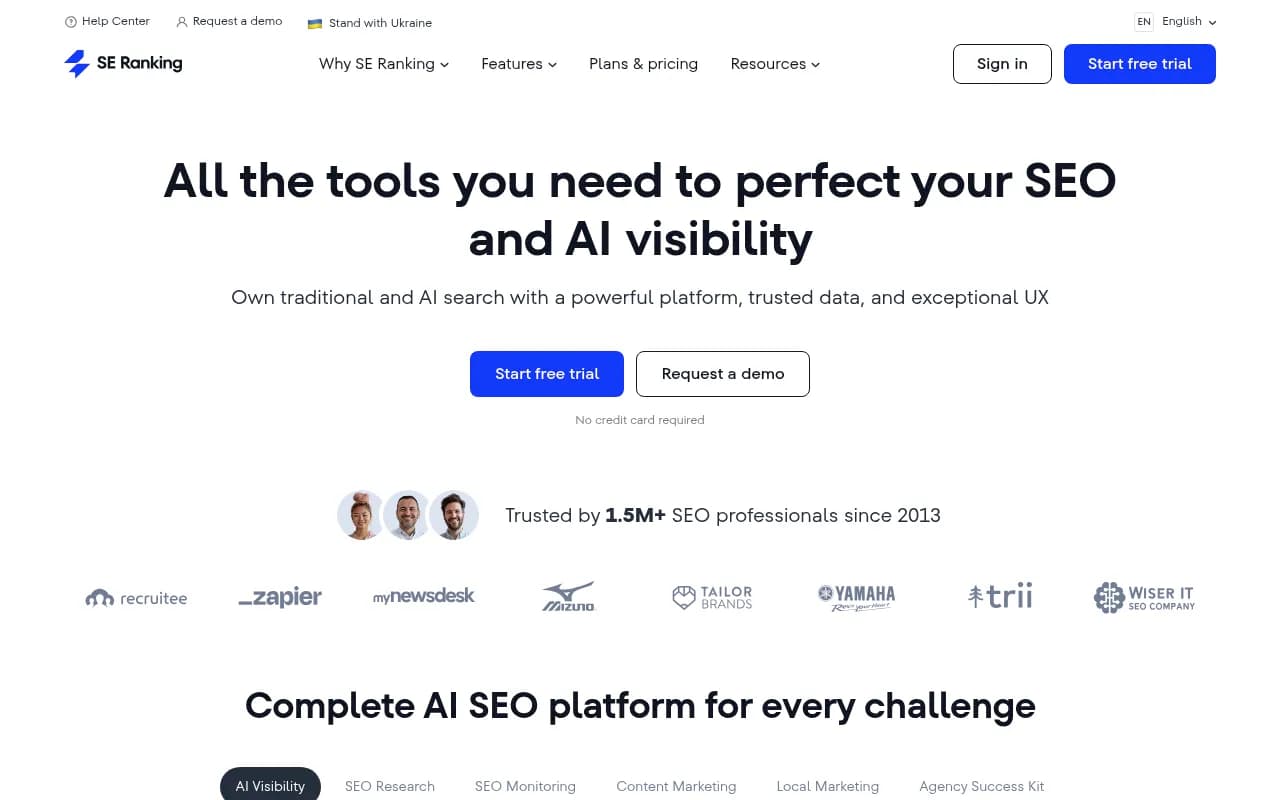
For larger organizations that already live in an SEO suite, Semrush and SE Ranking have added AI visibility modules.
The full range is much wider than any shortlist. The GEO software directory at bestgeosoftware.com is a good place to compare options.
Step 4: close the content gaps
Look at the prompts where competitors appear and you do not. Then check what kind of page gets cited. If it is a comparison page or a product page, that is what you build. Do not write a generic blog post and hope.
Step 5: measure business impact, not mentions
Mentions are a vanity metric on their own. Set up AI referral tracking in analytics and tie it to conversions. With a Dutch audience that is possibly small in volume, even a handful of high-intent visits from ChatGPT can matter more than a hundred organic visits to informational posts.
Sizing the plan by company type
| Company type | Start here | Skip for now |
|---|---|---|
| Small business (under 10) | Free visibility checks, crawler access, complete Google Business and Facebook profiles | Paid enterprise suites |
| MKB / midmarket | Bilingual prompt set, one tracking tool, 5 to 10 cornerstone commercial pages | Chasing every AI model |
| Enterprise | Full tracking across models and countries, crawler logs, content workflow, reporting | Ad hoc one-off audits |
| Agencies | White-label reporting, multi-client tracking | Building tooling in-house |
The CBS Dutch AI Monitor found that among Dutch companies using AI, marketing and sales was the most common application at 36%, and adoption is concentrated in larger firms. That supports the point for smaller businesses: pick one use case, prove it cheaply, then expand.
The knowledge gap is the real opportunity
Searchlab reports that 54% of Dutch marketers name lack of knowledge as their biggest barrier, against 32% for budget. If that holds, the competitive edge in 2026 is not buying another tool. It is understanding how AI answers are built and acting on it while most competitors are still using AI only to write faster.
If you want outside help, an agency that combines technical SEO with generative engine optimization can shorten the learning curve. 1001 SEO Media is one such agency, and it runs this site.
What to watch in 2027
- Whether Dutch-specific data from CBS or Eurostat on AI search use becomes available. Until then, be cautious with any "Dutch AI search" statistic.
- How the mix of AI crawlers keeps shifting away from a single dominant operator.
- Whether Google AI Overviews and AI Mode keep their higher reliance on YouTube and Facebook while ChatGPT stays almost social-free.
- Whether the 89% planning bigger AI budgets actually spend any of it on visibility rather than content production.
What I would do on Monday
Pull a crawler log, write 20 prompts in Dutch and 20 in English, run them across ChatGPT and Google, and note where you are absent. That takes an afternoon and tells you more than another adoption report will.
For more tool options, browse the AI rank tracking directory and compare how each handles languages and countries before you commit.