Key takeaways
- Ahrefs Brand Radar is a research and benchmarking layer. It runs a huge corpus of pre-collected, search-backed prompts and sits next to Ahrefs' SEO data. It is strongest for brands that already have search demand.
- Semrush's AI Visibility Toolkit adds prompt tracking, sentiment and competitor gap analysis to the SEO suite many teams already use. The base tier is tight on prompts and has no free trial.
- Promptwatch is the only one of the three built as an end-to-end GEO workflow: real-UI prompt tracking, AI crawler logs, visitor attribution, and content creation and publishing.
- "Real GEO data" depends on how the answers were collected. Pre-collected corpora, API calls and real consumer interfaces can give different answers to the same question.
- Pricing and limits change often. Check each vendor's pricing page before you commit.
What does "real GEO data" actually mean?
Every vendor in this space shows you a visibility score. The number matters less than how it was produced. Before comparing dashboards, ask four questions:
- Where did the AI answers come from? A pre-built index, an API call, or the actual consumer interface?
- Does the tool track the prompts you care about, or a fixed set someone else chose?
- Can it tell you why you are or aren't cited, not just that you are or aren't?
- Can it connect visibility to traffic and conversions?
The second-hand research here is useful on the first point. Growth Method's comparison of how these tools collect data makes the key distinction plainly: API answers and consumer answers are different products. A model called through its API often does not cite the same sources as the chat product people actually use.
Citation behaviour also varies by engine. According to Promptwatch Data's average sources per response report, ChatGPT cites about 5 sources per web-search answer, while Google AI Overviews and Perplexity cite about 10. Copilot's average swung from under 2 to nearly 17 within a few weeks. A tool that blends engines into one score hides all of that.
There is a second layer: query fan-outs. Promptwatch's ChatGPT query fanout data shows that a single prompt can trigger several separate web searches, and that those searches have gotten short and keyword-like. In August 2026, ChatGPT also started using the site: operator at scale, which jumped from roughly 0.4% to 17% of fanout queries overnight. If your tool only records the user's prompt, it misses the searches that decide which pages get retrieved.
The three tools at a glance
| Ahrefs Brand Radar | Semrush AI Visibility Toolkit | Promptwatch | |
|---|---|---|---|
| Core idea | Brand monitoring and benchmarking on top of Ahrefs' SEO data | AI tracking added to the Semrush SEO suite | End-to-end GEO platform: track, attribute, create, publish |
| Data source | Pre-collected prompt corpus (Ahrefs cites 496M+ on its own page) plus custom prompts | Semrush documents a 289M prompt and response dataset refreshed weekly, plus daily prompt tracking | Real UI monitoring of ChatGPT, AI Overviews, AI Mode, Gemini, Perplexity, Copilot and more, with API models alongside |
| Sentiment | Mentions and citations | Dedicated Brand Performance reports | Sentiment score and weekly AI summary |
| AI crawler logs | Via adjacent Ahrefs products (Bot Analytics) | AI Search Health checks in Site Audit | IP-verified crawler logs built in |
| Visitor and conversion tracking | Separate Web Analytics, no documented prompt-to-conversion join | Not a focus | Visitor analytics on paid plans |
| Content creation | Separate AI Content Helper and Agent A | Separate content tools | Content Agent with CMS publishing |
| Location targeting | Country filters | 220+ countries and territories | Country, state and city |
| Entry price (verify) | Custom prompts included on paid Lite and above | Around $99/mo per domain | From $95/mo, free Explore tier |
Treat the pricing row as a starting point. Semrush's figure comes from a third-party roundup, and Ahrefs add-on pricing is not verified here.
Ahrefs Brand Radar
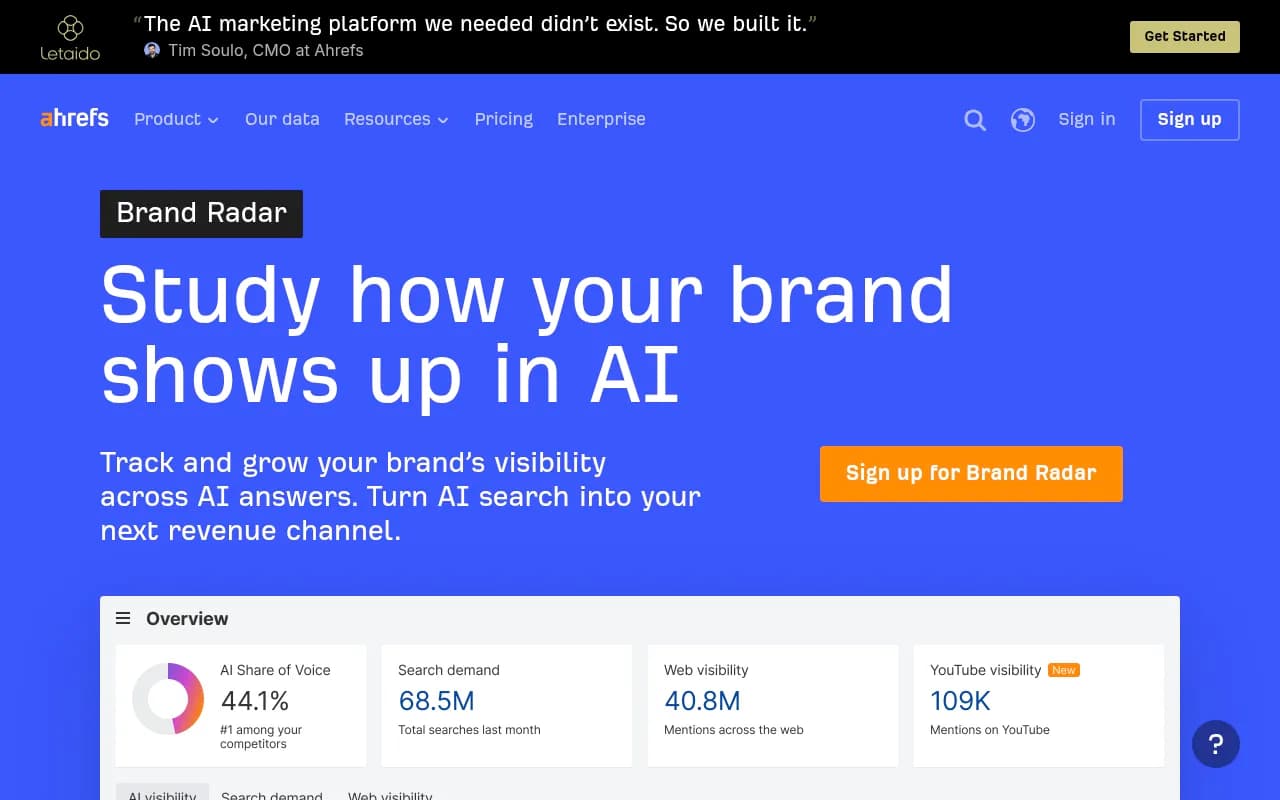

Brand Radar offers two ways in. The AI Visibility Index maps how brands appear across millions of pre-collected AI responses, instantly and with no setup. Custom Prompts let you define the exact buyer questions you care about, and Ahrefs runs them as often as daily.
Ahrefs published a methodology post explaining how the index works. It takes real queries from its keyword database, expands them into natural questions using People Also Ask and semantic fan-out, then runs the resulting prompts through each AI platform and stores the responses. Ahrefs' own page says 496 million+ prompts. Promptwatch's comparison page quotes 400M+. Someone is rounding differently or the number has moved, which is a small reminder to read vendor figures loosely.
What it does well
- Instant benchmarking. You can look at any brand, including competitors, without configuring anything.
- Coverage of AI Overviews, AI Mode, ChatGPT, Perplexity, Gemini and Copilot, plus YouTube, TikTok and Reddit in beta.
- It sits next to Ahrefs' backlink and keyword data, which is hard to beat if that is where your team already works.
- Custom prompts are free on paid Lite plans and above.
Where it is thin
- Ahrefs itself says the index is built on its keyword database, so coverage may be limited for brands with little or no search volume. Emerging brands and niche B2B topics are exactly where that bites.
- Claude is only available for custom prompts, via Claude Sonnet 4.6 with web search, and each run uses eight checks (per Promptwatch's comparison page, a vendor claim).
- Ahrefs documents country-level filters, not city or state targeting.
- Crawler activity, traffic and content creation live in separate products. Ahrefs' methodology describes Brand Radar as a visibility audit rather than audience measurement.
My read: Brand Radar is a strong research instrument. It tells you what the AI answer space looks like. It is not built to tell you what to publish this week or whether the page you published worked.
Semrush AI Visibility Toolkit
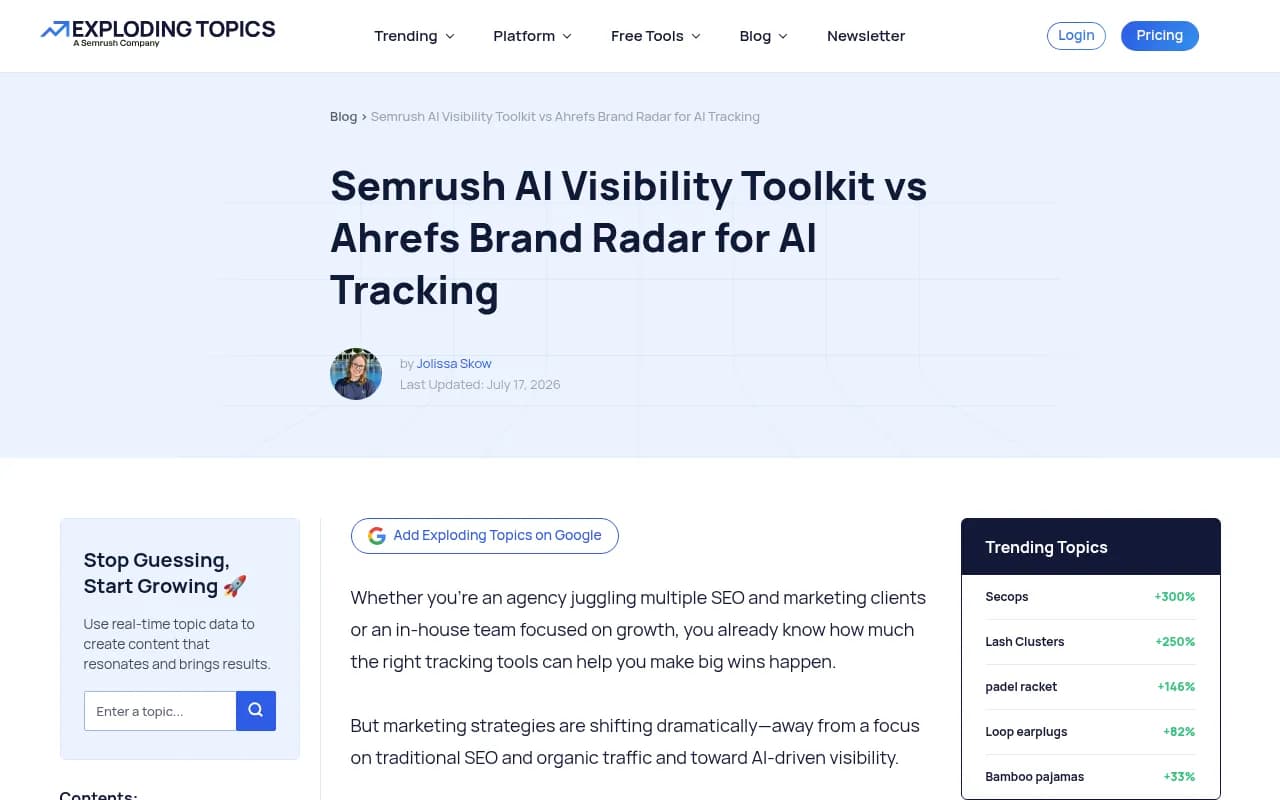
Semrush bolts AI tracking onto its SEO suite. Per a MentionBird review, the Prompt Research report works like keyword research, returning volume, difficulty and intent for the questions buyers ask AI. There is an AI Visibility Score benchmarked against competitors Semrush identifies automatically, Brand Performance reports on sentiment and share of voice, and a Competitor Research view showing prompts where rivals get cited and you don't. An AI Search Health widget inside Site Audit flags technical blockers for AI crawlers.
Semrush documents its data as a 289-million prompt and response dataset refreshed weekly, sourced from AI search clickstream data. Semrush owns its clickstream supplier, Datos, and acquired Otterly.ai.
What it does well
- Sentiment and narrative analysis, which Exploding Topics singles out as something you can't easily get elsewhere.
- Competitor gap analysis tied to specific prompts and topics.
- Prompt tracking across 220+ countries and territories, one of the widest geographic ranges in this comparison.
- It lives in the dashboard where many teams already track rankings.
Where it is thin
- The base license covers around 25 tracked prompts, one domain and one folder. Extra prompts reportedly cost $60 per 50, extra domains $99 each, and every user needs their own license (per MentionBird, so confirm on Semrush's site).
- No free trial, per the same review. The only way to evaluate it is to pay for a month.
- Brand Performance updates weekly rather than daily.
- It tells you where you're behind, and gives recommendations, but it is not a content production and publishing system.
Exploding Topics recommends Semrush over Brand Radar for LLM-specific work. That is a fair opinion, though note that Exploding Topics is a Semrush product, so weigh it accordingly.
Promptwatch
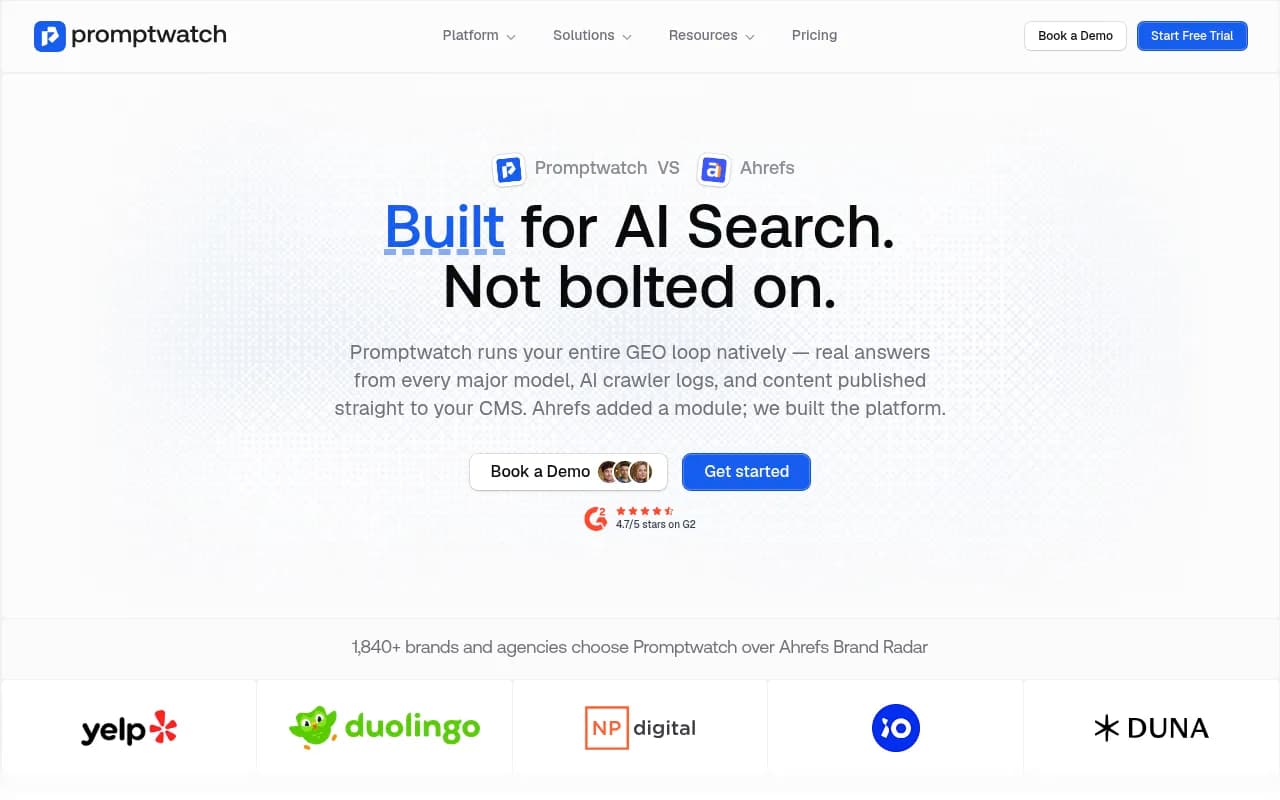
Promptwatch takes a different approach from both. It is a dedicated GEO platform rather than an SEO suite with an AI layer, and (full disclosure) it is the platform 1001 SEO Media uses for its own AI visibility work.

How the data is collected
Promptwatch monitors the actual user interfaces of ChatGPT, Google AI Overviews, Google AI Mode, Gemini, Perplexity, Microsoft Copilot and Amazon Alexa, in each country and language, and tracks API models like Claude, DeepSeek, Mistral and Grok alongside. That split matters because user-facing answers and citations can differ from API outputs. It also records query fan-outs, so you see the web searches the AI actually ran.
What it adds beyond monitoring
- IP-verified AI crawler logs show which pages GPTBot, ClaudeBot, PerplexityBot and others actually read, and where they hit errors. This answers the "why aren't we cited?" question that a visibility score can't.
- Visitor analytics connect AI platforms to real traffic and conversions.
- Citation analytics, including Reddit, YouTube and LinkedIn reports, show where AI finds content about you.
- Prompt volumes and difficulty scores help you pick what to go after.
- The Content Agent writes and publishes content aimed at your visibility gaps to WordPress, Webflow or Framer, then the pages are tracked through crawls, citations and traffic. The Action Board turns findings into a prioritized to-do list.
- Location tracking reaches state and city level on Business and agency plans.
A real example from Promptwatch's customer base: TreeHouse, the company behind Pararius, grew AI search to roughly 25% of organic conversions by fixing crawler access and publishing proprietary data. That kind of result depends on seeing crawler logs and conversion data together, which the other two tools split across products or don't offer.
Pricing
There is a free Explore tier (1 project, 10 prompts, ChatGPT only). Essential is $95/month for 50 prompts and all AI models; Professional is $245/month; Business is $579/month and includes the automated Content Agent. Agency plans start at $199/month. Confirm everything at promptwatch.com/pricing.
Where it is not the right pick
Promptwatch is not a classic SERP rank tracker or a backlink index. If your main job is backlink research, you still want Ahrefs. It brings in Search Console and Bing data, but it does not replace a full SEO suite.
Head-to-head on what matters
Data collection
Brand Radar and Semrush both lean on large pre-collected datasets, which are fast and wide but fixed to what the vendor chose to collect. Both also offer custom or tracked prompts. Promptwatch runs your prompts against live consumer interfaces. If you need to know what ChatGPT's actual product says to a buyer in Chicago, that distinction is the whole game.
Diagnosis
Semrush gives you an AI Search Health check in Site Audit. Ahrefs gives you bot visits through adjacent products. Promptwatch puts crawler logs, citations, page-level search data and audits in one view, with a crawl-to-citation path per page. For diagnosis, that is the most complete of the three.
Action
This is where the gap is widest. Ahrefs has capable content tools, but they are separate from Brand Radar. Semrush offers recommendations and separate content products. Promptwatch generates and publishes content from the gap analysis, then checks whether it worked. If your problem is "we know we're invisible and need output," that matters more than a prettier chart.
Measurement
Only Promptwatch documents attribution from AI traffic to conversions inside the same workflow. Ahrefs does not document a prompt-to-conversion join, and Semrush's toolkit is oriented around visibility and sentiment rather than revenue.
Which one should you choose?
| If you are... | Pick |
|---|---|
| An SEO team that lives in Ahrefs and wants to benchmark AI share of voice for established topics | Ahrefs Brand Radar |
| A Semrush shop that wants sentiment, competitor gaps and prompt research without another vendor | Semrush AI Visibility Toolkit |
| A team that needs to prove AI revenue, diagnose crawler issues and ship content from the same tool | Promptwatch |
| An agency running several clients with white-label reporting | Promptwatch agency plans or Semrush, depending on your existing stack |
| A small team with little search demand for its brand name | Custom prompts in Ahrefs, or Promptwatch, rather than the pre-built index |
It is also reasonable to combine them. Many teams keep Ahrefs or Semrush for classic SEO and add a dedicated GEO platform for AI-specific work. If you want to see the wider field, the GEO software directory at bestgeosoftware.com lists dozens of alternatives, including Profound, Peec AI and Otterly.AI.
How to test any of these before buying
- Write 20 real buyer prompts, including ones that never mention your brand.
- Run them manually in ChatGPT and Google AI Mode and write down the answers and citations.
- Compare those results with what each tool reports for the same prompts. Big mismatches suggest API-based or pre-collected data.
- Check whether the tool shows fan-out queries and per-engine citation counts.
- Ask what you can do on Monday morning. If the answer is "export a CSV," you are buying a monitor, not an optimizer.
- Use free options first: Promptwatch has a free tier and a free AI visibility report, and Ahrefs includes custom prompts on paid plans.
The bottom line
Brand Radar and Semrush's toolkit are good at telling you where you stand. Both are tied to the SEO suite around them, and both are strongest if you already pay for that suite. Promptwatch is the one built around the full loop of seeing the problem, finding the cause, fixing it and measuring the result. If your goal is data you can act on rather than a score to report, start there, and use the other two as research layers on top.
All pricing and limits above come from vendor pages and third-party reviews, and some were not independently verified. Check current numbers before you decide.