Key takeaways
- Generative AI referral traffic to websites grew 123% in the first half of 2025, making AEO tool investment no longer optional for most marketing teams.
- The biggest improvement across the category was speed: most platforms moved from weekly snapshot data to near-real-time tracking of AI responses.
- Content generation features went from gimmicky to genuinely useful, but only in a handful of platforms that grounded output in real prompt and citation data.
- Crawler log analysis -- understanding how AI bots actually crawl your site -- emerged as a meaningful differentiator in 2025, and most tools still don't have it.
- The monitoring-vs-optimization gap is the defining split in the market right now. Most tools show you the problem. Far fewer help you fix it.
The AEO tool market in 2024 was mostly a collection of dashboards that showed you a number and called it "AI visibility." You'd see a score, maybe a list of prompts your brand appeared in, and then... nothing. What were you supposed to do with that?
2025 changed things, but not evenly. Some platforms made genuine leaps. Others added features that look impressive in demos but don't hold up in practice. And a few fundamental problems -- the ones that actually matter for getting cited in ChatGPT or Perplexity -- are still largely unsolved.
This guide is a practical look at what actually shifted, what got fixed, and what still needs work. If you're evaluating tools heading into 2026, this is the context you need.
Why 2025 was the inflection point
Before getting into the tools, it's worth understanding why the category accelerated so fast.
The core technical shift was the widespread adoption of LLM + RAG (Retrieval-Augmented Generation). In 2023 and early 2024, most large language models were working from static training data that could be 12-18 months old. Optimizing for that was nearly impossible -- the feedback loop was too slow.
By mid-2025, the major AI search engines (ChatGPT, Perplexity, Gemini, Grok) had all moved to real-time or near-real-time web retrieval. When someone asks "what's the best project management software," the model now runs a live search, reads the results, and synthesizes an answer. That's essentially SEO with a different rendering layer.
The practical consequence: changes you make to your content can show up in AI responses within days, not years. That made AEO optimization tractable, and the tool market responded accordingly.
At the same time, the traffic numbers became impossible to ignore. Generative AI referral traffic to SMB sites was up 123% in the first half of 2025, while traditional search clicks continued declining. Marketing teams that had been watching AEO from a distance suddenly had a business case to act.
What genuinely improved in 2025
Data freshness and tracking cadence
This was the most universal improvement across the category. In 2024, most AEO tools were running prompt queries against AI models on a weekly or even monthly basis. That meant your "visibility score" was a lagging indicator that told you what happened weeks ago.
By late 2025, the leading platforms had moved to daily or near-daily tracking for most prompts, with some offering on-demand querying. This matters because AI search results are genuinely volatile -- a competitor publishing a strong piece of content can shift citations within 48 hours.
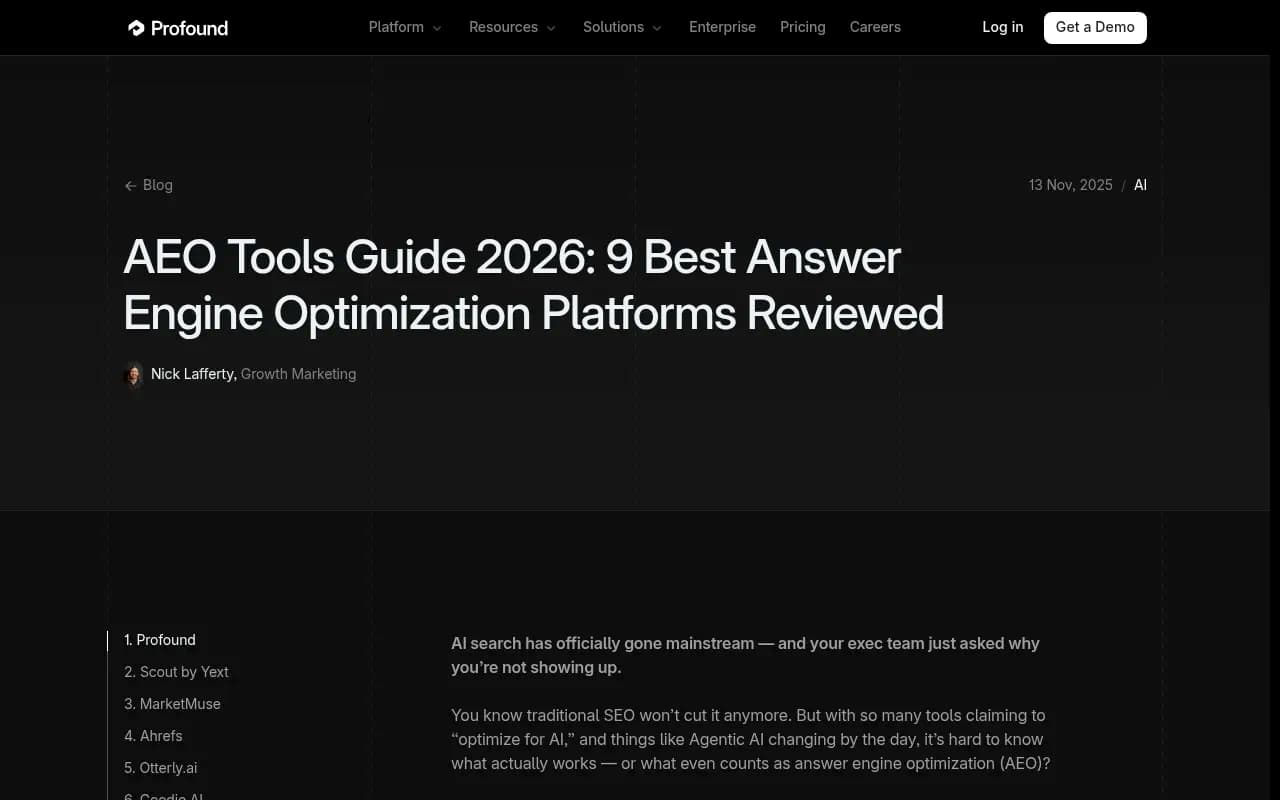
Tools like Promptwatch and Profound moved furthest on this, with tracking cadences that actually match how fast the AI search landscape moves.

Multi-model coverage became standard
In early 2024, most tools tracked one or two AI models -- usually ChatGPT and maybe Perplexity. By the end of 2025, tracking across 8-10 models (ChatGPT, Claude, Gemini, Perplexity, Grok, DeepSeek, Copilot, Meta AI, Google AI Overviews) had become table stakes for any serious platform.
This matters because model behavior varies significantly. A brand that ranks well in ChatGPT responses might be nearly invisible in Perplexity, and the reasons are different enough that you need separate strategies. Tools that only show you aggregate "AI visibility" are hiding information you need.


Prompt intelligence got more useful
Early AEO tools let you track a fixed list of prompts you defined yourself. The problem: you don't always know which prompts matter. You might be tracking "best CRM software" while missing "what CRM integrates with HubSpot" -- which is where your competitors are actually getting cited.
2025 saw meaningful progress on prompt discovery and prioritization. Several platforms added volume estimates (how often a given prompt is actually being asked), difficulty scores (how hard it is to get cited for it), and query fan-out analysis (how one prompt branches into related sub-queries).
This is the difference between guessing which prompts to target and actually knowing. Platforms like Promptwatch built this into their core workflow, while others bolted it on as an afterthought.

Content gap analysis moved from concept to practice
The most important strategic question in AEO is: "What prompts are my competitors getting cited for that I'm not?" In 2024, answering that required manual work -- running queries yourself, comparing results, taking notes.
By 2025, several platforms had automated this into proper Answer Gap Analysis. You can see, at scale, exactly which prompts your competitors appear in that you don't. More importantly, the better tools connect that gap analysis directly to content recommendations -- showing you not just that a gap exists, but what content you'd need to create to close it.

Citation and source analysis got serious
Understanding why AI models cite certain sources is a different problem from tracking whether they cite you. 2025 saw real progress on the former.
The better platforms now show you which specific pages, Reddit threads, YouTube videos, and third-party domains AI models are pulling from when they answer a given prompt. That's actionable in a way that a visibility score never is -- it tells you where to publish, what format works, and which external sources you should be trying to get mentioned in.
Reddit and YouTube tracking in particular emerged as a meaningful differentiator. These platforms have outsized influence on AI citations relative to their traditional SEO weight, and most tools still ignore them entirely.
What got fixed (mostly)
The "black box" problem
A year ago, the most common complaint about AEO tools was that they showed you a score with no explanation. Your AI visibility was 34. Was that good? Bad? What caused it to drop last week?
Most platforms addressed this in 2025. Response-level breakdowns, citation source attribution, and competitor comparison views are now common. You can generally trace a visibility change back to a specific prompt, a specific model, and a specific competitor who displaced you.
It's not perfect -- some platforms still present data in ways that obscure more than they reveal -- but the "here's a number, good luck" era is mostly over.
Onboarding and setup time
Early AEO tools required significant manual setup: defining your prompts, configuring your competitors, mapping your content. For a team already stretched thin, that friction meant tools sat unused.
2025 saw meaningful improvements here. Several platforms added automated prompt suggestions based on your domain, competitor auto-detection, and content mapping that pulls from your existing sitemap. What used to take a week of setup now often takes an afternoon.
Agency and multi-client workflows
The agency use case was underserved in 2024. Most tools were built for single-brand teams, and trying to manage 20 client accounts in a platform designed for one was painful.
By 2025, white-label reporting, multi-client dashboards, and role-based access had become standard features for the platforms targeting agencies. This is a real quality-of-life improvement for anyone managing AEO at scale.
What still needs work
AI crawler log analysis is rare
Here's a capability that almost no tool has adequately solved: understanding how AI crawlers actually behave on your website. Not just "are you being cited" but "when did the ChatGPT crawler last visit your site, which pages did it read, did it encounter any errors, and how long after crawling did a citation appear?"
This matters because you can have great content that AI models never see, because of crawl errors, robots.txt misconfigurations, or simply because the crawler hasn't visited recently. Without crawler log data, you're optimizing blind.
A small number of platforms -- Promptwatch being the clearest example -- have built real AI crawler log analysis. Most haven't. This is the capability gap that will matter most in 2026.
Traffic attribution from AI search
Knowing you're cited in AI responses is useful. Knowing that those citations are driving actual website traffic and revenue is what justifies the budget. The attribution problem -- connecting AI visibility to business outcomes -- is still largely unsolved.
The challenge is technical: AI search engines don't always pass referral data cleanly, and the user journey from "saw a brand mentioned in ChatGPT" to "became a customer" is hard to track. A few platforms are making progress, but this is an area where the tools are still catching up to what marketing teams actually need to report.
Offsite citation tracking
Most AEO tools focus on your own website's visibility. But a significant portion of AI citations come from third-party sources -- review sites, industry publications, Reddit threads, YouTube videos, comparison pages. If a competitor is dominating AI responses partly because they're mentioned in 15 high-authority third-party sources and you're only in 3, your on-site optimization will only get you so far.
Offsite citation analysis -- tracking which external sources are driving AI visibility for you and your competitors -- is still a gap for most platforms. It's one of the more complex problems to solve, but it's also one of the most valuable.
Prompt volume data quality
Several platforms now offer prompt volume estimates, but the data quality varies enormously. Some are extrapolating from traditional search volume data, which doesn't translate cleanly to how people actually prompt AI models. Others are using proprietary methodologies that aren't transparent.
The honest answer is that prompt volume data is still imprecise across the industry. It's useful for relative prioritization -- this prompt matters more than that one -- but treating it as precise traffic forecasting is a mistake.
How the tool landscape breaks down now
The market has consolidated around a few distinct categories, and knowing which you need matters more than picking the "best" tool in the abstract.
| Category | What it does well | What it misses | Example tools |
|---|---|---|---|
| Monitoring-only | Clean dashboards, easy setup, affordable | No content help, no crawler data, no attribution | Otterly.AI, Peec.ai |
| Enterprise monitoring | Deep data, multi-model, good reporting | Expensive, complex, still monitoring-focused | AthenaHQ, Profound |
| Optimization platforms | Gap analysis, content generation, action loop | Higher price, more setup required | Promptwatch, Conductor |
| Traditional SEO with AI add-ons | Familiar interface, existing data | AI features are shallow, fixed prompts | Semrush, Ahrefs Brand Radar |
| Niche/specialized | Good at one specific thing | Missing multiple core capabilities | Brandlight, Bluefish |
The monitoring-only tools are fine if you just need to answer "are we visible in AI search?" They're not fine if you need to improve that visibility and justify the work to leadership.
The optimization platforms are where the real action is, but they require more investment -- in setup, in ongoing work, and in budget. The payoff is that you're not just watching your visibility score, you're actually moving it.
The capability that separates leaders from followers
If I had to pick one feature that separates the tools that are genuinely useful from the ones that just look useful in a demo, it's the action loop.
Most AEO tools are built around a single question: "Where do you appear in AI search?" That's a fine starting point, but it's not a strategy. The tools that made the biggest leap in 2025 are the ones that answer the follow-up questions: "Where should you appear that you don't? What content would get you there? And how do you know when it's working?"
That loop -- find gaps, create content, track results -- is what turns an AEO tool from a reporting dashboard into something that actually moves the needle. It's also what most tools are still missing.
The platforms that have built this end-to-end workflow are the ones worth serious evaluation. The ones that haven't are useful for awareness, but they'll leave your team knowing exactly how invisible you are without any clear path to fixing it.
Practical recommendations for 2026
If you're evaluating AEO tools right now, here's what to actually look for beyond the feature checklist:
Ask about data freshness. How often are prompts re-run? Can you trigger on-demand queries? Weekly data is not enough in a market that moves daily.
Test the content workflow. If a tool claims to help you create content for AI visibility, ask to see the actual output. Is it grounded in real prompt data and citation analysis, or is it generic AI writing with an AEO label on it?
Request crawler log access. If a platform can't show you how AI crawlers are interacting with your site, you're missing a critical diagnostic layer.
Check multi-model coverage. Make sure the platforms you're evaluating track the specific AI models your audience actually uses. For most B2B brands, that's ChatGPT, Perplexity, and Google AI Overviews at minimum.
Push on attribution. How does the tool connect AI visibility to traffic and revenue? If the answer is vague, factor that into your expectations.
The AEO tool market in 2026 is genuinely better than it was 18 months ago. The best platforms have moved from passive monitoring to active optimization. But the gap between the leaders and the rest of the field is wider than ever -- and picking the wrong tool means spending budget on data you can't act on.