Key Takeaways
- User base tells a story: Searchable claims 12,000+ users vs AIclicks' 1,000+ -- a 12x difference that suggests broader market adoption, though both are relatively new players
- Pricing gap is significant: AIclicks starts at $59/mo for 30 prompts while Searchable's Starter is $50/mo for 50 prompts -- Searchable gives you 67% more prompts for less money
- AI agent vs standard dashboards: Searchable positions a "personal AI agent" that learns your brand voice and generates tailored recommendations; AIclicks uses a more traditional monitoring approach with content suggestions
- Model coverage differs: Searchable explicitly tracks ChatGPT, Claude, Perplexity, Google AI Overviews, and Copilot (5 engines); AIclicks mentions ChatGPT, Perplexity, and Gemini but coverage details are less clear
- Trial periods matter: Searchable offers 14 days with no credit card required; AIclicks gives you only 3 days -- if you need time to evaluate, Searchable is less pressured
- Technical depth: Searchable emphasizes technical SEO audits for AI search (schema markup, content structure, crawlability fixes); AIclicks focuses more on prompt discovery and content planning without the same technical audit layer
Overview: Two platforms chasing the same goal
Both Searchable and AIclicks exist to solve the same core problem: brands are invisible in AI search results, and traditional SEO dashboards don't track ChatGPT or Perplexity. The question is which platform does it better.
Searchable
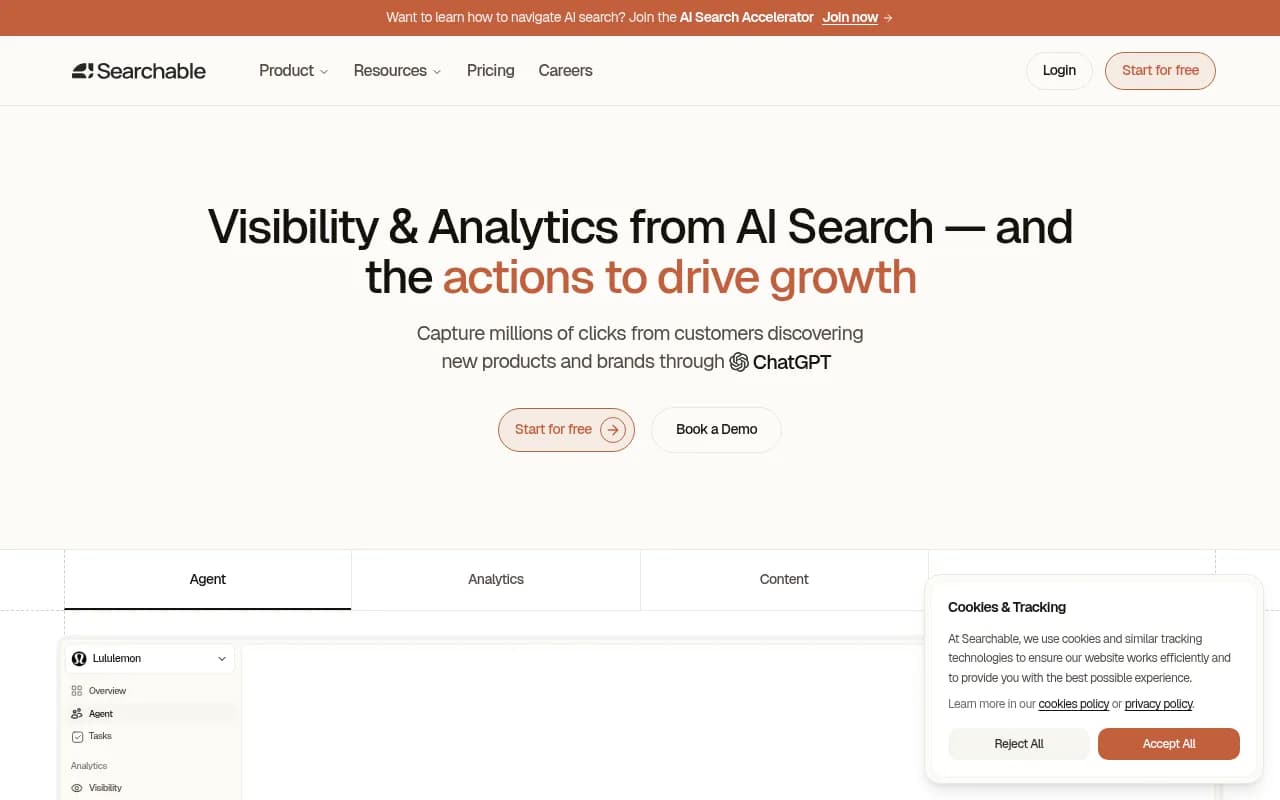
Searchable positions itself as a "full stack visibility & analytics" platform built by SEO and AI search specialists with agency backgrounds. The pitch centers on a "personal AI agent" that learns your brand voice from day one and delivers tailored recommendations instead of generic monitoring data. They claim 12,000+ users and highlight customer success stories like 40% visibility increases and £1M+ in qualified pipeline from AI search. The platform covers ChatGPT, Claude, Perplexity, Google AI Overviews, and Microsoft Copilot.
Pricing runs from $50/mo (Starter with 1 domain and 50 prompts) to $400/mo (Scale). The Professional plan sits at $100-125/mo with unlimited domains and 200 prompts. You get a 14-day free trial with no credit card required.
AIclicks
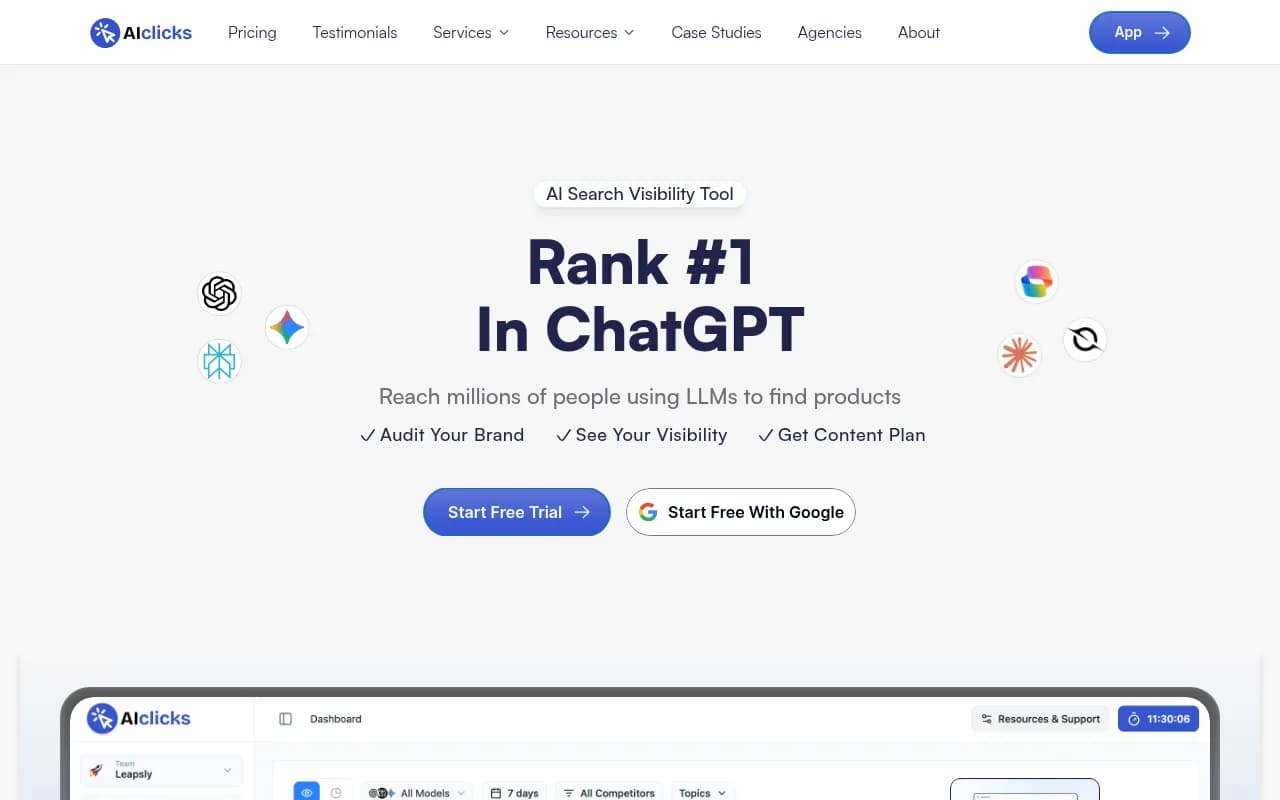
AIclicks takes a more straightforward approach: track prompts, analyze competitor mentions, get content recommendations. The platform monitors ChatGPT, Perplexity, and Gemini (Copilot and Claude aren't explicitly mentioned in their materials). They claim 1,000+ brands and agencies using the tool. The website emphasizes a "4 Step Formula to Rank on AI Search" -- enter your URL, discover what AI gets asked, audit your brand, get a content plan.
Pricing starts at $59/mo (Starter with 30 prompts) and goes up to $499/mo (Business with 300+ prompts). You get a 3-day free trial. Custom pricing is available for agencies and enterprises.
Side-by-Side Comparison
| Feature | Searchable | AIclicks |
|---|---|---|
| Starting price | $50/mo | $59/mo |
| Prompts at entry tier | 50 | 30 |
| Free trial | 14 days, no credit card | 3 days |
| AI engines tracked | ChatGPT, Claude, Perplexity, Google AI Overviews, Copilot (5) | ChatGPT, Perplexity, Gemini (3 confirmed) |
| User base | 12,000+ | 1,000+ |
| Domains at entry tier | 1 | Not specified |
| AI agent/personalization | Yes (learns brand voice) | Standard recommendations |
| Technical SEO audits | Yes (schema, structure, crawlability) | Not emphasized |
| Content generation | Yes (blog posts, landing pages, product descriptions) | Yes (content plan and briefs) |
| Integrations | Google Analytics, GSC, HubSpot, Salesforce | Not specified |
| Competitor analysis | Yes | Yes |
| Mid-tier pricing | $100-125/mo (200 prompts, unlimited domains) | Not clearly defined |
| Top-tier pricing | $400/mo (Scale) | $499/mo (Business, 300+ prompts) |
Pricing: Searchable wins on value at every tier
Let's be direct about this: Searchable gives you more for less money.
| Plan Level | Searchable | AIclicks |
|---|---|---|
| Entry | $50/mo (50 prompts, 1 domain) | $59/mo (30 prompts) |
| Mid-range | $100-125/mo (200 prompts, unlimited domains) | Not clearly defined |
| High-end | $400/mo (Scale) | $499/mo (Business, 300+ prompts) |
| Free trial | 14 days, no credit card | 3 days |
At the entry level, you're paying $9/mo less for 67% more prompts with Searchable. That's not a small difference -- if you're tracking 40-50 prompts, AIclicks literally can't accommodate you at the starter tier. You'd need to jump to a higher plan.
The mid-tier comparison is harder because AIclicks doesn't clearly define what sits between $59/mo and $499/mo. Searchable's Professional plan at $100-125/mo gives you 200 prompts and unlimited domains, which is a strong value proposition for agencies or brands with multiple properties.
At the high end, both platforms are in the same ballpark ($400 vs $499), but Searchable's Scale plan details aren't fully specified while AIclicks caps at 300+ prompts. If you need more than 300 prompts, you're looking at custom enterprise pricing for either platform.
The trial period difference matters more than it looks. Three days with AIclicks means you're evaluating over a weekend or a few rushed workdays. Fourteen days with Searchable gives you two full weeks to run the platform through real scenarios, test the AI agent, and see if the recommendations actually move the needle. No credit card requirement removes friction.
AI engine coverage: Searchable tracks more models
Searchable explicitly monitors five AI engines: ChatGPT, Claude, Perplexity, Google AI Overviews, and Microsoft Copilot. That's comprehensive coverage of the major players in AI search as of 2026.
AIclicks mentions ChatGPT, Perplexity, and Gemini in their materials. Copilot and Claude aren't called out, which suggests either they're not tracked or the coverage isn't a selling point. Given that Claude has significant market share (especially in enterprise contexts) and Copilot is Microsoft's AI search layer, missing these feels like a gap.
Google AI Overviews vs Gemini is an interesting distinction. Searchable tracks AI Overviews (the AI-generated summaries that appear in Google Search results), while AIclicks tracks Gemini (Google's standalone AI model). These are related but different surfaces -- AI Overviews reach a much larger audience because they appear in regular Google searches, while Gemini is a separate product people have to actively use.
If you're optimizing for maximum reach, you want to track AI Overviews. If you're focused on direct AI chat interactions, Gemini matters. Searchable covers both bases (AI Overviews + the other major chat models), which gives you a fuller picture.
The AI agent difference: Personalization vs standard monitoring
This is where Searchable's positioning diverges from AIclicks in a meaningful way.
Searchable emphasizes a "personal AI agent" that learns your brand voice, products, and goals from day one. The idea is that instead of getting generic "you should create content about X" recommendations, the agent tailors suggestions to your specific brand context. It's supposed to understand your tone, your competitive positioning, and your business model, then generate recommendations that fit.
AIclicks uses a more traditional approach: you enter your URL, the platform discovers relevant prompts, audits your brand visibility, and generates a content plan. It's monitoring plus content suggestions, but without the personalized agent layer.
Does the AI agent actually deliver on the promise? That's harder to verify without hands-on testing. The concept is appealing -- personalized recommendations beat generic ones -- but execution matters. If Searchable's agent just slaps your brand name into templated suggestions, the value disappears. If it genuinely learns your voice and adapts over time, that's a real differentiator.
AIclicks' approach is more straightforward and probably easier to understand. You see the prompts, you see where competitors appear, you get content ideas. No mystery about what the platform is doing or how it's generating recommendations.
For teams that want a clear, predictable workflow, AIclicks' simplicity might be a plus. For teams that want the platform to do more of the strategic thinking, Searchable's AI agent is worth exploring (assuming it works as advertised).
Technical SEO audits: Searchable goes deeper
Searchable explicitly calls out "technical SEO audits for AI search" as a core feature. This includes identifying schema markup opportunities, content structure improvements, and crawlability fixes that help AI engines understand and cite your content.
AIclicks doesn't emphasize technical audits in their materials. The focus is on prompt discovery and content planning, not on fixing technical issues that might be blocking AI crawlers.
This matters because AI engines process websites differently than traditional search. If your schema markup is missing or malformed, if your content structure is confusing, if your site has crawlability issues, AI models might not cite you even if your content is good. Technical fixes can unlock visibility that content alone won't solve.
Searchable's technical audit layer addresses this. AIclicks seems to assume your site is already technically sound and focuses on content gaps instead.
If you're a brand with a complex site or known technical issues, Searchable's audit capabilities are valuable. If your site is already well-optimized and you just need to track visibility and plan content, AIclicks' simpler approach might be enough.
Worth noting: if you're also looking to track how your brand shows up in AI search results at a deeper level -- including crawler logs, citation analysis, and content gap identification -- Promptwatch covers that angle with more technical depth than either of these platforms.

Content generation: Both platforms offer it, details are sparse
Both Searchable and AIclicks include content generation or content planning as part of their offering.
Searchable says it generates "blog posts, landing pages, and product descriptions engineered for AI citation" using principles like structured data, authoritative tone, and comprehensive coverage. The content engine supposedly understands what makes AI engines cite sources and applies those principles.
AIclicks provides a "content plan" as the final step in their 4-step formula. You get content briefs and recommendations based on the prompts and visibility gaps the platform identifies.
Neither platform provides enough detail to judge content quality without testing. The real question is whether the generated content is actually good enough to publish or if it's just a starting point that needs heavy editing. AI-generated content for AI citation is meta in a way that feels both clever and potentially circular -- you're using AI to write content that other AI models will cite.
Searchable's emphasis on "engineered for AI citation" suggests they're optimizing for specific signals AI models look for. AIclicks' approach seems more focused on identifying content gaps and giving you briefs to fill them (whether you write the content yourself or use their tools isn't entirely clear).
For teams that want to generate content at scale, Searchable's content engine might be more developed. For teams that prefer to write their own content and just need guidance on what to write, AIclicks' content plan approach could be sufficient.
Integrations and marketing stack connectivity
Searchable explicitly mentions integrations with Google Analytics, Google Search Console, HubSpot, and Salesforce. The pitch is that you can correlate AI visibility with traffic, leads, and revenue to prove ROI.
AIclicks doesn't call out integrations in their materials. This could mean they don't offer them, or it could mean integrations aren't a selling point they emphasize.
For marketing teams that need to connect AI visibility data to the rest of their stack, Searchable's integrations are a clear advantage. Being able to see "we increased AI visibility by 40% and it drove X leads" in HubSpot or Salesforce makes the business case easier.
If you're running AI visibility tracking as a standalone initiative and don't need to connect it to other tools, the lack of integrations with AIclicks might not matter.
User base and social proof
Searchable claims 12,000+ users. AIclicks claims 1,000+ brands and agencies. That's a 12x difference.
User count isn't everything -- a smaller, more focused user base can indicate a better product for a specific niche. But in this case, both platforms are targeting the same market (brands and agencies that want to track AI visibility), so the size difference suggests Searchable has broader adoption.
Searchable also provides specific customer success metrics: 40% visibility increases, 206% share of voice improvements, £1M+ in qualified pipeline. These are concrete numbers that give you a sense of what's possible.
AIclicks doesn't provide comparable success metrics in their materials. They have testimonials on their site, but without specific numbers it's harder to gauge typical results.
Both platforms are relatively new (AI visibility tracking as a category only emerged in the last couple years), so neither has the long track record of established SEO tools. But Searchable's larger user base and specific success metrics give it more credibility.
Pros and cons
Searchable pros
- Better pricing (more prompts for less money at every tier)
- Longer free trial (14 days vs 3 days) with no credit card required
- Broader AI engine coverage (5 models vs 3)
- Personal AI agent that learns brand voice and delivers tailored recommendations
- Technical SEO audits for AI search (schema, structure, crawlability)
- Integrations with Google Analytics, GSC, HubSpot, Salesforce
- Larger user base (12,000+ vs 1,000+)
- Specific customer success metrics (40% visibility increases, £1M+ pipeline)
- Unlimited domains at Professional tier
Searchable cons
- AI agent effectiveness is unproven without hands-on testing
- More complex feature set might have a steeper learning curve
- Scale plan details aren't fully specified
AIclicks pros
- Simpler, more straightforward approach (no AI agent mystery)
- Clear 4-step workflow is easy to understand
- Lower barrier to entry if you only need 30 prompts
- Focuses on core monitoring and content planning without extra complexity
AIclicks cons
- Worse pricing (fewer prompts for more money)
- Much shorter free trial (3 days)
- Fewer AI engines tracked (missing Claude and Copilot)
- No technical SEO audit layer
- No mentioned integrations with marketing stack
- Smaller user base and less social proof
- Domain limits at entry tier aren't specified
Who should pick which tool
Pick Searchable if:
- You want the best value (more prompts for less money)
- You need to track Claude, Copilot, or Google AI Overviews specifically
- You want 14 days to properly evaluate the platform
- You have technical SEO issues that might be blocking AI crawlers
- You need integrations with Google Analytics, HubSpot, or Salesforce
- You're managing multiple domains (unlimited at Professional tier)
- You want an AI agent to deliver personalized recommendations
- You're an agency serving multiple clients
Pick AIclicks if:
- You prefer a simpler, more straightforward monitoring approach
- You only need to track 30 prompts or fewer at the entry level
- You're skeptical of AI agent personalization and want a traditional dashboard
- You're focused specifically on ChatGPT, Perplexity, and Gemini
- You don't need technical audits or marketing stack integrations
- You want a clear 4-step workflow without extra features
Consider alternatives if:
- You need deeper technical capabilities like AI crawler logs, citation analysis at scale, or content gap analysis based on 880M+ citations -- platforms like Promptwatch offer more technical depth
- You're looking for traditional SEO tracking alongside AI visibility -- tools like Semrush or Ahrefs might make more sense
- You want to track AI visibility as part of a broader content optimization workflow
Final verdict: Searchable wins on value and features
Searchable is the better choice for most teams. You get more prompts for less money, broader AI engine coverage, a longer free trial, technical audits, and marketing stack integrations. The AI agent is either a meaningful differentiator or marketing fluff -- you'll need to test it yourself -- but even without that feature, Searchable's core offering is stronger.
AIclicks isn't a bad platform, but it's harder to justify when Searchable gives you more for less at every pricing tier. The simpler approach might appeal to teams that want straightforward monitoring without extra features, but simplicity doesn't offset the pricing and coverage gaps.
If you're serious about AI visibility tracking in 2026, start with Searchable's 14-day trial. The no-credit-card requirement makes it risk-free, and two weeks is enough time to see if the AI agent delivers on its promise and whether the technical audits surface actionable fixes. If Searchable doesn't fit after 14 days, you can try AIclicks' 3-day trial as a backup -- but most teams won't need to.