Key Takeaways
- Otterly.AI starts at $29/mo for basic monitoring (15 prompts), while GetCito starts at $299/mo bundled with agency services -- that's a 10x price difference for entry-level access
- GetCito is open-source and can be self-hosted (you pay API costs), giving you full control and transparency. Otterly.AI is closed-source SaaS only
- Otterly.AI is a pure monitoring tool -- it shows you where you appear but doesn't help you fix gaps or create content. GetCito bundles agency expertise and optimization guidance
- GetCito monitors 6 AI engines (ChatGPT, Gemini, Copilot, Perplexity, DeepSeek, Grok). Otterly.AI also covers 6 (ChatGPT, Perplexity, Google AI Overviews, Google AI Mode, Gemini, Copilot)
- Otterly.AI's GEO Audit analyzes 25+ on-page factors to show what's holding you back. GetCito focuses on agency-led strategy and sentiment analysis
- If you just need affordable monitoring, Otterly.AI wins. If you want strategic guidance and open-source flexibility, GetCito is the pick
Overview: Two different approaches to AI visibility
Otterly.AI and GetCito both help you track how your brand shows up in AI search engines, but they take opposite paths to get there.
Otterly.AI: Budget-friendly monitoring

Otterly.AI positions itself as the affordable entry point for AI visibility tracking. You get brand mention monitoring, website citation tracking, and a GEO audit tool that analyzes on-page factors. The pitch is simple: see where you rank in ChatGPT, Perplexity, and Google AI Overviews without breaking the bank. Plans start at $29/mo for 15 prompts, scaling up to $189/mo for 100 prompts. It's a straightforward SaaS dashboard -- no consulting, no hand-holding, just data.
The platform covers six AI engines: ChatGPT, Perplexity, Google AI Overviews, Google AI Mode, Gemini, and Copilot. You can run keyword research to find prompts your audience is asking, track which brands get recommended and which websites get cited, and audit your site's GEO readiness. Otterly.AI doesn't generate content or tell you what to write -- it shows you the landscape and leaves the optimization to you.
GetCito: Agency + tool hybrid
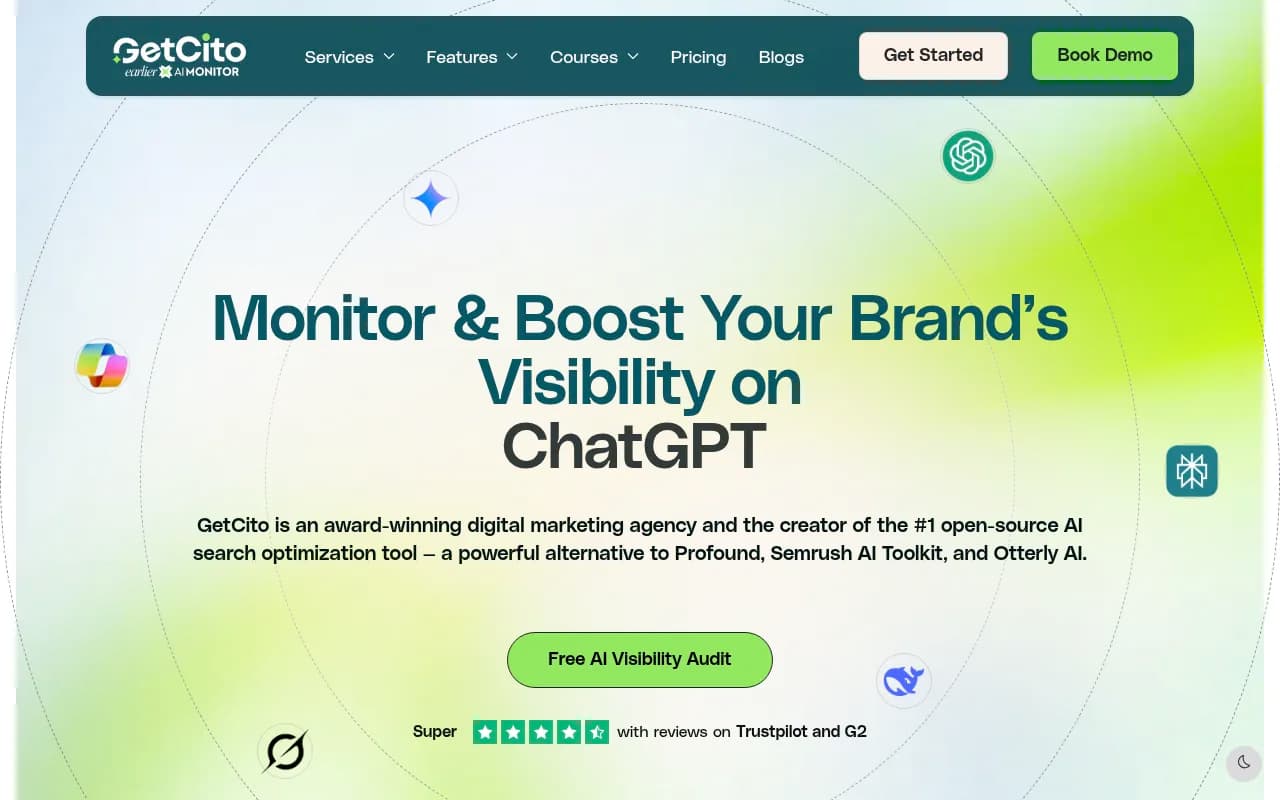
GetCito started as "AI Monitor" and rebranded in 2025. It's both a digital marketing agency and an open-source AI visibility tool. The core idea: most businesses need strategy, not just data. GetCito bundles agency expertise with monitoring software, so you get insights plus guidance on what to do with them. The catch? Pricing starts at $299/mo, and that includes agency services -- you're not just buying a dashboard.
The open-source angle is GetCito's differentiator. You can self-host the tool (paying only for API costs to query AI engines), inspect the code, and customize it. The paid plans bundle the hosted version with agency support: benchmarking, sentiment analysis, and strategic recommendations. GetCito monitors six AI engines: ChatGPT, Gemini, Copilot, Perplexity, DeepSeek, and Grok. The focus is less on raw data dumps and more on actionable insights -- "right message, right place" positioning.
If you're deciding between these two, the real question is whether you want a cheap monitoring tool you run yourself or a pricier package with strategic guidance baked in.
Side-by-side comparison
| Feature | Otterly.AI | GetCito |
|---|---|---|
| Starting price | $29/mo (15 prompts) | $299/mo (bundled with agency) |
| Free tier | 14-day trial | Free self-host (API costs apply) |
| Open source | No | Yes |
| AI engines monitored | 6 (ChatGPT, Perplexity, AI Overviews, AI Mode, Gemini, Copilot) | 6 (ChatGPT, Gemini, Copilot, Perplexity, DeepSeek, Grok) |
| Brand mention tracking | ✓ | ✓ |
| Citation tracking | ✓ | ✓ |
| GEO audit | ✓ (25+ on-page factors) | Limited (agency-led) |
| Sentiment analysis | ✗ | ✓ |
| Content generation | ✗ | ✗ |
| Agency services | ✗ | ✓ (bundled in paid plans) |
| Self-hosting option | ✗ | ✓ |
| Keyword research | ✓ | ✓ |
| Competitor benchmarking | Basic | ✓ (real-time) |
Pricing: $29/mo vs $299/mo
The price gap here is massive, and it reflects fundamentally different business models.
Otterly.AI pricing
| Plan | Price | Prompts | Key features |
|---|---|---|---|
| Lite | $29/mo | 15 | Basic monitoring, 1 brand, 6 AI engines |
| Standard | $189/mo | 100 | Multi-brand tracking, GEO audit, keyword research |
| Premium | Custom | Unlimited | White-label, API access, priority support |
Otterly.AI's Lite plan at $29/mo is the cheapest entry point in the AI visibility space. You get 15 prompts per month, which is enough to track a handful of core queries. The Standard plan at $189/mo bumps you to 100 prompts and unlocks the GEO audit tool. Premium pricing isn't public, but it's aimed at agencies and enterprises that need unlimited prompts and white-label options.
The 14-day free trial lets you test the platform before committing. No credit card required upfront.
GetCito pricing
GetCito's pricing is less transparent. The free self-host option means you can run the open-source tool yourself, but you're on the hook for API costs every time you query ChatGPT, Gemini, or other engines. Those costs add up fast if you're monitoring hundreds of prompts.
Paid plans start at $299/mo and bundle the hosted tool with agency services: strategic recommendations, sentiment analysis, and benchmarking. GetCito doesn't publish a detailed pricing grid -- you're expected to book a call and discuss your needs. The agency-first model means you're paying for expertise, not just software.
Verdict: If budget is tight and you just need monitoring, Otterly.AI wins by a mile. If you want strategic guidance and don't mind paying for it, GetCito's bundled approach makes sense. The self-host option is appealing for technical teams, but factor in API costs before assuming it's "free."
Feature deep-dive: What you actually get
AI engine coverage
Both tools monitor six AI engines, but the lineups differ slightly.
Otterly.AI covers:
- ChatGPT
- Perplexity
- Google AI Overviews
- Google AI Mode
- Gemini
- Copilot
GetCito covers:
- ChatGPT
- Gemini
- Copilot
- Perplexity
- DeepSeek
- Grok
Otterly.AI includes Google AI Overviews and AI Mode, which are critical if you're focused on Google's AI search features. GetCito adds DeepSeek and Grok, which are newer entrants but less widely used. Neither tool monitors Meta AI, Mistral, or Claude.
If Google AI Overviews matter to your business, Otterly.AI has the edge. If you want coverage of DeepSeek or Grok, GetCito is your only option here.
Brand monitoring and citation tracking
Both platforms track brand mentions and website citations across AI engines. You can see which prompts trigger your brand, how often you're cited, and which competitors appear alongside you.
Otterly.AI presents this data in a straightforward dashboard. You get visibility scores, mention counts, and citation breakdowns by AI engine. The interface is clean and easy to navigate -- no learning curve.
GetCito adds sentiment analysis on top of raw mention tracking. You can see whether AI engines are presenting your brand positively, negatively, or neutrally. This is useful for reputation management, but it's not a feature most teams will use daily.
Verdict: Otterly.AI's monitoring is more polished and easier to use. GetCito's sentiment layer is nice to have but not essential.
GEO audit and optimization guidance
This is where the two tools diverge sharply.
Otterly.AI includes a GEO audit tool that analyzes 25+ on-page factors: structured data, E-E-A-T signals, content depth, internal linking, and more. You get a score for each page and specific recommendations on what to fix. It's like an SEO audit but tailored for AI search visibility. The audit runs automatically, and you can export results to share with your team.
GetCito doesn't offer a self-service audit tool. Instead, the agency team reviews your site and provides strategic recommendations as part of the paid plan. You're not getting a checklist of technical fixes -- you're getting a consultant telling you what to prioritize. This works if you want someone else to think through the strategy, but it's slower and less transparent than Otterly.AI's automated approach.
Verdict: Otterly.AI's GEO audit is a clear win for teams that want to self-serve. GetCito's agency-led model is better if you lack in-house expertise.
Keyword research and prompt discovery
Both tools help you find prompts your audience is asking on AI search engines.
Otterly.AI's keyword research tool surfaces conversational queries from ChatGPT, Perplexity, and Google. You can filter by topic, see search volume estimates, and identify gaps where competitors rank but you don't. It's a solid feature, though not as robust as dedicated SEO tools like Ahrefs or Semrush.
GetCito's prompt discovery is similar but less detailed. The focus is on finding high-impact queries rather than exhaustive keyword lists. The agency team helps you prioritize which prompts to target based on your business goals.
Verdict: Otterly.AI gives you more control and granularity. GetCito's approach is more curated but less flexible.
Content generation and optimization
Neither tool generates content for you. Otterly.AI shows you what's missing and leaves the writing to you. GetCito's agency team can provide content strategy and recommendations, but they're not writing articles on your behalf.
If you need content generation as part of your AI visibility workflow, tools like Promptwatch fill that gap with AI writing agents that create articles grounded in citation data and prompt volumes.

Open-source flexibility
GetCito's open-source model is its biggest differentiator. You can clone the repo, inspect the code, and run it on your own infrastructure. This matters if you:
- Want full control over your data
- Need to customize tracking logic for specific use cases
- Prefer to avoid vendor lock-in
- Have technical resources to manage self-hosting
Otterly.AI is closed-source SaaS. You're locked into their platform, their pricing, and their feature roadmap. No customization, no self-hosting, no code access.
Verdict: GetCito wins on transparency and flexibility. Otterly.AI wins on ease of use and not having to manage infrastructure.
Competitor benchmarking
Otterly.AI includes basic competitor tracking. You can add competitor brands and see how often they're mentioned relative to you. The data is useful for understanding share of voice, but it's not real-time and doesn't include deep analysis.
GetCito emphasizes real-time benchmarking as a core feature. The agency team helps you identify which competitors are winning specific prompts and why. You get strategic insights, not just raw numbers.
Verdict: GetCito's benchmarking is more actionable if you're willing to pay for the agency layer. Otterly.AI's competitor tracking is sufficient for basic monitoring.
Ease of use and learning curve
Otterly.AI is designed for self-service. The interface is intuitive, the onboarding is quick, and you can start tracking prompts within minutes. No training required.
GetCito's learning curve depends on whether you're self-hosting or using the paid plan. Self-hosting requires technical chops -- you need to set up API keys, configure the tool, and manage infrastructure. The paid plan includes onboarding and support from the agency team, which smooths the process but adds time.
Verdict: Otterly.AI is faster to get started. GetCito requires more upfront effort, especially if you're self-hosting.
Support and documentation
Otterly.AI offers email support on all plans, with priority support on Premium. The knowledge base covers basic setup and troubleshooting. Response times are decent but not instant.
GetCito's paid plans include direct access to the agency team. You're not filing support tickets -- you're working with a consultant who knows your account. The open-source version has community support via GitHub, but you're on your own for troubleshooting.
Verdict: GetCito's agency support is more hands-on. Otterly.AI's support is standard SaaS fare.
Pros and cons
Otterly.AI pros
- Cheapest entry point in the market ($29/mo)
- Clean, easy-to-use interface with no learning curve
- GEO audit tool with 25+ on-page factors analyzed automatically
- Covers Google AI Overviews and AI Mode
- 14-day free trial, no credit card required
- Keyword research and prompt discovery built in
Otterly.AI cons
- Monitoring only -- no content generation or optimization help
- Closed-source SaaS with no customization options
- Basic competitor tracking, not real-time
- No sentiment analysis
- Limited support on lower-tier plans
- Prompt limits can feel restrictive (15 on Lite, 100 on Standard)
GetCito pros
- Open-source with self-hosting option (full control, no vendor lock-in)
- Bundles agency expertise with monitoring (strategic guidance included)
- Sentiment analysis for reputation management
- Real-time competitor benchmarking
- Covers DeepSeek and Grok (newer AI engines)
- Direct access to agency team on paid plans
GetCito cons
- 10x more expensive than Otterly.AI ($299/mo vs $29/mo)
- Self-hosting requires technical skills and API cost management
- No self-service GEO audit tool (agency-led only)
- Less polished interface compared to Otterly.AI
- Pricing transparency is poor (need to book a call)
- Slower to get started, especially for self-hosting
Who should pick which tool
Pick Otterly.AI if:
- You're on a tight budget and need basic AI visibility monitoring
- You want a simple, self-service tool with no learning curve
- You need Google AI Overviews and AI Mode coverage
- You prefer to handle optimization and strategy in-house
- You're a solo marketer or small team testing AI visibility for the first time
- You want a 14-day trial to evaluate before committing
Pick GetCito if:
- You have budget for agency services and want strategic guidance
- You value open-source transparency and want to self-host
- You need sentiment analysis for reputation management
- You want real-time competitor benchmarking with expert interpretation
- You're tracking DeepSeek or Grok specifically
- You lack in-house AI visibility expertise and need a consultant to drive strategy
Consider alternatives if:
- You need content generation to close visibility gaps (neither tool offers this)
- You want crawler logs to see how AI engines discover your site (neither tool has this)
- You need deeper analytics like prompt volumes, difficulty scores, or query fan-outs (both tools are basic here)
- You want to track more than 6 AI engines (neither covers Meta AI, Claude, or Mistral)
For teams that want the full action loop -- find gaps, generate content, track results -- tools like Promptwatch go beyond monitoring to actually help you optimize and create content that ranks in AI search.
Final verdict
Otterly.AI and GetCito serve different audiences. Otterly.AI is the budget-friendly monitoring tool for teams that want data without hand-holding. GetCito is the agency-plus-tool hybrid for teams that need strategic guidance and value open-source flexibility.
If you're just starting with AI visibility and want to see where you stand without spending much, Otterly.AI at $29/mo is the obvious pick. The GEO audit tool alone is worth the price, and the interface is polished enough that you won't waste time figuring it out.
If you have budget and want someone to tell you what to do with the data, GetCito's agency-bundled approach makes sense. The open-source option is appealing for technical teams, but don't underestimate the API costs and infrastructure overhead.
Neither tool is a complete solution. Both show you where you're invisible but leave the fixing to you. For most teams, that means pairing one of these monitoring tools with a content strategy and optimization workflow -- whether that's in-house or through a platform that closes the loop from insight to action.