Key Takeaways
- For AI search visibility: Promptwatch leads with content gap analysis, AI crawler logs, and citation tracking across 10+ AI models—something traditional crawlers like Oncrawl don't offer
- For real-time monitoring: ContentKing (now Conductor Website Monitoring) catches issues instantly instead of waiting for scheduled crawls
- For all-in-one enterprise: Botify, Lumar, and Siteimprove combine technical SEO with AI search optimization (GEO/AEO) in unified platforms
- For budget-conscious teams: Screaming Frog offers unlimited crawling at £199/year, while Sitebulb starts at $35/mo for desktop crawling
- For traditional SEO depth: Semrush and Ahrefs add AI visibility features to their established SEO toolkits
Oncrawl built its reputation on deep technical SEO analysis for large websites—crawling, log file analysis, and proving ROI through data reconciliation. But at $4,500/year minimum and annual contracts only, it's a significant commitment. The technical SEO landscape has also shifted dramatically: AI crawlers from ChatGPT, Claude, and Perplexity now visit your site alongside Googlebot, and visibility in AI answer engines matters as much as traditional search rankings.
Some teams need Oncrawl's enterprise-grade depth. Others need real-time alerts, AI search tracking, or simply a more flexible pricing model. Here's what actually competes.
Promptwatch

While Oncrawl focuses on traditional search engine crawlers, Promptwatch addresses the elephant in the room: AI search engines are fundamentally changing how people discover content. ChatGPT, Claude, Perplexity, and Gemini don't crawl your site the same way Google does, and traditional technical SEO metrics don't tell you if you're visible in AI responses.
Promptwatch monitors brand mentions and citations across 10 AI models—ChatGPT, Perplexity, Claude, Gemini, Meta AI, DeepSeek, Grok, Mistral, Copilot, and Google AI Overviews. But unlike monitoring-only competitors (Otterly.AI, Peec.ai, AthenaHQ), it doesn't stop at showing you data. The platform's Answer Gap Analysis reveals exactly which prompts competitors rank for but you don't, then shows you the specific content your site is missing. The built-in AI writing agent generates articles, comparisons, and listicles grounded in real citation data (880M+ citations analyzed) and prompt volumes—content engineered to get cited by AI models, not generic SEO filler.
You also get AI crawler logs showing when ChatGPT, Claude, and Perplexity bots hit your site, which pages they read, and errors they encounter. Page-level tracking connects visibility improvements to actual traffic through code snippet integration, Google Search Console data, or server log analysis. Competitor heatmaps show who's winning for each prompt and why. Reddit and YouTube insights surface discussions that influence AI recommendations—a channel most technical SEO tools ignore entirely.
Promptwatch starts at $99/mo (Essential: 1 site, 50 prompts, 5 AI-generated articles), $249/mo (Professional: 2 sites, 150 prompts, 15 articles, crawler logs), or $579/mo (Business: 5 sites, 350 prompts, 30 articles). That's a fraction of Oncrawl's entry price, with a 7-day free trial and no annual lock-in.
Trade-offs: Promptwatch isn't a traditional technical SEO crawler—it won't audit your robots.txt or diagnose redirect chains. If you need deep crawl budget analysis or log file reconciliation for Googlebot specifically, Oncrawl or JetOctopus are better fits. But if your goal is visibility in the search landscape that's actually growing (AI answer engines), Promptwatch is the only platform that helps you find gaps, create optimized content, and track results in a closed loop.
Best for: Marketing teams, SEO professionals, and agencies who recognize that AI search visibility is now as important as traditional SEO—and want a platform that helps them take action, not just monitor.
Semrush
Semrush built its reputation as an all-in-one digital marketing suite—keyword research, backlink analysis, rank tracking, content tools, PPC planning. In 2025, they added AI Visibility Toolkit as a $99/mo add-on to track brand mentions across ChatGPT, Perplexity, Gemini, and other AI search engines. Semrush One (their unified package) starts at $165.17/mo with annual billing.
The AI visibility features are solid for basic monitoring: you can see when AI models mention your brand, track sentiment, and compare against competitors. The traditional SEO toolkit remains comprehensive—billions of keywords, site audits, position tracking, traffic analytics. For teams already using Semrush for SEO and wanting to add AI search visibility, the $99 add-on makes sense.
But there's a catch: Semrush uses fixed prompt sets for AI visibility tracking. You can't customize the queries or add your own prompts to monitor niche topics specific to your industry. The AI visibility data also doesn't integrate deeply with the content creation workflow—you see where you're missing, but there's no built-in content gap analysis or AI writing agent to help you fix it. You're essentially getting monitoring plus traditional SEO tools, not an optimization loop.
Compared to Oncrawl, Semrush is broader but shallower on technical SEO. Oncrawl's log file analysis and crawl budget optimization go deeper for enterprise sites. Compared to Promptwatch, Semrush monitors AI visibility but doesn't help you act on it—no answer gap analysis, no AI content generation, no crawler log insights.
Trade-offs: Semrush excels as a general-purpose SEO platform. If you need keyword research, backlink tracking, and rank monitoring alongside basic AI visibility, it's a strong choice. But for deep technical SEO (Oncrawl's strength) or actionable AI search optimization (Promptwatch's strength), it's a compromise.
Best for: Marketing teams who want a single subscription covering traditional SEO, PPC, content, and basic AI visibility monitoring—and don't need deep technical crawling or advanced GEO capabilities.
Ahrefs Brand Radar
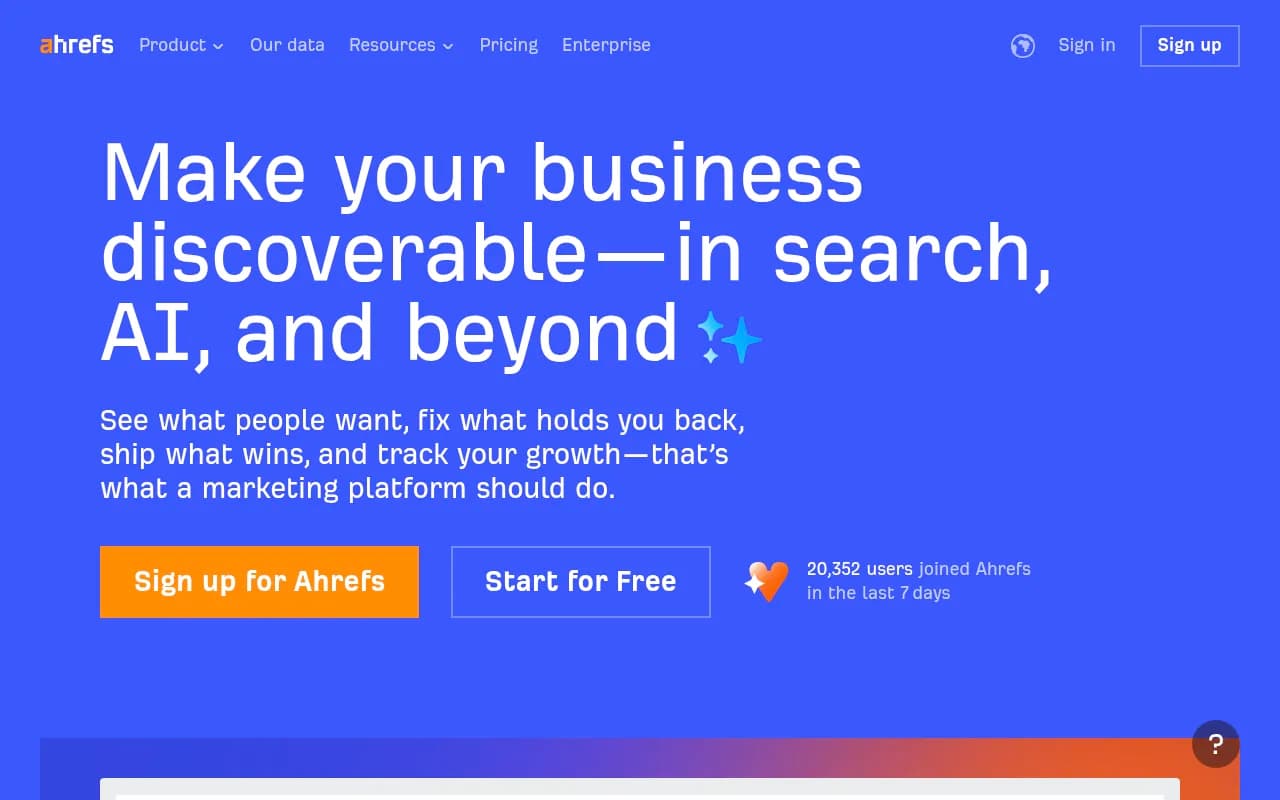
Ahrefs is the other heavyweight in traditional SEO—massive backlink index, keyword explorer, site audit, rank tracking. Brand Radar is their AI search monitoring feature, included with Ahrefs subscriptions starting at $129/mo (Lite) up to $999/mo (Enterprise) on annual billing. No standalone pricing.
Brand Radar tracks mentions across AI-powered search engines and traditional search. You see when your brand appears in AI responses, monitor sentiment, and compare visibility against competitors. The core Ahrefs platform remains excellent for link analysis, keyword research, and content gap identification in traditional search.
The limitations mirror Semrush: fixed prompt sets (you can't add custom queries), no AI traffic attribution, and no content optimization workflow. You get monitoring data but no actionable path to improve your AI visibility. Ahrefs also doesn't provide AI crawler logs or insights into how ChatGPT, Claude, or Perplexity bots interact with your site.
Compared to Oncrawl, Ahrefs offers broader SEO capabilities but less depth on technical crawling and log file analysis. The site audit feature covers basics but doesn't match Oncrawl's enterprise-scale crawl budget optimization. Compared to Promptwatch, Brand Radar monitors AI visibility without the content gap analysis, AI writing tools, or crawler behavior insights that turn monitoring into optimization.
Trade-offs: Ahrefs is a powerhouse for backlink research and keyword analysis. If those are your primary needs and you want basic AI visibility tracking included, Brand Radar adds value. But it's not a replacement for deep technical SEO platforms or dedicated AI search optimization tools.
Best for: SEO teams and agencies already invested in Ahrefs for link building and keyword research who want to add basic AI search monitoring without paying for a separate tool.
Sitebulb
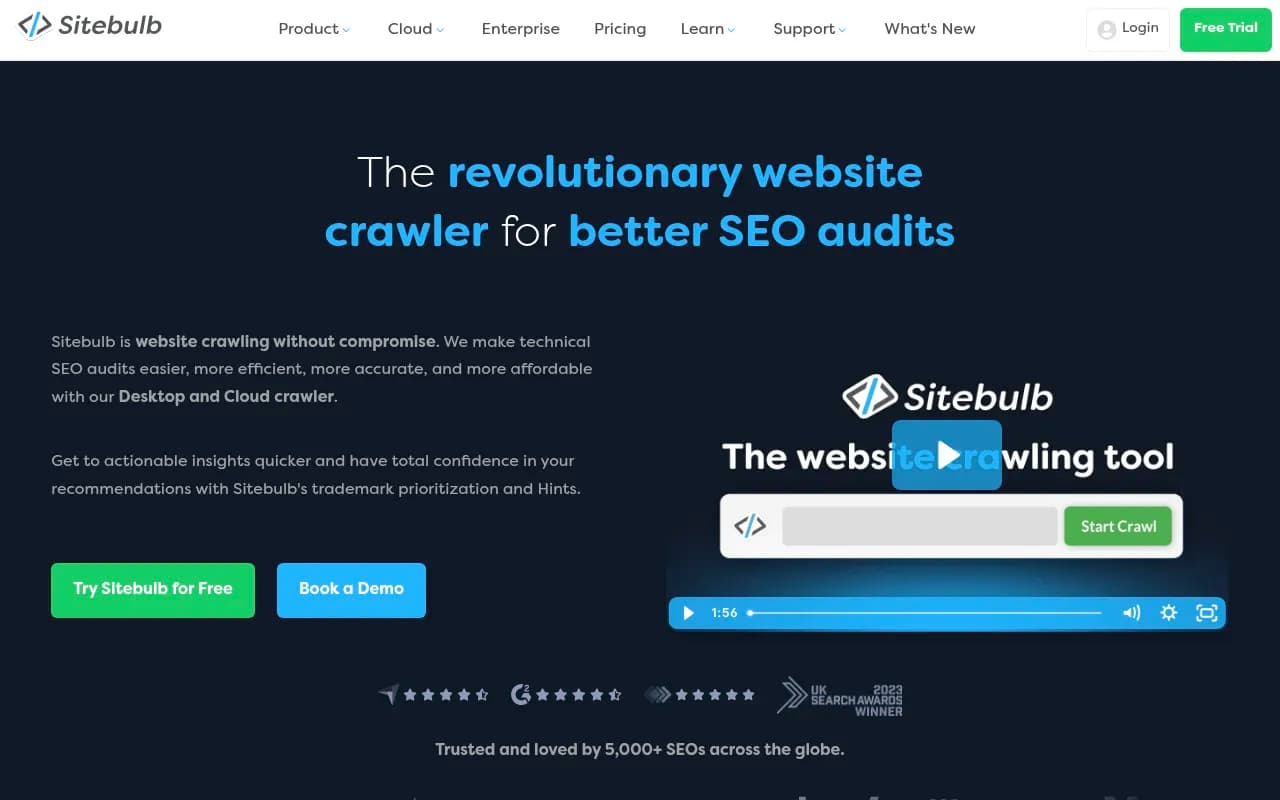
Sitebulb is a technical SEO crawler loved by agencies and consultants for its clarity—visual reports, prioritized recommendations, and detailed issue explanations that clients actually understand. It comes in two versions: Desktop (from $35/mo Lite, $65/mo Pro) and Cloud (from $125/mo for 2 users up to $495/mo for 10 users). Both offer 14-day free trials.
The platform crawls up to 500,000 URLs on Desktop or 10 million on Cloud, automatically checks 300+ SEO issues, and presents findings with Sitebulb's trademark "Hints"—contextual explanations of why each issue matters and how to fix it. The visual data representations (Sankey diagrams, treemaps, crawl visualizations) make complex site architecture problems immediately clear. PDF reports are polished enough to send directly to clients without additional formatting.
Sitebulb excels at technical audits: broken links, redirect chains, duplicate content, crawl depth analysis, JavaScript rendering issues. The Cloud version adds real-time team collaboration, Google Analytics and Search Console integration, and unlimited projects. It's significantly more affordable than Oncrawl while covering most technical SEO needs for sites under 10 million pages.
What it doesn't do: log file analysis (no insights into Googlebot or AI crawler behavior), AI search visibility tracking, or content optimization recommendations. It's a pure technical SEO crawler—excellent at what it does, but it won't tell you if ChatGPT is citing your competitors or help you optimize for AI answer engines.
Trade-offs: Sitebulb is more affordable and user-friendly than Oncrawl, with better reporting for client-facing work. But it lacks log file analysis, AI bot monitoring, and the enterprise-scale data reconciliation that Oncrawl provides. For AI search visibility, you'd need a separate tool like Promptwatch.
Best for: Agencies, consultants, and in-house SEO teams who need clear, actionable technical audits with client-ready reports—and don't require log file analysis or AI search monitoring.
Screaming Frog
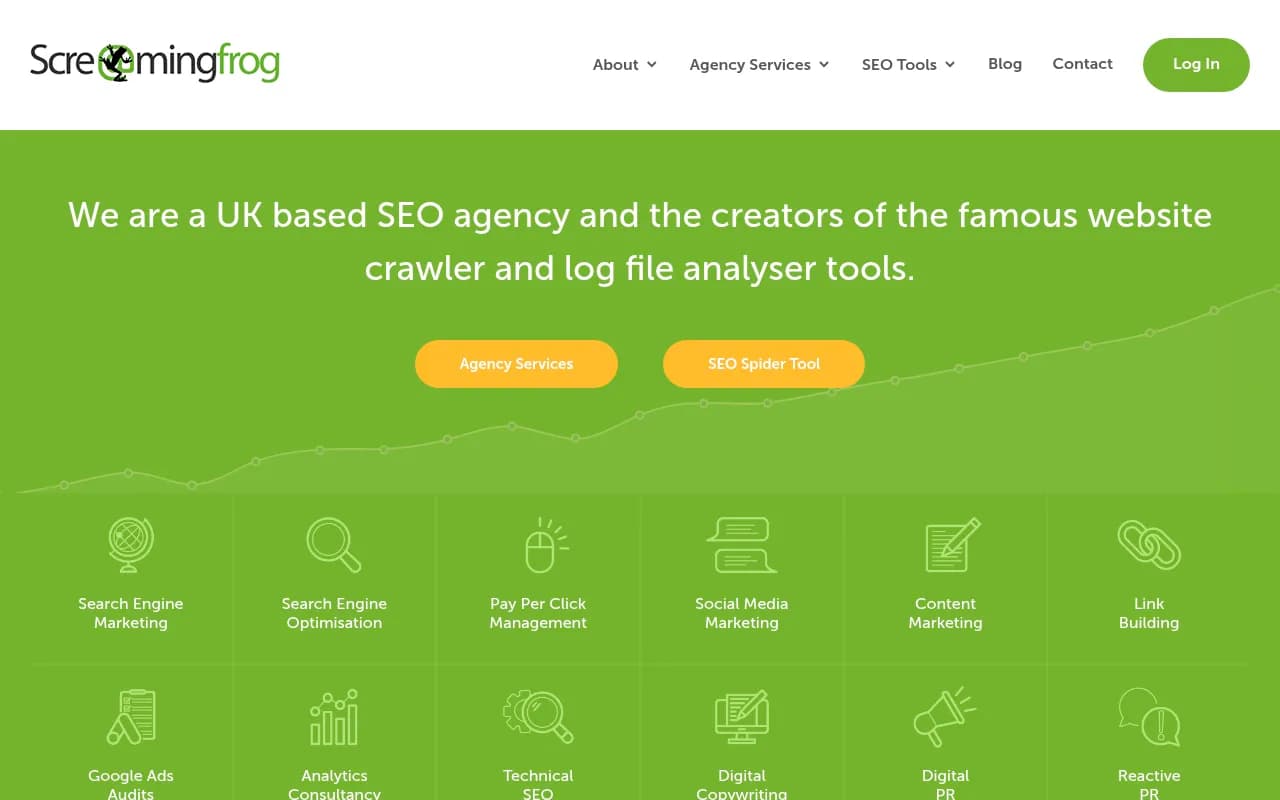
Screaming Frog SEO Spider is the industry standard desktop crawler—used by thousands of SEO professionals for quick technical audits. Free up to 500 URLs, £199/year (~$250) for unlimited crawling. That's the most affordable unlimited crawling you'll find.
The tool is fast, flexible, and powerful for its price. Crawl any site, extract data, analyze page elements, find broken links, audit redirects, check robots.txt and XML sitemaps, render JavaScript, integrate with Google Analytics and Search Console. The interface is utilitarian (think spreadsheet on steroids), but once you learn it, you can diagnose technical issues quickly.
Screaming Frog runs on your local machine, so crawl speed depends on your hardware and internet connection. For large sites (1M+ pages), this becomes a bottleneck—crawls can take hours or days. There's no log file analysis, no AI bot monitoring, no automated scheduling, and no cloud collaboration. It's a manual tool: you run a crawl, export data, analyze it yourself.
Compared to Oncrawl's $4,500/year, Screaming Frog at £199/year is a steal for basic technical audits. But you're trading automation, log analysis, and enterprise-scale data processing for affordability. For AI search visibility, Screaming Frog offers nothing—it's purely a traditional SEO crawler.
Trade-offs: Unbeatable value for unlimited crawling. But it's a manual tool with no log file analysis, no AI monitoring, and crawl speed limited by your machine. For quick audits and budget-conscious teams, it's perfect. For enterprise-scale automation and AI search optimization, look elsewhere.
Best for: Freelancers, small agencies, and in-house SEOs who need a reliable, affordable crawler for technical audits and don't mind manual workflows.
Lumar
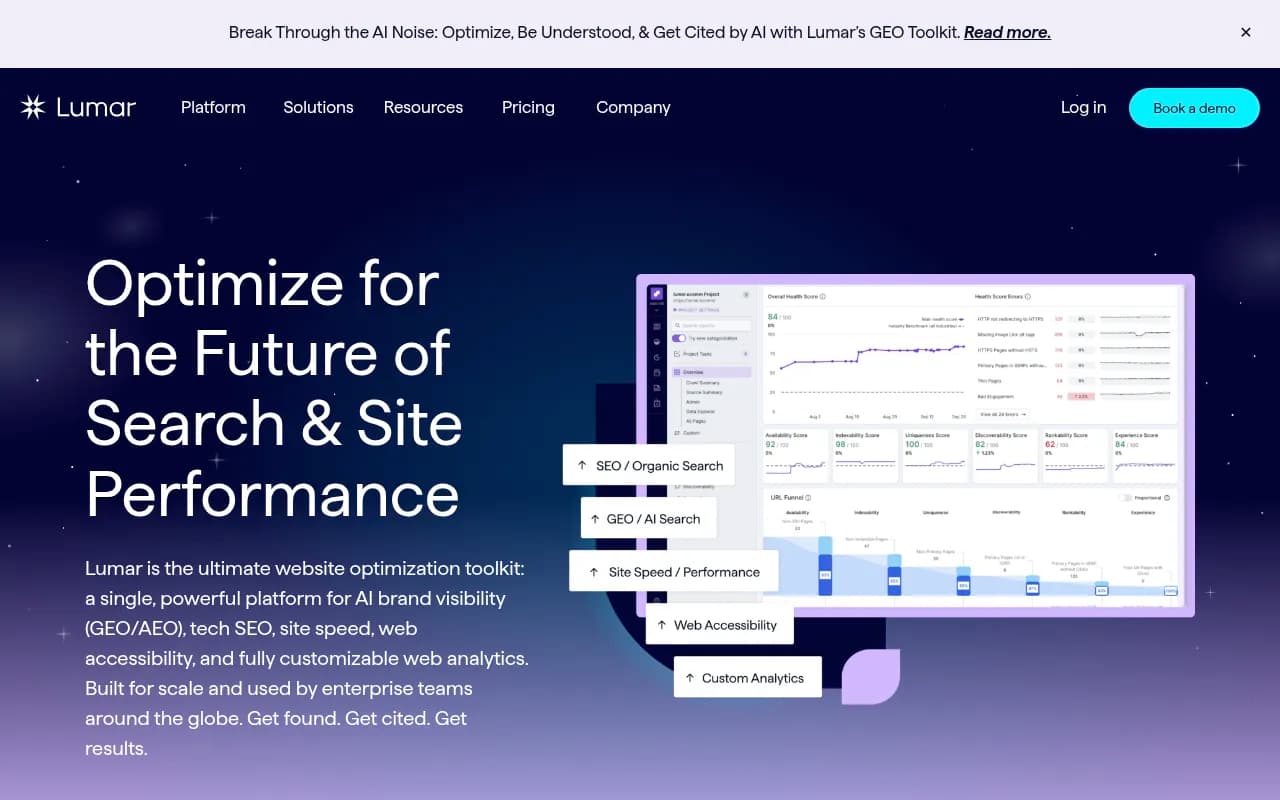
Lumar (formerly Deepcrawl) is an enterprise website optimization platform that combines technical SEO, AI search visibility (GEO/AEO), site speed monitoring, web accessibility testing, and custom analytics. Built for large organizations managing complex, multi-million-page websites. Pricing is custom (contact sales), typically starting around $10k+/year.
The platform's strength is unification: instead of juggling separate tools for technical SEO, AI visibility, performance, and accessibility, Lumar handles all of it. The GEO/AEO toolkit tracks brand mentions and sentiment across major AI platforms, provides content and technical optimization recommendations, and shows you what's missing. Site speed monitoring includes Lighthouse reports at scale and Core Web Vitals tracking. Accessibility testing aligns with WCAG 2.2 standards with suggested fixes.
Lumar's custom analytics capabilities let you build tailored metrics and dashboards beyond standard SEO reports. The platform integrates with Google Analytics, Search Console, Looker Studio, and Google Sheets for flexible reporting. For enterprise teams managing multiple large sites with complex requirements (e-commerce, media, travel), Lumar consolidates workflows that would otherwise require 3-4 separate tools.
Compared to Oncrawl, Lumar covers similar technical SEO depth but adds AI search visibility and accessibility—areas Oncrawl doesn't address. The trade-off is cost: Lumar's enterprise pricing is higher than Oncrawl's already-steep $4,500/year minimum. Compared to Promptwatch, Lumar monitors AI visibility and provides recommendations but lacks the content gap analysis and AI writing agent that turn insights into action.
Trade-offs: Lumar is comprehensive and powerful for enterprise teams with budget. But the high cost and enterprise-only positioning make it overkill for smaller sites or teams that don't need accessibility testing and performance monitoring bundled with SEO.
Best for: Enterprise brands and large agencies managing multi-million-page websites who need technical SEO, AI search optimization, performance monitoring, and accessibility testing in a unified platform—and have the budget for it.
Botify
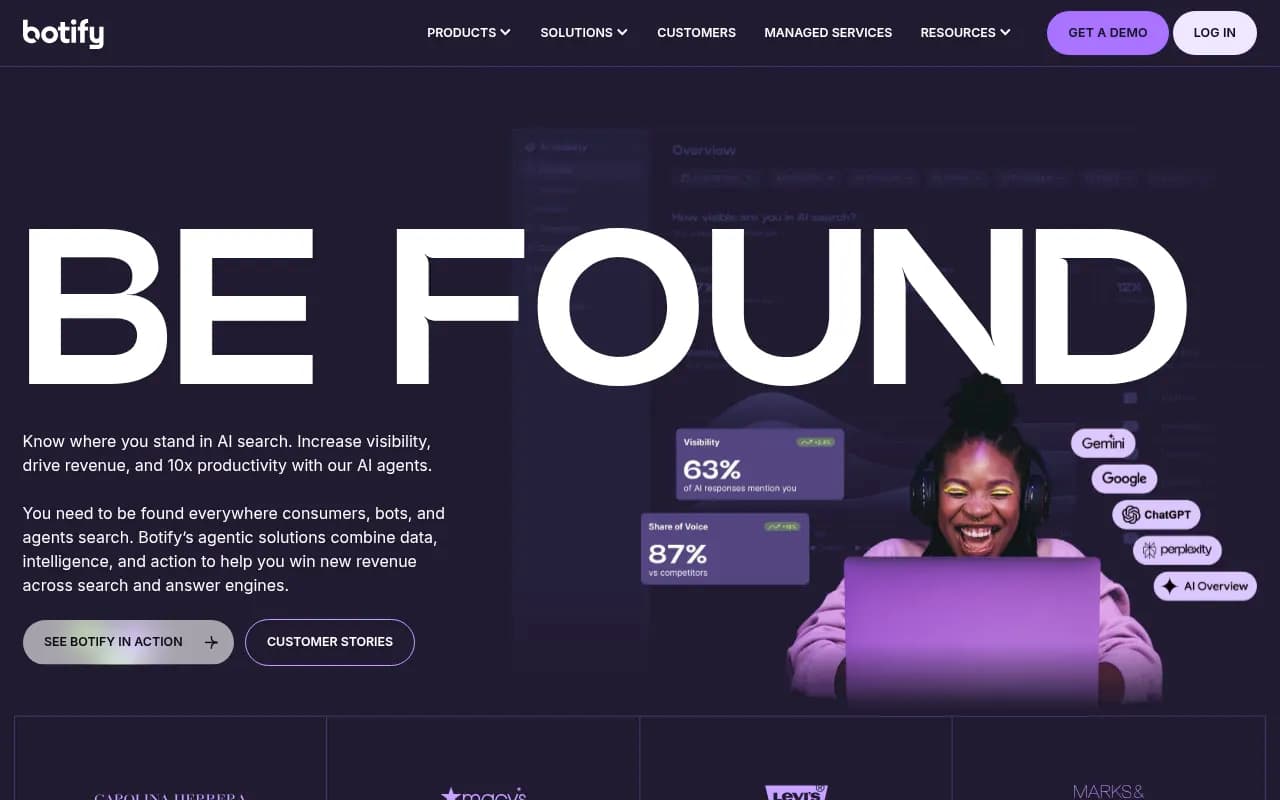
Botify is an all-in-one AI search optimization platform for enterprise brands and growth companies. It combines data analytics, AI-powered recommendations, and automated workflows to maximize visibility across traditional search engines and AI answer engines (ChatGPT, Perplexity, Google AI Overviews). Pricing starts around $10k/month on annual contracts—firmly enterprise territory.
The platform's core value is its "agentic" approach: AI agents work alongside your team to analyze data, surface insights, and automate optimization tasks. Botify tracks AI bot behavior (which pages they crawl, how often, what they cite), monitors brand visibility across AI platforms, and provides specific recommendations to improve discoverability. The technical SEO capabilities cover crawl budget optimization, log file analysis, and indexation diagnostics at scale.
Botify also includes content optimization tools, automated reporting, and integrations with analytics platforms. For enterprise e-commerce sites, media companies, and large agencies managing multiple clients, it consolidates technical SEO and AI search optimization into a single workflow. The platform is built for teams that need both depth (technical diagnostics) and breadth (AI visibility, content strategy).
Compared to Oncrawl, Botify offers similar technical SEO depth plus AI search optimization—something Oncrawl doesn't address. The pricing is higher (roughly $10k/mo vs Oncrawl's $4,500/year), but you're getting a broader platform. Compared to Promptwatch, Botify provides enterprise-scale data and automation but lacks the specific content gap analysis and AI writing agent that help smaller teams act quickly on insights.
Trade-offs: Botify is powerful and comprehensive for enterprise teams with significant budgets. But the high cost and complexity make it impractical for smaller sites or teams that don't need enterprise-scale automation and multi-site management.
Best for: Enterprise brands, large e-commerce sites, and agencies managing multiple high-traffic clients who need deep technical SEO, AI search optimization, and automated workflows—and can justify $10k+/month.
ContentKing
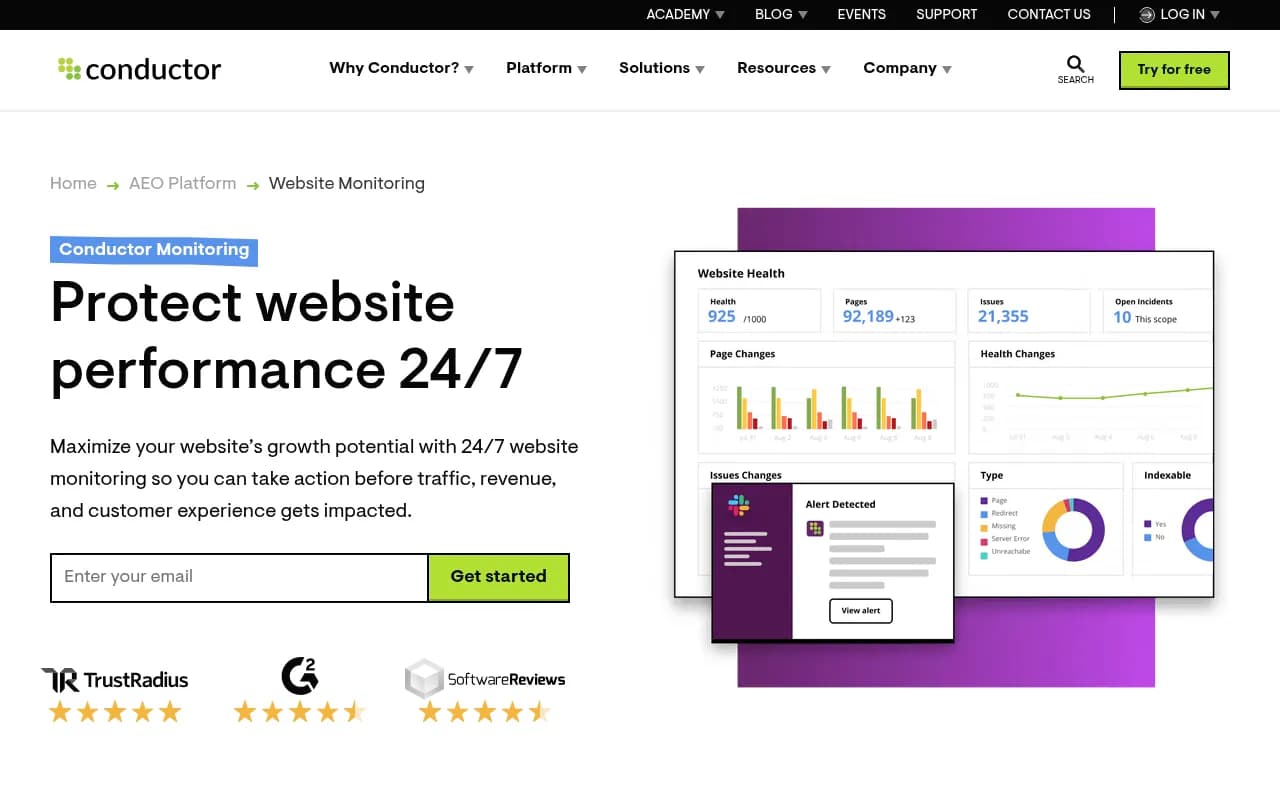
Conductor Website Monitoring (formerly ContentKing) is a real-time technical SEO monitoring platform that tracks every change on your website 24/7. Instead of scheduled crawls (daily, weekly, monthly), it monitors continuously and alerts you instantly when issues occur. Pricing ranges from $139/mo (Basic: 10k pages) to $1,279/mo+ (Enterprise: 100k+ pages), with annual discounts available.
The real-time approach catches problems before they impact traffic: a developer accidentally noindexes a category, a CMS update breaks structured data, a redirect chain appears after a migration. ContentKing detects it immediately and sends alerts, so you can fix issues in minutes instead of waiting days or weeks for the next crawl to reveal the damage.
The platform monitors 300+ technical SEO elements: indexability, canonicals, hreflang, structured data, page speed, mobile usability, content changes. The change log shows exactly what changed, when, and on which pages. For enterprise sites with frequent updates (e-commerce, news, SaaS), this prevents costly mistakes from lingering undetected.
What ContentKing doesn't do: log file analysis (no insights into Googlebot or AI crawler behavior), AI search visibility tracking, or content optimization. It's purely a monitoring and alerting tool for technical SEO. You still need separate tools for crawl budget analysis, AI visibility, or content strategy.
Compared to Oncrawl, ContentKing offers real-time monitoring instead of scheduled crawls, but lacks log file analysis and data reconciliation. Compared to Promptwatch, ContentKing monitors technical SEO issues in real-time but doesn't address AI search visibility or content gaps.
Trade-offs: Real-time monitoring is invaluable for catching issues fast, especially on frequently updated sites. But ContentKing is narrowly focused on technical SEO monitoring—no log analysis, no AI visibility, no content tools. You'll likely need additional platforms for a complete SEO stack.
Best for: Enterprise SEO teams and agencies managing large, frequently updated websites (e-commerce, media, SaaS) who need instant alerts when technical issues occur—and can pair it with other tools for log analysis and AI visibility.
JetOctopus
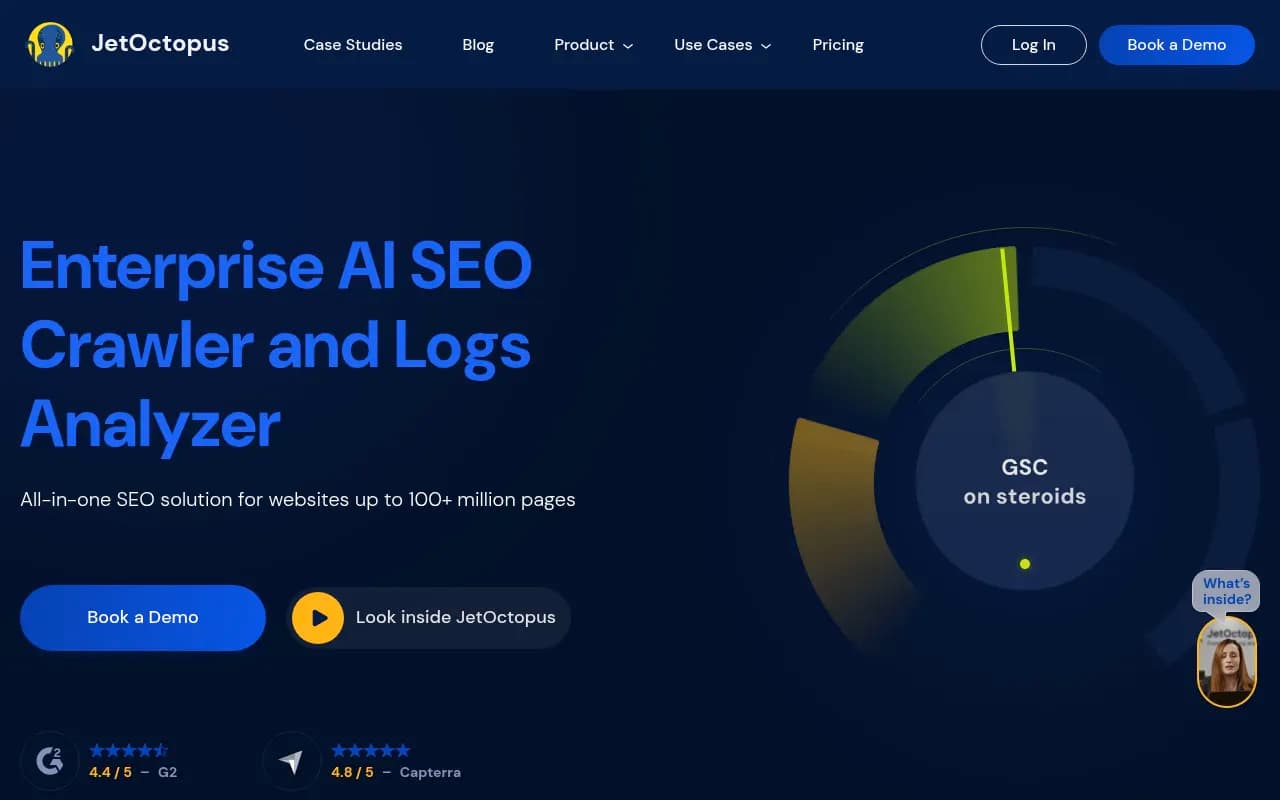
JetOctopus is a cloud-based technical SEO platform built for large websites (10K+ pages). It combines site crawling, log file analysis, and Google Search Console integration to help enterprise teams optimize crawl budget, fix indexation issues, and increase organic traffic. Pricing starts at $59/mo (up to 10K pages), $199/mo (100K pages), $499/mo (1M pages), with enterprise custom pricing and 25% annual discounts.
The platform's strength is its log analyzer—detailed visualizations of how Googlebot (and other crawlers) interact with your site. You see crawl frequency, response codes, crawl budget waste, and correlations between crawl activity and rankings. The crawler itself handles JavaScript rendering and scales to 100M+ pages. Google Search Console integration adds ranking and click data to the analysis.
JetOctopus also provides preset charts and insights that save time—common SEO issues surfaced automatically, with recommendations. The interface is more technical than Sitebulb's visual approach but offers deeper data for teams comfortable with spreadsheets and segmentation.
What it doesn't do: AI search visibility tracking, content optimization tools, or real-time monitoring (crawls are scheduled, not continuous). It's a traditional technical SEO platform focused on crawl efficiency and indexation.
Compared to Oncrawl, JetOctopus offers similar log file analysis and crawling capabilities at a lower price point ($199-$499/mo vs Oncrawl's $4,500/year minimum). The trade-off is less polish and fewer enterprise features (Oncrawl's data reconciliation and custom reporting are more advanced). Compared to Promptwatch, JetOctopus handles traditional technical SEO but doesn't address AI search visibility or content gaps.
Trade-offs: JetOctopus delivers strong log analysis and crawling for large sites at a more accessible price than Oncrawl. But the interface is less polished, and there's no AI visibility tracking or real-time monitoring. For teams focused purely on technical SEO and crawl budget optimization, it's a solid value.
Best for: Enterprise SEO teams and agencies managing large websites (100K+ pages) who need log file analysis and crawl budget optimization at a lower price point than Oncrawl—and don't need AI visibility or real-time alerts.
Siteimprove
Siteimprove is an enterprise content intelligence platform that combines accessibility compliance, SEO/AEO optimization, analytics, and content strategy into a unified workflow. Used by major brands like Vodafone, BT, and Costco, it deploys AI agents to help teams create discoverable, compliant, high-performing content. Pricing is custom (enterprise quotes only), with service tiers: Essential, Expert, Enterprise.
The platform's differentiator is accessibility—WCAG 2.2 compliance testing across web, mobile, social, documents, and applications. AI agents assist designers, developers, and editors to ensure content is accessible by default. The SEO/AEO capabilities track visibility in traditional search and AI answer engines, with real-time optimization guidance. Analytics agents translate traffic and behavior data into prioritized next steps tied to business goals.
For organizations with legal compliance requirements (government, education, healthcare, finance), Siteimprove consolidates accessibility, SEO, and analytics into a single platform. The AI agents provide contextual recommendations throughout the content creation process, reducing the need for manual audits.
What it doesn't do: deep log file analysis (limited insights into crawler behavior), AI crawler logs, or content gap analysis for AI search. The focus is on creating compliant, optimized content rather than diagnosing technical crawl issues.
Compared to Oncrawl, Siteimprove offers broader capabilities (accessibility, analytics, content strategy) but less depth on technical SEO and log file analysis. Compared to Promptwatch, Siteimprove monitors AI visibility and provides optimization guidance but lacks the specific content gap analysis and AI writing agent that turn insights into action.
Trade-offs: Siteimprove is ideal for organizations that need accessibility compliance alongside SEO and analytics. But the enterprise-only pricing and broad focus make it overkill for teams that only need technical SEO or AI visibility tracking.
Best for: Enterprise brands in regulated industries (government, education, healthcare, finance) who need accessibility compliance, SEO/AEO optimization, and analytics in a unified platform—and have the budget for enterprise software.
Which Oncrawl alternative is right for you?
If you're evaluating Oncrawl alternatives, your decision comes down to three questions:
1. Do you need AI search visibility tracking?
Oncrawl doesn't monitor ChatGPT, Claude, Perplexity, or other AI answer engines. If visibility in AI search matters to your business (and it should—AI search traffic grew 5.6x in 2025), you need a platform that tracks it. Promptwatch leads here with content gap analysis, AI crawler logs, and an AI writing agent that helps you act on insights. Semrush, Ahrefs, Lumar, Botify, and Siteimprove add basic AI visibility monitoring, but none offer Promptwatch's optimization loop.
2. What's your site's scale and complexity?
For sites under 100K pages, Sitebulb ($35-$65/mo) or Screaming Frog (£199/year) handle most technical audits at a fraction of Oncrawl's cost. For 100K-1M pages, JetOctopus ($199-$499/mo) delivers log analysis and crawling without the enterprise price tag. For 1M+ pages with complex requirements, Oncrawl, Lumar, or Botify provide the depth and scale you need—but expect to pay for it.
3. Do you need real-time monitoring or scheduled crawls?
If your site changes frequently (e-commerce, news, SaaS), ContentKing's real-time alerts catch issues before they impact traffic. If you're fine with daily or weekly crawls, traditional crawlers (Sitebulb, Screaming Frog, JetOctopus, Oncrawl) work well.
The honest answer: most teams don't need Oncrawl's enterprise-scale depth and $4,500/year commitment. If you're managing a 10M+ page site with complex crawl budget issues, Oncrawl or Lumar make sense. If you're optimizing for AI search visibility, Promptwatch is the only platform that helps you find gaps, create content, and track results in a closed loop. If you need affordable technical audits, Sitebulb or Screaming Frog deliver 90% of what most teams need at 10% of the cost.
The search landscape is changing. Traditional technical SEO still matters, but AI search visibility is the growth channel. Pick the tool that addresses your actual bottleneck, not the one with the longest feature list.