Key takeaways
- Promptwatch is the best pick if you want visibility tracking plus the tools to actually act on it: crawler logs, content gap analysis, automated content generation, and CMS publishing, not just a dashboard telling you what you already suspected.
- Qwairy has the broadest model coverage by far (38+ models across 10+ providers), GDPR-compliant EU hosting, and multi-language support, which matters if Gumshoe's English-only, US-centric data is the reason you're shopping around.
- Otterly.AI is the cheapest entry point ($29/mo) if you just want basic prompt monitoring and don't need content generation or deep crawler data.
- Profound and Scrunch AI are built for enterprise teams with budget to match ($250-$500+/mo entry, custom Enterprise beyond that) and want deeper real-user prompt panels or an Agent Experience Platform.
- Semrush makes sense if you're already paying for the SEO suite and want AI visibility bolted on rather than a standalone tool.
Why people look past Gumshoe AI
Gumshoe's pitch is specific: persona-driven visibility scoring instead of a flat average across prompts. That's a genuinely different angle, and if you need to know how a "Value-Conscious Newcomer" persona sees your brand versus a "Goal-Oriented Powerlifter" persona, nothing else on this list does it quite the same way.
But the complaints are consistent across independent reviews. Gumshoe measures via API only, no browser-based or headless capture of what a real user actually sees in ChatGPT or Gemini's interface. It markets 11 tracked models but audits only pull from 6 at a time, and no published tier raises that ceiling. And it's English-only with US-centric data, no GDPR-compliant EU hosting, which rules it out for a lot of European marketing teams outright. Pricing has also been inconsistent across sources: the live site shows flat tiers ($99 Starter, $299 Pro), while some reviewers report a pay-as-you-go model closer to $0.10 per prompt-model conversation, works out to $60-$1,680/mo depending on monitoring frequency. That kind of ambiguity alone is reason enough for some buyers to shop around.
If any of that sounds like your situation, here's what else is out there.
Promptwatch

Promptwatch is built around a different question than most of this list. Instead of just answering "was my brand mentioned," it's trying to answer "how do I grow AI-driven revenue," which means it goes past monitoring into actually fixing what it finds. It tracks ChatGPT, Gemini, Claude, Perplexity, Grok, DeepSeek, Copilot, Mistral, Meta Llama, Google AI Overviews, and AI Mode, and unlike Gumshoe's API-only approach, it captures real interface data, since what a user sees on screen can differ from what the API returns.
The bigger differentiator versus Gumshoe is the action layer. Promptwatch has AI crawler logs (Agent Analytics) showing exactly when ChatGPTBot, ClaudeBot, PerplexityBot and 400+ other crawlers hit your site and what they read, a Content Agent that plans, writes, and publishes GEO-optimized content straight to Webflow, Framer, or WordPress, content gap analysis with git-diff-style refresh suggestions, and Unified Actions, a prioritized to-do list generated from your own visibility and crawler data. It also tracks Reddit and YouTube citations and ChatGPT Shopping/Ads placements, channels most competitors, Gumshoe included, don't touch.
Pricing starts at $95/mo (Essential: 1 site, 50 prompts, 6,000 responses, all LLM tracking, 5 AEO articles/mo) with a 7-day free trial, up to $245/mo Professional and $579/mo Business. Agency plans start at $199/mo. It's used by 1,840+ brands including Yelp, Duolingo, and Typeform, and sits at 4.7/5 on G2. Per Promptwatch's own data, average sources per AI response vary a lot by engine, ChatGPT cites around 5 sources per web-search answer while Perplexity sits consistently near 10, which is the kind of granularity you get once you move past persona scores into actual citation mechanics.
Best for: Teams who want the full loop, tracking, diagnosis, and content production, in one platform instead of stitching a monitor and a content tool together.
Qwairy
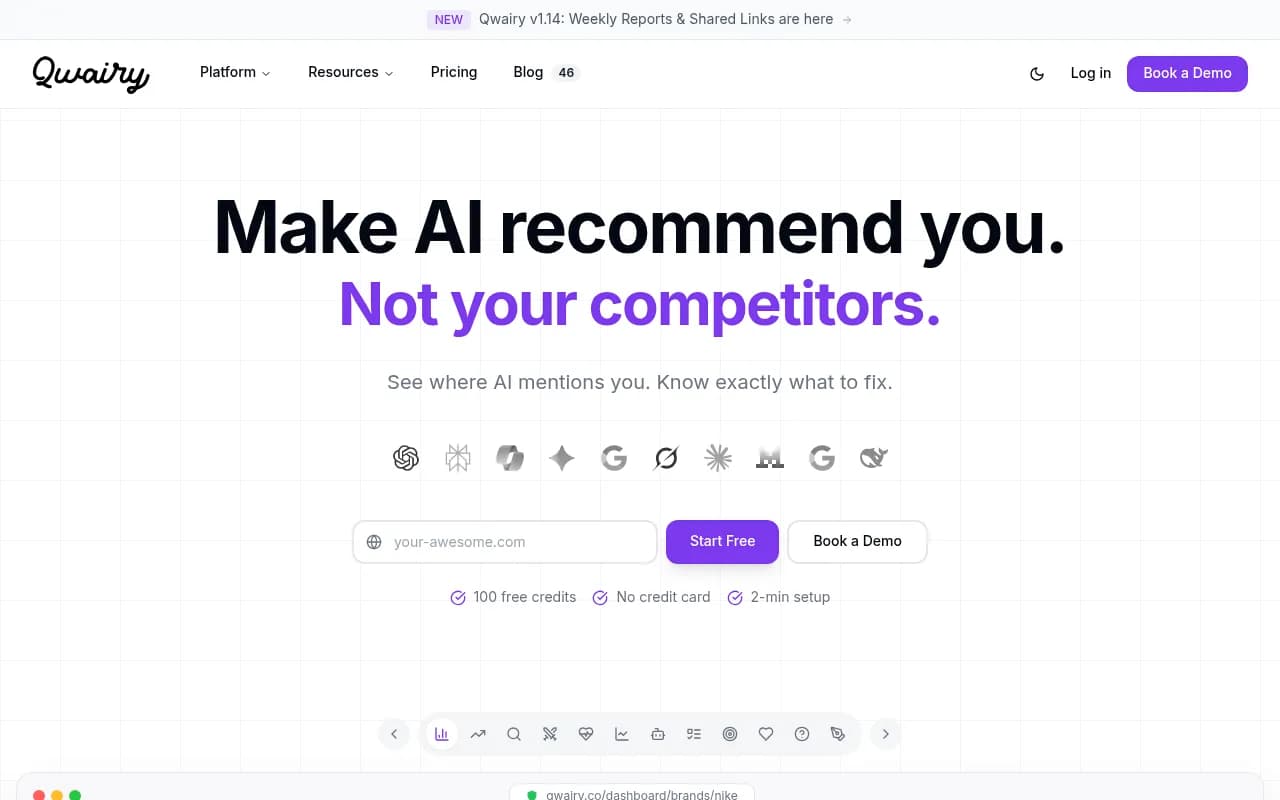
Qwairy is the direct answer to Gumshoe's biggest weakness: coverage. Where Gumshoe measures 6 models per audit out of 11 advertised, Qwairy tracks 38+ models across 10+ providers, including Mistral and DeepSeek, which nobody else on this list bothers with. It also runs GDPR-compliant EU hosting and supports 10+ languages across 100+ countries, which matters a lot if your brand sells outside the US and Gumshoe's US-centric data has been giving you an incomplete picture.
It also adds a technical GEO audit (llms.txt, robots.txt, crawler access checks) and social-signal monitoring across Reddit, YouTube, and Hacker News, both things Gumshoe skips entirely.
The catch: Qwairy's credit system means premium models cost 2-9x more per query than standard ones, so hitting that full 38-model breadth in practice costs well above the $89/mo Starter sticker. Current tiers are Starter $89/mo (1,300 credits), Growth $229/mo ($190 annual, 3,900 credits), and Business $519/mo ($432 annual), plus custom Enterprise.
Best for: European teams, or anyone selling in multiple languages/countries, who got burned by Gumshoe's English-only, US-only data.
Semrush
Semrush folds AI visibility into its existing SEO suite rather than selling it as a standalone product. If you're already running keyword research, backlink analysis, and rank tracking through Semrush, adding AI Visibility means one login instead of two tools and two invoices. It covers ChatGPT, Perplexity, Gemini, Google AI Mode, and AI Overviews on lower tiers, with Claude, DeepSeek, and Grok reserved for the Enterprise AIO plan.
Compared to Gumshoe, Semrush's prompt database is enormous (289M+ LLM prompts globally), but the AI-specific data is shallower than a purpose-built GEO tool. There's no crawler log analysis and no content-gap-to-publish workflow like Promptwatch's. Worth flagging: following Adobe's $1.9B acquisition of Semrush (completed around August 2026), the AI Toolkit's free tier was dropped and AI visibility got bundled into paid plans only, so test before assuming a free option exists.
Pricing starts around $165/mo for Semrush One (annual), with the AI Visibility Toolkit as a $99/mo add-on.
Best for: Teams who already live in Semrush for SEO and just want AI visibility as a bolt-on, not a primary tool.
Otterly.AI

Otterly is the cheapest real option on this list and a recognized 2025 Gartner Cool Vendor. The Lite plan is $29/mo for 15 prompts across 4 engines (ChatGPT, AI Overviews, Perplexity, Copilot) with unlimited team members and daily tracking, no per-seat fee anywhere. Standard jumps to $189/mo for 100 prompts plus API and MCP access.
Where it falls short of Gumshoe: no persona-level scoring, and Claude, Gemini, and Google AI Mode are all paid add-ons rather than included. Where it beats Gumshoe: pricing transparency (no conflicting pay-as-you-go confusion), a dedicated Looker Studio connector for BI reporting, and an actual agency/reseller partner program.
Otterly is a pure monitor, though. There's no content generation or crawler-log layer, so if the gap you're trying to close is "now what do I do with this data," you'll need a second tool regardless.
Best for: Budget-conscious teams or freelancers who want basic, reliable monitoring without paying for features they won't use.
Peec AI

Peec repriced in August 2026 to EUR-denominated, geo-priced annual billing. Current brand tiers are Starter at roughly €85-95/mo (50 prompts, pick 3 engines, 1 project, unlimited seats), Pro at €205-245/mo (150 prompts, 2 projects), and Advanced at €425-495/mo (350 prompts, 5 projects, multi-country tracking, Looker Studio/GA4/GSC integrations).
Unlimited seats at every tier, including the entry plan, is the standout feature versus competitors like Profound that gate seats hard. Peec also supports sentiment tracking and competitor benchmarking out of the box. What it doesn't have: a content generation layer or crawler logs, so like Otterly, it stops at "here's what's happening" rather than "here's how to fix it."
Additional model tracking beyond your tier's 3 engines costs extra ($35-$165/mo per engine depending on plan), which adds up fast if you need broad coverage.
Best for: Mid-market teams who want unlimited seats and solid sentiment/competitor data without Profound's enterprise price tag.
Profound

Profound is the enterprise option, and it's priced like one. Current published tiers are Starter $99/mo (ChatGPT only, 50 prompts, 1 seat, no exports) and Growth $399/mo (3 engines, 100 prompts, 3 seats, adds the Opportunities panel and exports), with custom Enterprise scaling up to 10 engines. A common complaint is that the $99 Starter is basically a funnel; the features that actually differentiate Profound (multi-engine tracking, Opportunities, AI Marketer agents) only unlock at $399+.
It makes up for the price with depth: a real-user prompt panel built on 1.5B+ prompts (versus Gumshoe's API-only measurement), an AI Marketer workbench that drafts and stages content changes across your CMS, and SOC 2/SSO for enterprise procurement. Profound raised a $180M Series D in September 2026 and reports 700+ enterprise customers including MongoDB, Ramp, and Zapier.
Best for: Large brands with budget for custom Enterprise contracts who need the deepest real-user prompt data and don't mind a sales-led buying process.
ZipTie
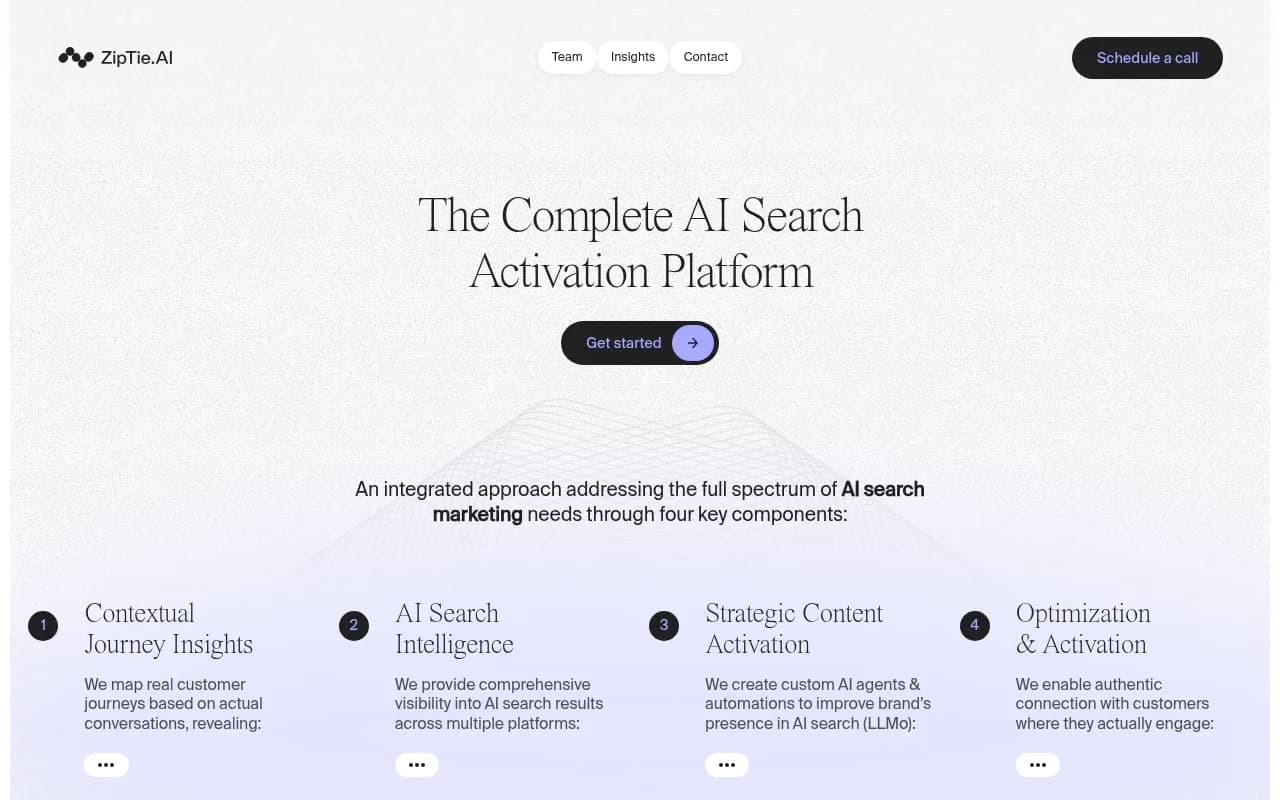
ZipTie moved to a usage-based configurator rather than fixed tiers: you build a plan from prompt count x refresh frequency x engine count, at roughly $0.01 per prompt-engine check. A 7-day free trial covers ChatGPT, Google AI Overviews, and Copilot across 25 prompts with daily refresh, no card required.
The pitch is screenshot-level evidence, actual visual proof of how your brand appears in an AI answer, which is genuinely useful for client reporting if you're an agency. But it's check-based and stops at proof; there's no next-step optimization layer, and agencies specifically run into two walls: no white-label reports (ZipTie's branding stays on every PDF) and no cross-client rollup view, each client lives in its own project.
Content generation and API/MCP access are both paid add-ons ($20/mo and $10/mo respectively) on top of the usage-based base cost, which makes total pricing hard to predict upfront.
Best for: Agencies that need visual proof of AI mentions for client decks, less so teams wanting a path from insight to fix.
Scrunch AI
Scrunch's Core plan is $250/mo, covering 125 unique prompts, 5 site audits per month, and 4 engines (ChatGPT, Perplexity, Google AI Overviews, Copilot) on 5 user licenses. That's the steepest entry price on this list behind Profound's Enterprise tier, and a common complaint is that $250 is a lot for a plan capped at 4 engines, with no volume discount for agencies on Core.
What justifies the price for some teams is the Agent Experience Platform (AXP), available on custom Enterprise, which can generate an AI-friendly version of your site and flags misinformation about your brand circulating in AI answers. Enterprise also adds Claude, Gemini, Google AI Mode, Meta AI, and Grok, bringing total coverage to 9 engines, plus Query API, CLI access, and SSO.
Scrunch reports 500+ customers including Lenovo and Crunchbase, and runs a 7-day free trial of Core.
Best for: Mid-market teams that specifically want the AXP misinformation-detection angle and can justify the $250/mo floor.
Which one should you actually pick
If Gumshoe's core problem for you was narrow model coverage and US-only data, Qwairy solves that directly with 38+ models and EU hosting, though budget for the credit system eating into that breadth. If the problem was "I have a dashboard full of gaps and no way to close them," Promptwatch is built specifically around that handoff from insight to published content, with crawler logs showing you why you're invisible in the first place. If you just need cheap, reliable monitoring without the bells, Otterly's $29/mo Lite plan beats everything else here on price. And if you're an enterprise team with the budget and the patience for a sales cycle, Profound or Scrunch's Enterprise tiers go deeper than anything self-serve.
For a broader look at the GEO software category beyond these eight, the directory at bestgeosoftware.com is worth a scan before you commit to an annual contract.