Key takeaways
- Anagram's pitch is narrow and specific: turn your own on-site shopper questions into a feedback loop that shapes AI visibility. If you want a broader, multi-engine AI visibility platform with crawler logs and automated content, look elsewhere.
- Promptwatch is the strongest all-around pick if you want monitoring and execution in one place, crawler logs, Reddit/YouTube citation tracking, and CMS publishing, starting at $95/mo.
- AthenaHQ and Profound are the closest in spirit to "AEO command centers," with Profound now enterprise-only after its September 2026 pricing restructure.
- Otterly.AI and Peec AI are the budget-friendly, monitoring-only options if you just need a dashboard, not a fix-it engine.
- Semrush and Brandlight sit at opposite ends: Semrush for teams already inside the Semrush ecosystem, Brandlight for Fortune 500-scale multi-brand enterprises with a paid pilot and no self-serve tier.
Anagram is a genuinely different product from most of the tools on this page. It is not a pure AI-visibility tracker, it is a Site Agent that answers shopper questions on your product pages, then feeds what it learns back into AI visibility monitoring and content strategy. That is a clever loop for a DTC or e-commerce brand that already has traffic and wants to convert more of it while also showing up better in ChatGPT and Perplexity answers.
But plenty of teams look for an Anagram alternative because they don't need a conversational Site Agent at all. They need straightforward AI search visibility tracking across ChatGPT, Gemini, Claude, and Google AI Overviews, crawler-level diagnostics, and a way to turn content gaps into published pages without a widget sitting on every product page. Others want enterprise-grade multi-brand rollups, or just a cheap dashboard to start tracking mentions this week. Here's how the realistic alternatives stack up.
Promptwatch

Promptwatch is built around a simple idea: telling you that you're invisible in AI search isn't useful unless something then fixes it. It tracks ChatGPT, Claude, Gemini, Perplexity, Grok, DeepSeek, Copilot, Mistral, Meta Llama, and Google AI Overviews/AI Mode, and pairs that with real AI crawler logs (Agent Analytics) that show which pages ChatGPTBot, ClaudeBot, and 400+ other bots actually read and whether they hit errors. That crawler-to-citation path is something Anagram, and most of the tools below, simply don't have.
Where it differs most from Anagram: Promptwatch isn't shopper-question-led, it's prompt-led and crawler-led. You give it your site and competitors, it tells you where you're cited, where you're not, and its Content Agents draft and publish fixes directly to Webflow, Framer, or WordPress on a schedule, with a review inbox or fully automated. It also tracks Reddit and YouTube citations specifically, and has a dedicated ChatGPT Shopping and Ads Radar, both channels e-commerce brands (Anagram's core audience) should care about just as much as on-site Q&A.
Pricing starts at $95/mo (Essential: 1 site, 50 prompts, all LLMs, AEO articles), $245/mo Professional (adds crawler logs, automated content, shopping insights), $579/mo Business. A 7-day free trial is available. That undercuts Scrunch and Brandlight significantly while covering more engines than either.
Best for: e-commerce and SaaS teams that want one platform doing both the "are we visible" tracking and the "here's the fix, published" execution, without paying enterprise prices.
AthenaHQ

AthenaHQ is the closest thing to a direct Anagram competitor in spirit, both platforms frame themselves around turning customer/AI signal into action, though Athena does it with an Action Center rather than an on-site chat widget. It tracks across 9 AI models, has an Essential free tier (300 credits/mo), and a Starter plan at $295/month (3,600 credits, content optimization agent, single region/language).
The credit-based billing is flagged by reviewers as fair but hard to forecast, and the jump from Starter ($295, one region) to Enterprise is steep with no published middle tier, a real problem if you're a multi-market e-commerce brand. AthenaHQ recently added a free tier and a predictive citation engine as it races Profound on automation.
Best for: teams that want an AEO command center with inbound agency referrals and don't mind credit-based pricing uncertainty.
Semrush
Semrush's AI Visibility Toolkit is an add-on to a tool most marketing teams already pay for. Standalone it's $99/month per domain (25 tracked prompts, 300 daily AI Analysis queries), or bundled into Semrush One starting around $165/mo annually. If your SEO team already lives in Semrush, this removes a second login.
The honest trade-off: independent reviewers call it the strongest monitoring layer with a lighter optimization layer. It tracks fewer AI engines than dedicated AEO tools (Claude, Grok, Meta AI, and DeepSeek aren't covered), and there's no crawler-level attribution. One agency CMO quoted in a third-party review put it bluntly: "I can't say this tool is worth $99/month." Adobe's $1.9B acquisition of Semrush closed in August 2026, and the toolkit's free tier was reportedly dropped as part of post-acquisition bundling.
Best for: teams already paying for Semrush who want a lightweight AI visibility add-on, not a standalone AEO platform.
Otterly.AI

Otterly is the cheapest real option here. Lite starts at $29/mo for 15 tracked prompts, Standard is $189/mo (100 prompts), Premium $489/mo. Base engines are ChatGPT, Perplexity, AI Overviews, and Copilot, with Gemini, AI Mode, and Claude priced as separate add-ons, meaning a "Standard" setup with full engine coverage can run closer to $350/mo once you add them all.
It's monitoring-only. No real prompt-volume data (it converts your keywords into prompt formats rather than pulling actual AI conversations), and no in-platform content generation, every recommendation ends in a handoff somewhere else. That's a fair trade if you're a solo marketer or small agency just starting to track AI mentions.
Best for: solo operators or small shops who want a cheap, fast way to see if they're mentioned at all, before investing in anything heavier.
Peec AI

Peec repriced in August 2026 to EUR-denominated annual plans: Starter €85/mo, Pro €205/mo, Advanced €425/mo. Every tier, even Starter, includes unlimited user seats, a real differentiator against Profound's single-seat entry plan. It tracks ChatGPT, Perplexity, and Gemini with clean, trustworthy screenshot-based reporting that agencies like for client dashboards.
Like Otterly, it's monitoring by design, no content generation. Reddit sentiment on r/aeo sums it up fairly: "Peec: decent starting point, affordable, good if you just need basic visibility data without too much complexity." If you want Anagram's content-strategy half without the on-site widget, Peec won't give it to you; you'd pair it with a separate content tool.
Best for: agencies and lean teams that want a clean multi-model dashboard and don't need built-in content execution.
Profound

Profound made a big pricing move in September 2026, around its $180M Series D: it pulled its self-serve Starter ($99/mo) and Growth ($399/mo) brand plans entirely. Now it's a free one-off trial (10 prompts, ChatGPT only) or a custom Enterprise plan covering up to 9 engines. If you were hoping to self-serve your way into Profound on a budget, that door closed.
What you still get at Enterprise: a dataset of 1.9B+ real user prompts segmented by intent and demographics, Agent Analytics tying crawler visits to GA4 conversions, and Agency Mode with pitch environments that convert straight into live client accounts. It's rated highly on G2 (#1 in AEO, 4.6/5 across 300+ reviews) and has strong customer proof points, including one agency taking a client from $1,000 to over $100,000/mo in AI-attributed revenue.
Best for: enterprises and agencies with budget for custom pricing who want the deepest prompt-volume dataset and don't mind a sales process.
Brandlight
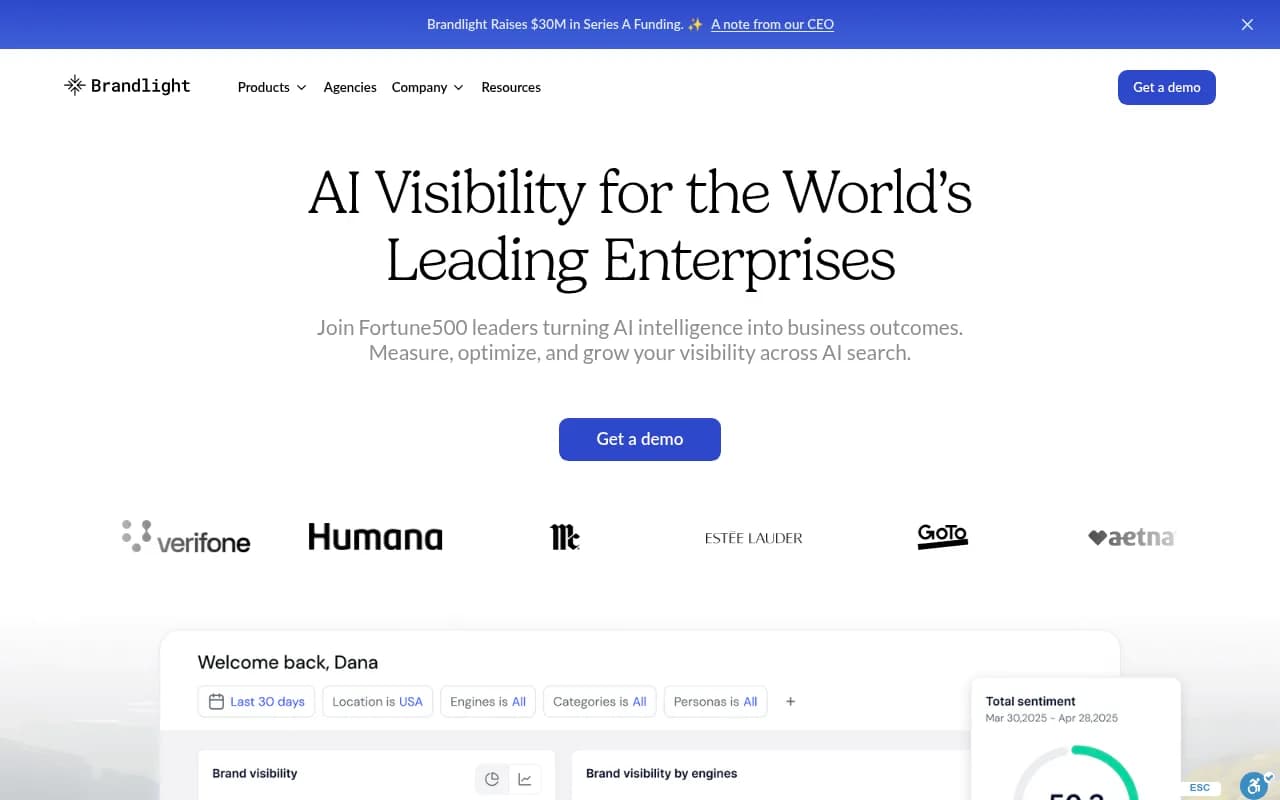
Brandlight sits furthest from Anagram's self-serve, product-led spirit. It's fully custom, enterprise-only pricing with no self-serve tier and no free trial, engagements typically start with a paid three-month pilot. Third-party estimates place entry somewhere between $199 and $750/month, though Brandlight doesn't publish actual numbers.
What you get for that: coverage across 13 engines with per-market adaptation, a See-Shape-Act-Transform workflow that pairs measurement with executed content and partnership activation, and a dedicated strategy team rather than just a dashboard. Its Kimberly-Clark case study claims 12 of 12 brands moved into the top 3 across major LLMs. This is built for Fortune 500-class multi-brand organizations, not the growth-stage e-commerce brands Anagram targets.
Best for: large multi-brand, multi-market enterprises that want a managed strategy partner, not a self-serve tool.
Scrunch AI
Scrunch's Core plan is $250/month for 125 unique prompts, 5,000 responses, and 4 tracked LLMs (ChatGPT, Perplexity, AI Overviews, Copilot), with a 7-day free trial. Enterprise unlocks 9 LLMs, API/CLI access, and SSO. One tracker flagged Scrunch as priced about 192% above the category median, calling it "not built for casual experimentation."
What makes Scrunch different from a pure tracker is its AXP (AI experience layer), it serves AI-optimized versions of your pages directly to crawlers rather than just reporting on how your existing pages perform. It raised $26M to build out this "dual-web" approach. The catch: no content generation yet, and prompts are configured rather than pulled from real AI conversations.
Best for: teams willing to pay a premium for Scrunch's crawler-facing AXP approach over straightforward monitoring.
Which one should you actually pick
If your business model genuinely depends on answering shopper questions on-site, like a DTC brand selling a considered-purchase product, Anagram's loop of engage, learn, improve is hard to replicate with a pure visibility tracker. But if what you actually need is broad AI engine coverage, crawler-level diagnostics, and a way to turn visibility gaps into published content without a chat widget, Promptwatch covers the most ground for the price, especially once you factor in Reddit/YouTube tracking and ChatGPT Shopping, both relevant to the e-commerce brands Anagram serves. Budget-constrained teams should start with Otterly or Peec and upgrade once they know what they're optimizing for. Enterprises with multiple brands and real budget should talk to Brandlight or Profound's sales teams directly. For a broader look at the GEO software category, the directory at bestgeosoftware.com is worth a scan before you commit to a 12-month contract.