Key takeaways
- On August 8, 2026, the share of ChatGPT fan-out queries containing the site: operator jumped from 0.37% to 16.8% in a single day, according to Promptwatch Data.
- The jump looks like a platform-side rollout, not something individual sites caused. Average fan-outs per response rose from about 1.08 to 1.83 the same day, so site: searches sit on top of generic ones.
- Several independent studies (Peec AI, Nectiv, Resoneo) show the same direction: more searches per prompt, more domain-scoped searches, more retrieval, fewer unique domains cited.
- Lily Ray's working theory is that site: acts partly as a spam filter, steering ChatGPT toward sources it already trusts. That is a theory, not a confirmed fact.
- For content teams: make your domain a good retrieval surface, cover more angles per topic, and monitor fan-outs continuously instead of auditing once.
What actually changed on August 8
For weeks, site:-scoped searches were a rounding error in ChatGPT's behavior. Roughly 1 in 280 fan-out queries used the operator. Then, on August 8, 2026, that share went to about 1 in 6.
The numbers come from Promptwatch's data on ChatGPT and the site: operator:
- Share of fan-outs with site: went from 0.37% to 16.8%, around a 46x increase in one day.
- The share had hovered between 0.3% and 0.5% for weeks, dipped to 0.15% on August 3 to 5 (consistent with a staged rollout or experiment), then jumped.
- Average fan-out queries per response rose from about 1.08 to about 1.83 and stayed there.
That second point matters more than it looks. If ChatGPT had swapped generic queries for site: queries, the average per response would have stayed flat. It went up, so the domain-scoped searches are additional. Your chances of showing up through ordinary searches are intact. There is now a second retrieval path next to them.
A change that lands in one day across the whole platform is a model or system-prompt change at OpenAI. Nobody's content strategy caused it, and nobody's content strategy can be judged by it alone.
A quick refresher on query fan-out
When a prompt needs fresh information, ChatGPT doesn't search for your exact words. It breaks the prompt into several background searches, runs them in parallel, and writes an answer from what comes back. Those background searches are fan-out queries.
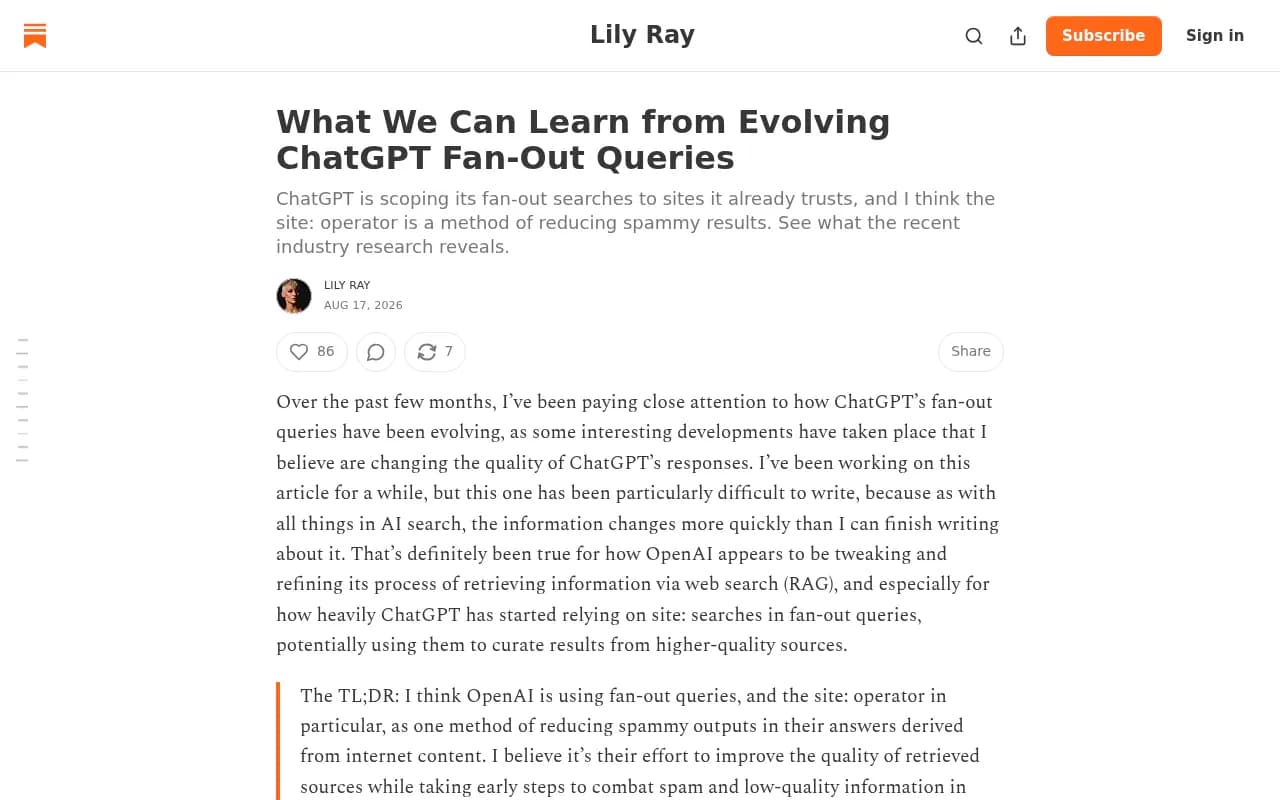
Two terms get mixed up constantly in this space, and Lily Ray's analysis of evolving ChatGPT fan-outs draws the line clearly:
- Retrieved means a page ChatGPT fetched while running fan-outs.
- Cited means a page that made it into the visible answer as a link.
They are moving in opposite directions. Retrieval is growing while unique domains cited per response are falling. If two studies disagree, check first whether one measured retrieval and the other citations.
What the other studies found
Promptwatch's data isn't the only source. The picture looks similar across several independent datasets, though the exact numbers differ a lot.
| Source | What they measured | Key finding |
|---|---|---|
| Promptwatch Data (Aug 2026) | Fan-outs collected from ChatGPT's real interface | site: share 0.37% to 16.8% on Aug 8; fan-outs per response 1.08 to 1.83 |
| Peec AI (David Konitzny), day GPT 5.6 became default | Fan-outs via consumer UI | site: from about 0.3% to about 23% of fan-outs; single-query prompts fell from 94.0% to 43.5%; retrieved sources roughly doubled from about 12 to 24 |
| Nectiv (Chris Long), about 4,000 prompts on 5.6 Sol | Fan-outs pulled from OpenAI's API | Queries per prompt 2.17 to 7.61; site: in 64% of queries; "official" and "gov" among top unigrams |
| Writesonic study (via Chris Long, March 2026) | 119 conversations on GPT 5.4 | 37% of searches used site:; 56% of results contained a brand site vs 8% on 5.3 |
| Resoneo (Olivier de Segonzac) | Retrieval architecture reverse-engineering | Unique domains cited per response dropped from 19 to 15 after 5.3 |
The gap between 16.8%, 23%, and 64% looks alarming until you check the collection method. Nectiv pulls from the API, which is clean and repeatable. Promptwatch and Peec capture what the consumer interface does, which is closer to what real users get, though no tool captures personalization. I'd read all three as the same direction at different magnitudes, and I wouldn't average them.
The same caution applies to absolute fan-out counts. Promptwatch's ChatGPT query fanouts report shows averages well below Nectiv's 7.61, with early-2026 figures between roughly 1.0 and 2.15 per response. Different methods, different numbers. Don't mix them in one chart.
Why would ChatGPT do this?
Nobody outside OpenAI knows. Here are the two most credible readings.
Theory one: site: as a spam filter
Lily Ray's argument is that the operator works, at least partly, as a quality filter. Judging whether a random open-web page is trustworthy, in real time, hundreds of millions of times a day, is expensive. Restricting searches to .gov domains, established review platforms, big brands, and official sources is a cheap way to get most of the same result.
Some supporting evidence:
- "Official" and "gov" show up among top unigrams in Nectiv's data, and Conductor's research also shows more site: and "official" searches.
- Retrieval share is shifting toward product pages (16.39% of retrieved pages in Peec's data) and away from listicles, how-tos, and comparison pages, the formats most heavily gamed for GEO.
- Writesonic's GPT 5.4 sample found brand sites in 56% of results versus 8% before. Chris Long's read: this may be a way to bypass self-promotional listicles and affiliate sites.
I find this persuasive but unproven. It fits the data. It also fits other explanations, like simply wanting fresher, more precise answers, or cutting retrieval cost.
Theory two: precision and verification
The 85SIXTY write-up on fan-out frames it as due diligence. The model checks consensus, price, recency, and risks from several angles, and sources that fail the cross-check get quietly dropped. Scoping a query to a domain is a natural extension: go straight to the place most likely to hold the fact.
The two ideas aren't exclusive. Either way, the practical result is the same. ChatGPT is visiting specific, trusted places more often.
The numbers that matter most for brands
The Resoneo sample is small (57 conversations, 3,554 retrieved pages), so treat it as directional. But the pattern is striking:
- 21 of 27 initial fan-out queries contained brand names the user never typed.
- Brands named in the fan-out were cited 68.9% of the time.
- Pages that were only fetched were cited 2.1% of the time.
- Only about 3.1% of retrieved pages ended up in an answer.
Being retrieved isn't the goal. Being named in the fan-out is. Once ChatGPT writes your brand or domain into a query, your odds change dramatically. Suganthan's routing observation adds another layer: facts route to official pages, opinions route to reviews and Reddit.
One more thing worth knowing: Promptwatch's Reddit citation data shows reddit.com's share of ChatGPT citations fell from about 4% to 0.5% on August 14, 2026, so the opinion-routing half of that story is moving too. Don't build a strategy on a single week of behavior.
What this means for your content strategy
Treat your domain as a retrieval surface
When ChatGPT runs "site:yourdomain.com [topic]", it is using a search engine to search your site. A site:-scoped query can only return what search engines have indexed from your domain. So:
- Check that your key pages are indexed. Search the operator yourself for your core topics and see what comes back.
- Fix thin category pages and weak hub pages. They are what a domain-scoped search will find first.
- Make sure internal search and navigation don't leave good content orphaned.
- Confirm AI crawlers and search engines can read your pages. Tools like Promptwatch's AI crawler logs show whether bots actually hit a page and where they fail, which helps separate an access problem from a content problem.
Promptwatch's own recommendation is blunt: gaps in coverage translate directly into gaps in AI answers.
Cover more angles per topic
At about 1.8 fan-outs per response instead of 1.1 (on Promptwatch's collection method), each answer draws on more distinct retrievals. Comparisons, pricing, alternatives, and domain-scoped lookups are separate chances to be found.
Peec's analysis of 5 million fan-outs adds a mechanism. It reports that ChatGPT combines sub-query results with Reciprocal Rank Fusion, so content that appears across several fan-outs scores higher than content that shows up once. That's third-party analysis (credited to Metehan Yesilyurt), not something OpenAI has confirmed. But it matches the advice from the data: build a cluster of focused pages, not one mega-page.
A practical cluster for any core topic:
- A main guide
- A comparison or alternatives page
- A pricing or cost page
- A use-case page per audience
- An FAQ or how-to for the common objections
Write headings like short keyword queries and front-load the entity and category. That's also the Promptwatch guidance from its fan-out report.
Make it obvious which site is the official one
Because "official" keeps appearing in fan-outs, Lily Ray suggests revisiting whether "Official Site" belongs in your homepage title or meta description. This is most useful if your brand shares a name with other entities. It's a cheap test, though I'd treat it as an experiment, not a rule.
Re-check old keyword mappings
Fan-outs changed materially on August 8. Any mapping of prompts to sub-queries built before that date is stale. Re-run the analysis for your tracked prompts. You can also pull fan-outs yourself, using the Resoneo plugin or the free GEO Inspector Chrome extension, or the ChatGPT query fan-out generator for rough planning.
Rethink the listicle bet
If the spam-filter theory is right, self-promotional "best X" roundups are the thing being squeezed. Promptwatch's content type data shows product pages as the most cited type in ChatGPT at 22.4% (Sep 28 to Oct 4, 2026), followed by landing pages and listicles. Make your own product and landing pages strong enough to answer spec, pricing, and comparison questions directly, rather than relying on third-party roundups to carry your story.
What not to do
- Don't rewrite your whole strategy off one platform change. Promptwatch's point holds: this was a ChatGPT rollout, and behavior can flip again overnight.
- Don't compare absolute numbers across studies. API versus interface collection explains much of the spread.
- Don't assume more retrieval means more citations. Citation counts have fallen even as retrieval grew. Promptwatch also found that almost half of ChatGPT responses cite 10 or more domains (Sep 28 to Oct 4, 2026), so the ceiling is still wide, but each slot is more contested.
- Don't chase fan-outs that have no search volume. 85SIXTY reports that about 95% of fan-out phrases show zero monthly volume in keyword tools. That's why classic keyword research misses them.
Tools for monitoring fan-outs
You need two things: what ChatGPT searches, and whether it lands on you. A few options in the category:
Promptwatch tracks real-interface prompts with query fan-outs per response, then ties them to citations, crawler logs, and AI-referred traffic. It also has a Content Agent for filling gaps it finds, and the Action Board for prioritizing them.

Peec AI exposes fan-outs through its platform and an MCP, which its team uses to compare themes across prompts.

Profound is another monitoring platform, and its data is used in some of the studies above.

For a quick, free read, Writesonic has published fan-out research of its own and sells an AI visibility platform.
| Tool | Fan-out visibility | Beyond monitoring |
|---|---|---|
| Promptwatch | Per-response fan-outs, compared per model | Crawler logs, content creation, CMS publishing, traffic attribution |
| Peec AI | Fan-outs plus MCP access | Mostly monitoring |
| Profound | Prompt and citation tracking | Monitoring-focused |
| Writesonic | Research plus visibility tracking | Content creation |
| Free (plugins, extension) | One query at a time | Manual work only |
For wider coverage, the GEO software directory lists more tools in this category.
A short action plan
- This week: run site:yourdomain.com for your five most important topics. Note what's missing or thin.
- This month: pull fan-outs for your tracked prompts and map them against your pages. Fill the gaps with focused pages.
- Ongoing: monitor fan-outs and citations on a schedule. Platform behavior changed in a day, and it can again.
- Test "official" cues on your homepage, and measure whether brand citations move.
Frequently asked questions
Did ChatGPT really change overnight?
Promptwatch's daily data shows the site: share going from 0.37% to 16.8% on August 8, 2026. Peec and Nectiv saw similar shifts around the GPT 5.6 default and 5.4 releases, respectively.
Is site: a spam filter?
That's Lily Ray's hypothesis, supported by the rise of "official" and "gov" in fan-outs and the shift toward brand and product pages. OpenAI hasn't confirmed it.
Will I get more citations if I'm indexed?
Indexing is necessary, not sufficient. A site:-scoped query can only surface what search engines have indexed. Whether the retrieved page gets cited depends on content, and on being named in the fan-out.
Why do studies show such different site: percentages?
Different collection methods. API pulls (Nectiv) and consumer-interface collection (Peec, Promptwatch) measure different things, and so do different models and tiers.
The bottom line
ChatGPT now searches more, and it increasingly searches inside specific domains. For content teams, that makes your own site's indexability, structure, and topic coverage count in a new way. Start with the site: check on your top topics, then build out the missing angles.