Key takeaways
- Query fan-out is the process where AI systems split a single prompt into multiple (often 8-10, sometimes dozens) sub-queries, run them in parallel, and stitch the retrieved results into one answer
- Most of these sub-queries have zero search volume in traditional keyword tools, which is exactly why brands get blindsided in AI answers despite ranking fine in Google
- "Fan-out tracking" comes in two very different flavors: simulated (an LLM guesses what the sub-queries probably look like) and real (pulled from the actual API or crawl logs of the AI system)
- Most AI visibility platforms only do the simulated version, or skip fan-out analysis entirely and just report whether your brand got mentioned
- Real fan-out data matters because it tells you which specific angles of a topic you're missing, not just that you're missing something
The hidden layer of every AI answer
Ask ChatGPT "what are the best running shoes for a first marathon" and you get one clean answer back. What you don't see is the machinery behind it: the model silently rewriting your question into something like "best marathon shoes for beginners," "cushioned vs minimalist shoes for long distance," "marathon shoe reviews 2026," and "common shoe mistakes for first-time marathoners," then running all of those as separate retrieval queries before synthesizing one response.
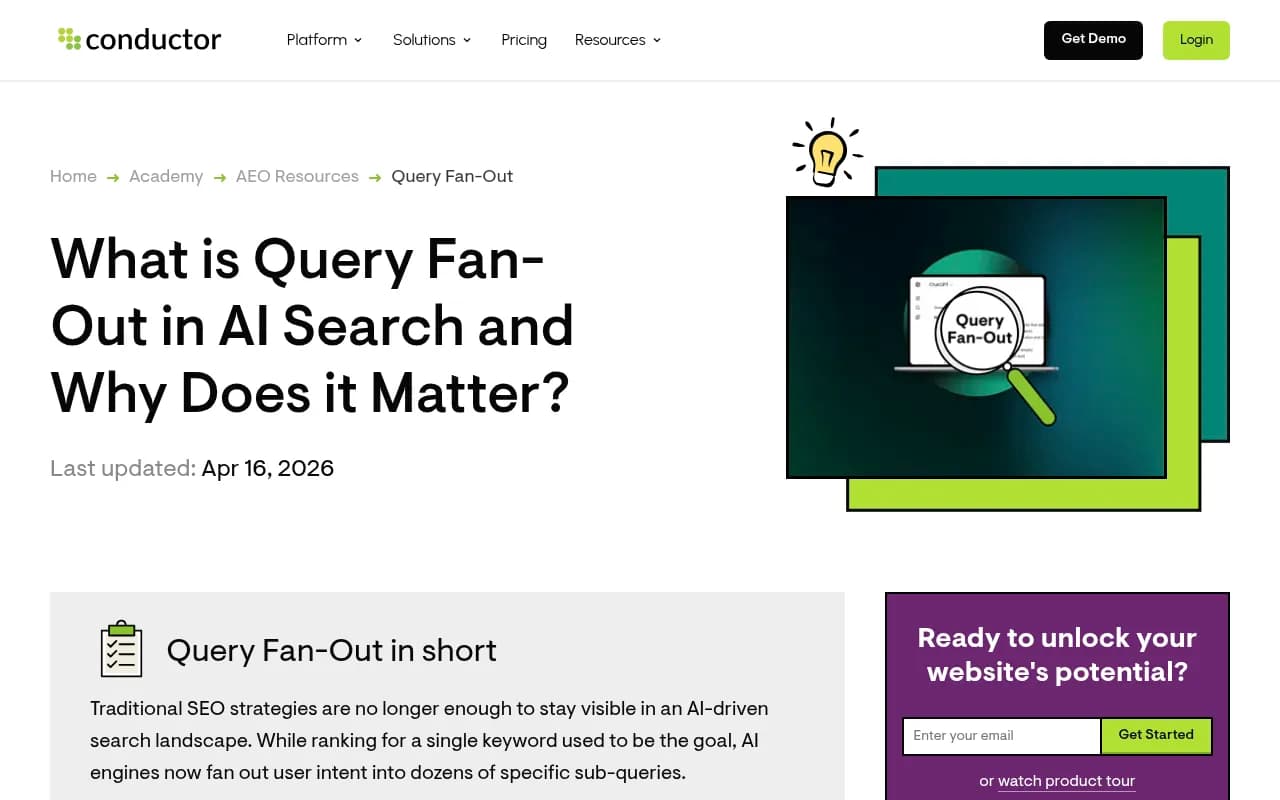
That's query fan-out. Conductor's academy piece on the topic describes it as a retrieval technique where the model "expands, or fans out, the intent, generating a series of related questions to gather a complete set of information on the core topic." It's not a quirky side effect. It's the core mechanism by which Google AI Mode, ChatGPT Search, and Perplexity decide what to cite.
The numbers here are bigger than most people assume. A 2026 analysis from 85SIXTY covering 72,000+ AI-generated queries and 8,700+ prompts found that a single question routinely triggers 8-10 parallel sub-queries before an answer comes back. And here's the part that should worry anyone doing keyword-first content planning: 95% of those fan-out phrases show zero monthly search volume in standard keyword tools. They're invisible to Ahrefs or Semrush's keyword explorer, but they're the actual gatekeepers deciding who gets cited.
Why this breaks traditional keyword research
Traditional SEO optimizes for a single query. You pick a keyword, you write a page that answers it well, you rank. Query fan-out throws that model out because the AI isn't evaluating your page against one query, it's evaluating your entire topical footprint against a whole cluster of sub-intents that never show up in a rank tracker.
SEOcrawl AI frames the practical risk well: a page can rank #1 for its target keyword and still never get cited in an AI answer, because it only satisfies one of the eight or ten angles the model checked. They call this "LLM invisibility," ranking fine in traditional search while being completely absent from AI-generated answers. The more aggressively a platform fans out a query, the wider the net of sub-intents your content needs to cover.
Fan-out behavior also isn't uniform across platforms. SEOcrawl's breakdown is useful here:
| Platform | Fan-out scope | What it actually does |
|---|---|---|
| Google AI Mode | Most aggressive, reportedly dozens to hundreds of sub-queries | Decomposes deeply into related, implicit, and comparative angles before synthesizing with links |
| ChatGPT Search | Moderate | Reformulates and expands the prompt, runs web retrieval, cites a focused set of sources |
| Perplexity | Focused | Breaks into a smaller set of targeted sub-queries optimized for fast, citation-heavy answers |
Google's own data backs up how much this has scaled. Promptwatch's tracking of the site: operator shows ChatGPT Search itself started using site-scoped fanout queries at scale on August 8, 2026, jumping from roughly 0.4% to about 17% of all fanout queries overnight, with the number of searches per response nearly doubling. That's a platform-level behavior shift happening in a single day, the kind of thing you'd only catch if you were actually watching fanout queries change over time, not just checking whether your brand got mentioned once a week. See Promptwatch's data on the ChatGPT site-operator shift for the daily breakdown.
Why AI systems bother fanning out at all
This isn't decoration, it's risk management on the model's part. 85SIXTY's research identifies a few recurring patterns baked into fan-out behavior: models pin timestamps ("2024 2025" shows up in about 6% of all fan-outs), anchor pricing ("free," "pricing," "cost" cluster in top five-grams), and hunt for consensus and risk signals ("pros and cons," "complaints," "limitations"). If a claim can't be confirmed from multiple angles, the model treats it as unverified and quietly leaves it out of the final answer.
That also explains why freshness matters so much more than people expect. Multi-year qualifiers show up in roughly one in sixteen fan-outs, even for evergreen topics. Content that hasn't been touched in a while isn't necessarily excluded, but it gets treated as lower-confidence, and lower-confidence sources lose the cross-examination.
Two very different things people call "fan-out tracking"
Here's where most AI visibility tools quietly cut corners, and it's worth being precise about the distinction because vendors blur it constantly.
Simulated fan-out means a tool asks an LLM to predict what sub-queries a search engine would probably generate for a given prompt. This is useful for content planning brainstorms, but it's a guess. The model doesn't have access to Google's actual query expansion logic, so it's pattern-matching based on training data, not reporting what actually happened.
Real fan-out means pulling the actual sub-queries a platform generated, either from an exposed API (Google's AI Mode API surfaces some of this, which is what tools like queryfanout.ai extract directly) or from analyzing crawler and retrieval logs tied to a specific response. This tells you exactly what the system searched for, not what an LLM thinks it probably searched for.
The gap between these two matters a lot in practice. A simulated fan-out tool might guess five plausible sub-queries and miss the three that actually drove the citation decision. A real fan-out extraction shows you the literal search strings, including oddly specific ones a human wouldn't have predicted (comparison qualifiers, date stamps, niche modifiers).
Why most AI visibility tools skip real fan-out entirely
Most of the AI visibility category, and there are dozens of tools now, was built to answer one question: "did my brand get mentioned in this AI response?" That's a monitoring problem, and it's solvable with prompt libraries and scheduled queries against ChatGPT, Gemini, Perplexity, and friends.
Real fan-out tracking is a different, harder problem. It requires either:
- Access to crawler and retrieval logs showing what the AI system actually searched for before generating a response, which means instrumenting your own site's server logs and matching crawl patterns to citation outcomes, or
- Direct API access to a platform's internal query expansion step, which most vendors (Google, OpenAI, Anthropic) don't expose publicly in a stable, documented way
Most prompt trackers do neither. They run a prompt, capture the answer, check if you're cited, and report a percentage. That's genuinely useful for measuring share of voice, but it tells you nothing about why you weren't cited, which specific sub-query your content failed to satisfy, or which competitor filled that gap.
This is the same gap that shows up across crawler analytics generally. Tools like ZipTie and Otterly.AI focus on prompt-level monitoring, which is valuable, but doesn't connect crawl behavior to specific fan-out queries. Profound and Scrunch go deeper on citation analytics but still stop short of surfacing the literal sub-query strings tied to a given response.


What real fan-out tracking actually requires
If you want to move past guessing and actually see the query layer AI systems are checking against your content, you need three things working together, not one dashboard metric.
First, crawler log access. You need to see when AI crawlers (ChatGPTBot, ClaudeBot, PerplexityBot, GoogleOther, Google-Agent, Meta-WebIndexer) hit your pages, what they read, and whether the visit turned into a citation. Meta's crawler is a good example of why this matters in real time: Promptwatch's crawler data shows Meta-WebIndexer's share of all tracked AI crawler requests went from about 2% to nearly 38% between mid-July and August 9, 2026, a massive shift that would be invisible without log-level monitoring. See Promptwatch's Meta crawler data for the daily trend.
Second, prompt-level volume and difficulty scoring, so you know which sub-queries are worth chasing and which are noise. A tool that just lists possible fan-out phrases without any signal on how often they actually surface in real responses isn't giving you much to prioritize against.
Third, a way to connect citation outcomes back to specific content gaps, ideally with enough granularity to say "you're missing the pricing-comparison angle of this topic" rather than a generic "improve your content" note.
This is the layer where Promptwatch does more than most competitors in the category. Its Prompt Intelligence module surfaces query fan-outs alongside monthly search volumes, difficulty scores, and citation rates per prompt, so you're not just seeing a list of guessed sub-queries, you're seeing which ones actually drive citations and how hard they are to win. Combined with AI crawler logs (Agent Analytics) that show the crawl-to-citation path per page, and Content Gap Analysis that maps your existing content against those fan-out angles with coverage scores, it closes the loop between "here's a sub-query you're missing" and "here's a content brief to fix it," something most fan-out simulators can't do because they have no visibility into your actual crawl and citation data.

Comparing the fan-out tracking landscape
| Approach | What it shows | Limitation |
|---|---|---|
| Simulated fan-out generators (LLM-based) | Plausible sub-queries an LLM predicts for a prompt | Guesswork, not grounded in what a platform actually searched |
| Direct API extraction (e.g. queryfanout.ai style tools) | Real sub-query strings from an exposed API | Limited to platforms with accessible APIs, no link to your own content gaps |
| Prompt trackers (most AI visibility tools) | Whether your brand was mentioned/cited in a response | No visibility into the sub-query layer at all |
| Crawler log analysis | Which pages AI crawlers read, crawl-to-citation path | Needs log access and correlation work, most tools skip this entirely |
| Full-stack platforms (Promptwatch) | Fan-out queries with volume/difficulty, crawler logs, citation data, and content gap scoring together | Requires broader platform adoption, not a single free tool |
A practical way to start, even without a full platform
You don't need enterprise tooling to get a first read on fan-out exposure. Pick a core topic for your business, run it through a handful of fan-out simulators (Otterly's simulator and DEJAN's queryfanout.ai both give different angles, one modeled, one API-extracted), and compare the sub-queries against your existing content. Where you have nothing addressing a sub-query, that's your gap list.
Then check whether your content calendar has a freshness problem. If your last update on a topic page is more than six months old and the fan-out includes date-anchored phrases like "2026" or "latest," that page is probably losing the cross-examination step models run before citing.
For ongoing tracking rather than a one-time audit, you'll eventually want something that connects crawl data to citation outcomes automatically, since manually re-running simulators every month doesn't scale past a handful of pages. That's the point where a dedicated AI visibility platform earns its cost, and it's worth browsing the broader options in the GEO software directory at bestgeosoftware.com if you want to compare more than one before committing.
The bottom line
Query fan-out isn't a niche technical detail, it's the actual decision layer AI systems use before citing anyone. The tools that only tell you "you got mentioned" or "you didn't" are reporting an outcome without explaining the mechanism behind it. Real fan-out tracking, grounded in actual crawl logs and citation data rather than LLM guesses, is what lets you fix the specific gap instead of guessing at a general content refresh and hoping it works.