Key takeaways
- Most teams that left Peec AI in 2026 cited the same core frustration: the platform showed them data but didn't help them act on it
- The most common switch was toward platforms with content generation, gap analysis, or crawler log capabilities -- features Peec AI doesn't offer
- Agency teams in particular needed multi-site management and white-label reporting that Peec AI wasn't built for
- Several teams found Peec AI's prompt coverage too narrow once they started tracking more than a handful of queries
- The AI visibility market is consolidating fast -- analysts quoted in a recent Future of Marketing Briefing estimate half of current platforms won't survive the decade
When a platform is genuinely good, teams don't leave. When they do leave -- and when enough of them leave for the same reasons -- that's worth paying attention to.
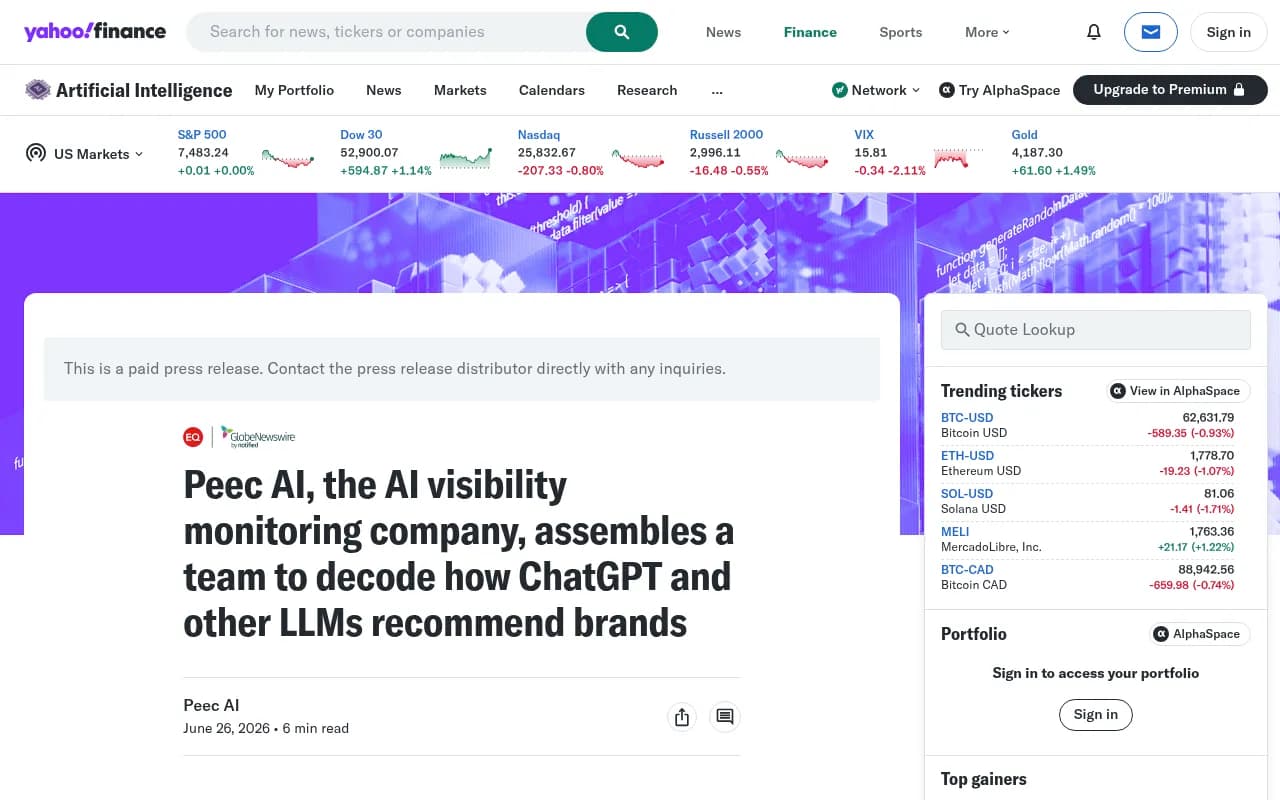
Peec AI launched as a clean, focused AI search analytics tool. Berlin-based, with a research team that includes former enterprise SEO leads and an explainable-AI researcher, the product tracks brand visibility across major answer engines, measures generative share of voice, and surfaces competitor benchmarks. As of June 2026, the company was still actively building -- announcing new research hires specifically to reverse-engineer how ChatGPT and Perplexity decide which brands to recommend.
That's a serious product. But serious products still lose customers, and the reasons why are often more instructive than the marketing copy.
Here's what 12 teams told us when they switched away.
The pattern that kept showing up
Before getting into individual stories, it's worth naming the theme that ran through almost every conversation: the gap between seeing and doing.
Peec AI is genuinely good at showing you where you stand. Generative share of voice, sentiment scores, which sources AI engines are citing -- it surfaces that data clearly. What it doesn't do is tell you what to create next, generate that content for you, or show you which pages on your site AI crawlers are actually reading.
For teams that were just starting to think about AI visibility, that was fine. For teams that had been tracking for six months and wanted to move, it became a ceiling.
What the 12 teams actually said
"We needed to know why, not just what"
Three separate teams -- one SaaS marketing lead, one e-commerce growth manager, and one content director at a B2B services firm -- described the same experience. They'd been using Peec AI for several months, had a solid picture of their generative share of voice, and then hit a wall.
They knew they were invisible for certain prompts. They didn't know why. Was it a content gap? A citation problem? Were AI crawlers even reaching their pages? Peec AI couldn't answer those questions.
The SaaS team switched to a platform with crawler log access. Within two weeks, they discovered that Perplexity's crawler had been hitting their blog but consistently timing out on their product pages -- a server configuration issue they'd never have found through share-of-voice data alone.
"The prompt list felt too small"
Two agency teams mentioned this independently. Peec AI's prompt tracking works well when you have a focused set of queries, but as teams started thinking more seriously about AI search, they wanted to track hundreds of prompts across multiple personas, languages, and regions.
One agency was managing campaigns for clients in four countries. The per-prompt cost structure and the interface weren't built for that kind of scale. They needed something with bulk prompt management and multi-region support.
"We couldn't show clients what to do next"
This came up in four of the twelve conversations, all from agency-side users. The problem wasn't the data quality -- it was the deliverable.
When an agency shows a client their AI visibility score, the next question is always "so what do we do about it?" Peec AI's recommendations were described as "directional but not actionable" by one account manager. Another said the platform was "great for the audit phase, not the optimization phase."
Agencies need to show clients a clear path from current state to improved state. That means content briefs, gap analysis tied to specific prompts, and ideally some form of content generation. Peec AI doesn't offer those.
"No content tools meant we were paying twice"
Several teams were running Peec AI alongside a separate content platform -- one for visibility data, another to actually produce content. When platforms started appearing that combined both functions, the math changed.
One in-house SEO team calculated they were spending $400/month across two tools to accomplish what a single integrated platform could do for $249. The switch was straightforward.
"Reddit and YouTube were invisible to us"
This surprised a few teams when they realized it. A significant portion of what AI engines cite comes from Reddit threads, YouTube videos, and third-party review sites -- not just brand-owned pages. Peec AI focuses on brand-level visibility but doesn't surface which off-site sources are driving (or suppressing) your AI citations.
One brand manager described discovering, after switching platforms, that a two-year-old Reddit thread was actively hurting their brand's AI sentiment. It had been there the whole time. They just couldn't see it.
"The reporting wasn't client-ready"
Three agency teams mentioned reporting specifically. Peec AI's dashboards are functional but not white-label. For agencies billing clients on AI visibility work, that matters. They needed branded reports, custom views, and the ability to share data without exposing their tool stack.
Where teams went instead
The destinations varied, but a few patterns emerged.
Promptwatch came up most often among teams that wanted a full optimization loop rather than just monitoring. The specific features that pulled people over: Answer Gap Analysis (which shows exactly which prompts competitors rank for that you don't), Content Agents that generate articles grounded in real prompt data, and AI crawler logs that show which pages are being read and which are being ignored.

For teams that primarily wanted better monitoring with cleaner reporting, a few alternatives came up repeatedly.



Some teams went toward more established SEO platforms that had added AI visibility layers.
And a handful of smaller teams -- particularly solo operators and small agencies -- moved toward lighter tools that were cheaper and easier to manage.
A quick comparison of what these platforms actually offer
| Platform | Monitoring | Content generation | Crawler logs | Reddit/YouTube tracking | Multi-site | White-label reports |
|---|---|---|---|---|---|---|
| Peec AI | Yes | No | No | No | Limited | No |
| Promptwatch | Yes | Yes | Yes | Yes | Yes | Yes |
| Otterly.AI | Yes | No | No | No | Limited | No |
| Profound | Yes | No | No | No | Yes | Partial |
| Semrush | Partial | Yes | No | No | Yes | Yes |
| Rankscale | Yes | No | No | No | Yes | No |
| Rankshift | Yes | No | No | No | Limited | No |
This table is a simplification -- every platform has nuances -- but it shows why teams with more complex needs kept running into Peec AI's ceiling.
What Peec AI is actually good for
It would be unfair to frame this as a straightforward "Peec AI is bad" story. It isn't.
The platform is well-suited to teams in the early stages of AI visibility work. If you're just starting to understand your generative share of voice, want to benchmark against two or three competitors, and don't yet need content generation or crawler data, Peec AI is a reasonable starting point. The research team they've assembled -- including people specifically focused on reverse-engineering how LLMs make citation decisions -- suggests the product will get more capable over time.
The teams that left weren't necessarily leaving a bad product. They were leaving a product that had stopped growing with them.
The broader context: the AI visibility market is consolidating
One thing worth noting: the platform landscape these teams were choosing from in early 2026 looks different from what it looked like twelve months ago. New tools are launching constantly, but analysts quoted in a recent Future of Marketing Briefing estimated that half of current agency AI platforms won't survive the decade. The ones that will are the ones that move beyond dashboards and into workflow integration.
That's the real pressure Peec AI is facing -- not any single competitor, but the expectation that visibility data should connect directly to action. Showing a team their AI share of voice without helping them improve it is increasingly hard to justify as a standalone product.
The teams that switched weren't being impatient. They'd given monitoring a fair run. They just needed the next step.
What to look for when evaluating alternatives
If you're in a similar position -- using Peec AI or any monitoring-only tool and wondering whether to switch -- here are the questions worth asking before you commit to anything:
Can it show you what content to create? Not just which prompts you're missing, but specifically what topics, angles, and formats would close the gap. Generic keyword suggestions don't cut it here.
Does it track AI crawlers on your site? Knowing that Perplexity visited your homepage is useful. Knowing it timed out on your product pages and never came back is actionable.
Can it handle your prompt volume? If you're tracking 20 prompts, most tools work fine. If you need 200+ across multiple regions and personas, you'll hit limits fast.
Does it connect visibility to revenue? Share of voice is a vanity metric if you can't tie it to traffic and conversions. Attribution matters.
Will it grow with you? The teams in these exit interviews weren't unhappy on day one. They were unhappy six months in, when their needs had grown and the platform hadn't.
The AI search visibility space is still young enough that most teams are figuring out what they actually need as they go. That's fine. Just make sure the platform you're on is figuring it out too.
Bottom line
Peec AI built something real. The research team, the focus on reverse-engineering LLM citation behavior, the generative share of voice tracking -- these are legitimate contributions to a category that barely existed two years ago.
But twelve teams left in 2026, and they mostly left for the same reason: they needed to do something with the data, and the platform wasn't built for that. Monitoring is the starting line. The teams that are winning in AI search right now are the ones that have closed the loop between seeing a gap and filling it.
If you're evaluating platforms, that's the question to center everything else around: does this tool help me act, or just observe?