Key takeaways
- No single tool gives you the full picture. GEO trackers, native platform reports (Search Console, Bing AI Performance), and web analytics (GA4) each measure a different layer of the funnel: visibility, citation, and traffic.
- Citation behavior changes overnight. ChatGPT's average citations per response dropped about 27% around the GPT-5.3 rollout in March 2026, and Reddit's ChatGPT citation share collapsed from roughly 3.8% to 0.5% in a single day in August. One-off audits miss this entirely.
- Sampling matters more than most people think. Running a prompt once instead of 100 times can swing a visibility score by plus or minus 30 points or more at the topic level, according to Evertune's own testing.
- GA4's new AI Assistant channel is useful but incomplete. Perplexity traffic still lands in "Referral," and an estimated 60-70% of real AI referral sessions arrive with no referrer at all.
- Building the stack correctly means combining a specialist GEO tracker, native platform reporting, and cleaned-up analytics, then treating each as a distinct signal rather than a substitute for the others.
Why one tool is never enough
Here's a thing that trips up a lot of marketing teams right now: they buy one AI visibility tool, look at a dashboard that says "62% visibility score," and treat that number as the whole story. It isn't. It's one measurement, from one method, at one moment in time, and that number can move by dozens of points depending on how many times the tool actually asked the question.
I've been watching this category get built out in real time, and the pattern is consistent. Vendors that started as "prompt trackers" answer one question: did an AI engine mention my brand? That's useful, but it's the shallow end. It doesn't tell you why you got mentioned (or didn't), whether the mention drove any actual traffic, or what to fix next. You need a stack, not a subscription.
That stack has three layers, and each one tells you something the others can't.
Layer 1: visibility and citation tracking (the GEO trackers)
This is the layer most people think of first: tools that fire prompts at ChatGPT, Perplexity, Gemini, Claude, and Google's AI surfaces on a schedule, then log whether your brand got mentioned and which sources got cited. Profound, Otterly.AI, Peec AI, Scrunch, and dozens of others live here.


The mechanics look simple from the outside, but the data underneath is genuinely volatile. Promptwatch's own analysis of citation-count trends found that around the GPT-5.3 rollout on March 4, 2026, average citations per ChatGPT response dropped from roughly 6.4 to 4.7-4.9 overnight, across every model variant, with no recovery a month later (https://promptwatch.com/data/chatgpt-citation-drop). That's not something you catch with a quarterly audit. You need continuous monitoring because the platforms themselves keep changing the rules without telling anyone.
Same story with Reddit. Reddit's share of ChatGPT Search citations sat steady around 3.8% from mid-July through early August 2026, then collapsed to about 0.5% on August 14, an 86% relative drop, in less than a day (https://promptwatch.com/data/reddit-citations-are-dropping-in-chatgpt). Google's AI Overviews and AI Mode declined too, but gradually, over weeks. If you were only checking one engine, you'd have drawn the wrong conclusion about what's happening to Reddit citations across the board.
Layer 2: native platform reporting
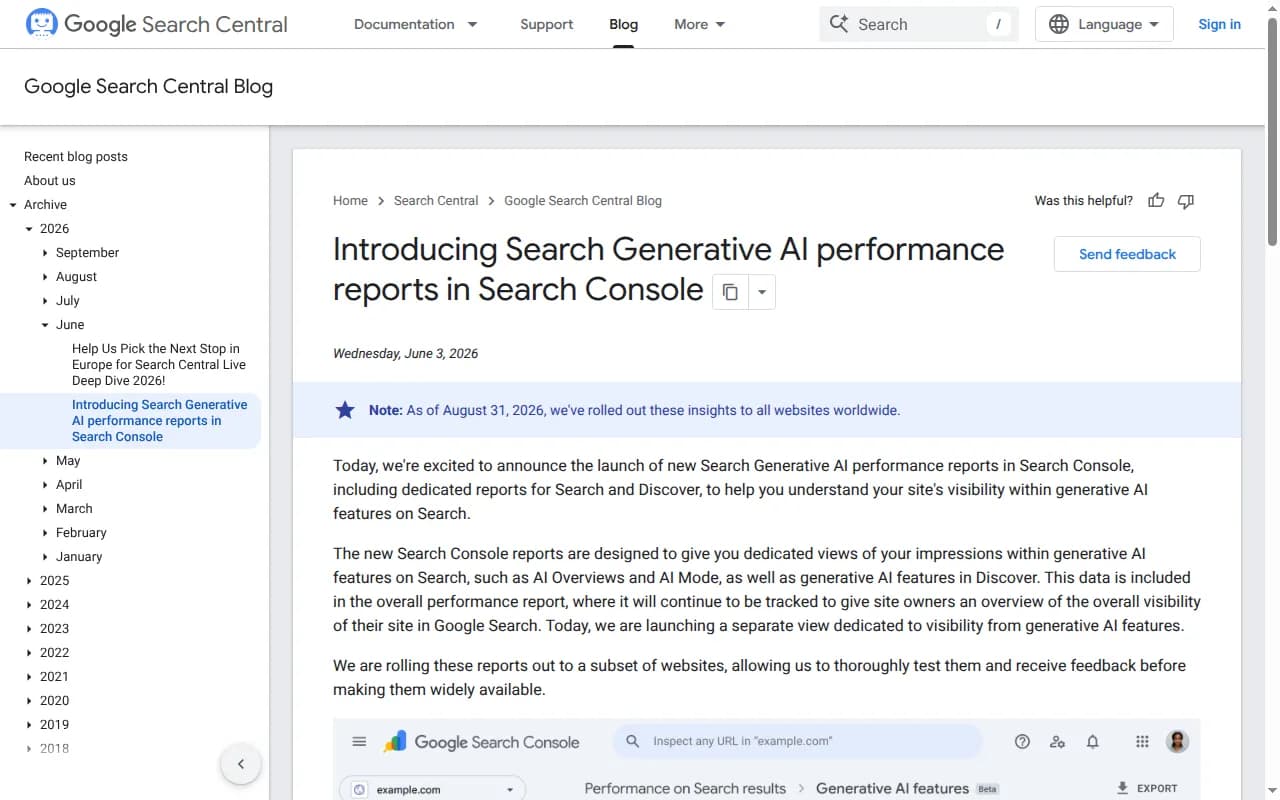
This is the layer people forget exists, mostly because it's new. Google Search Console rolled out dedicated Generative AI performance reports in June 2026, giving Impressions, Pages, Countries, and Device breakdowns specifically for AI Overviews, AI Mode, and generative Discover features.
Microsoft followed with Bing Webmaster Tools' "AI Performance" report in public preview from February 2026, which surfaces citations, cited pages, and grouped "grounding query" themes for Bing's AI surfaces.
The advantage here is that this data comes straight from the source, no sampling, no prompt guessing. The disadvantage is that it's siloed. Search Console only tells you about Google's surfaces, Bing's tool only tells you about Microsoft's. Neither covers ChatGPT, Perplexity, or Claude, which is where most of the consumer-facing AI search volume actually lives right now.
Layer 3: analytics and attribution
This is where you find out if any of it mattered. GA4 added a native "AI Assistant" default channel on May 13, 2026, automatically classifying sessions from recognized AI referrers under the medium ai-assistant. The current documented list covers ChatGPT, Gemini, DeepSeek, Copilot, and Grok.
But there are real gaps, and they're worth knowing before you trust the number. Perplexity isn't included in the AI Assistant channel at all, it still lands in "Referral." Google's own AI Overviews and AI Mode clicks get classified as plain "Organic Search," not AI. And an estimated 60-70% of genuine AI referral sessions show up with no referrer whatsoever, landing in "Direct," mostly because of how ChatGPT's mobile apps and the Atlas browser strip referrer headers (Perplexity, for what it's worth, passes referrers reliably, it's just miscategorized). Since GA4's default channel groups can't be edited, fixing the Perplexity gap requires building a custom channel group by hand.
If you want to see how much of your real AI-referred traffic GA4 is actually catching, it's worth cross-checking against a specialist tool's visitor analytics, tools like Promptwatch pair citation data with AI traffic attribution so you're not relying on GA4's defaults alone.

A practical four-layer framework
Putting this together, a workable measurement stack for 2026 looks something like this:
- Google Search Console for AI Overviews and AI Mode impressions on your own pages
- Bing Webmaster Tools' AI Performance report for Microsoft's AI surfaces
- GA4 (with a custom channel group patched in for Perplexity) for AI-referred sessions and conversions
- A specialist GEO tracker for repeated, prompt-level mentions, citations, and share of voice across ChatGPT, Claude, Gemini, and Perplexity
Each layer answers a different question. Search Console tells you if Google is showing your pages inside its AI answers. GA4 tells you if any humans actually clicked through and did something. A GEO tracker tells you whether your brand gets named at all, even in responses that never link out to your site, which is most of them. Treat these as four separate signals. Don't let one substitute for another, because they measure genuinely different things.
Comparing the specialist GEO trackers
The GEO tracker layer is where most of the vendor noise lives, so it's worth being specific about what you're actually paying for.
| Tool | Entry price | Engines covered (base) | Notable feature | Best for |
|---|---|---|---|---|
| Otterly.AI | $29/mo (Lite) | 4 (ChatGPT, AI Overviews, Perplexity, Copilot) | GEO URL audits flag missing schema/crawl blockers | Budget-conscious teams starting out |
| Profound | $99/mo (Starter, ChatGPT only) | 1 at Starter, 3 at Growth ($399/mo) | Agent Analytics on crawler behavior | Teams that need deep, engine-specific analytics |
| Semrush AI Visibility Toolkit | $99/mo standalone | Multiple, bundled with Semrush One | Folds into existing SEO workflow | Teams already inside Semrush |
| Ahrefs Brand Radar | $199/mo add-on (+ $129/mo base plan) | Multiple | Extends Ahrefs' existing backlink/keyword data | Ahrefs-native teams with budget to spare |
| Promptwatch | $95/mo (Essential) | All major LLMs plus AI Overviews/AI Mode | Crawler logs, content agents, CMS publishing | Teams that want monitoring and content fixes in one platform |

A note on pricing that's easy to miss: several vendors quote a low headline number that doesn't include the features you actually want. Profound's $99/mo Starter tier is ChatGPT-only with 50 prompts and no exports, most reviewers treat the $399/mo Growth tier as the real entry point because that's where multi-engine tracking and the content-opportunities panel actually unlock. Ahrefs Brand Radar's $199/mo add-on sits on top of a required $129/mo base plan, so the effective floor is closer to $328/mo. Read the fine print on prompt limits, engine add-ons, and export caps before comparing sticker prices.
If you want a wider view of the category before picking one, the GEO software directory at bestgeosoftware.com lists more of these platforms side by side, and agenticseotools.com is worth a look if you specifically want tools that act on the data rather than just report it.
The sampling problem nobody talks about
This is the part of GEO measurement that I think gets glossed over the most, and it changes how you should read any visibility percentage a vendor hands you.
Evertune ran a controlled test: 100 unique prompts fired once each versus the same 100 prompts fired 100 times each (10,000 total responses). At the overall brand level, single-run sampling gave Adidas a 29% visibility score with a margin of error of plus or minus 9 points. Repeating each prompt 100 times kept the same 29% figure but shrank the margin of error to plus or minus 1 point. Fine so far.
But at the topic level, it gets ugly. Single-run sampling on the topic "sustainable shoes" produced a range anywhere from 19% to 81% visibility depending on which run you happened to catch. That's not a number, that's noise wearing a number's clothes. Repeated 100x sampling narrowed the same topic to 51-57%, which is actually something you can act on. At the individual-prompt level, single-run margins of error reached as high as plus or minus 98 points. Basically meaningless.
The takeaway: if a tool or a report shows you a visibility score without telling you how many times it sampled each prompt, be skeptical of the precision. This is also, interestingly, not the main thing people distrust about GEO data. A survey of 163 respondents found only about 15% cited non-determinism or sampling variance as their core objection to GEO tooling, most complaints were actually about a lack of clear next steps, not the data itself. Which says something about where the category still needs to improve, on the action side, not just the measurement side.
Two things you should stop doing
Trusting llms.txt as a real lever. It gets recommended constantly, and it barely does anything right now. Otterly.AI ran a 90-day server-log experiment across 62,100+ AI bot visits and found only 84 requests, about 0.1%, hit /llms.txt, three times worse than the site's average content page. A separate 90-day study covering 500 million AI bot visits found only 408 requests targeted /llms.txt directly. No major LLM provider has adopted it at scale, and Google has said outright it doesn't use it. Spend your time elsewhere.
Relying only on user-agent strings to identify AI crawlers. User agents can be spoofed. If you want an accurate read on which AI systems are actually hitting your site, match requests against published crawler IP ranges instead. Promptwatch's crawler traffic data, which is IP-verified rather than user-agent based, found OpenAI accounted for 79.8% of verified AI crawler requests in the week of August 31-September 6, 2026, down from 94.8% just two and a half months earlier in mid-June (https://promptwatch.com/data/ai-crawler-traffic). That's a fast-moving mix. If your own logs show a totally different split, that's usually a sign a crawler is blocked or can't reach you, not that the report is wrong. This is exactly the kind of thing worth checking with a specialist tool's crawler log feature rather than guessing from robots.txt alone.
What to actually cite when someone in your organization asks "is this working"
Don't hand over a single visibility percentage. Hand over three numbers, one from each layer: an impressions trend from Search Console or Bing's AI Performance report, a citation share trend from your GEO tracker sampled at scale (not single-run), and an AI-referred conversion count from GA4 with the Perplexity gap patched. If those three move together, you're actually improving. If only one moves, you've found a blind spot, and that's arguably more useful information than a clean upward chart.
For teams that want to go a step further than tracking and start closing the gap between citation and action, Promptwatch combines the citation and crawler-log layers with content gap analysis and CMS publishing, so the same platform that tells you where you're invisible can also generate and ship the fix. It's not the only way to build this stack, but it's a reasonable starting point if you'd rather not stitch four separate dashboards together by hand.
If your organization is thinking about this at the strategy level, not just the tooling level, that's really a GEO and content operations question rather than a software-shopping one, and it's the kind of thing an agency like 1001 SEO Media works through with clients directly: which prompts matter, which content gaps are worth closing first, and how to read the measurement stack without getting fooled by a single noisy number.