Key takeaways
- Small teams generally want a prompt tracker that's cheap, fast to set up, and covers the three or four AI engines that matter most (ChatGPT, AI Overviews, Perplexity, Copilot) without a steep learning curve.
- Enterprise teams need SOC 2 compliance, SSO/SAML, RBAC, unlimited seats, API access, and ideally a path from "we're invisible" to "here's the content that fixes it" — not just a dashboard.
- Pricing isn't linear. Tools that look cheap at the entry tier (Semrush, Ahrefs Brand Radar) can balloon fast once you add domains, users, or prompts, so model your real usage before committing.
- A tracker that only tells you whether you were mentioned is a different product from one that tells you why you weren't, and fixes it. That distinction matters more as your budget and stakes grow.
- Don't trust a single AI engine's data. ChatGPT, Google AI Overviews, and Perplexity pull from different sources and cite a different number of domains per answer, so tracking just one gives you a skewed picture of your actual visibility.
Why "prompt tracker" means something different depending on team size
Here's a confusion that trips up a lot of buyers: "prompt tracking" gets used for two genuinely different products. One tracks the prompts you write for your own AI app or chatbot (that's PromptLayer's world, built for engineering teams managing LLM calls). The other tracks how AI search engines like ChatGPT and Gemini answer prompts about your brand — that's the GEO/AEO category, and it's what most marketers mean when they say "prompt tracker" in 2026.
This guide is about the second kind. But the size of your team changes what "good" looks like more than any other variable I've seen in this space. A five-person agency and a 2,000-person enterprise are not buying the same thing, even if the vendor's homepage says the same words.
What small marketing teams actually need
If you're a lean team (say, under 15 people) running a single brand or a couple of client accounts, your constraints are budget, time, and headcount. You don't have a dedicated data analyst to interpret a 40-tab dashboard, and you probably don't need coverage across nine AI engines on day one.
The things that matter most for small teams:
- Price per prompt. Entry tiers at $25 to $95 a month are common, and the gap between those numbers and the next tier up ($200+) is usually where real capability (more models, API access, more prompts) kicks in.
- Fast setup. If it takes a consultant to configure, it's the wrong tool for a five-person team.
- Coverage of the engines your customers actually use. ChatGPT and Google AI Overviews first, Perplexity next if you're in a research-heavy niche.
- Some kind of action layer. A percentage score with no next step is, as a few reviewers have bluntly put it, overhead rather than insight. Small teams especially can't afford a tool that just tells them they have a problem.
On pricing, Otterly.AI remains one of the cheapest credible entries at roughly $25 to $29 a month for 15 prompts across four engines, which is a reasonable floor for a very small team just getting oriented. Peec AI restructured its pricing in August 2026 to around $95/mo for 50 prompts and unlimited seats on every tier, which is worth noting if your "small team" actually has a lot of people checking the dashboard even though budget is tight.


Semrush's AI Visibility Toolkit is often pitched as a small-team-friendly add-on at $99/mo per domain, but the add-on costs compound quickly: another domain is another $99, another user is another $99, another 50 prompts is $60. Profound's own comparison found a Semrush user adding one teammate and 50 extra prompts ends up paying $258 a month, nearly triple the sticker price. If you're small, model that math before you sign.
For a 10-person team with a bit more breathing room, Promptwatch sits in an interesting spot. Its Essential plan is $95/mo for one site, 50 prompts, and full tracking across ChatGPT, Gemini, Claude, Perplexity, Grok, Copilot and the rest, plus MCP and API access out of the box, which a lot of entry tiers at this price don't include.

A note on how many AI engines you actually need
It's tempting to track one engine and call it done, but the research is pretty clear that this gives you a distorted picture. Promptwatch's own data shows ChatGPT cites roughly 5 sources per web-search answer while Google AI Overviews cites close to 10, almost double, and Perplexity sits at a steady 10 as well, making it a good "test bench" for GEO work since its citation swings reflect your content changes rather than engine noise. Microsoft Copilot, by contrast, swung from under 2 sources to nearly 17 within weeks before settling low again, which makes it the one to judge on monthly trends rather than week-to-week snapshots. (See Promptwatch's average sources per response data.) Track at least three engines before you draw any conclusions about whether your brand is actually visible.
What enterprise teams actually need
The conversation changes entirely once you're dealing with multiple brands, multiple regions, legal and compliance review, and stakeholders who want a named account manager rather than a support ticket queue.
Enterprise buyers consistently flag a specific checklist as non-negotiable, not a nice-to-have:
- SOC 2 Type II certification
- SSO/SAML, ideally with SCIM provisioning
- Role-based access control with granular, payload-level scoping
- Immutable audit logs
- Data residency options
- A named account manager with a documented SLA
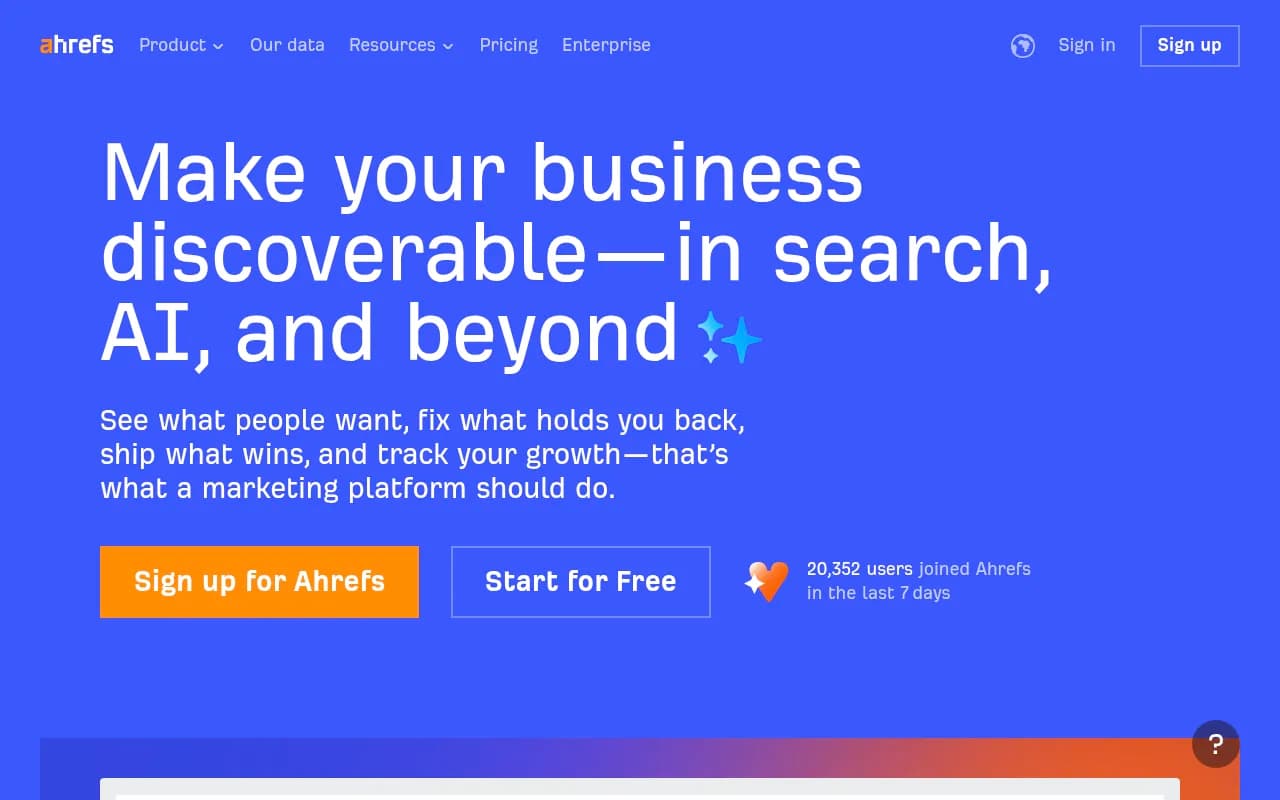
That's a very different buying conversation from "does it track ChatGPT." Profound, for example, doesn't even publish enterprise pricing, it's custom-quoted, with coverage across up to nine answer engines, unlimited seats, SOC 2 compliance, dedicated Slack support with a 24-hour SLA, full API and export access, and ChatGPT Shopping tracking. Ahrefs' Enterprise plan runs $1,499/mo flat for unlimited users and unlimited history. Those numbers are a different universe from the $25-a-month small-team entry points above, and that's by design.

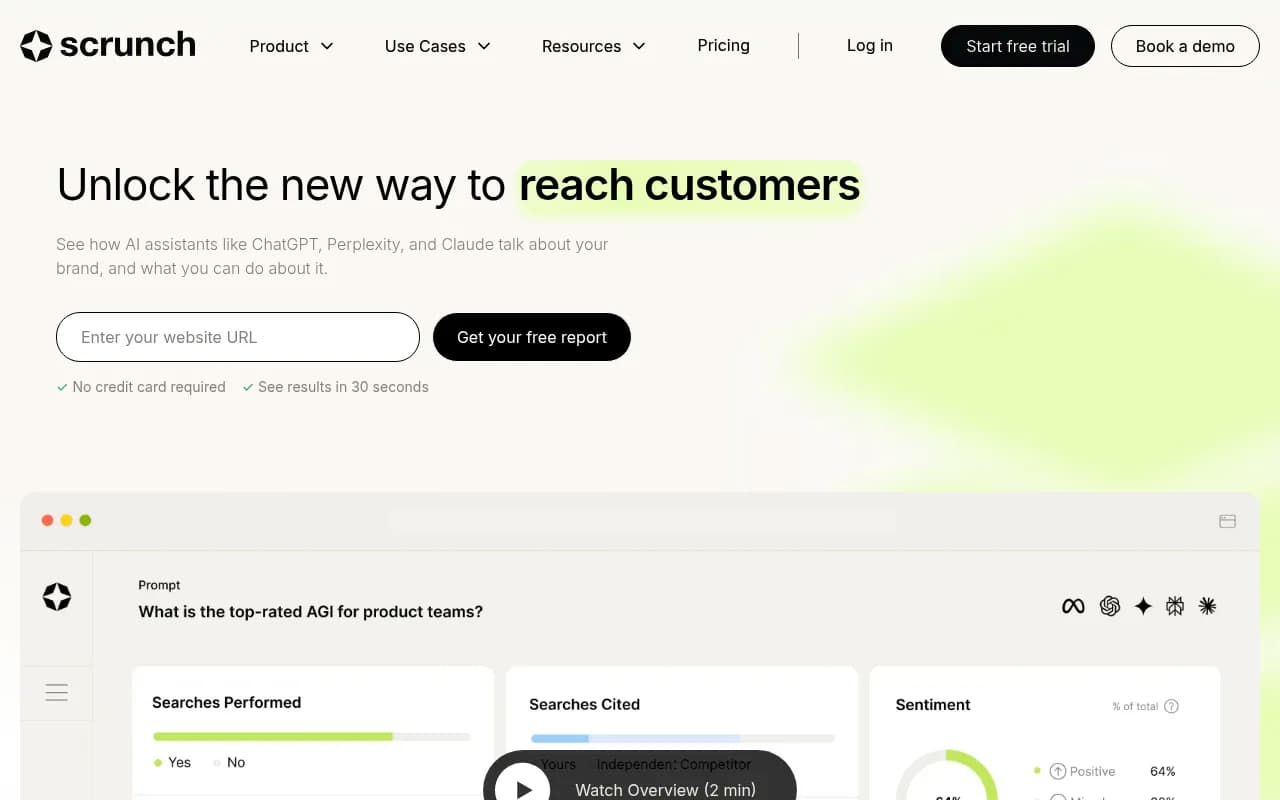
Scrunch AI's acquisition by Sitecore in mid-2026 is worth flagging too: it's now being positioned less as a standalone prompt tracker and more as feeding into Sitecore's broader AI customer experience platform, which could matter if you're evaluating it as part of a larger CMS or experience stack decision rather than a point solution.
The real enterprise differentiator: diagnosis and execution, not just monitoring
A useful framing from an enterprise AI visibility comparison I came across: the buying question in 2026 isn't "which platform has the most features," it's "which part of our AI visibility problem do we actually need solved." Some platforms are deep on prompt and market intelligence. Some connect visibility to existing SEO infrastructure. A smaller group goes further, diagnosing why you're invisible (crawler access, technical barriers) and then actually doing something about it, generating or optimizing content rather than just flagging the gap.
That third category is where enterprise budgets increasingly concentrate, because a dashboard that says "your visibility score dropped 4%" is not useful to a VP of marketing unless it comes with a recommended fix and ideally someone, or something, that executes the fix.
This is also where Promptwatch's positioning differs from most of the monitoring-only tools in this space. Beyond prompt tracking with volume and difficulty scoring, it logs AI crawler activity (ChatGPTBot, ClaudeBot, PerplexityBot, and 400+ others) hitting your site so you can see exactly what AI systems are reading and where they hit errors, tracks visitor analytics to show actual AI-driven traffic and conversions rather than just mentions, and runs Content Agents that plan, write, and publish GEO-optimized content directly to your CMS. Unified Actions turns all of that into a prioritized to-do list rather than a static score. Crisp, one of its customers, scaled to 5 to 10 published articles a day using the system and saw 2x higher conversion rates from AI traffic compared to traditional channels. Agencies like Monks use its Answer Gap Report to build content roadmaps for enterprise clients across brands like Netflix and BMW.
For enterprise pricing specifically, Promptwatch's Business plan runs $579/mo for 5 sites, 350 prompts, 42,000 responses, and 100M crawler logs, with a fully custom Enterprise tier for SSO, managed content workflows, and white-label needs above that.
Side-by-side comparison
| Tool | Entry price | Best fit | Compliance/scale features | Action layer beyond monitoring |
|---|---|---|---|---|
| Otterly.AI | $25-29/mo | Solo marketers, very small teams | Limited, no API/MCP on entry tier | No |
| Peec AI | $95/mo (Starter) | Small teams wanting unlimited seats | Enterprise tier adds SSO, custom | No |
| Semrush AI Visibility Toolkit | $99/mo per domain | Teams already on Semrush | Scales via add-ons, not built for enterprise RBAC | Limited |
| AthenaHQ | Free tier, $295/mo Starter | Small teams wanting a real free option | Single region/language on paid tier | Content optimization agent included |
| Promptwatch | $95/mo (Essential) | Teams from 10 people to enterprise | Business tier adds dedicated support, custom Enterprise adds SSO | Yes: crawler logs, Content Agents, Unified Actions |
| Profound | Free trial only, Enterprise custom | Large enterprises, multi-brand | SOC 2, SSO/SAML, unlimited seats | Agent-based, credit-billed |
| Ahrefs Brand Radar/Enterprise | $50/mo custom prompts, $1,499/mo Enterprise | Teams already on Ahrefs at scale | Unlimited users/history at Enterprise tier | Limited, mostly measurement |
Common mistakes regardless of team size
A few pitfalls show up constantly, whether you're a five-person startup or a global enterprise.
The first is tracking a single AI engine and treating the result as the truth. ChatGPT, Gemini, and Perplexity pull from different sources and rank differently, so a brand that's invisible in one can be perfectly visible in another. The second is relying on API-only monitoring, which skips the live citations block and in-SERP AI widgets real users actually see, especially relevant for Google AI Overviews and AI Mode where the live UI often differs from the API output. The third is checking citations once at launch and never again. AI models retrain and re-rank continuously, and a one-time snapshot tells you nothing about drift six months later. Monthly checks on at least 20 to 30 prompts is the baseline most practitioners recommend.
The content type data backs up why this matters for what you publish, not just what you measure. Promptwatch's citation data shows product pages are the single most-cited content type in ChatGPT answers at 22.4%, with landing pages at 16.8%, meaning nearly 39% of all citations go to pages that simply describe what a company sells. For commercial-intent prompts that combined share jumps to roughly 70% once you add listicles. Reviews, by contrast, only pull 1.7% overall but jump to 5.6% on branded prompts, about three times the average. If your tracker tells you you're invisible on a certain prompt type, that content-type breakdown tells you what kind of page to build to fix it.
How to actually decide
If you're a small team, start by counting how many prompts you genuinely need to watch (not aspirational, actual) and how many AI engines your customers use before you search. Don't buy nine-engine enterprise coverage for a product only discussed on three platforms. If budget is the binding constraint, Otterly.AI or AthenaHQ's free tier are reasonable starting points; if you want room to grow without re-platforming in six months, Promptwatch's Essential tier gives you all-engine tracking and API access at a price close to the small-team entries.
If you're enterprise, the SOC 2/SSO/RBAC checklist should eliminate half your shortlist immediately, regardless of how good the dashboard looks. After that, the real differentiator is whether the platform stops at measurement or helps you act on it. A platform that can show you crawler logs, content gaps, and then actually publish the fix is solving a different, bigger problem than one that just emails you a weekly visibility score.
For broader comparisons across the dozens of AI visibility tools on the market right now, the GEO software directory at bestgeosoftware.com is a useful place to keep browsing options by category and price point.