Key takeaways
- Peec AI tracks brand visibility in AI engines like ChatGPT and Perplexity, but its feature set leaves gaps for agencies managing multiple clients
- Most alternatives fall into two camps: monitoring-only dashboards and full optimization platforms that help you act on the data
- For agencies, the most important factors are multi-site support, white-label reporting, content gap analysis, and prompt-level insights
- Promptwatch is the only platform in this list rated as a "Leader" across all GEO categories in 2026, and the only one with built-in AI content generation tied directly to visibility gaps
- Several solid options exist at lower price points if your agency just needs basic tracking across a handful of clients
Peec AI does a few things well. It scrapes AI interfaces at the UI level (not just through APIs), tracks prompts across ChatGPT, Perplexity, Claude, and Gemini, and gives you a reasonable view of brand visibility over time. For a solo marketer or small brand, it's a workable starting point.
But agencies have different requirements. You're managing multiple clients, producing reports, explaining why visibility changed, and ideally doing something about it. That's where Peec AI starts to show its limits: it's primarily a monitoring tool, and monitoring alone doesn't move the needle for clients who are paying you to grow their AI presence.
Here's a look at the seven best alternatives, what each one actually does well, and where each falls short.
1. Promptwatch
Promptwatch is the most complete GEO platform available right now, and it's the one most worth knowing about if you're running an agency.

The core difference from Peec AI and most other tools is that Promptwatch doesn't stop at showing you data. It runs a full loop: find the gaps, create content to fill them, then track whether that content actually gets cited. Most competitors only do the first step.
For agencies specifically, a few things stand out:
- Answer Gap Analysis shows exactly which prompts competitors are visible for that your client isn't. You get specific topics and questions, not vague scores.
- Content Agents generate articles, listicles, and briefs grounded in real prompt data, citation patterns, and competitor analysis. This isn't generic AI writing -- it's content built around what AI models are already looking for.
- AI Crawler Logs track when ChatGPT, Claude, Perplexity, and others actually crawl your client's pages, what errors they hit, and when a crawled page moves to a citation. Almost no other tool has this.
- Page-level tracking shows which specific pages are being cited, by which models, and how often -- useful for client reporting.
- Traffic attribution connects AI visibility to actual revenue, which is the question every client eventually asks.
Promptwatch monitors 10 AI models (ChatGPT, Perplexity, Claude, Gemini, Google AI Overviews, Google AI Mode, Grok, DeepSeek, Copilot, Meta AI), supports multi-language and multi-region tracking, and has agency/enterprise pricing available alongside its standard tiers (Essential at $99/mo, Professional at $249/mo, Business at $579/mo).
Over 1,480 brands and agencies use it, including Booking.com and Center Parcs. A free trial is available.
2. Profound
Profound is one of the more established names in the GEO space and has a strong feature set, particularly for enterprise-level tracking.

It covers prompt tracking, share of voice, citation analysis, and competitive benchmarking. The interface is clean and the data quality is generally good. Where Profound tends to fall short for agencies is price -- it sits at a higher price point than most alternatives -- and it lacks some of the action-oriented features that make Promptwatch useful. There's no built-in content generation, no Reddit or YouTube tracking, and no ChatGPT Shopping monitoring.
That said, if your agency works with larger brands that care primarily about monitoring and competitive benchmarking, Profound is a serious option.
3. Scrunch AI
Scrunch AI is built for enterprise-wide AI monitoring and handles large-scale deployments reasonably well.
It tracks brand mentions across AI engines, gives you competitive visibility comparisons, and supports multi-brand setups. The reporting is solid for client-facing work. Like Profound, though, Scrunch is primarily a monitoring platform -- it shows you where you stand but doesn't help you change it. No content generation, no crawler logs, no prompt gap analysis tied to actionable briefs.
For agencies that already have strong content teams and just need better visibility data to inform their work, Scrunch is worth evaluating.
4. AthenaHQ
AthenaHQ tracks brand visibility across 8+ AI search engines and has a reasonably intuitive interface.

It's monitoring-focused, which is fine for some use cases. The sentiment analysis features are a differentiator -- you can see not just whether your brand is mentioned but how it's being characterized. That's useful for brand-sensitive clients.
The limitations are similar to others in this category: no content optimization tools, no crawler logs, no traffic attribution. It's a good dashboard for understanding your current state; it won't help you improve it.
5. Otterly.AI
Otterly.AI is one of the more affordable options in the GEO tracking space, and it's popular with smaller agencies and freelancers.

It covers the basics: prompt tracking, brand mention monitoring, share of voice across a handful of AI engines. Setup is quick and the interface is approachable. For agencies just getting started with AI visibility reporting, it's a low-friction entry point.
The trade-offs are real, though. No visitor analytics, no crawler logs, no content generation, and limited prompt metrics. It's a monitoring-only tool, and a fairly lightweight one at that. If a client asks why their visibility dropped or what to do about it, Otterly won't give you much to work with.
6. SE Visible
SE Visible is the AI visibility module from SE Ranking, which means it comes bundled with a full SEO suite.
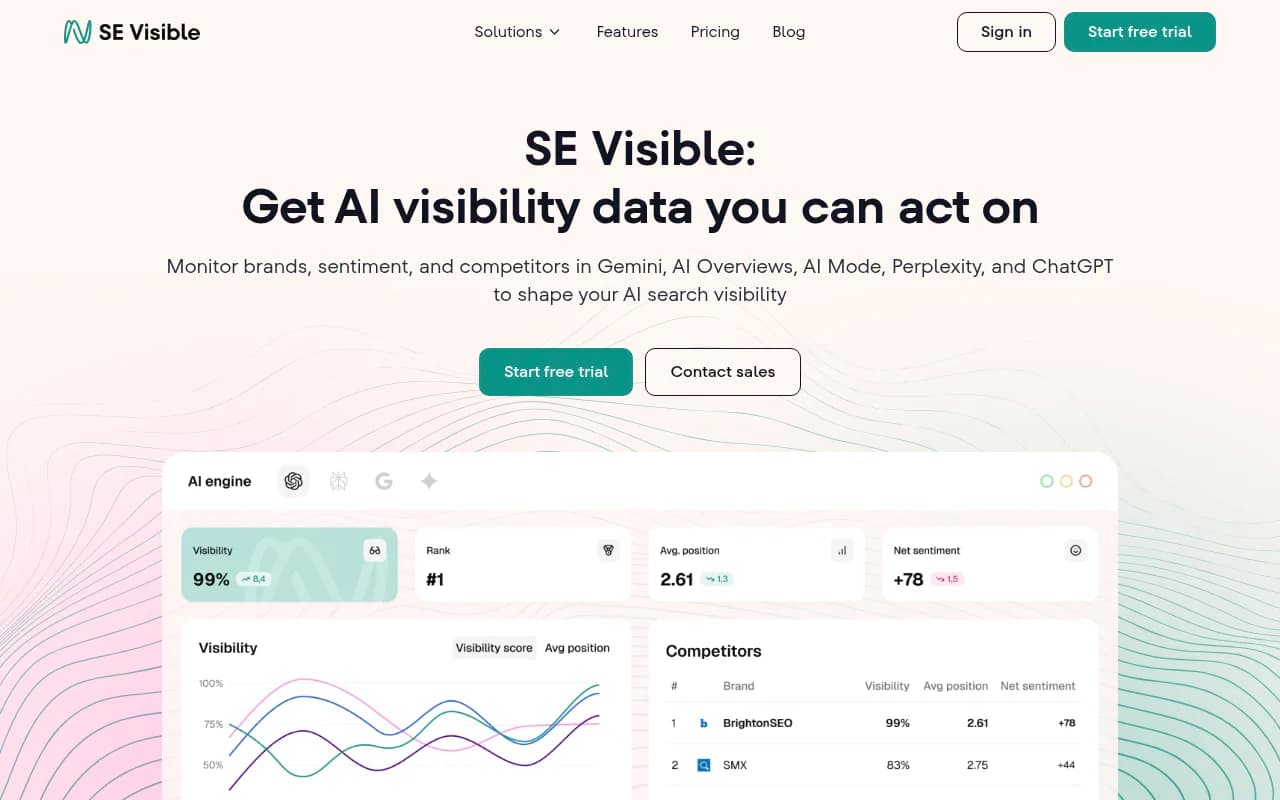
For agencies already using SE Ranking for traditional SEO work, adding AI visibility tracking through SE Visible is a natural extension. You get brand monitoring across AI engines, some competitive benchmarking, and integration with the broader SE Ranking data. The pricing is reasonable relative to standalone GEO tools.
The downside is depth. SE Visible is a module, not a dedicated GEO platform, and it shows. Prompt-level insights are limited, there's no content generation tied to visibility gaps, and the crawler log functionality isn't there. It works well as a supplementary view alongside traditional SEO data, less well as a primary AI visibility tool.
7. Ahrefs Brand Radar
Ahrefs Brand Radar is worth mentioning because Ahrefs has significant brand recognition and many agencies already have Ahrefs subscriptions.
Brand Radar lets you track your brand across a selection of AI models -- ChatGPT, AI Overviews, AI Mode, Copilot, and a couple of others. The data quality is decent and the integration with Ahrefs' existing keyword and backlink data is genuinely useful for connecting traditional SEO work to AI visibility.
The limitations are meaningful for agencies, though. You're limited to 3 of 6 available AI models per project, prompts are fixed rather than custom, and there's no AI traffic attribution. It's a solid add-on for teams already deep in the Ahrefs ecosystem, but not a replacement for a dedicated GEO platform.
How these tools compare
Here's a side-by-side view of the most important features for agencies:
| Tool | Multi-site support | Content generation | Crawler logs | Traffic attribution | Reddit/YouTube tracking | Prompt gap analysis |
|---|---|---|---|---|---|---|
| Promptwatch | Yes | Yes | Yes | Yes | Yes | Yes |
| Profound | Yes | No | No | No | No | Limited |
| Scrunch AI | Yes | No | No | No | No | No |
| AthenaHQ | Yes | No | No | No | No | No |
| Otterly.AI | Limited | No | No | No | No | No |
| SE Visible | Yes (via SE Ranking) | No | No | No | No | No |
| Ahrefs Brand Radar | Yes | No | No | No | No | No |
The pattern is pretty clear. Most of these tools are monitoring dashboards. They show you data. Promptwatch is the only one in this list that closes the loop from "here's where you're invisible" to "here's the content that will fix it" to "here's proof it worked."
What agencies should actually look for
Before picking a tool, it's worth being clear about what your agency actually needs. A few questions worth asking:
How many clients and sites do you need to manage? Most tools have per-site pricing. Promptwatch's Business plan covers 5 sites; agency/enterprise pricing is available for larger portfolios. Peec AI's pricing can get expensive quickly at scale.
Do your clients want reports or results? If clients just want a dashboard showing their AI visibility score, most tools here will do. If they want to know why they're invisible and what to do about it, you need something with gap analysis and content tools.
Which AI models matter most to your clients? Coverage varies. Promptwatch monitors 10 models including Google AI Mode and DeepSeek. Some tools only cover 3-4. If your clients care about Google AI Overviews specifically, make sure the tool actually tracks it properly.
Do you need white-label reporting? Not all tools support this. Check before committing.
Is AI traffic attribution on the roadmap for your clients? Most CMOs will eventually ask whether AI visibility is driving actual business outcomes. Only a handful of tools can answer that question today.
The bottom line
Peec AI is a reasonable monitoring tool, but "reasonable monitoring" isn't a strong value proposition for an agency trying to justify its fees. Clients don't pay agencies to show them dashboards -- they pay for results.
The tools that will matter most in 2026 are the ones that help you move from visibility data to content action to measurable outcomes. Right now, Promptwatch is the clearest example of a platform built around that loop. The others on this list are worth knowing about depending on your budget, client mix, and existing tech stack -- but if you're evaluating from scratch, start there.