Key takeaways
- Social listening captures what humans post about you. AI perception tracking captures what models generate when a buyer asks them a question. These are two separate data streams, and neither replaces the other.
- Social content feeds AI answers very unevenly. In Promptwatch's data for Oct 11 to Nov 9, 2026, social platforms made up 13.16% of Google AI Overviews citations but only 0.64% of ChatGPT citations.
- Citation patterns shift fast. Reddit's share of ChatGPT citations fell from about 3.8% to about 0.5% within weeks in August 2026, which no social listening dashboard would have flagged.
- Most teams do not need both programs at equal depth. PR-heavy brands lean on listening, and brands that win on research and comparison queries lean on AI tracking.
- The cheapest sensible setup is your existing listening tool for crisis and sentiment work, plus one AI visibility platform that also helps you fix gaps.
Why this question keeps coming up
Your social listening dashboard shows healthy sentiment. Mentions are up, the tone is positive, nobody is yelling about your product. Meanwhile a prospect asks Perplexity for the best option in your category, and the answer names two competitors and skips you. No human posted anything about that. No listening tool sees it.
That gap is why the "do I need both?" question is everywhere in 2026. Several vendors have published their own versions of the answer (BobBuilds, SearchFit, LLM Monitor, Toolsolved), and most land in the same place: yes, mostly. But the blanket "yes" hides something useful. The two programs overlap less than you would expect, and the overlap is itself uneven depending on which AI engine you care about.
This guide separates what each approach actually measures, shows what the data says about how social content reaches AI answers, and gives you a way to decide how much of each you need.
What social listening actually does
Social listening tools crawl public conversations (social networks, forums, news, blogs, review sites) and let you search, filter and analyze mentions of your brand, competitors and topics. Brandwatch, Meltwater and Brand24 are the usual names. The modern versions add AI-based sentiment, emotion detection and trend alerts.
They are good at a specific set of jobs:
- Spotting a PR problem while it is still small
- Measuring campaign reaction and share of conversation
- Finding customer complaints and feature requests in the wild
- Tracking influencers and creators who mention you
- Benchmarking sentiment against competitors over time
The key word is human. Every data point is something a person wrote. If nobody wrote it, it does not exist as far as the tool is concerned.
Tools worth knowing in this category
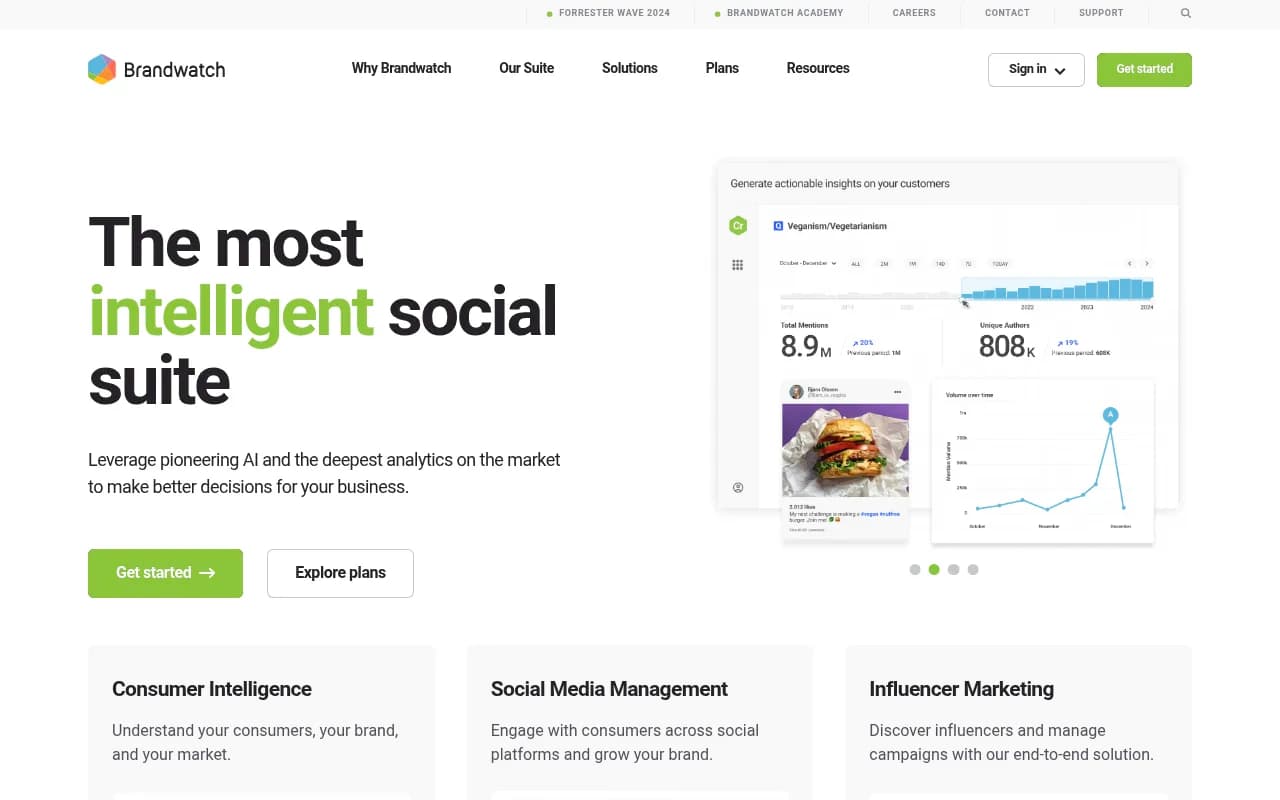
Brandwatch is the enterprise option for consumer intelligence at scale.
Brandwatch Consumer Intelligence
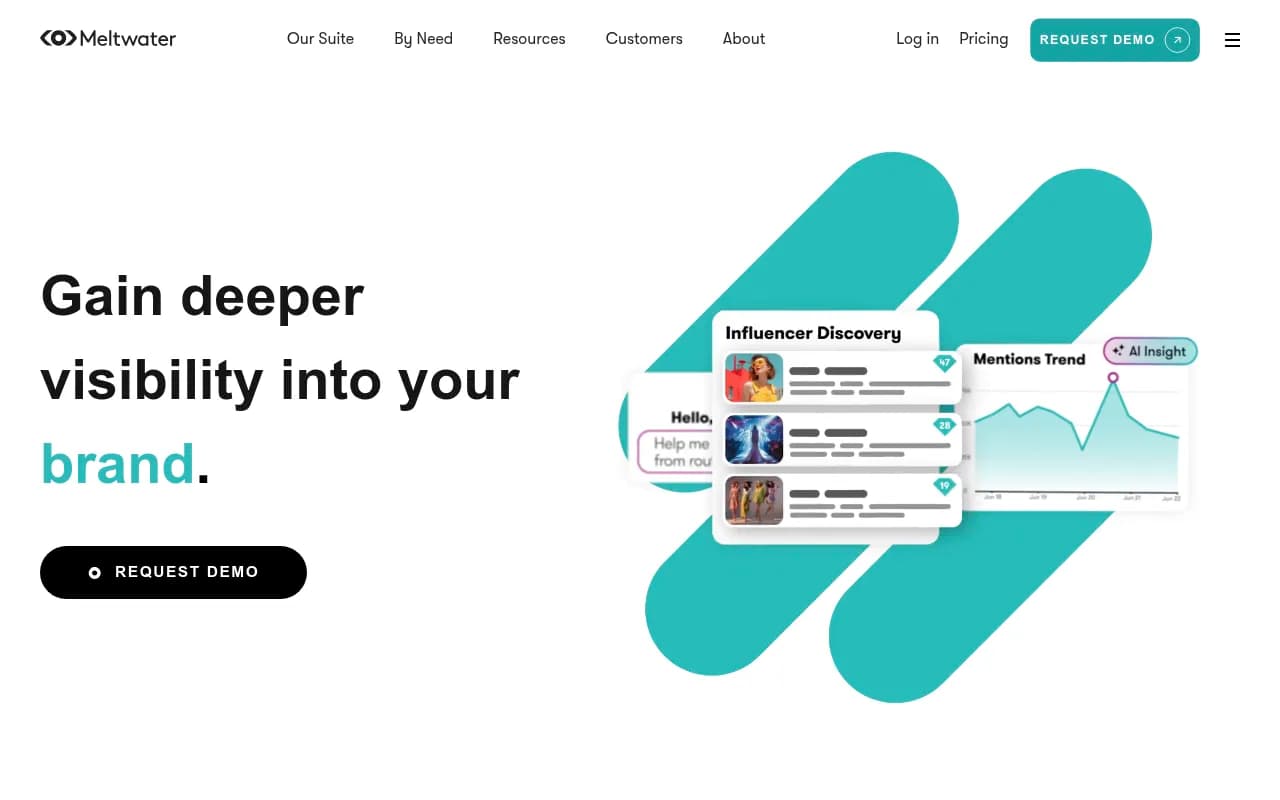
Meltwater combines media monitoring with social listening, and tends to suit comms teams.
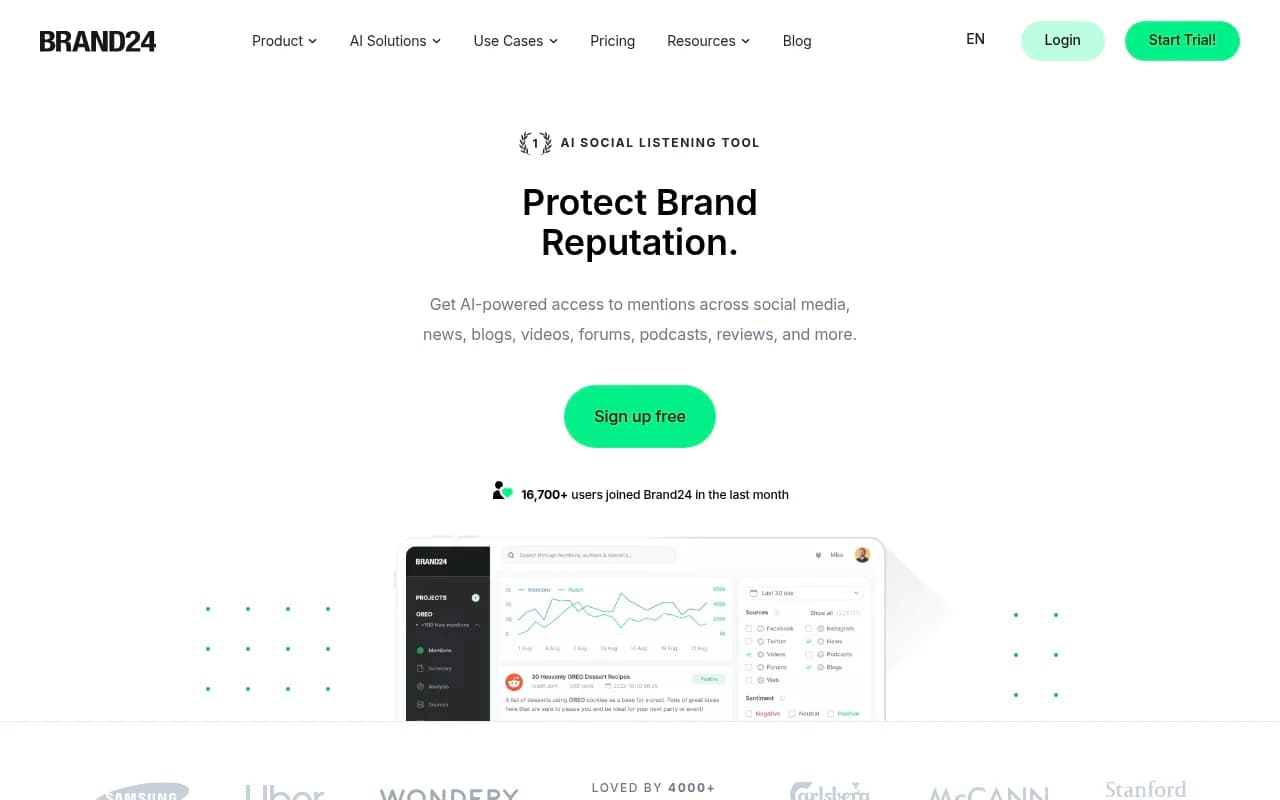
Brand24 is the more approachable, mid-market choice and tracks mentions across a very large source pool.
Awario, Mentionlytics, Talkwalker, YouScan and Pulsar sit in the same neighborhood, with different strengths (visual recognition, audience research, agency pricing).
What AI perception tracking does
AI perception tracking measures what language models say about your brand when someone asks them something. You define a set of prompts that mirror real buyer questions, run them repeatedly across ChatGPT, Gemini, Perplexity, Claude, Google AI Overviews and others, then record whether you are mentioned, where you rank in the answer, what tone the model uses, which claims it makes, and which sources it cites.
That is a different object of measurement. You are not listening to a conversation. You are sampling the output of a system that synthesizes crawled pages, its training data and live search results into a single answer.
Some vendors use the phrase "AI perception tracking" for sentiment analysis of human audiences, which muddies the water. Agenoria's January 2026 post, for example, uses it for NLP-driven analysis of how people feel. In this guide the term means what models say, because that is the part traditional listening cannot reach.
The metrics that matter
Good AI tracking tells you more than "were we mentioned." The useful readings are:
- Visibility, meaning how often and how prominently you show up across a prompt set
- Share of voice against named competitors
- Position within the answer, because being listed fifth is not the same as being recommended first
- Sentiment and the specific claims made about you (pricing, features, support)
- Which of your pages get cited, and which third-party pages shape the answer instead
Read together, these point to the cause. Low share of voice is a coverage problem. Mentions without citations to your own site usually mean a content or crawlability problem. Poor sentiment is a reputation problem, and that one often does connect back to what social listening picks up.
The core differences, side by side
| Dimension | Social listening | AI perception tracking |
|---|---|---|
| What it measures | Human posts and articles about you | Model-generated answers about you |
| Data source | Social networks, forums, news, reviews | ChatGPT, Gemini, Perplexity, Claude, AI Overviews, AI Mode |
| Trigger | Someone publishes something | Someone (or a scheduled monitor) asks a prompt |
| Typical owner | PR, comms, social, brand | SEO, content, growth, marketing |
| Main use | Crisis response, sentiment, campaign reaction | Visibility, recommendation rank, citation gaps |
| Output you can act on | Reply, escalate, adjust messaging | Publish or fix pages, earn mentions on cited sources |
| Speed of change | Minutes to hours | Days to weeks, but with sudden jumps after model updates |
| Blind spot | Anything no human wrote down | Offline sentiment and private conversations |
How much do social posts actually influence AI answers?
This is the question that decides how the two programs relate. If AI engines leaned heavily on social content, listening data would be a decent proxy for AI visibility. They do not, and it varies enormously by engine.
Promptwatch Data tracked social platform citations across engines for Oct 11 to Nov 9, 2026 in its social media citations report for November 2026. Social platforms' share of all citations:
| AI engine | Social share of citations (Oct 11 to Nov 9, 2026) | October figure (Sep 28 to Oct 4) |
|---|---|---|
| Google AI Overviews | 13.16% | 12.22% |
| Perplexity | 1.94% | 2.71% |
| ChatGPT | 0.64% | 0.46% |
AI Overviews cites social media roughly 20 times as often as ChatGPT. Note the different windows: the October report covers 7 days and the November one covers 30, so treat the month-over-month changes as directional.
The platform mix matters too. In AI Overviews, YouTube alone was 6.71% of citations (up from 4.28%), more than the other six platforms combined. Facebook was 2.34% and Reddit 2.10%. Perplexity leaned on Reddit (0.82%) and LinkedIn (0.66%). ChatGPT cited Reddit at 0.40% and LinkedIn at 0.20%, with everything else at or below 0.01%. X barely registered anywhere, at 0.02% in AI Overviews and 0.04% in Perplexity.
What I take from this: a viral thread on X or a pile of TikTok chatter is nearly invisible to AI engines as a citation source, however loud it is in your listening tool. YouTube matters a lot for Google. Reddit and LinkedIn matter a little for Perplexity. For ChatGPT, your own site and the listicles, guides and comparisons it cites matter far more, which fits Promptwatch's citation share by content type data, where product pages were the most cited type at 22.4% in Sep 28 to Oct 4, 2026.
Citation sources move quickly
The second lesson is volatility. According to Promptwatch's Reddit citations report (data from Jul 7 to Aug 17, 2026), Reddit held a steady 3.83% of ChatGPT citations from Jul 18 to Aug 7, slipped on Aug 8, and collapsed to under 1% on Aug 14. The Aug 14 to 17 average was 0.52%, an 86.4% relative drop. Promptwatch flags the size of that drop as provisional because a data-collection issue cannot be ruled out. In AI Overviews the same source eased gradually from about 2.37% to 2.10%, and in AI Mode it fell from 2.22% to 1.54%.
If your plan assumed that seeding Reddit threads would carry you into ChatGPT answers, that assumption changed in a week. Your social listening tool would have kept showing the same healthy Reddit conversation. Only something that samples AI answers continuously would have noticed.
What each approach misses
What social listening cannot see
- Zero-mention moments. When an AI answer omits you, no human wrote anything, so there is no mention to find.
- What the model believes about you. A model can state an outdated price or a feature you dropped two years ago. Nobody posted it. It just sits in the answer.
- Which pages the model cites. Listening tools do not tell you whether ChatGPT used your documentation, a competitor's comparison page, or a review site.
- Crawler access problems. If AI bots cannot read your site, no amount of positive sentiment helps.
What AI tracking cannot see
- A brewing PR issue before it reaches search or AI answers. Models lag, and listening catches the first hour.
- Customer language and complaints in raw form. Prompts are your hypothesis about buyer questions. Social conversation is where you find questions you did not think to ask.
- Offline and private channels, and sentiment among existing customers who never ask an AI about you.
- Influencer and creator activity, unless it lands on a cited YouTube video or article.
The two blind spots are almost mirror images. That is the cleanest argument for running both.
Where the two programs connect
They are separate streams, but they feed each other in a few useful ways.
- Listening finds the language, tracking tests it. Complaints and questions in social conversation become candidate prompts for your AI monitors.
- AI answers surface reputation claims, listening explains them. If a model says your support is slow, check whether a review thread or forum post is the origin.
- Cited social sources become targets. If AI Overviews cite specific YouTube videos or Reddit threads in your category, your social team knows where to show up.
- Crisis hits both. A real PR event can end up in AI answers for months. Listening handles the first week, AI tracking tells you when the story fades from answers.
A maturity model: how deep to go on each
SearchFit's 2026 post makes a fair point that not every team needs both programs at equal depth. Here is how I would split it.
| Brand type | Social listening | AI perception tracking |
|---|---|---|
| Consumer brand with heavy social presence | Full program | Light to medium: core prompts, weekly review |
| B2B SaaS with long research cycles | Light: alerts and review sites | Full program: prompts, citations, content gaps |
| Agency managing many clients | Per-client tier by need | Multi-client platform with reporting |
| Local or multi-location business | Reviews and reputation focus | Local prompt tracking by location |
| Ecommerce | Medium: reviews and creators | Medium to full: shopping and comparison prompts |
| Early-stage startup | Free alerts are enough | One affordable tracker plus a free visibility check |
Start where your buyers actually research. If they ask AI engines before they talk to sales, move budget toward tracking. If your category is driven by creators and public debate, keep listening at the center.
Choosing AI perception tracking tools
The category is crowded. Tools in the catalog range from simple prompt monitors (Otterly.AI, Peec AI, Rankscale) to enterprise suites (Profound, Brandlight, BrightEdge). The meaningful divide is between tools that report a score and tools that help you change it.
Promptwatch is the one I would put first for teams that want the whole loop in one place. It monitors the real interfaces of ChatGPT, Gemini, Perplexity, Google AI Overviews, AI Mode, Copilot and others, then traces which pages and third-party sources get cited. Brand Narrative pulls out the individual claims AI makes about you, grouped by theme like pricing or support, which is the closest thing in this space to listening for sentiment. Fact Check lets you mark a claim inaccurate and find the page on your site that is teaching the model the wrong thing. It also covers Reddit, YouTube and LinkedIn citation reports, IP-verified AI crawler logs and visitor analytics, and its Content Agent can write and publish pages for the gaps it finds. Plans start at $95/mo on Essential, and the Content Agent arrives with Business at $579/mo; confirm current details at promptwatch.com/pricing. There is a 7-day free trial on monthly billing, and a free AI visibility report if you want a first look with no login.

Profound is a strong enterprise monitoring option, with higher price points and less emphasis on executing fixes.

Peec AI and Otterly.AI are lighter prompt trackers that suit smaller budgets when you mainly need to know whether you are mentioned.


Semrush and Ahrefs Brand Radar add AI tracking to suites you may already pay for, which is convenient, though the prompt sets and depth are more limited than dedicated platforms.

For a wider view of the field, the GEO software directory at bestgeosoftware.com lists far more options than fit in one article.
Quick comparison of the options above
| Tool | Category | Strength | Watch out for |
|---|---|---|---|
| Brandwatch | Social listening | Enterprise-scale consumer intelligence | Cost, setup effort |
| Meltwater | Social listening and media | PR and comms workflows | Not built for AI answers |
| Brand24 | Social listening | Approachable, broad source coverage | Limited AI engine insight |
| Promptwatch | AI visibility and GEO | Tracking plus fixing, crawler logs, content agents | Content Agent needs Business tier |
| Profound | AI visibility | Enterprise monitoring depth | Price, less execution |
| Peec AI | AI visibility | Multi-language tracking | No crawler logs or content generation |
| Otterly.AI | AI visibility | Affordable monitoring | Basic prompt tracking |
| Semrush / Ahrefs Brand Radar | SEO suite add-on | Fits an existing workflow | Shallower AI-specific data |
A practical way to run both
You do not need a new department. A workable setup looks like this.
Step 1: keep listening where it earns its keep
Configure alerts for brand names, product names, executives and a short competitor list. Route negative spikes to whoever owns comms. Skip the vanity dashboards.
Step 2: build a prompt set from real language
Take 20 to 50 questions your buyers ask, drawn from sales calls, support tickets and the questions you find in listening data. Write them as natural sentences, not keywords. Tag them by intent: category research, comparison, brand-specific.
Step 3: baseline your AI visibility
Run the set across at least ChatGPT, Gemini, Perplexity and Google AI Overviews. Record visibility, position, sentiment and cited sources for you and three or four competitors. Most brands find the first baseline humbling.
Step 4: match sources to engines
Use the citation data to decide where effort goes. Based on the November 2026 numbers, a rough guide:
- Google AI Overviews: YouTube first, then Facebook and Reddit
- Perplexity: Reddit and LinkedIn
- ChatGPT: your own site, plus the guides, listicles and comparisons it cites
- X: low priority for AI search specifically, though it may still matter for your listening program
Step 5: check the technical basics
Confirm AI crawlers can read your site. Promptwatch's free Agentic Readiness Check shows which crawlers get through and which agent standards you support. If bots are blocked, fix that before anything else.
Step 6: close the loop monthly
Once a month, compare the two views. Did a spike in social conversation coincide with any change in AI answers? Did an AI claim trace back to a specific review or thread? Feed those findings into content and PR plans. Then rerun the prompts, because citation shares drift, and some of them drift hard.
So, do you need both?
If customers research through AI engines, yes. But the weighting is the real decision.
Social listening answers "what are people saying and how do they feel?" AI perception tracking answers "what will a model tell the next buyer, and why?" The second question is newer, the tooling is younger, and the data moves more abruptly, which is exactly why it deserves its own program rather than a tab inside your listening tool.
If you can only fund one expansion this quarter, run a free baseline of your AI visibility first. If the answers are fine, keep your budget in listening. If you are missing from the prompts that matter, you have found your priority. For more rankers and directories to compare options, surferstack.com covers both categories.