Key takeaways
- Ranketta is a standalone AI visibility tool aimed at online stores. Semrush One and SE Ranking are SEO suites where AI tracking sits next to rank tracking, audits and keyword research.
- If you already pay for Semrush or SE Ranking, adding their AI layer is usually the cheapest first step. Check the prompt caps, because they are small on entry tiers (Semrush Starter tracks 50 prompts on 1 domain).
- Ranketta's pricing is built around prompts per model, countries and websites. It starts at EUR 79/mo, and it targets product-level tracking and feed fixes, not classic rank tracking.
- None of the three replaces the other completely. A suite covers Google rankings, backlinks and audits. A standalone tracker covers depth in AI answers.
- Several figures in this comparison come from vendor pages. Confirm current pricing before you buy.
The real question: one tool or two?
The three tools in this comparison answer different questions, even though all three now claim to track AI search.
Semrush One and SE Ranking started as SEO platforms. Their AI features arrived later and share a login, a billing relationship and a project structure with rank tracking, site audits and backlink analysis. Ranketta started on the AI side and is positioned for online stores, with separate pricing tabs for Brands and Agencies.
The frustration that keeps showing up in rank tracker discussions is paying suite-level prices for one capability. The mirror image exists too: paying for a standalone AI tracker, then still needing a classic rank tracker, a crawler and a backlink tool. Neither is wrong. It depends on what you already own.
At a glance
| Ranketta | Semrush One (SEO + AI Search) | SE Ranking | |
|---|---|---|---|
| Type | Standalone AI visibility tool | SEO suite with AI layer | SEO suite with AI visibility tracker |
| Entry price | EUR 79/mo (Starter) | $117.33/mo annual for the SEO plan; $165.17/mo annual for Starter with AI Search | $103.20/mo annual (Core), though other sources cite $129; plan prices unverified |
| AI engines | Google AI Overviews, AI Mode, ChatGPT, Gemini, Perplexity as standard; Alexa, Claude, Copilot, Grok and others as premium | Google, ChatGPT, Perplexity, Gemini and more | Google AI Overviews, AI Mode, ChatGPT, Gemini (Copilot listed in older material) |
| Prompt limits | 50 prompts per model on Starter | 50 prompts, 1 domain on Starter | Check current plan; not verified |
| Classic rank tracking | No | Yes, daily Position Tracking | Yes, daily on Core and Growth |
| Free trial | 7 days | 7 days | 14 days, no card |
| Best for | E-commerce brands and agencies with store clients | Teams already living in Semrush | Agencies and small teams wanting one affordable suite |
Ranketta: the standalone option
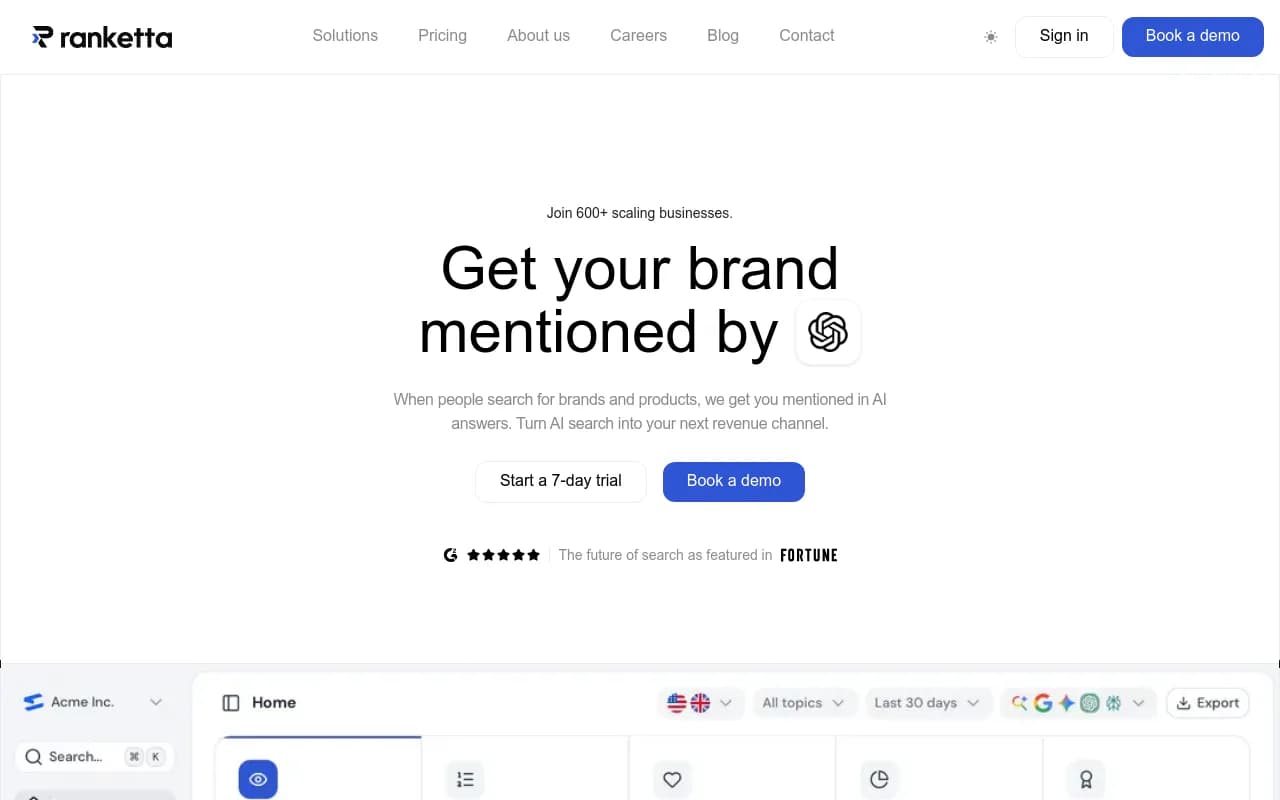
Ranketta is built around the idea that AI visibility for a store is a product problem. Its pitch is that tracking which products AI recommends is now table stakes, and the difference is what happens after a gap is found.
Pricing and limits
Pricing is in euros, with a 7-day free trial. Only the Online Stores tab came through in research, so Brands and Agencies pricing is unverified.
| Plan | Monthly | Models | Prompts per model | Credits | Sites | Countries |
|---|---|---|---|---|---|---|
| Starter | EUR 79 | 3 of your choice | 50 | 5k | 1 | 1 |
| Growth | EUR 199 | 4 | 100 | 15k | 2 | 3 |
| Scale | EUR 449 | 5 | 300 | 45k | 5 | 10 |
| Enterprise | Custom | Custom | 1,000+ | Custom | Custom | Custom |
Standard models are Google AI Overviews, AI Mode, ChatGPT, Gemini and Perplexity. Premium models include Amazon Alexa, Claude, Microsoft Copilot, Grok, Meta Muse, Walmart Sparky and Instacart Clementine. The retailer assistants are the interesting part. Almost no SEO suite covers Walmart or Instacart surfaces.
What it does well
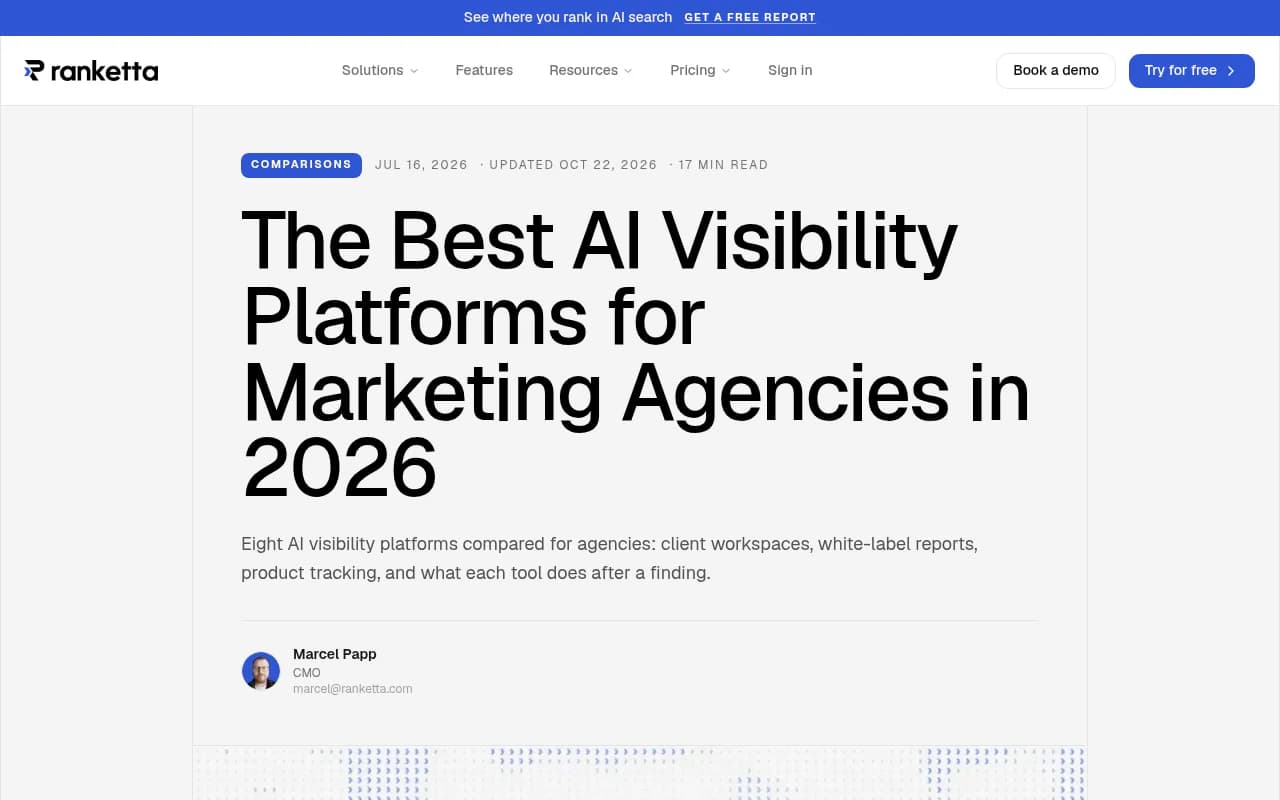
The product-data angle is the differentiator. According to Ranketta's own agencies post, it fixes the product data behind gaps, attaches a confidence score to each change, and exports the corrected feed to Amazon, Google Merchant Center, Heureka and Zbozi. MCP access is included from the Starter plan.
That post is vendor-authored, and it ranks Ranketta first for agencies with e-commerce clients. Treat the ranking as marketing. The claim that product-level tracking is now standard across Peec AI, Profound, AthenaHQ and Scrunch AI is still useful, because it tells you product tracking alone will not set a tool apart.
Where it falls short
It is not a rank tracker, a site crawler or a backlink tool. If your reporting still includes Google positions, you need something else next to it. And there are no independent reviews comparing it against both suites, so you are leaning on the vendor's description and your own trial.
Semrush One: the suite with an AI layer
Semrush is a very good rank tracker inside a very good marketing suite. If you already subscribe, its tracker is one you should keep using. The question is how much of the AI add-on you need.
Pricing and limits
| Plan | Annual price per month | Monthly billing | Key limits |
|---|---|---|---|
| SEO | $117.33 | $139 | 5 websites, 500 keywords tracked daily, basic AI search items (custom prompts, AI sentiment, AI visibility reports) |
| Starter (SEO + AI Search) | $165.17 | $199 | 500 daily keywords, 5 websites, 50 daily prompts, 1 domain, 300 AI visibility reports per day, MCP access |
| Pro+ (SEO + AI Search) | $248.17 | $299 | 15 websites, 1,500 daily keywords; higher AI limits not verified |
The pricing page was truncated in research, so higher tiers are incomplete.
A data-freshness wrinkle
The Semrush One page claims weekly data updates, while the pricing page lists daily keyword tracking. Those can both be true if one refers to AI data and the other to Position Tracking, but the pages do not say so. Ask support, or test it during the 7-day trial, before you promise a client daily AI numbers.
Who it suits
Teams that need Google rankings, content tools, backlinks and AI visibility in one bill. The weak spot is the prompt cap. Fifty prompts on one domain is enough for a small brand, and thin for an agency or a store with a large catalog.
Worth noting: a YouTube walkthrough mentions a 261M-prompt database in Semrush One. I could not verify that figure, so I would not build a decision on it.
SE Ranking: the affordable all-in-one
SE Ranking is the budget-friendly suite here. Its Rank Tracker updates daily on Core and Growth plans, covers desktop and mobile in 190+ countries, and its AI Visibility Tracker covers Google AI Overviews, AI Mode, ChatGPT and Gemini.
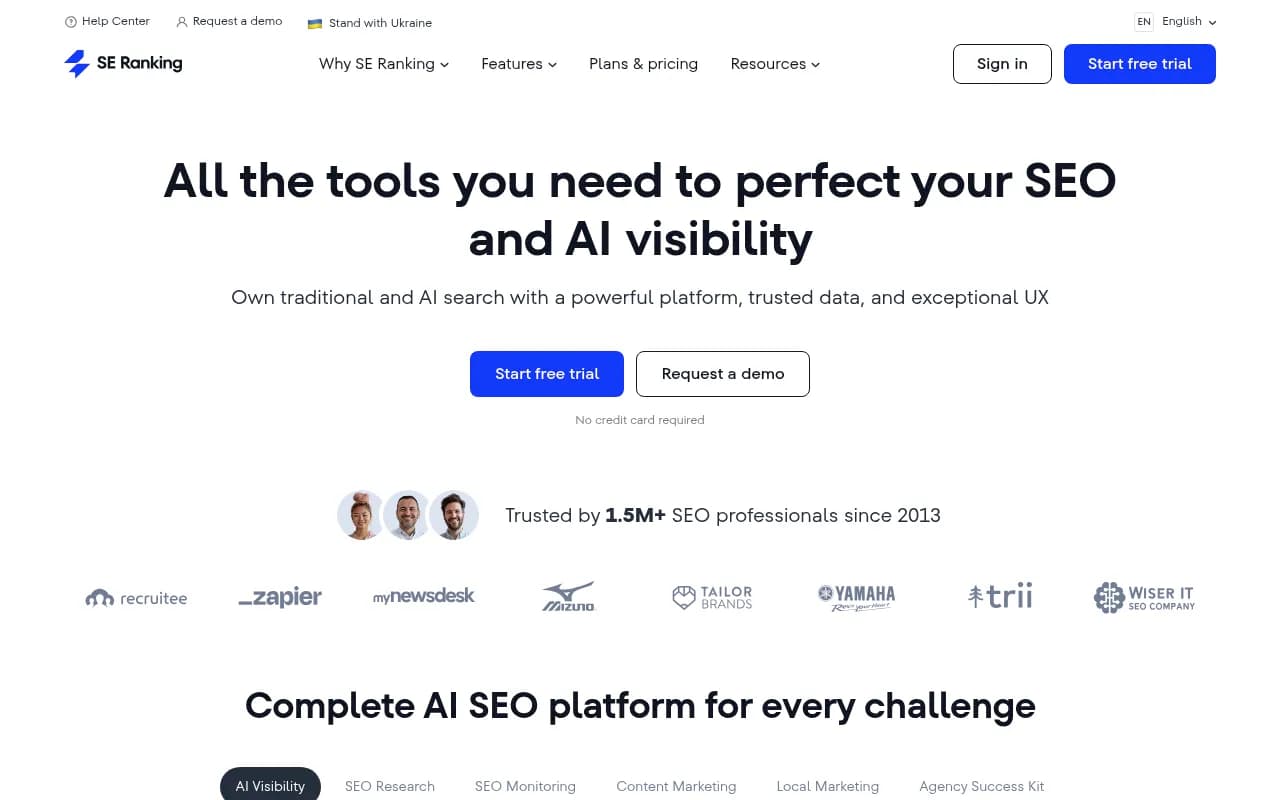
The AI side has three modules: AI Competitor Research (up to five competitors), the AI Results Tracker, and AI Source and Coverage Analysis. Source analysis covers 7 markets and 5 languages and sorts sources into media, blogs, forums and similar buckets. For reporting, it connects to Data Studio, AgencyAnalytics and Whatagraph, has API and MCP access, and works with Make, n8n and Zapier.
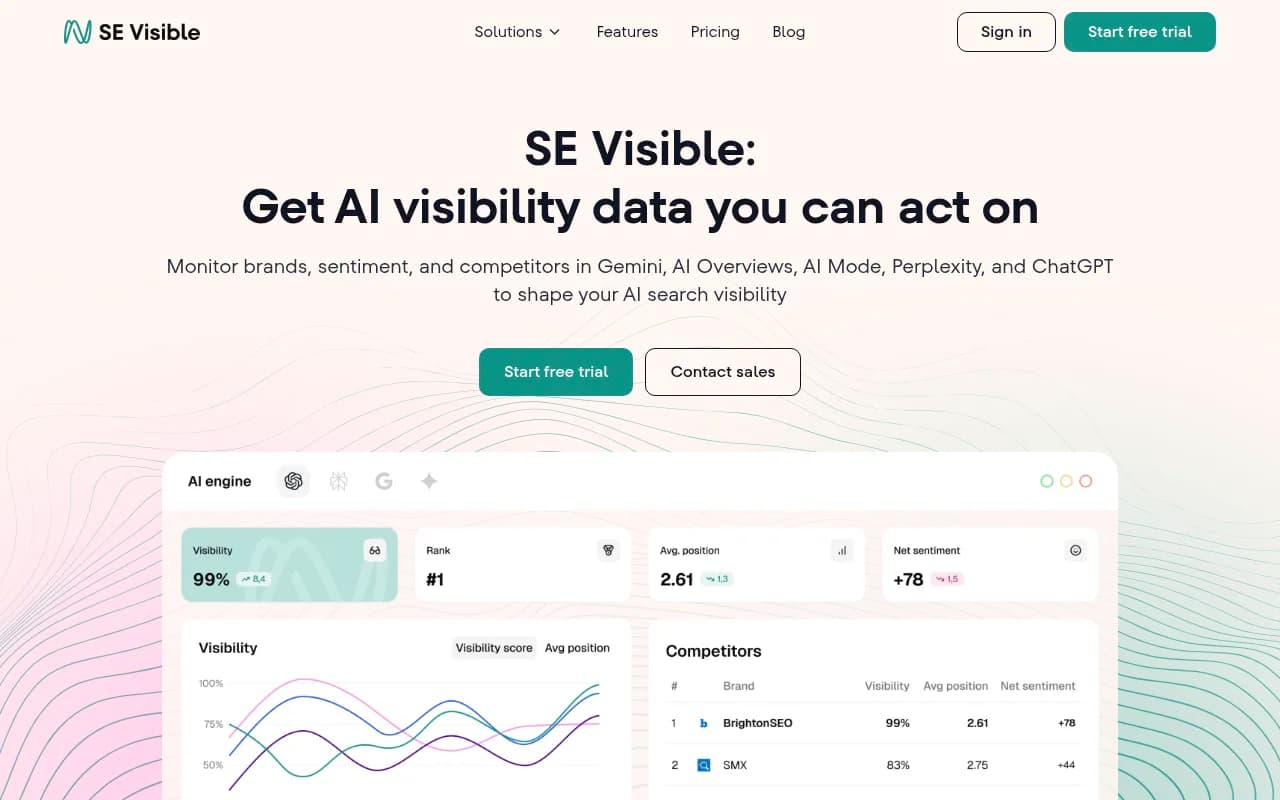
Two caveats. Current plan prices and AI add-on pricing could not be verified, since the pricing page returned a 404 during research. And the Core price shows up as $103.20 per month billed annually in one source and $129 in another, which probably reflects annual versus monthly billing, but confirm it. SE Ranking also runs a separate product, SE Visible, focused only on AI visibility.
There is a free 14-day trial with no credit card, plus a free competitor check limited to five attempts a day. That is the easiest of the three to try with zero commitment.
How many prompts and engines do you actually need?
This is where the standalone-versus-suite debate gets practical. Promptwatch Data's Average Sources Per Response report found that ChatGPT cites about 5 sources per web-search answer, while Google AI Overviews and Perplexity cite about 10. It also suggests measuring each engine separately, since AI Overviews citations do not predict ChatGPT citations. A tracker that lumps engines together hides that.
The ChatGPT query fanouts report adds a second lesson. Average fanouts per response fell from 2.15 in early December to about 1.84 by early March, and average fanout query length dropped from roughly 117 characters to the high 80s. Short, keyword-like prompts are a better mirror of what ChatGPT actually searches. The report's intro says a prompt can trigger 3 to 8+ searches, which conflicts with those averages, so treat any single number carefully.
Practically, that means:
- A 50-prompt cap goes fast if you split prompts across engines and countries.
- Ranketta counts prompts per model, so 50 on Starter across 3 models is up to 150 tracked prompt-model pairs. Semrush's 50 is a flat daily prompt count.
- Multi-country needs differ. Ranketta Starter is limited to 1 country and 1 website. Check that against your market before you commit.
So which one should you pick?
| Your situation | Likely best fit |
|---|---|
| Already on Semrush, small brand, just starting with AI tracking | Semrush One Starter or the existing plan's AI items |
| Agency or in-house team wanting rank tracking, audits and AI tracking on a tight budget | SE Ranking |
| Online store where product recommendations and feed quality drive sales | Ranketta |
| Retail surfaces beyond Google and ChatGPT (Walmart, Instacart, Alexa) | Ranketta premium models |
| Heavy classic SEO work with backlinks, content and ads research | Semrush or SE Ranking, with AI tracking as a side feature |
| Large prompt sets across many engines and countries | A standalone tool, or a higher suite tier after checking limits |
A common setup
Plenty of teams run both: a suite for Google rankings and technical SEO, a standalone tool for AI answers. The cost is real, but so is the clarity. If AI search is becoming a revenue line rather than an experiment, you probably want its own dashboard, its own prompt budget and its own owner.
Other options worth a look
If neither a suite nor Ranketta fits, the field is wide. For a full AI visibility platform that also fixes gaps with content, Promptwatch tracks the real interfaces of ChatGPT, AI Overviews, Gemini and others, and ties visibility to crawler logs, AI traffic and a Content Agent that publishes to your CMS.

Other trackers in the catalog include Peec AI for multi-client monitoring, Profound for enterprise rosters, and Otterly.AI for low-cost monitoring.



For a wider shortlist, the GEO software directory at bestgeosoftware.com lists dozens more.
Questions to ask before you buy
- How many prompts do I need per engine, per country, per site?
- Is the AI data refreshed daily or weekly on my plan?
- Do I need classic Google rank tracking in the same tool?
- Does the tool stop at a finding, or help me act on it?
- Can I export data or pull it through an API or MCP into my own reports?
Run the same 20 to 30 prompts through each free trial and compare. The 7-day trials from Ranketta and Semrush and the 14-day SE Ranking trial are enough to see whether the numbers agree and whether the workflow fits.
Bottom line
If you already pay for Semrush or SE Ranking, switch on the AI features first and see where the prompt caps pinch. If you sell products online and AI recommendations are your growth channel, Ranketta is the purpose-built option, with the caveat that its own claims are unverified by independent reviews. And whichever you choose, confirm the current plan limits on the vendor's pricing page, because several of the numbers above came from partial pages.