Key takeaways
- Enterprise pricing buys governance (SSO, SOC 2, SLAs, dedicated support), not better AI visibility data. Most small and mid-size teams do not need it to get real GEO results.
- Profound and AthenaHQ both gate their headline features (agents, ACE Citation Engine, SSO, multi-brand workspaces) behind custom contracts. Ranketta also gates SSO, SLA and a dedicated specialist, but its self-serve tiers go up to EUR 449/month.
- Published prices conflict across sources. Profound shows $99, $399 or $499 entry points depending on who you read. AthenaHQ shows $245 to $295. Ranketta shows EUR 29 or EUR 79. Confirm everything on the vendor pricing page before buying.
- Credits (AthenaHQ, Ranketta) and tiers (Profound) hurt in different ways. Model your own prompt volume before comparing sticker prices.
- Monitoring is the cheap part. Fixing the gaps, meaning content, crawler access and citations, is where results come from, so pay attention to whether a tool helps you do that work.
The real question behind the enterprise pricing debate
Every GEO vendor has the same pricing page shape now. A few self-serve tiers, then a big "Contact sales" button where the interesting features live. If you are a marketing lead trying to decide between Ranketta, Profound and AthenaHQ, the useful question is not "which is best." It is "what exactly am I paying extra for at the enterprise level, and will it change my results?"
My short answer: mostly no. Enterprise tiers buy procurement comfort. They buy SOC 2 paperwork, SSO, a Slack channel with a human on the other end, and a contract your legal team can sign. Those matter if you are a Fortune 500 brand. They do not make ChatGPT cite you more often.
What moves the needle is boring: pages AI can crawl, content that answers the prompts buyers actually use, and third-party sources that mention you. Data from Promptwatch Data shows mid-authority sites (domain rank 46-75) earned almost half of ChatGPT citations in August 2026, while the very highest-authority sites (DR 91-100) fell to about 3%. Big budgets and big brand names are not the only route in.
The three platforms in one paragraph each
Ranketta
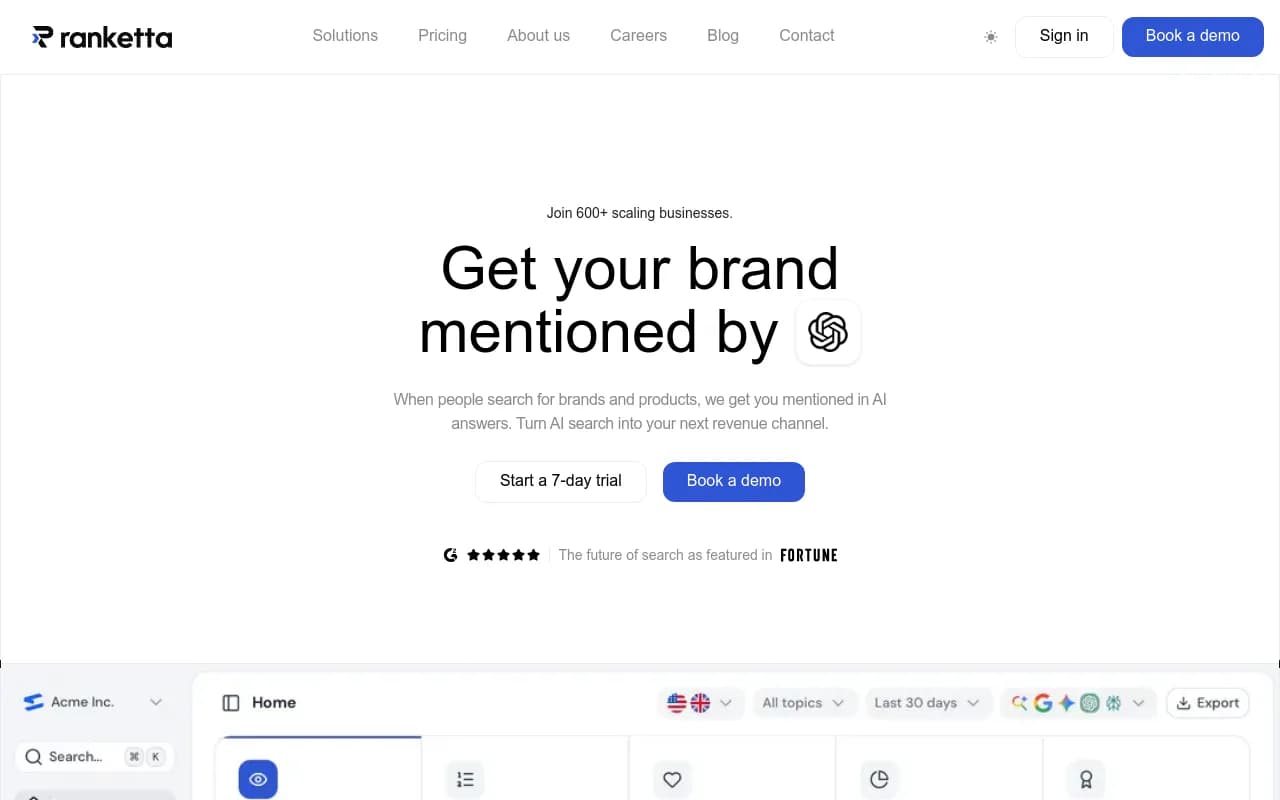
Ranketta leans toward ecommerce and product-focused teams. Its pricing page talks about merchandising product titles, attributes and descriptions, and the homepage mentions product feeds, Agent Mode and article generation. Self-serve plans are public, which is rare in this category.
Profound
Profound is the enterprise name in the space. Its own materials cite 700+ enterprise customers, a $155 million raise, and a data foundation of 2B+ real user prompts refreshed weekly. Enterprise covers up to nine answer engines, SSO/SAML, SOC 2, API access and ChatGPT Shopping, and its AI Marketer agents can publish to connected CMSs.

AthenaHQ
AthenaHQ is a YC-backed platform covering 8+ AI engines from the entry plan. It runs on credits (1 credit is roughly one AI response), has unlimited seats, and pairs monitoring with action-oriented workflows. Its ACE Citation Engine and content optimization agent are Enterprise-only.
Pricing: what the sources actually say
This is the messy part, and I would rather show you the mess than pretend it is clean. Third-party comparisons disagree with each other and sometimes with the vendors.
| Platform | Entry price (reported) | Mid tier | Top tier | Pricing model |
|---|---|---|---|---|
| Ranketta | EUR 29 (homepage snippet, Tracker plan) or EUR 79 (pricing page, Starter) | Growth EUR 199 | Scale EUR 449, then custom Enterprise | Tiers plus monthly credits |
| Profound | $99 Starter (older sources), $499 Lite (newer sources), or a free trial then custom | Growth $399 (yearly billing) | Custom Enterprise | Fixed tiers plus separate agent credits |
| AthenaHQ | $295/month monthly, about $245/month annual | Credit-based scaling | Custom Enterprise | Credits (3,600/month at entry) |
A few things to flag:
- Ranketta's EUR 29 Tracker plan (2 models, 30 prompts per model, one website, one country) appears in a search snippet but not on the pricing page I could verify. It may be an older or separate tier. Treat EUR 79 as the safer number until you check live.
- Profound's figures vary by source and by date. Some list a $99 Starter, others a $499 Lite tier, and one source says self-serve is free. Its own pricing now pushes most buyers toward a sales conversation.
- AthenaHQ has been reported with a first-month discount on monthly self-serve, so the first invoice may not match month two.
What the self-serve tiers actually give you
Ranketta self-serve
| Plan | Price/month | Models | Prompts per model | Credits | Websites | Countries |
|---|---|---|---|---|---|---|
| Starter | EUR 79 | 3 | 50 | 5k | 1 | 1 |
| Growth | EUR 199 | 4 | 100 | 15k | 2 | 3 |
| Scale | EUR 449 | 5 | 300 | 45k | 5 | 10 |
| Enterprise | Custom | Custom | 1,000+ | 45k+ | 5+ | 10+ |
All tiers include Google AI Overviews, AI Mode, ChatGPT, Gemini and Perplexity as selectable engines. Claude, Copilot, Grok, Alexa, Meta and a few retail assistants are marked Premium. MCP is included on every tier. A 7-day free trial is offered, and yearly billing gives two months free.
The notable bit: the top self-serve plan has 300 prompts across 5 models, which is a real monitoring footprint for one brand. SSO, an SLA and a dedicated AEO specialist only arrive at Enterprise.
Profound self-serve
The weak point is engine coverage. At the entry tier you are tracking ChatGPT only, according to several comparisons. To cover Perplexity and Google you are pushed to the $399 Growth tier, a roughly 4x jump, and even there content output is capped at about three articles a month. Enterprise unlocks up to nine engines, SSO/SAML, SOC 2, API access and dedicated Slack support.
To be fair to Profound, the data foundation is a genuine differentiator. Prompt volumes based on real user prompts, broken down by intent and demographics, are harder to replicate than estimated volumes.
AthenaHQ self-serve
AthenaHQ gives you 8+ engines and unlimited seats from the start, which is generous. The catch is the credit meter. Your real monthly cost depends on how many prompts you run across how many engines, how often. One comparison calls out the risk plainly: the credit model can cause sticker shock as query volume grows. Another agency reviewer said the better features sit in enterprise tiers and that clients who "can't justify $300+/month" got left without a workable GEO offer.
Keep in mind this page is written by AthenaHQ about Profound. So is Profound's page about AthenaHQ. Read both with that in mind.
What enterprise pricing actually unlocks
| Capability | Ranketta | Profound | AthenaHQ |
|---|---|---|---|
| SSO | Enterprise | Enterprise (SSO/SAML) | Enterprise (SAML/OIDC) |
| SOC 2 | Not confirmed in research | Enterprise | Published (Type I and II) |
| Dedicated support | Enterprise (AEO specialist, SLA) | Enterprise (Slack) | Enterprise (specialist, Slack, 2-hour SLA) |
| Agents and content engine | Agent Mode, article generation | AI Marketer (Aim) agents | ACE Citation Engine, content agent (Enterprise only) |
| Multi-brand workspaces | Multiple websites per plan | Multiple companies on Enterprise | Portfolio benchmarking |
| Engine coverage at entry | 3 of your choice | ChatGPT only | 8+ |
Look at that list. Almost none of it is about measurement quality. It is governance, support and automation. If your procurement team has a security questionnaire, those items are non-negotiable. If it does not, you are paying for things you will not use.
When you do need enterprise
Pay for the custom tier when at least one of these is true:
- Procurement requires SOC 2 reports, SSO and an enforceable SLA before any vendor gets signed.
- You manage many brands or business units and need workspace separation and portfolio-wide benchmarking.
- You track thousands of prompts across many markets and need volume pricing that does not scale linearly with credits.
- You want someone else to run the program, with a named specialist and a support channel.
Pick by profile. If your clients are Fortune 500 and procurement asks for SOC 2 first, Profound is the obvious shortlist entry. If you want action workflows, Shopify attribution and portfolio benchmarking, AthenaHQ fits. If you sell products online and want merchandising-focused tooling with transparent tiers, Ranketta is the one to test first.
When you do not
Skip enterprise if you are one brand, one or two markets, and a team of under ten. In that case your constraint is not data. It is execution. A tracker that tells you that you are invisible in 40% of buyer prompts is useless if nobody ships the pages that fix it.
There is also the question of the content itself. Promptwatch's research shows product pages are the most cited content type in ChatGPT at 22.4% of citations (Sep 28 to Oct 4, 2026), and that almost half of ChatGPT responses cite 10 or more unique domains. Many sources get cited per answer, so you do not need to be the biggest brand. You need to be one of the useful ones.
A decision framework that does not involve a sales call
- Count your prompts. Take your buyer questions, multiply by engines, multiply by markets. That number tells you whether Ranketta's 300 per model, AthenaHQ's credits or a custom plan fits.
- Count your engines. If you need Perplexity and Google AI Overviews, Profound's ChatGPT-only entry plan is out.
- List your compliance needs on one page. If SOC 2 and SSO are not on it, enterprise is optional.
- Run the same 50 prompts on two tools for 30 days. Fixed prompts, fixed engines, fixed scoring. Published vendor benchmarks should not substitute for this.
- Check what happens after the dashboard. Ask who writes and publishes the fix, and how you will know it worked.
The gap all three share
It is worth noticing what the comparison pages for these tools quietly admit. One analysis concluded that both Profound and AthenaHQ "measure the output of a GEO strategy. They do not build one." That is harsh and a bit overstated, since both have agents. But the agent features are exactly what gets gated behind enterprise contracts, which leaves self-serve buyers with a dashboard.
If you want execution included at a lower tier, look at platforms built around the full loop. Promptwatch is one example: it tracks prompts across ChatGPT, Gemini, Perplexity, Claude and Google AI Overviews from the real interfaces, shows which pages AI cites and which crawlers hit your site (IP-verified logs), then uses a Content Agent to write and publish pages to WordPress, Webflow or Framer, and measures whether they got crawled, cited and clicked. Pricing is public at promptwatch.com/pricing: Essential $95/month, Professional $245/month, Business $579/month, with the Content Agent starting at Business. There is a 7-day free trial and a free AI visibility report if you want a baseline first.

If you want to compare the wider field, the GEO software directory at bestgeosoftware.com lists dozens of alternatives, and Promptwatch's side-by-side comparison of GEO platforms covers features like crawler logs and visitor analytics that many trackers skip.
Other tools worth a look in the catalog if budget is the main constraint include [tool:peec-ai] and [tool:otterly-ai] for simple monitoring, and [tool:getmint] or [tool:workduo] as lower-cost alternatives named in the comparisons above.
A note on who is telling you what
Almost every source in this space is a vendor. Profound's article favors Profound. AthenaHQ's favors AthenaHQ. GetMint, WorkDuo, GEOly and Dageno write comparison pages that conclude with their own products. Ranketta's agency roundup says it ranks its own product alongside others and lists where it falls short, which is a refreshing admission, but it is still its own blog. Use these pages for feature lists and pricing structure, and ignore the verdicts.
Bottom line
You do not need enterprise pricing to get real GEO results. You need enough prompt coverage to see the gaps, enough engine coverage to avoid blind spots, and a way to ship fixes. Ranketta's public tiers, AthenaHQ's credit-based self-serve plan and Profound's growth tier can each get a lean team started. Enterprise earns its price when governance, multi-brand scale or managed support is a hard requirement. Otherwise, spend the difference on content, crawlability and the pages AI actually cites.
Before you sign anything, re-check each vendor's pricing page live. As this guide shows, the numbers move.
The agency behind this site, 1001 SEO Media, helps brands set up GEO programs without long-term contracts if you would rather have senior specialists run the strategy while you pick the tooling.