Key takeaways
- AI prompts are long and personal. Kevin Indig puts the average at about 23 words versus 4.2 for classic keywords, so a single "best X tool" prompt tells you very little about how real buyers see you.
- Build personas from real information needs (support tickets, CRM notes, reviews, Search Console questions), then let the persona produce prompts. Never build personas from prompts. That is circular.
- A workable starting point is about 15 prompts per persona, run several times per prompt, tracked per platform for at least 30 days.
- The prompt's intent changes which content gets cited, so a CFO's shortlist query and an engineer's how-it-works query can surface different winners.
- The biggest gap is the persona with the largest difference in visibility, position, and sentiment against your general audience baseline. Fix that one first.
Why generic prompt tracking misleads you
Most teams start AI visibility tracking the same way. They type "best [category] software" into a tool, add a few brand-name prompts, and watch a score. It feels like progress. It is mostly noise.
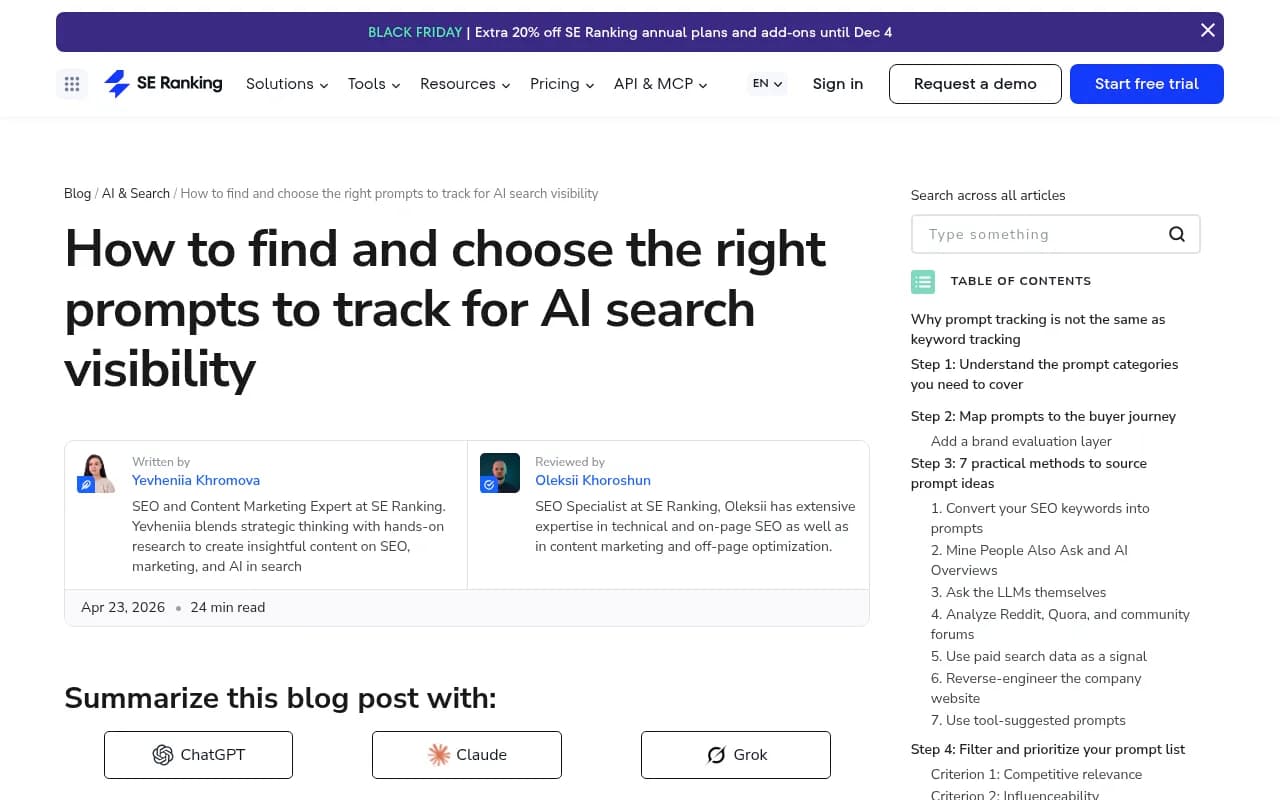
There are two problems. First, nobody asks AI the way they ask Google. SE Ranking's guide on choosing prompts makes the point well: there is no reliable query volume, no fixed positions, and technically infinite prompt variations. The same question can return different brand recommendations depending on session context, location, or history.
Second, the answers themselves are unstable. In research summarized by Kevin Indig on Search Engine Land, sampling alone produces 10-34% variance on identical prompts. Indig and AirOps looked at 815,000 prompt-page pairs and found that after running the same prompt three times in ChatGPT, only about 2.2-2.3% of citations remained constant. SISTRIX tracked 82,619 prompts over 17 weeks and found Google AI Mode replaces 56% of its cited sources every week, ChatGPT 74%.
So you cannot monitor "the" AI response. What you can do is sample the realistic range of questions your buyers ask, repeatedly, and read the pattern. Personas are the cleanest way to organize that sampling.
What a persona means in AI search tracking
In classic marketing, a persona is a profile on a slide deck. In prompt tracking, it is a working tool: a description of who is asking, what they care about, and how they phrase things. The persona is the translation layer between a human information need and a prompt.
Take Indig's example contrast. An enterprise IT buyer might ask "enterprise project management tools SOC 2 compliance audit logs". A price-driven individual asks "best free project management app". Same category, completely different prompts, likely different brands in the answer, and different sources cited.
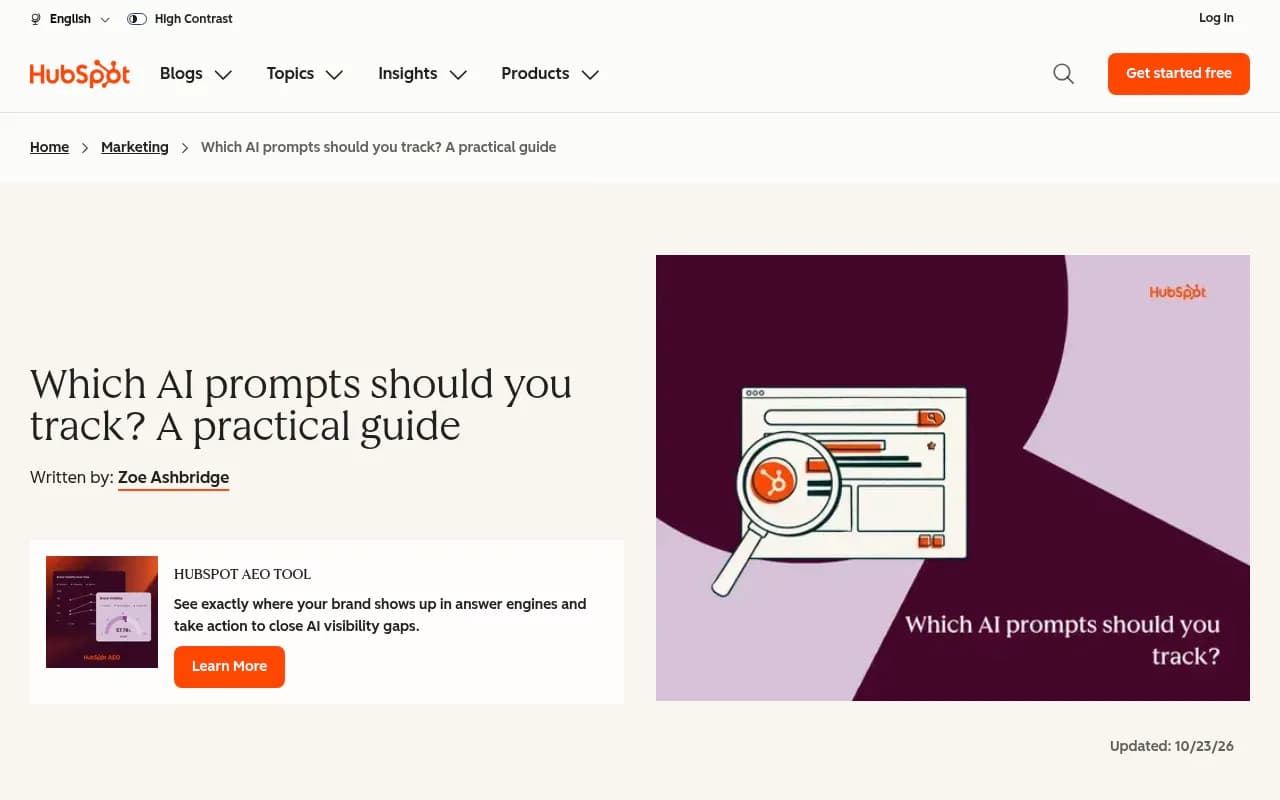
HubSpot's guide on which prompts to track gives a B2B version. A CFO asks for "software that shortens month-end close", while an Operations Lead asks how to "automate invoice approvals". Both may end up buying the same product. If your brand only shows up for one of them, you are invisible in half the buying committee.
Build the personas from data, not guesses
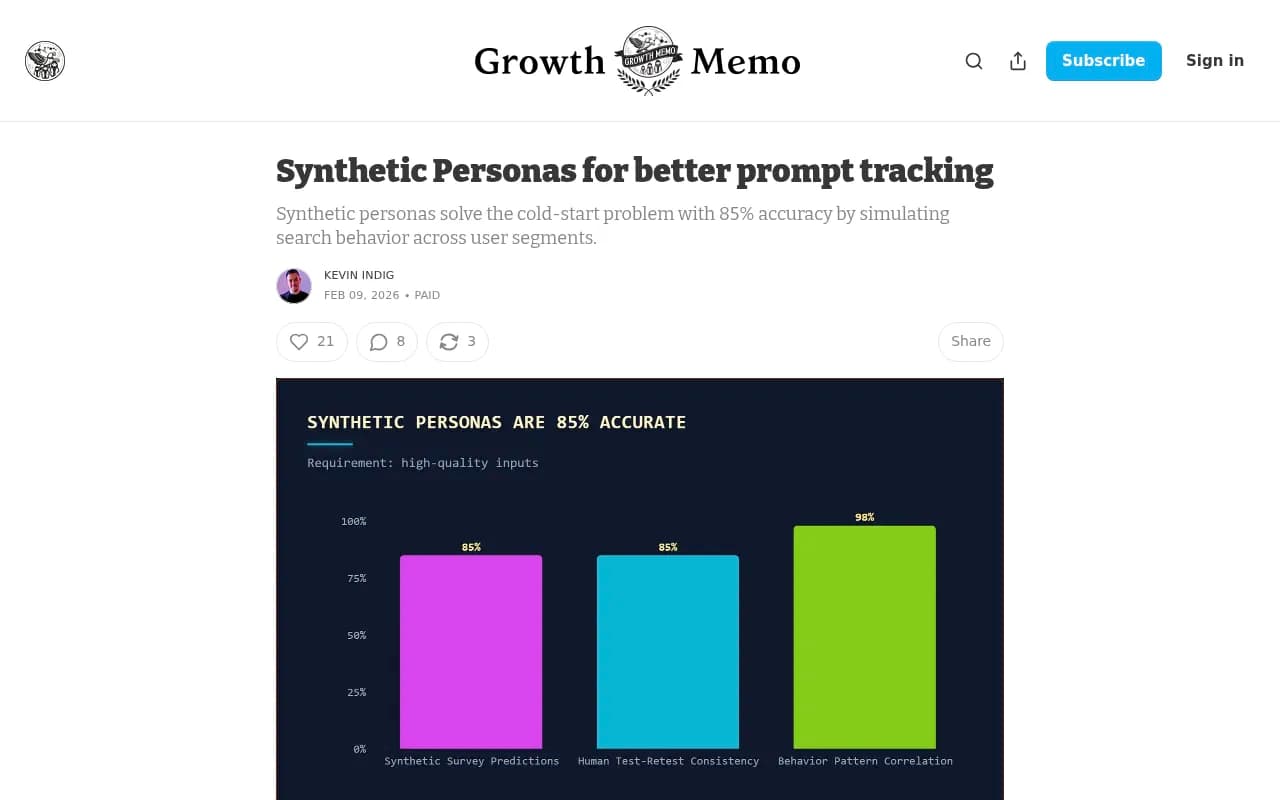
Traditional persona research takes weeks and goes stale. Synthetic personas are the faster route. Indig's argument is that personas built from behavioral and profiling data can simulate search behavior across segments at a fraction of the cost.
The supporting evidence is worth knowing, with its caveat attached:
- A Stanford and Google DeepMind study found synthetic personas trained on two-hour interview transcripts replicated participants' later survey answers with 85% accuracy, comparable to human test-retest consistency.
- A Bain pilot reported 50-70% time reduction and 60-70% cost savings on synthetic customer research.
- The catch: the Stanford result relied on rich input. Shallow inputs give shallow personas.
Where to get the input
Good sources are the ones that carry real buyer language:
- Support tickets and community forums
- CRM notes and sales-call transcripts
- Customer interviews and surveys
- Review sites such as G2 and Trustpilot
- Search Console queries phrased as questions, filtered with a regex, over the last 28 days and segmented by target country
Indig also recommends keeping the persona card short, at five fields, because every extra field is maintenance debt. I could not verify the exact five from the excerpt available, so pick the ones your team will actually keep updated: role, goal, main pressure or constraint, evaluation criteria, and the way they phrase questions is a sensible set.
The circularity trap
Do not build personas out of the prompts you already track. You would just be describing your own assumptions back to yourself. Start with user information needs, then ask the persona what it would type into an AI assistant.
Orbit Media has a practical version of this. Give the model a detailed buyer persona and ask it to predict, based only on that persona's role, goals, pressures, constraints, and evaluation style, 25 likely commercial-intent prompts for researching vendors. Tell it to write the way a real buyer would, with specific details. Then sanity-check the output against real customer language. If you can, ask an actual customer to read the list.
Turn personas into a prompt set
How many prompts per persona
The numbers practitioners converge on:
| Source | Recommendation |
|---|---|
| Kevin Indig (via SE Ranking) | About 15 prompts per persona, ~5 consecutive runs, once a week |
| Indig, Search Engine Land worked example | 40 seed prompts (12 brand, 12 category, 16 problem), tracked per platform |
| SE Ranking | Start with 20-40 prompts across 2-3 models, 30+ days before conclusions |
| Indig, synthetic personas memo | 15-30 trackable prompts per segment across intent levels |
In the Search Engine Land example, a B2B SaaS CRM tracks ChatGPT, Perplexity, Gemini, and AI Overviews separately, five runs per prompt per platform, weekly. The 28 category and problem prompts are then customized for three personas: CFO, IT, and marketing. Brand prompts stay as they are, since a brand query is a brand query regardless of who asks.
Keep a sensible mix
HubSpot suggests a starting ratio worth borrowing:
| Prompt type | Share of set | Why |
|---|---|---|
| Unbranded | 50-60% | Shows the biggest visibility gaps |
| Competitor | 20-30% | Shows who AI treats as the default options |
| Branded | 10-20% | Checks accuracy |
Branded prompts should mostly show your brand anyway. The decision often happens earlier. HubSpot cites Responsive research that 56% of tech buyers use generative AI to build vendor shortlists, which is why unbranded, research-stage prompts matter most.
Write prompts the way people write them
Bad persona prompt: "best CRM for CFOs". Better: "We are a 60-person B2B company, our CFO wants a CRM that integrates with NetSuite and gives us reliable forecasting. Which tools should we shortlist and what are the downsides?"
Include role, team size, budget, constraints, and a follow-up. That is how people actually write, and it is what changes the answer.
Also cover more than turn one. Tracking only the first message of a conversation is one of the flaws Indig lists, along with running each prompt once, blending platforms into one score, counting mentions without context, and a monthly cadence.
Why persona intent changes who gets cited
Personas differ in more than topic. They differ in intent, and intent changes which pages win. Promptwatch Data's breakdown of the content types ChatGPT cites (Sep 28 to Oct 4, 2026) shows it clearly:
| Prompt intent | Most cited content types |
|---|---|
| All prompts | Product pages 22.4%, landing pages 16.8%, listicles 13.6% |
| Commercial | Product pages 26.0%, landing pages 20.6%, listicles 15.0%, comparisons 7.9% |
| Informational | Product pages 19.1%, landing pages 13.9%, listicles 13.6%, how-tos 10.7%, docs 8.5% |
| Branded | Product pages 23.3%, landing pages 22.8%, reviews 5.6%, FAQ 4.8% |
A CFO building a shortlist writes commercial prompts and gets product pages, landing pages, and listicles. An engineer asking how something works writes informational prompts and sees more how-tos and docs. If your content library is all listicles and no docs, one persona will find you and the other will not.
There is also a fan-out angle. Promptwatch's ChatGPT query fanout data shows average fanouts per response at 2.15 in early December 2025 and about 1.84 by early March 2026, with average query length falling from about 117 characters to the high 80s. Use those dated averages rather than any single claim about how many searches a prompt triggers. My own inference, not a Promptwatch finding: different personas probably produce different fan-out queries, so persona-specific prompts test different retrievals, not just different wording.
How to spot the biggest gap
This is the payoff. Once every persona has its own prompt set and its own runs, compare them.
- Set a baseline. Run a general-audience set (no persona) so you have one number to compare against.
- Score each persona on visibility, average position, and sentiment. Keep platforms separate.
- Find the persona with the largest distance from baseline. A persona where you appear in 8% of answers while the general set shows 30% is your gap.
- Diagnose the type of gap by reading the metrics together.
| Symptom | Likely problem |
|---|---|
| Low share of voice for one persona | Coverage: you have no content for their questions |
| Mentioned, but late in the answer | Prominence: weak or generic positioning |
| Mentioned but never cited from your domain | Content or crawlability problem |
| Mentioned with negative or lukewarm claims | Reputation or messaging problem |
- Check the sources. Look at which domains and content types AI cites for that persona's prompts. If it is Reddit threads and G2 pages, a blog post will not fix it.
- Fix, then re-measure. Publish content aimed at that persona, wait for crawl and citation, and run the same prompts again.
To keep the data honest, review the prompt mix after the first month. If branded prompts keep returning accurate, positive answers, move those slots to unbranded or competitor prompts where you learn more. Merge near-duplicate phrasings too, since they waste tracking slots.
Tools that support persona-based tracking
You can run all of this in a spreadsheet and a few chat windows. It works for a first pass and falls apart at scale: five runs, several platforms, weekly, per persona adds up quickly.
Promptwatch has personas built in. You define custom personas, stack them, and get persona insights showing visibility, position, and sentiment per persona on a radar chart against the general audience, with the persona that has the biggest gap called out. That is exactly the comparison described above, without the manual work. It also tracks the real interfaces of ChatGPT, Gemini, Perplexity, Google AI Overviews, and others, and can then help close the gap with content gap analysis and the Content Agent. See the prompt tracking page for details, and confirm current plans at promptwatch.com/pricing.

Other tools in the catalog mention persona features in their positioning:
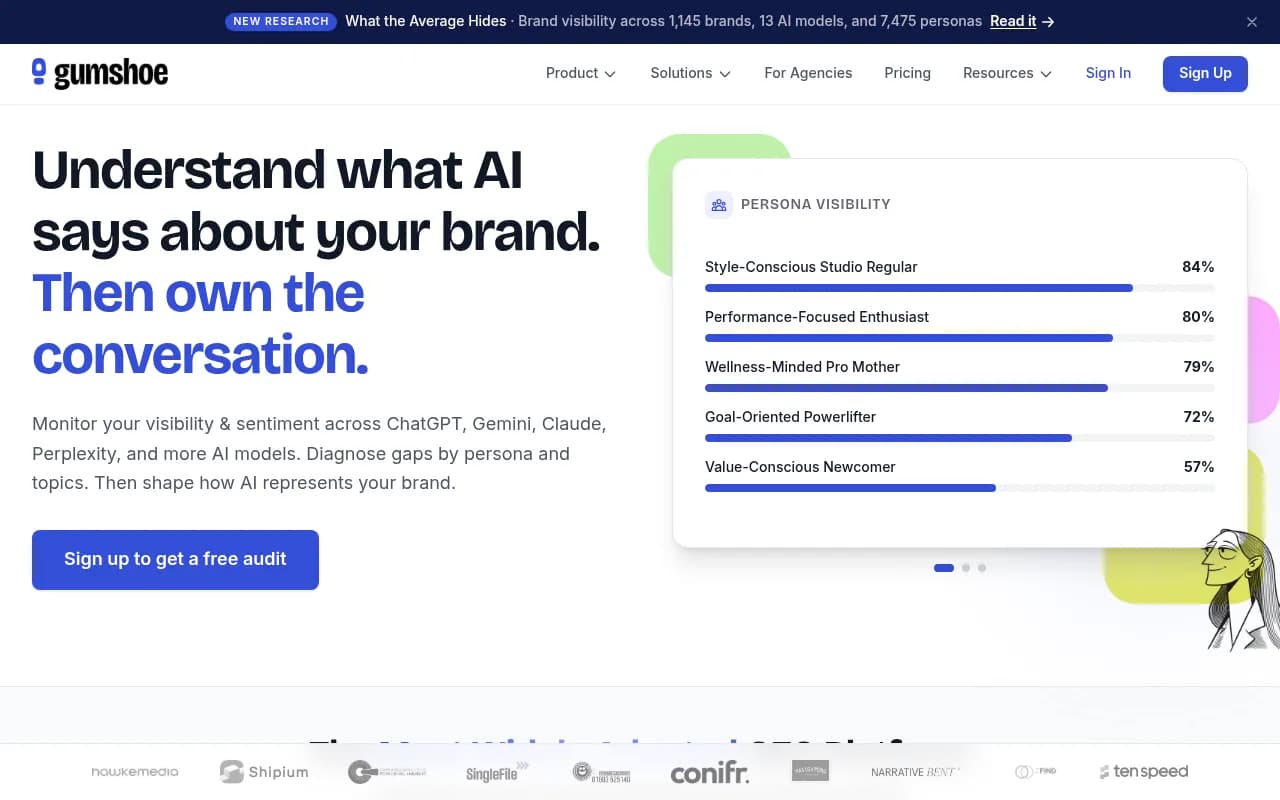
Gumshoe AI describes itself as persona-driven AI visibility and GEO scoring.
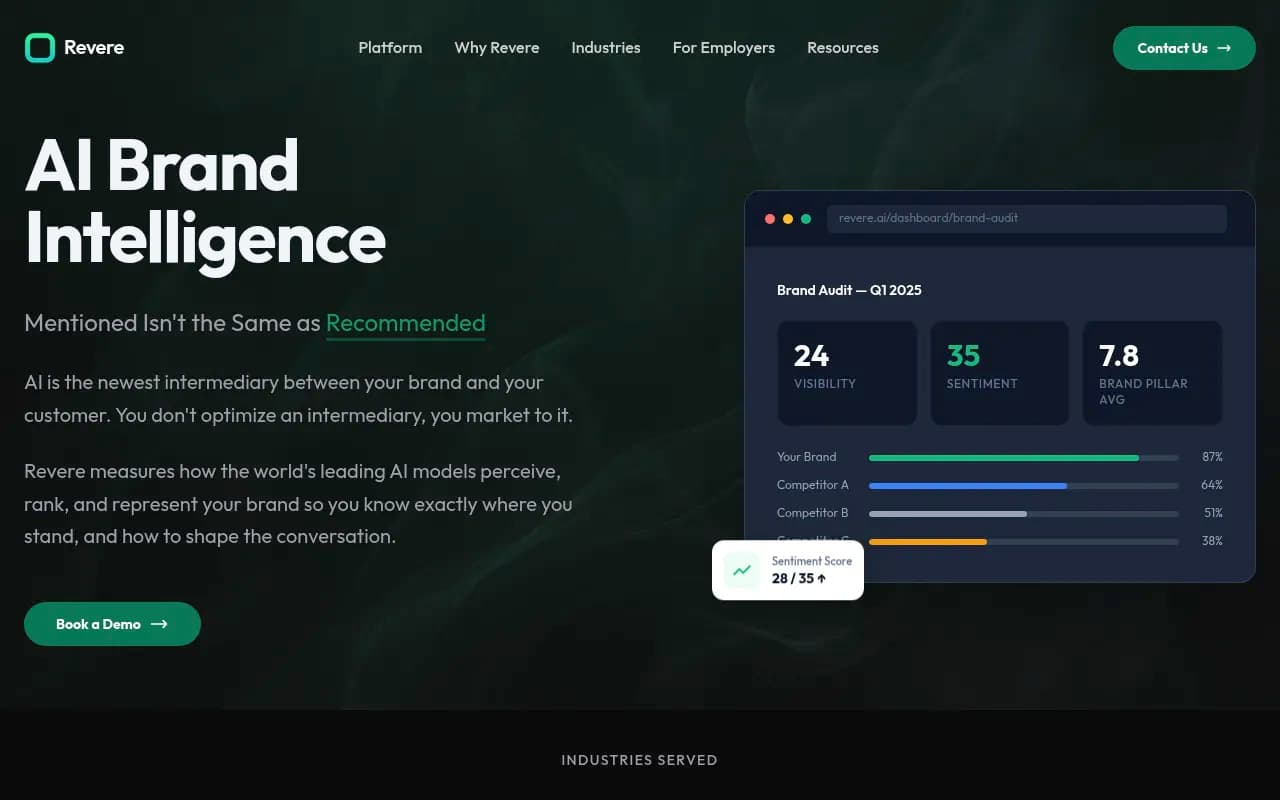
Revere is listed for persona-level AI prompt analytics aimed at enterprise brands.
Conductor lists AI visibility tracking with persona customization.
I have not compared pricing or depth across these, so check each one against your needs before committing. For broader browsing, the GEO software directory at bestgeosoftware.com lists many more options.
A simple weekly routine
- Monday: review last week's persona runs, per platform, per persona.
- Pick the one persona with the widest gap and the one prompt cluster driving it.
- Check which sources AI cited for that cluster and what content type they were.
- Ship one piece of content or one fix aimed at that persona.
- Re-run the same prompts next week and compare against the baseline, not against last week's single run.
Give it 30 days before deciding anything. A single week of data on a system where 74% of ChatGPT sources can change weekly will mislead you.
Common mistakes
- Too many personas. Fifteen prompts each adds up. Have as many as you want, as long as they are distinct and useful.
- Personas built from your own prompt list.
- Shallow inputs. The 85% accuracy figure came from two-hour interviews, not a job title and a guess.
- One blended score across platforms.
- Treating a persona gap as a content volume problem when it is really a source problem, such as missing review-site presence.
- Never refreshing the personas. Review them each quarter against new support tickets and sales calls.
Bottom line
Pick two or three personas that map to real buyers, write 15 realistic prompts for each, run them repeatedly on each platform, and compare every persona against a no-persona baseline. The one furthest below baseline is your biggest gap, and the sources AI cites for it tell you what to fix first.