Key takeaways
- Persona context can change which brands AI recommends, but only some kinds of context do. In Gander's study, buyer values and affiliations cut national-chain recommendations from 59% to 23%, while age and gender barely moved anything.
- Radyant's study of 17,929 chats found swings of up to +24 percentage points in visibility for single brands, strongest in Google AI Overviews and Gemini and largely absent in ChatGPT.
- Both studies are vendor research in single verticals with small prompt sets. Treat them as directional, not as laws.
- Natural volatility is large. Asking ChatGPT the same question twice changes about half the recommended companies, so one query proves nothing.
- The practical response is to monitor by persona, find where your brand is missing for a given buyer type, and publish content that speaks to that buyer.
What persona-based AI perception actually means
An AI assistant does not hold one fixed opinion of your brand. It builds an answer from the prompt in front of it, and the prompt often includes clues about who is asking: a job title, a company size, a stated worry, a preference. Change those clues and the answer can change with them.
The common claim is that a CFO gets an answer about ROI and security while a small business owner gets one about price and ease of use. That is plausible, and a lot of vendor content repeats it. Some of it also claims that models infer your persona from browsing history and interaction patterns. I could not find primary evidence for that part, so I would not build a strategy on it. What can be measured is simpler: if a buyer tells the model who they are, does the answer move?
Two 2026 studies tried to measure exactly that.
What the research shows
The Gander study: values beat demographics
Gander ran a B2B test in commercial cleaning. It used 10 buying questions across ChatGPT, Perplexity, Gemini and Google AI Overviews, ran each question 10 times per version, and compared every version to a no-context baseline. Only one persona sentence was added per version, so a single variable changed at a time. You can read the full write-up in Gander's persona study.
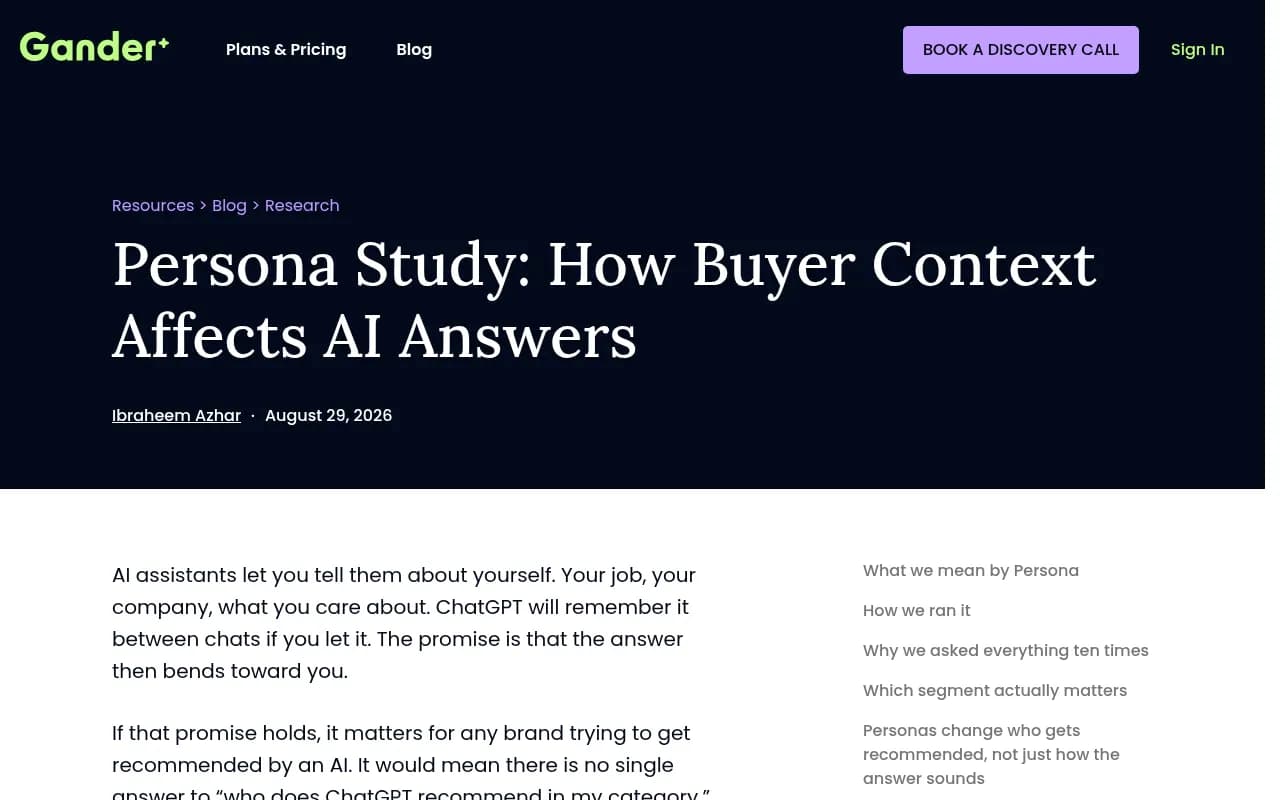
They tested four persona types:
| Persona type | Example sentence added | Effect on answer language |
|---|---|---|
| Firmographic | Mid-sized commercial real estate firm managing several office buildings | Office and building talk rose from about 4 to about 14 mentions per answer |
| Psychographic | Skeptical of big national chains, burned before, very price-sensitive | Price and value talk rose from about 3 to about 10 |
| Sociographic | Part of a local business owners' association, prefers locally-owned providers | Local and independent talk rose from under 2 to about 13, the largest shift |
| Demographic | 52-year-old man | Almost nothing moved, about the same as no persona |
The headline: buyer values and affiliations cut national-chain recommendations from 59% to 23%. Age and gender did almost nothing.
That makes intuitive sense once you think about it. A model can act on "prefers locally-owned providers" because it maps directly to attributes of businesses. "52-year-old man" maps to nothing useful about a cleaning company. Persona details work when they translate into criteria the model can match against your brand's attributes.
The volatility problem
Here is the part that should make you cautious. Gander also measured baseline churn. Asking ChatGPT the identical question twice changes about half of the recommended companies. On Gemini it is closer to 7 in 10. So a persona effect only counts if it exceeds that natural noise, and a single screenshot of ChatGPT recommending you to a "CTO" is anecdote, not evidence.
This is why repeated runs matter. Gander ran each question 10 times per version for exactly this reason.
The Radyant study: models differ a lot
Radyant (Yannick Reihs and Niklas Buschner) tracked 64 prompts with eight buyer personas across five AI models in the funnel builder software category. The study ran from March 18 to May 10, 2026, covering 17,929 chats, and was published in June 2026. They used Peec AI for tracking.
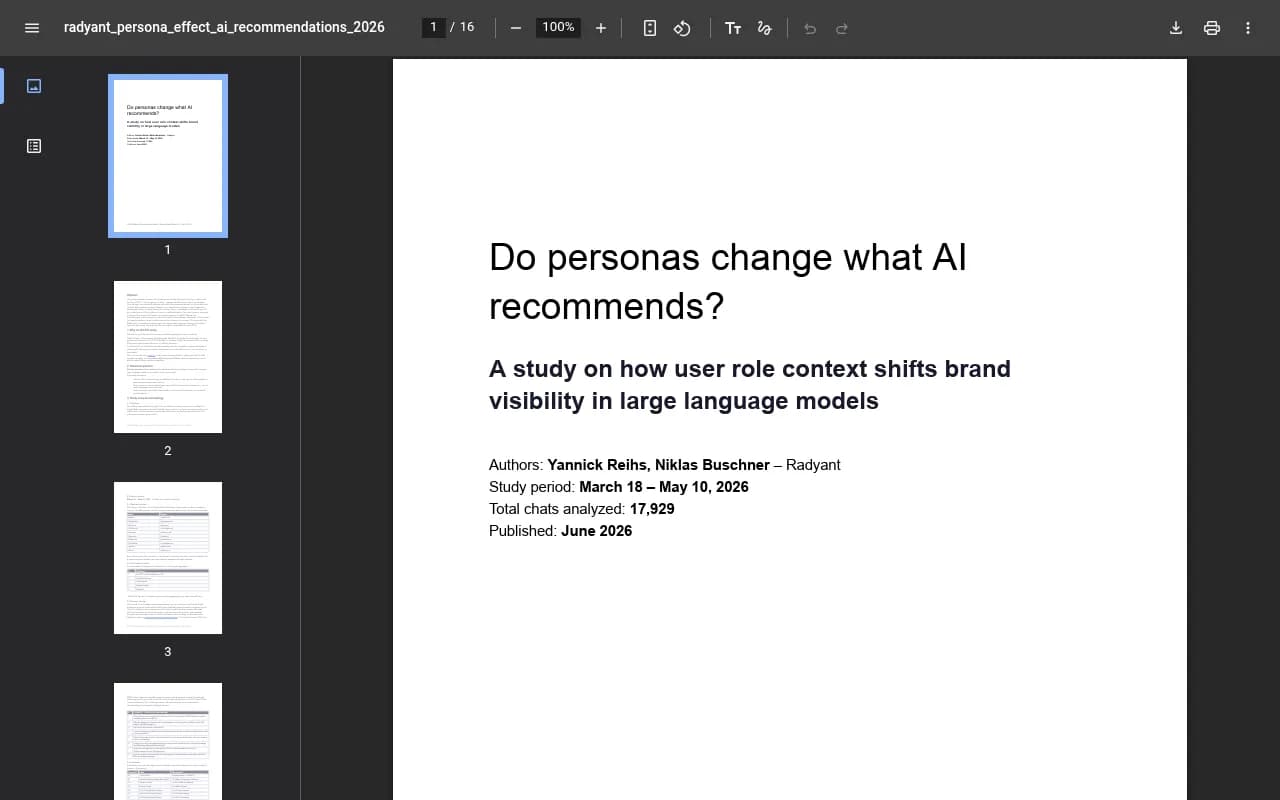
Their abstract reports absolute swings of up to +24 percentage points in visibility and +9 points in share of voice for individual brands. The effect looked strongest in Google AI Overviews and Gemini, and largely absent in ChatGPT. I have only the abstract and setup, not the per-model tables, so I would not quote specific brand numbers beyond that. The full PDF has the per-brand shifts.
Two things stand out. First, "I'm a CEO" style role tags did move recommendations in some engines. Second, model choice matters: a persona strategy that pays off in Gemini may do nothing in ChatGPT.
How the two studies fit together
They point the same way with different emphasis. Gander says the kind of persona detail matters (values and affiliation over demographics). Radyant says the engine matters (Google surfaces over ChatGPT). Both are vendor studies in one vertical each, with limited prompt sets. A different category, like consumer products or healthcare, could behave differently. Run your own test before changing strategy.
Why persona context changes answers
A model produces an answer by combining the user's prompt with what it retrieves and what it learned in training. In search-enabled products, the prompt gets turned into web searches, often called query fan-outs. Promptwatch Data shows the measured average was 2.15 searches per response in early December 2025 and about 1.84 by early March 2026, with average fan-out query length falling from about 117 characters to the high 80s. By April 2026 the data showed fan-out queries around 53 characters. See Promptwatch's ChatGPT query fan-out data for the daily series.
Why does that matter for personas? A persona detail only influences which sources are retrieved if it survives into the search queries. Short queries of six to eight words carry little persona context. The persona may still shape how the model writes the final answer, but the pool of pages it draws from can be nearly persona-blind. That is one plausible reason the effect looked weak in ChatGPT in Radyant's data. It is my reading, not something either study proved.
Intent changes citations too
Persona is not the only buyer variable. Buyer intent and stage also change what gets cited. Promptwatch's content type data for Sep 28 to Oct 4, 2026 shows:
| Prompt intent | Top cited content types |
|---|---|
| Commercial | Product pages 26.0%, landing pages 20.6%, listicles 15.0%, comparisons 7.9% (almost 70% combined) |
| Informational | Product pages 19.1%, landing pages 13.9%, listicles 13.6%, how-tos 10.7%, docs 8.5% |
| Branded | Product pages 23.3%, landing pages 22.8%, reviews 5.6%, social posts 3.0% |
Promptwatch's report does not segment by persona, so treat this as a related lever, not proof of persona effects. Still, it tells you something practical: a branded prompt from someone already evaluating you pulls in reviews at more than three times their overall share. If your reviews tell a story that does not match your positioning, a skeptical buyer sees that story first.
What the vendor FAQs get right and wrong
Some vendor pages, like Hop AI's FAQ on persona perception, describe a CFO getting ROI and compliance framing while a freelancer gets creative features and community support. That framing is useful as a thinking exercise.
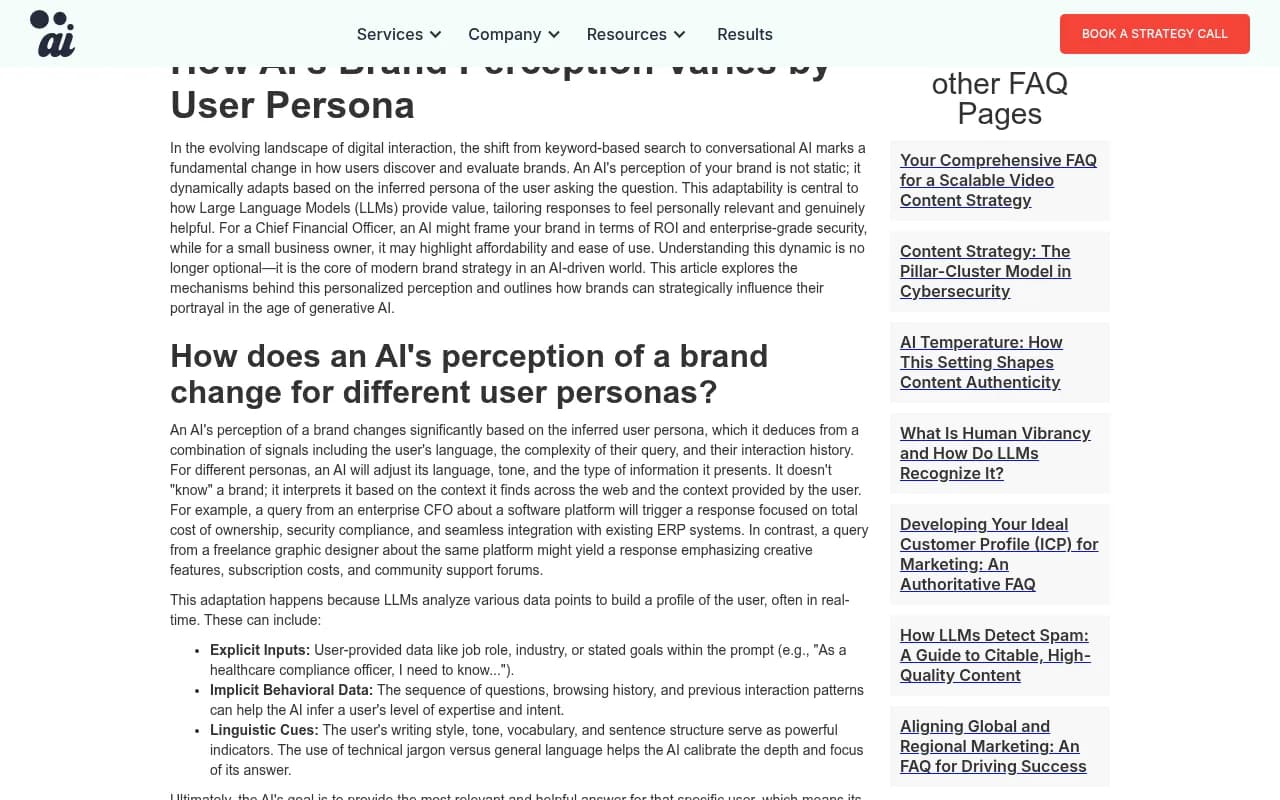
Be careful with the mechanism claims, though. The idea that models build a profile from linguistic cues and behavioral history is asserted, not demonstrated in the research I reviewed. What the studies actually tested is explicit persona context: text in the prompt. Plan around that.
A practical framework: audit by buyer type
Step 1: Pick personas that map to real criteria
Gander's results suggest skipping demographics. Choose persona details that change what a good answer looks like:
- Company size and industry (firmographic)
- Priorities and attitudes such as price sensitivity, risk aversion, distrust of big vendors (psychographic)
- Affiliations and preferences such as local, independent, open source, enterprise-only (sociographic)
- Role, if the category has distinct decision makers, as in Radyant's CEO versus agency founder setup
Four to eight personas is plenty. Radyant used eight.
Step 2: Hold the question constant, change one sentence
Take your core buying prompts, like "best [category] for [use case]", and append one persona sentence per version. Keep a no-context control. This is the same single-variable design Gander used, and it is the only way to attribute a change to the persona.
Step 3: Run it many times, across engines
Because of the churn numbers above, one run is useless. Repeat each prompt-persona pair many times and look at averages. Track ChatGPT, Gemini, Google AI Overviews, Perplexity and others separately, since Radyant saw big model differences.
Step 4: Read the gaps by metric
For each persona compare against the control:
- Did your visibility rise or fall?
- Did your position in the list change?
- Did the language describing you change (price-focused, enterprise-focused, local-focused)?
- Did competitors with a clearer persona position take your slot?
A drop for one persona is the useful finding. It tells you that when this buyer signals who they are, the model no longer thinks you fit.
Step 5: Fix with persona-specific content
If you vanish for the price-sensitive skeptic, you probably lack content that addresses price and trust directly. If you vanish for the "local, independent" buyer, you may need pages and third-party mentions that make your local presence explicit. Radyant's conclusion points the same direction: brands with well-positioned, persona-specific content could gain systematically.
Write headings that read like search queries, with the entity and category up front, so the fan-out queries can find you. A page titled "Pricing for small teams" can match a persona-flavored search. A page titled "Our approach" cannot.
Tools for persona-level monitoring
You can run the audit manually with a spreadsheet, but it gets tedious quickly given the repeat-run requirement. Several platforms in the directory support persona-style tracking in some form.
Promptwatch supports custom personas and persona stacking, so you can prompt like your actual buyers. Its persona insights show visibility, position and sentiment per persona on a radar chart against the general audience, and flag the persona with the biggest gap. It also monitors the real interfaces of ChatGPT, Google AI Overviews, Google AI Mode, Gemini, Perplexity and others rather than only APIs, which matters since user-facing answers can differ from API outputs. After you find a gap, its Content Agent and gap analysis help you publish the pages to close it, and crawler logs plus page tracking show whether those pages get read and cited. Its pricing starts at $95/month, and there is a 7-day free trial on monthly plans.

Other platforms in the catalog mention persona features in their positioning:

Peec AI, the platform Radyant used for its study, tracks visibility, share of voice, sentiment and position across multiple models and languages.

Profound is another well-known option for tracking visibility across AI engines.

| Tool | Persona angle | Best for |
|---|---|---|
| Promptwatch | Custom personas, persona stacking, radar chart vs general audience, plus content and crawler tooling | Teams that want to find gaps and fix them in one place |
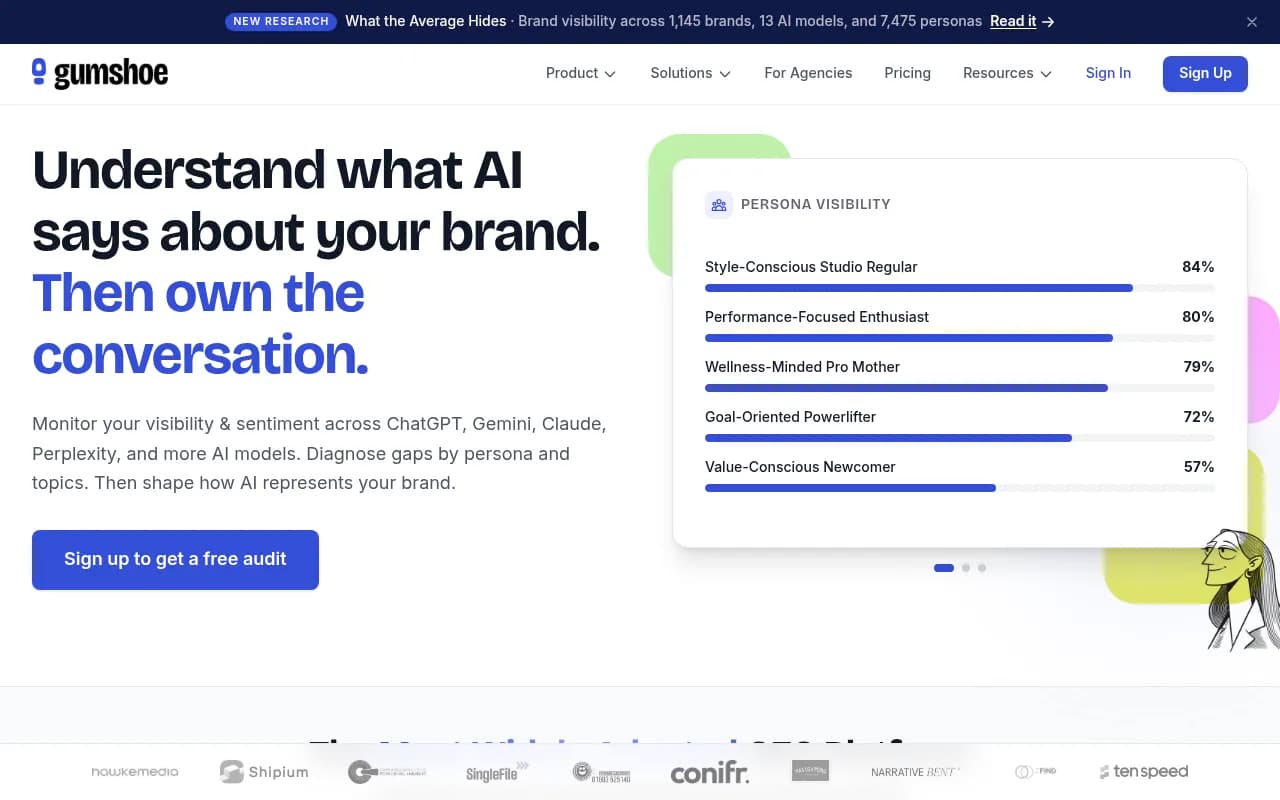
| Gumshoe AI | Persona-driven scoring | Teams starting with persona-led GEO scoring |
| Revere | Persona-level prompt analytics | Enterprise brands |
| Conductor | Persona customization in AI visibility tracking | Existing Conductor SEO users |
| Peec AI | Prompt tracking used in Radyant's study | Multi-language monitoring |
Check each vendor's current feature set before buying, since I did not compare their pricing or depth. For a wider look, the GEO software directory at bestgeosoftware.com lists more options.
Common mistakes
Reading one answer as a result
Given that identical questions change about half of ChatGPT's recommended companies, a single persona prompt showing you or missing you means nothing. Aggregate.
Using demographic personas
Age and gender barely moved Gander's results. Don't spend your testing budget there. Test values, affiliations and firmographics.
Assuming one engine speaks for all
Radyant saw the effect concentrated in Google AI Overviews and Gemini and largely absent in ChatGPT. If your buyers use ChatGPT, persona work may show smaller returns than your Gemini data suggests.
Over-segmenting your content
You do not need a page for every micro-persona. Pick the two or three buyer types whose criteria differ most and make sure your content states, plainly and specifically, how you serve each. Persona-driven content should reflect real brand strengths. If you claim to be the affordable local option when you are not, review sites and Reddit threads will contradict you, and models read those too.
Ignoring the baseline
Without a no-context control, you cannot tell a persona effect from drift. Always keep one.
What to expect
The research is early. Two vendor studies, two verticals, modest prompt counts. The consistent signal is that persona details tied to concrete buying criteria can reshape recommendations, sometimes dramatically, and that engines differ in how much they respond. The less glamorous signal is the churn: half of ChatGPT's recommended companies can change between two identical runs.
So the sensible move is modest and measurable. Pick a handful of buyer types, test them against a control with repeated runs, find the persona where you disappear, and publish content that speaks to that buyer's actual criteria. Then rerun the test a month later and see whether the gap closed.
If you want help planning that kind of program, 1001 SEO Media runs GEO work for brands and uses Promptwatch for AI visibility tracking.