Key takeaways
- Claude Code recommends libraries, APIs and tools while developers work. If you sell to developers, whether it names you is now a measurable distribution question.
- There are two signals worth tracking: what Claude Code says when you prompt it (monitoring), and whether Anthropic's fetchers can reach your pages (crawler logs).
- Claude's citation crawler grew from about 30 visits a day in December 2025 to several thousand a day by mid-April 2026, but it is still only about 1% of tracked AI crawler traffic.
- Start with 10 to 20 implementation-style prompts, a competitor list and a baseline, then review monthly.
- Unblock Claude-User and ClaudeBot first. A page that cannot be fetched cannot be recommended from a live lookup.
Why Claude Code visibility is its own problem
Most AI visibility advice is written for consumer chatbots: someone asks ChatGPT for the best CRM and a brand list comes back. Claude Code is different. A developer types "add payments to this app" or "set up transactional email" in a terminal, and the agent picks a library, writes the integration and moves on. Nobody reads a list of ten options. The agent chooses one.
That makes the stakes lopsided. If you are the SDK it reaches for, you get adopted in five minutes. If you are not, the developer may never learn you existed.
I should be upfront about what is and is not measurable here. Claude Code answers come from two places: what the model learned in training, and what it fetches live when it searches the web or opens a doc page. You can influence the second one more directly than the first. And you can only observe either through indirect signals, because there is no Claude Code equivalent of Search Console.
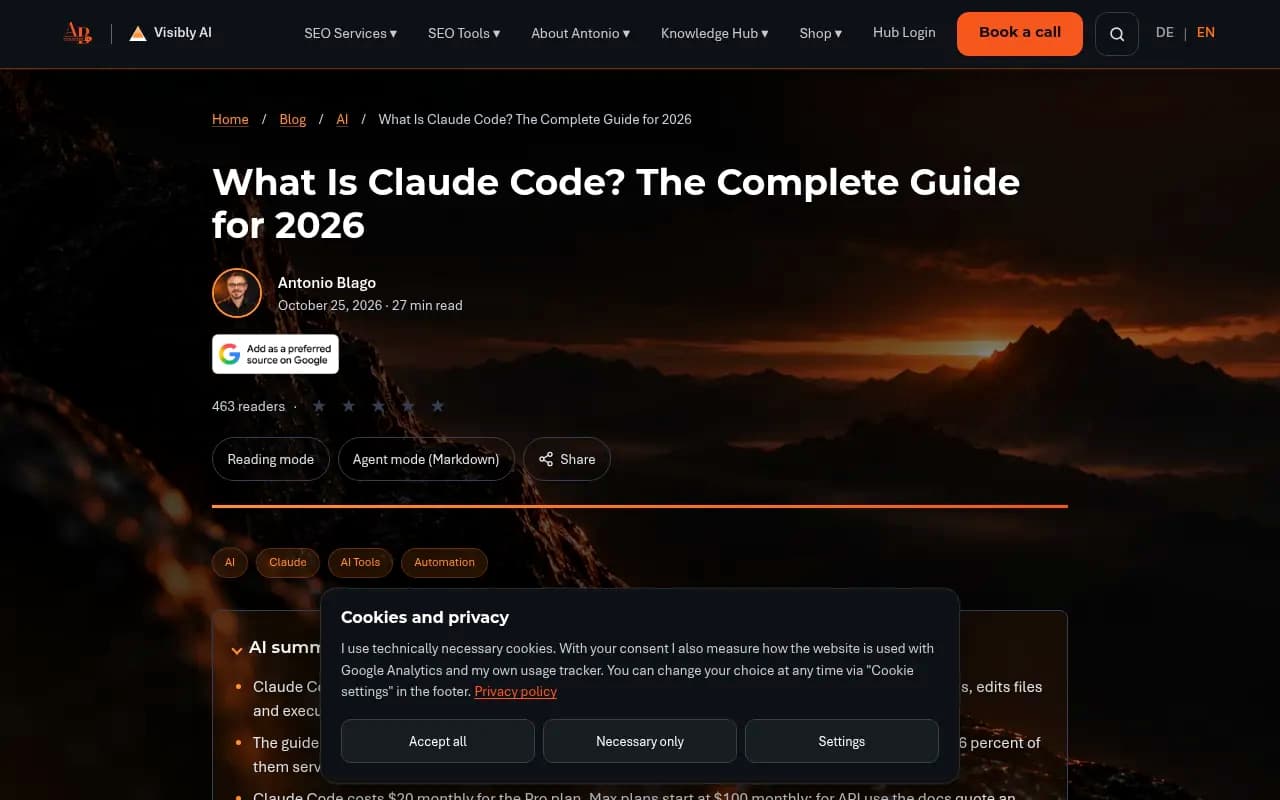
If you are new to Claude Code itself, Antonio Blago's complete guide is a decent map of the building blocks (CLAUDE.md, skills, subagents, hooks, MCP, plan mode). You need to understand how developers configure it, because project-level instructions can steer which tools get recommended.
What you can and cannot track
Be honest with yourself about this before buying anything.
| Signal | What it tells you | How to get it | Reliability |
|---|---|---|---|
| Prompt responses from coding agents | Whether your brand, API or SDK is recommended | Prompt monitoring tools, or manual runs | Medium, answers vary run to run |
| Claude-User and ClaudeBot hits in logs | Whether Anthropic fetchers can read your pages | Server or CDN logs | High, it is direct evidence |
| Citation and source lists | Which pages and third-party sources feed answers | Monitoring platform with citation data | Medium to high |
| Referral traffic from Claude | Whether clicks arrive from Claude surfaces | Web analytics | Low volume, partial attribution |
| Implementation success | Whether the agent can actually use your API | Manual test runs, specialist tooling | High for the tests you run |
The last row matters more than people expect. Being recommended is one thing. Having the agent produce working code against your API is another. If the docs are ambiguous, the agent may recommend you and then fail, and a developer will switch to whatever worked.
Step 1: Define what you are tracking
Write down the entities Claude Code might need to name. For a developer-facing company that usually means:
- Your company and product names, including common misspellings
- API names, key endpoints and SDK package names (npm, PyPI, and so on)
- Documentation domains
- Three to six direct competitors
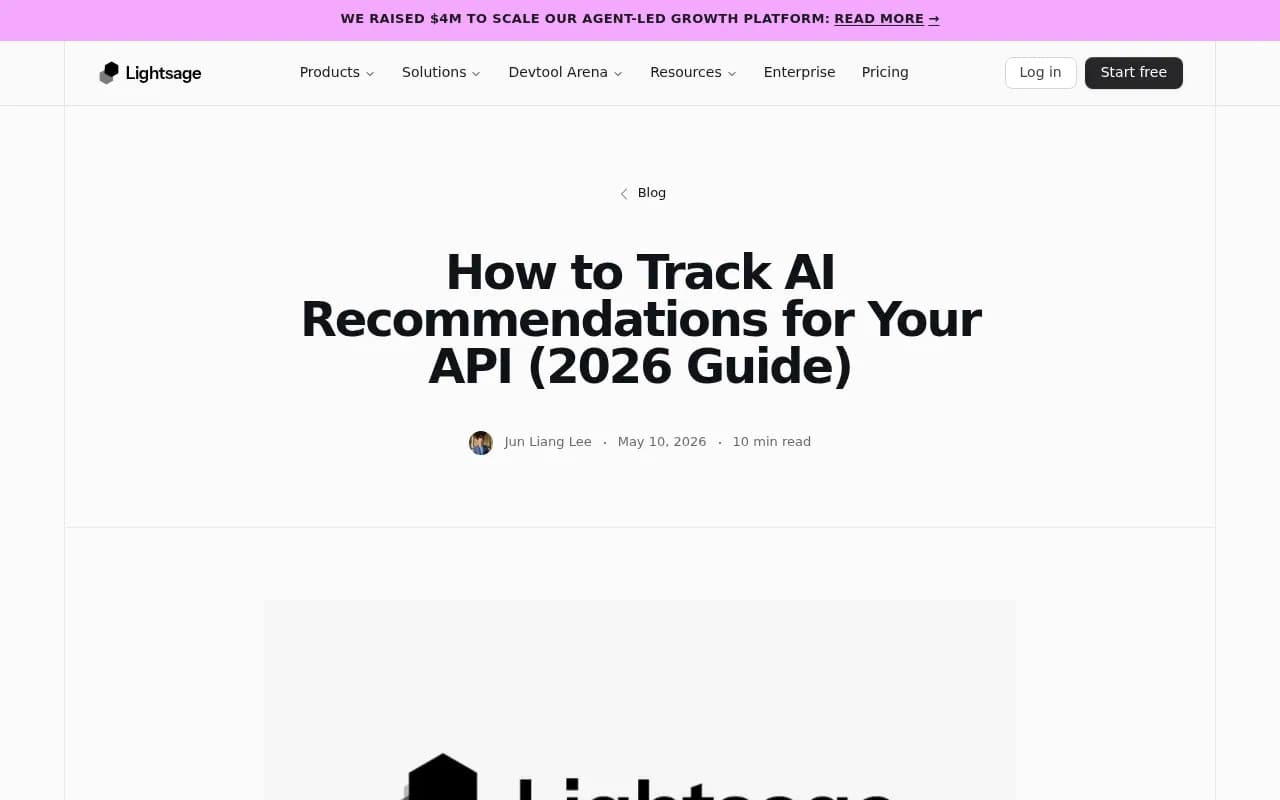
This is the same starting setup the Lightsage team describes in their guide to tracking AI recommendations for APIs: add the API name, endpoints and SDK names, add direct competitors, then define implementation prompts for your top use cases. It is vendor content from a company that sells coding agent measurement, so take its claim of being the only option with some salt. The workflow itself is sensible regardless of tool.
If your brand name is also a common word, write that down now. You will need an instruction later that tells your monitoring tool what counts as a real mention.
Step 2: Write implementation prompts, not brand prompts
This is where most setups go wrong. Prompts like "what is [YourBrand]?" tell you whether the model knows you. They say nothing about whether it recommends you when it matters.
Write prompts the way a developer actually asks an agent for help:
- "Add webhook signature verification to my Express app"
- "I need to send transactional email from a Next.js project. What should I use?"
- "Set up rate-limited API calls to [category] in Python"
- "Compare options for [your category] and pick one"
Aim for 10 to 20 prompts spread across three types:
- Open recommendation prompts where no brand is named ("what should I use for X")
- Comparison prompts that name you and a competitor
- Task prompts where the agent has to write real code
Pick your top three use cases and write several phrasings of each. Keep a plain spreadsheet of them. You will rerun the same set every month, so stability matters more than cleverness.
Step 3: Set up prompt monitoring
You have two options: run prompts manually inside Claude Code, or use a platform that does it on a schedule across countries and models.
Manual runs are fine to start. Open a clean project directory with no CLAUDE.md of your own (or a deliberately minimal one), run each prompt, and record the first recommendation, the order of any alternatives, and whether the agent searched the web. Run each prompt three times. One run proves nothing because answers vary.
Manual testing stops scaling around the point where you want daily data, multiple regions or a competitor trend line. At that point a platform makes sense. Promptwatch tracks Claude Code, Codex and OpenCode alongside ChatGPT, Gemini, Perplexity, Google AI Overviews and others, so coding agent recommendations sit in the same view as your wider AI visibility, plus citations and AI crawler logs. Its prompt tracking lets you load the implementation prompts from Step 2, and the Visibility Score, Share of Voice and Position metrics show whether you are mentioned, how often against competitors, and how early in the answer.

Other tools in the category cover parts of this, mostly the chat-assistant side. If you are comparing, the directories at bestgeosoftware.com and ai-rank-tools.com list dozens. Check each one's model list for coding agents specifically, because many only cover ChatGPT, Perplexity and Gemini.
| Approach | Covers coding agents | Covers crawler logs | Good for |
|---|---|---|---|
| Manual runs in Claude Code | Yes | No | First baseline, small prompt sets |
| Promptwatch | Claude Code, Codex, OpenCode | Yes, IP-verified | Ongoing tracking plus fixes |
| Lightsage | Claude Code, Codex, Cursor | Not its focus | Devtool teams measuring implementation success |
| Profound, Otterly, AthenaHQ, Peec AI | Not confirmed in our research | Generally no | Brand mentions in chat assistants |
I could not verify pricing for most of these, so confirm current plans on each vendor's site. Promptwatch's are at promptwatch.com/pricing, and there is a free AI visibility report if you want a quick read before committing.
Step 4: Check that Claude can reach your site
This step is cheap, verifiable and often skipped. When someone asks Claude a question or uses Claude Code and it fetches a cited page, the request comes from the Claude-User user agent. ClaudeBot and Claude-SearchBot are the other Anthropic agents you will see.
Promptwatch Data's report on the Claude citation crawler tracked this from December 2025 to April 18, 2026. Daily visits went from about 30 a day in mid-December (roughly 0.04% of tracked AI citation crawler traffic) to several thousand a day by mid-April, a rise of more than 100x in four months. The share peaked at 1.73% of tracked requests in mid-April and sat at 1.09% on April 18. Over the whole 130-day window it averaged 0.45%.
That last number is the reality check. Claude is growing fast, but it is still about 1% of tracked citation crawler traffic while OpenAI dominates the rest. The AI crawler traffic report (June 8 to September 6, 2026) shows OpenAI at 79.8% of IP-verified requests in the last week, down from 94.8% in mid-June. Treat Claude as a secondary channel to unblock and watch, not the place for your whole optimization budget. Developer audiences are the exception, since they are the ones using Claude Code.
Do this:
- Open your robots.txt and confirm you are not disallowing Claude-User or ClaudeBot. The robots.txt generator for AI helps if you want to write rules deliberately.
- Check your CDN or WAF bot rules. Plenty of sites block these agents by default through a managed rule set, and nobody remembers turning it on.
- Search your server or CDN logs for Anthropic user agents and note the weekly count. That is your baseline.
- Compare it with the public mix. Promptwatch advises that a provider which is large in the benchmark but near zero in your logs suggests you are blocked or unreachable for that provider.
A caveat: only requests whose source IP matches the operator's published ranges should count, because user agents are easy to spoof. Raw log greps will include some fakes. Promptwatch's AI crawler logs verify IPs against each operator's ranges and work with Cloudflare, Vercel, Fastly and raw logs. A free alternative for a first look is the AI crawler URL inspector.
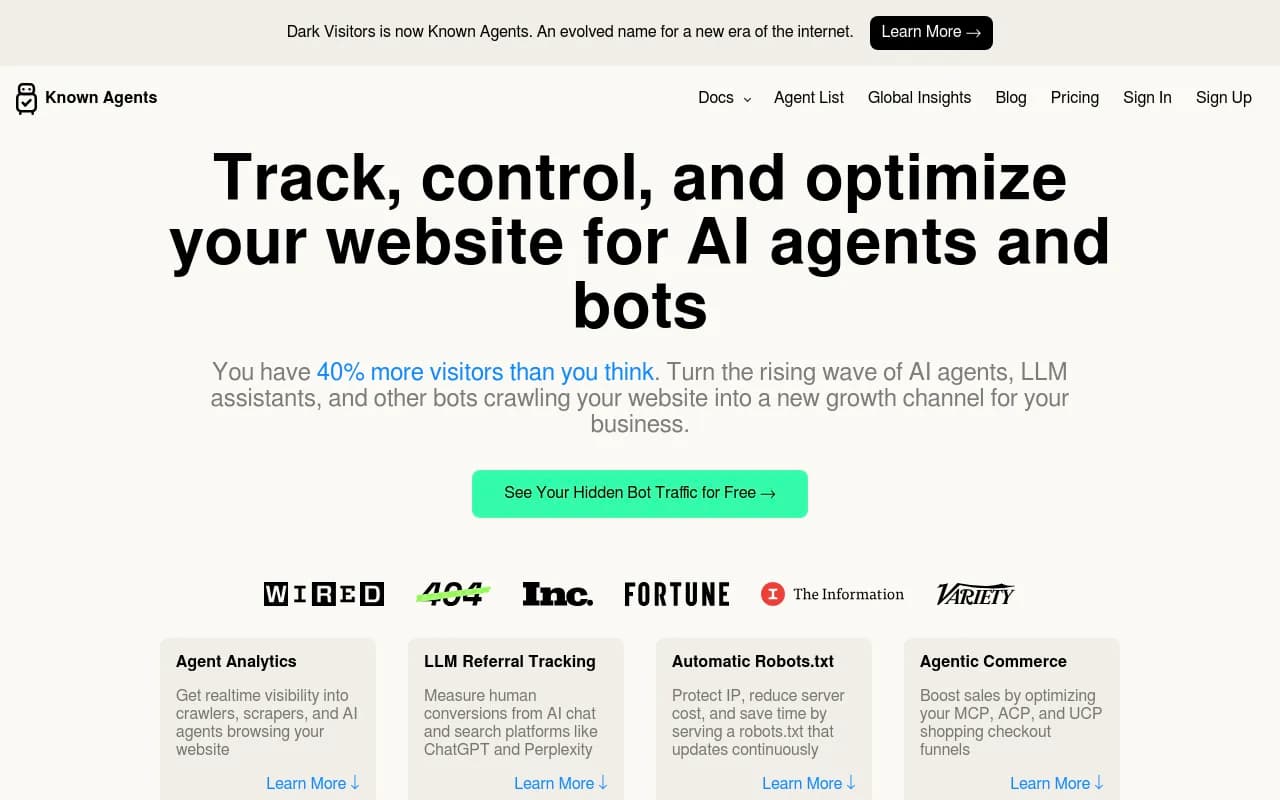
If you want a lightweight standalone option, DarkVisitors also tracks AI agents visiting your site.
Step 5: Set your baseline
Before you change anything, capture four numbers:
- Recommendation rate: out of your open recommendation prompts, how many name you at all
- First-pick rate: how often you are the agent's first choice
- Competitor share: who gets named instead, and how often
- Weekly Anthropic fetcher hits on your docs and key pages
Add one qualitative column: did the code the agent wrote against your API actually run? Mark pass or fail for each task prompt, and note the failure reason. "Used a deprecated endpoint" is a gold finding, because it points straight at a docs problem.
In a monitoring platform, the metrics map to different problems. Low Share of Voice is a coverage problem. Late Position is a prominence problem. Mentions without citations to your own domain point to content or crawlability. Weak sentiment is a reputation problem. The metrics overview in the Promptwatch Academy explains each.
Step 6: Find out why you are missing
Once you see gaps, work out which kind you have.
The agent cannot read your pages
Crawler hits are zero or errors dominate. Fix robots rules, WAF settings, JavaScript-only docs and login walls. Docs that render only client-side are a common culprit.
The agent reads you but does not choose you
Hits exist but recommendations go to competitors. Look at what the winning competitors have: clearer quickstarts, more third-party tutorials, GitHub examples, or a presence in the sources AI cites for your category. Promptwatch Data's software report (Sep 28 to Oct 4, 2026) found GitHub, Microsoft's docs and G2 leading ChatGPT citations for software prompts, with documentation and help centers earning the largest share. That is ChatGPT, not Claude, and I have no Claude-specific citation report to point to. But it suggests docs and repositories carry more weight than marketing pages for technical queries.
The agent chooses you and fails
Recommendation is fine but implementation breaks. Rewrite the quickstart, keep one canonical code sample per task, and make sure SDK names, package versions and endpoint paths are consistent across your docs. Add an llms.txt if you like (the LLMs.txt generator is free), but do not expect miracles. Promptwatch Data found markdown files are just 0.05% of AI search citations: they serve agents reading docs, not AI search ranking.
Step 7: Fix and publish
Typical fixes, roughly in order of effort:
- Unblock crawlers.
- Publish or rewrite task-based docs that match your implementation prompts word for word, such as "verify webhook signatures in Express".
- Add copy-paste examples in the languages your audience uses.
- Get listed or discussed where developers look: GitHub, docs aggregators, review sites like G2.
- Publish comparison pages that state your actual differences honestly.
The query fan-outs matter here. AI systems break a request into several web searches, and your page needs to match those sub-queries, not just the headline question. The query fan-outs guide explains how to read them.
If you want the fixing automated, Promptwatch's Content Agents plan, write and publish pages against your visibility gaps to WordPress, Webflow or Framer, and the Action Board gives a prioritized to-do list. That is on the Business plan ($579/mo) and up, so check the plan details before assuming you need it. For a small docs team, doing steps 1 to 3 by hand is perfectly reasonable.
Step 8: Run a monthly review
Monthly beats weekly for most teams. Answers are noisy and Claude's crawler volume is still small, so daily swings tell you little. A simple cadence:
- Rerun your full prompt set (or let your tool do it) and update the baseline sheet
- Pull Anthropic fetcher hits and note changes by page
- Retest three task prompts by hand in a clean Claude Code project
- Log what you changed and what moved
Tie changes to outcomes where you can. If you published a new quickstart on the 3rd, check whether Claude fetched it, whether it showed up as a source, and whether the task prompt now passes. That chain (published, fetched, cited, recommended) is the only way to know a fix worked. Platforms with page tracking and visitor analytics, like Promptwatch, collapse that chain into one view; with manual tracking you are stitching it together from logs and your spreadsheet.
If you would rather hand this to specialists, 1001 SEO Media runs GEO and AI search programs for brands and uses Promptwatch for the monitoring side.
Common mistakes
- Tracking only brand-name prompts and calling a high mention rate a win
- Testing inside your own configured project, where a CLAUDE.md or an MCP server of yours biases the result
- Treating one run as data
- Ignoring the WAF, then wondering why logs are empty
- Spending the entire budget on Claude when it is about 1% of tracked crawler traffic, unless your buyers are developers
- Trusting any vendor's claim to be the only way to do this, mine included
A realistic expectation
You will not get a clean dashboard number that says "Claude Code recommends us 34% of the time" and means the same thing next month. Treat it as directional. What you can get is a stable prompt set, a crawler baseline, a list of tasks where the agent succeeds or fails with your API, and a trend over a few months. That is enough to decide where docs effort goes, and it is more than most teams in your category have today.
Start this week with the free parts: check robots.txt and WAF rules, grep your logs for Claude-User, and run ten implementation prompts by hand.