Key takeaways
- AI models mostly cite third-party sources. Brand-owned blogs and self-published press releases rarely get quoted, so earned coverage is the main GEO lever you control through PR.
- Build your media list from what AI cites for your category's prompts, not from traditional reach metrics. The two lists overlap less than most PR teams expect.
- Pitch for formats ChatGPT cites often: "best of" roundups, comparisons, and reviews, plus the product and landing pages that coverage links to.
- News coverage fades fast (about 36 days to lose half its cited pages in Promptwatch's data), so a PR-led strategy needs a steady cadence, not one big launch.
- Measure citations, share of voice, and AI-referred traffic monthly, then feed the gaps back into the next pitch cycle.
Why GEO is a PR problem
For years, the AI search conversation belonged to SEOs: schema, FAQ blocks, llms.txt. Those things matter. But when you look at what a model actually cites in its answers, it is overwhelmingly other people's pages. Crackle PR's field guide on this puts it bluntly: models don't cite homepages, they cite the publications PR teams earn placement in.
The background numbers explain why this matters. Crackle PR, citing SparkToro and Semrush data from 2025, reports that 58% of Google searches end without a click, 83% when AI Overviews appear, and 93% inside Google AI Mode. If the click is disappearing, the thing that remains is the answer, and the answer is stitched together from sources the model trusts.
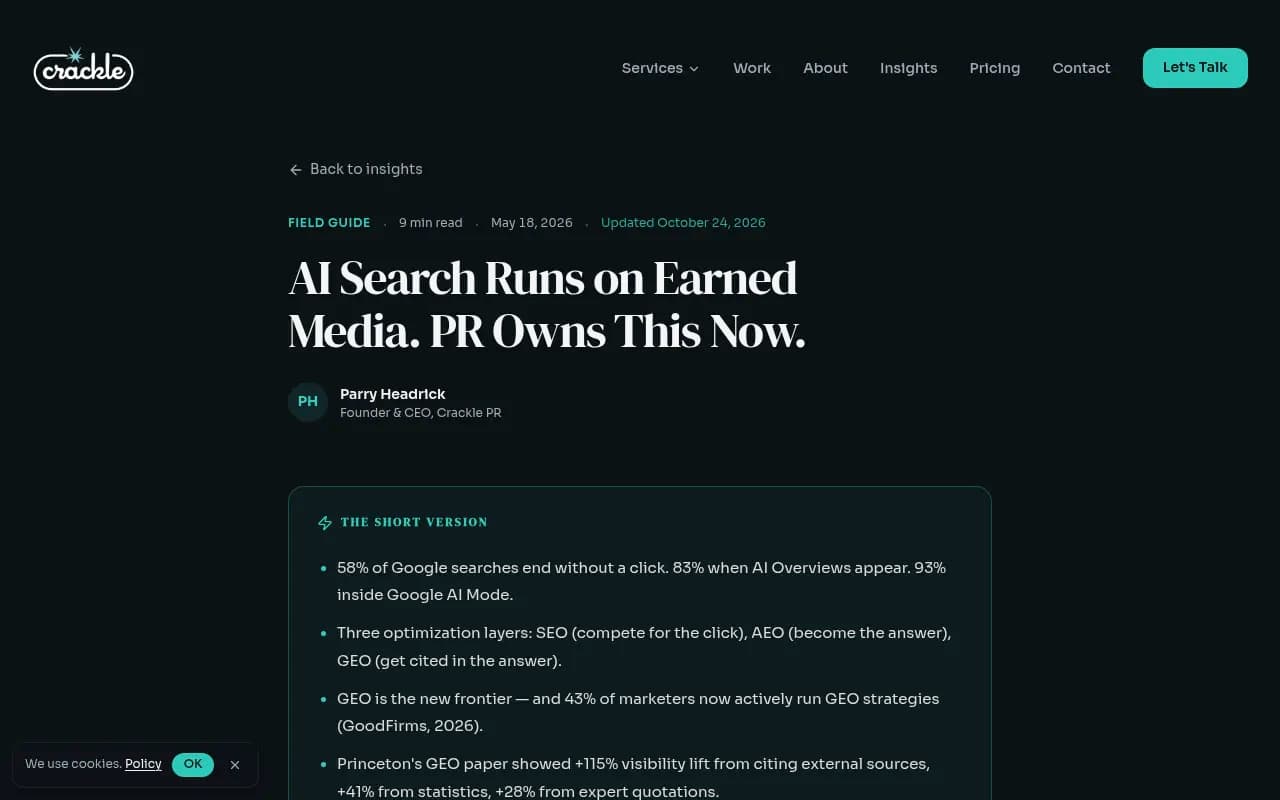
The Crackle guide splits the work into three layers. SEO competes for the click. AEO tries to become the single extracted answer. GEO aims to be cited as a source when a model synthesizes an answer. Statistics, expert quotes, source attribution, and presence in publications the models draw from are what win at the GEO layer, and that is a list PR people already know how to work with.
I would not go as far as saying SEO is dead or that PR replaces it. A site that AI crawlers cannot read will not benefit from any amount of coverage, and several of the sources below say earned media works best on top of a technically sound foundation. But the claim that GEO is largely a PR discipline in new clothes holds up when you look at the data.
What the citation data says about earned media
Two Promptwatch Data reports are worth reading before you plan anything. They tell you which content formats ChatGPT cites and how long those citations last.
Which formats get cited
Promptwatch analyzed ChatGPT citations from Sep 28 to Oct 4, 2026 and classified them by content type. In Promptwatch's content type data, product pages account for 22.4% of citations and landing pages 16.8%. Together that is 39% going to pages describing what a company sells.
Editorial formats add up to 43%:
- Listicles: 13.6%
- How-to guides: 8.7%
- General articles: 6.1%
- Comparisons: 5.9%
- News: 5.7%
- Reviews: 1.7%
The split by prompt type is where PR strategy gets concrete.
| Prompt type | Top cited formats | PR takeaway |
|---|---|---|
| Commercial ("best CRM for small businesses") | Product pages 26.0%, landing pages 20.6%, listicles 15.0%, comparisons 7.9% | Get into the "best of" roundups ChatGPT already cites for your category |
| Informational | Product pages 19.1%, landing pages 13.9%, listicles 13.6%, how-tos 10.7%, docs 8.5% | Place expert commentary and how-to contributions |
| Branded | Product pages 23.3%, landing pages 22.8%, reviews 5.6%, FAQ 4.8%, press releases 2.1% | Third-party reviews matter most when the prompt names your brand |
Reviews are 5.6% of branded citations, more than three times their overall share. Press releases reach 2.1% on branded prompts, higher than their share across all prompts. So if someone asks ChatGPT about you by name, what independent reviewers wrote about you is part of the answer.
How long coverage keeps working
The second report is the one I would show a skeptical CMO. In Promptwatch's content half-life data, pages ChatGPT cited on July 6, 2026 were tracked until Oct 4, 2026. News decays fastest. Almost a quarter of news pages are never cited again after day 0, half are gone after 36 days, and 41% are still cited at day 60.
Other formats last longer:
- Landing pages: 78% still cited at 30 days, 69% at 60 days
- Docs: 76% at 30 days, 67% at 60 days
- Comparisons: 72% at 30 days, 63% at 60 days
- Listicles: 60% still cited at 60 days
- Product pages, reviews, and how-tos: roughly 55% at 60 days, with half-lives of 74 to 77 days
The implication is uncomfortable for launch-driven PR. A single news hit buys about five weeks. The more durable assets are comparison pages, listicles, and the landing and docs pages that your coverage points to. Keep earning fresh placements, and make sure there is something worth citing at the other end of the link.
The long tail is real
No single domain dominates. In Promptwatch's June 2026 ChatGPT citation share report, Reddit held 3.71% of citations (down from 6.11% in May) and Wikipedia was second at 0.56%. Nothing was above 4%. Promptwatch lists TechRadar, Reuters, and Forbes among the publishers worth pitching. Reddit's slide continued: Promptwatch's Reddit data shows reddit.com's share of ChatGPT citations falling from roughly 4% to 0.5% on August 14, 2026. Treat it as a channel that can vanish overnight, not a foundation.
Step 1: Audit what AI says and cites today
Before pitching anyone, find out where you stand. Build a set of 30 to 100 prompts your buyers would actually ask: category queries ("best X for Y"), comparison queries, and branded queries. Run them across ChatGPT, Gemini, Perplexity, Claude, and Google AI Overviews, and record two things: whether you are mentioned, and which URLs are cited.
The second column is the one PR teams skip. 5WPR's guide on AI PR strategy makes the point that a media list built for traditional reach may miss the outlets AI engines actually read. A tier-one outlet with huge readership might never be cited for your category, while a trade publication with modest traffic shows up in half the answers.
Doing this manually works for a pilot. Beyond that you need a tracker. Tools like Promptwatch track mentions and citations across the real interfaces of the major AI engines, and its Offsite Mentions feature finds third-party pages that name your brand without linking, which is useful for PR because unlinked coverage still counts as a mention.

Other trackers in the same space include Profound, Peec AI, and Otterly.AI, which are mostly monitoring-focused. The GEO software directory lists many more if you want to compare.



Step 2: Build an AI-informed media list
Take the cited URLs from your audit and group them by domain and by content type. You will usually see three clusters:
- Publications that cover your category (trade press, major tech or business outlets)
- Roundup and comparison pages, often from review sites and affiliate-style publishers
- Reference and community sources (Wikipedia, docs sites, forums)
Then add a priority score. A simple one: how many of your target prompts cite that domain, multiplied by how many of your competitors already appear there. A domain cited in 12 prompts where two competitors are featured and you are absent is your first pitch target.
Monitoring tools you may already own help with the second half of this. Meltwater and Cision cover traditional media monitoring, and brand-mention tools like Mention and Brand24 catch coverage as it lands.
Step 3: Pitch for the formats that get cited
This is where the data from the earlier section earns its keep. Generic "we launched a thing" pitches produce news, and news is the fastest-decaying format. Aim your pitches at the other formats.
Roundups and comparisons
Commercial prompts lean on listicles and comparisons. If a publication runs an annual "best tools for X" piece, that is a placement worth more than a product announcement. Find out who writes it, when it updates, and what evidence the writer wants (usually a demo, customer data, and a clear differentiator).
Expert commentary and original data
The Crackle PR guide lists statistics, expert quotations, and source attribution as what wins at the GEO layer. A discussion in r/PublicRelations says AI models especially favor conversational and interview-style content. Both point in the same direction: give journalists a quotable number or a named expert, and you become a source rather than a subject. Proprietary data is the strongest version of this. Promptwatch's TreeHouse case study, for instance, describes publishing proprietary rental data as part of growing AI search to roughly 25% of that company's organic conversions.
Reviews
Because reviews carry weight on branded prompts, a review program with independent publishers and credible directories is a GEO investment, not just a reputation one. Ask for reviews that state concrete claims (pricing, who it is for, what it lacks), since those are the statements models repeat.
Make the destination page worth citing
Coverage points somewhere. Landing and docs pages are among the longest-lived cited formats, so the page a journalist links to should state facts clearly: what the product does, who it is for, pricing where you can, and comparisons. If your coverage links to a thin homepage, you are wasting the citation.
Step 4: Keep a cadence, not a campaign
Muck Rack's advice for communications teams is to build a consistent coverage pattern rather than one-off hits. The half-life data backs that up. If news placements lose half their cited pages in about 36 days, a quarterly launch cycle leaves long gaps where the model has nothing recent to pull.
A workable rhythm for a small team:
- Weekly: one expert comment or reactive pitch tied to a news hook
- Monthly: one data-led story or contributed piece for a publication from your priority list
- Quarterly: refresh the comparison, docs, and landing pages that your coverage points to, and re-pitch roundup writers
The compounding effect is the best argument for starting early. Bolt PR makes the case that placements you secure this quarter are not just impressions for this quarter's report, because they keep feeding AI answers afterward. Also note the warning from one of the sources: a brand with zero earned authority does not benefit from GEO at any meaningful scale. Tactics layered on top of nothing do not work.
Step 5: Measure what the coverage did
PR reporting usually stops at placements and reach. For GEO you need a second layer: did the placement change what AI says?
| Metric | What it tells you | Where to get it |
|---|---|---|
| Citation frequency by domain | Whether the outlets you pitched are being cited | AI visibility tracker |
| Share of voice | Your slice of brand mentions versus competitors | AI visibility tracker |
| Position in answers | Whether you are named first or buried | AI visibility tracker |
| Sentiment and claims | What AI actually says about you | Brand narrative or sentiment reports |
| AI-referred traffic | Whether answers send visitors | Analytics, visitor tracking |
| AI crawler activity | Whether bots can read your landing pages | Server or CDN crawler logs |
Read them together. Low share of voice is a coverage problem, which more placements can fix. Mentions without your own pages being cited is a content or crawlability problem, which PR cannot fix. Weak sentiment is a reputation problem, and here PR is exactly the right tool. Track monthly, because citation shares can swing quickly. Promptwatch's own advice from the June data is to do exactly that.
On the traffic side, note that ChatGPT stopped sending a referrer on October 8, 2026, so untagged visits can land in direct. If you can, use utm_source=chatgpt.com on links you control and set up AI traffic attribution; see Promptwatch's guide to attributing AI traffic.
Tooling options for the measurement layer
The catalog is crowded. A rough way to sort it:
| Tool | Strength | Best for |
|---|---|---|
| Promptwatch | Tracking plus citations, crawler logs, traffic, and content actions in one loop | Teams who want to act on gaps, not just see them |
| Profound | Enterprise monitoring | Large brands with monitoring budgets |
| Peec AI | Multi-language tracking | Lightweight monitoring across markets |
| Otterly.AI | Affordable monitoring | Small teams starting a pilot |
| Semrush | Existing SEO suite with AI tracking | Teams already living in Semrush |
| Ahrefs Brand Radar | Brand monitoring in AI results | Ahrefs users wanting mention data |
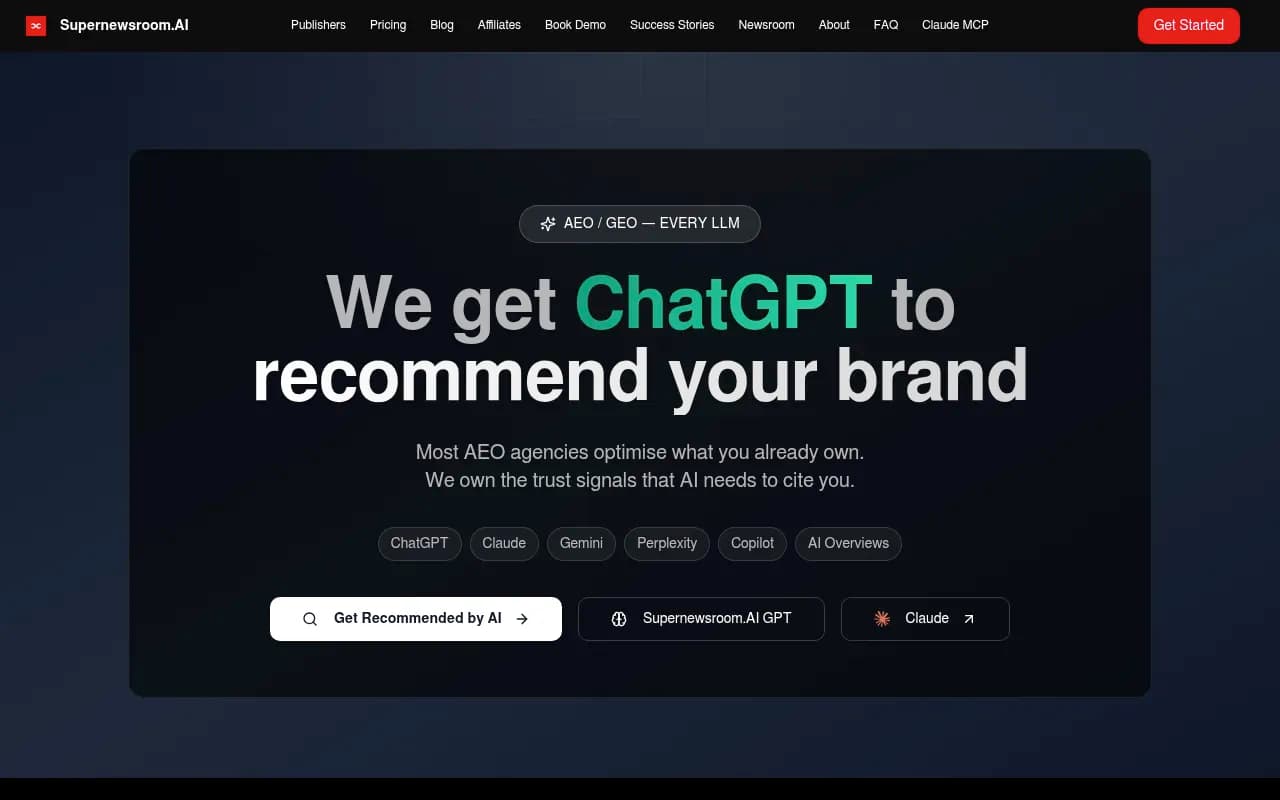
| Supernewsroom.AI | PR-oriented AI visibility through news | PR teams exploring agentic news workflows |

If you want a quick baseline before spending anything, Promptwatch has a free AI visibility report at promptwatch.com/ai-visibility-report, and the pricing page lists current plans. For a wider look at AI rank tracking options, the AI rank tools directory is a decent starting point.
Step 6: Close the loop with the content team
PR creates the coverage. Someone still has to make the owned pages that coverage links to. When your audit shows a prompt where competitors are cited and you have no relevant page, that is a content gap, and the fix is often a comparison page, a docs page, or a data landing page rather than another pitch.
This is where an end-to-end platform pays off. Promptwatch's content gap analysis maps your pages against the prompts AI answers, and its Content Agent can draft and publish pages to WordPress, Webflow, or Framer, then track whether those pages get crawled and cited. The PR team and the content team then work from the same prompt list, which stops the common failure of PR winning coverage while the destination page stays thin.
If you do not have the in-house capacity to run PR, content, and technical work together, an agency that covers digital PR and GEO can fill the gap. 1001 SEO Media combines digital PR, content, technical SEO, and AI search work, and it uses Promptwatch for AI visibility measurement.
Common mistakes
- Chasing prestige outlets that AI never cites for your category
- Treating a self-published press release as earned media. Brand-owned blogs and releases on your own domain are largely invisible to AI citation engines.
- Reporting on placements without checking whether they appear in answers
- Ignoring format. A news hit and a roundup inclusion are not the same asset.
- Relying on one channel. Reddit's share of ChatGPT citations dropped from about 4% to 0.5% in a single day, so no single source is safe.
- Skipping the owned pages. Coverage that points to a weak landing page wastes the citation.
A 90-day starter plan
- Weeks 1 to 2: Build your prompt set, run the baseline across the major AI engines, and log cited domains.
- Weeks 3 to 4: Score domains, build the priority media list, and identify the roundups and comparison pages that matter.
- Weeks 5 to 8: Pitch two to three roundup writers, publish one original data piece, and fix the landing and docs pages your coverage will link to.
- Weeks 9 to 12: Re-run the prompt set, compare citation share and sentiment against the baseline, and rework the media list based on what moved.
Expect uneven results. Some placements get cited quickly, others never do, and model changes can shift everything. The point of measuring is to learn which outlets and formats work for your category and put more effort there.
Final thought
The practical shift is small but real: pick outlets from citation data instead of reach, pitch for roundups, comparisons, reviews, and data, and keep a steady rhythm because news fades in about five weeks. PR teams already have the skills. What they usually lack is the citation data to aim them, and that is a tooling problem you can fix in an afternoon.