Key Takeaways
- AI engines assemble your brand story mostly from third-party pages. AirOps found brands are 6.5x more likely to be cited through third-party sources than through their own domains.
- Review profiles matter. Seer Interactive's study of 804,491 AI responses found brands with no Trustpilot profile had a median AI citation rate of 1%, versus 53.5% for brands with as few as 1-13 reviews.
- Reddit's role is volatile and engine-specific. In Promptwatch Data, reddit.com fell from about 3.8% to 0.5% of ChatGPT citations over the summer, then sat at 0.40% from Oct 11 to Nov 9, 2026.
- Studies disagree on numbers because they measure different things (share of citations, share of answers, different prompt sets). Treat every percentage as tied to its method.
- Practical priorities: get listed in the roundups AI cites, build a minimal profile on the review sites in your category, fix what third-party pages say about you, and track the result per engine.
Why AI brand perception is built off-site
When someone asks ChatGPT whether your product is any good, the model rarely quotes your homepage. It pulls from a web of other pages: review platforms, comparison articles, forum threads, videos, news. Then it blends them into a confident paragraph that sounds like one voice.
That is the uncomfortable part. Your brand narrative in AI is a collage, and you only hold a few of the pieces.
The AirOps 2026 State of AI Search report puts numbers on this: 85% of brand mentions originate from third-party pages rather than owned domains, and nearly 90% of those third-party mentions come from listicles, comparison pages and review roundups. Roughly 80% of mentioned brands appear within the first three positions of the page. First-party mentions show up in about 25% of generated answers, mostly when the user moves from broad exploration to verification.
Read that last bit twice. Your own site matters late in the journey. Early on, other people's pages decide whether you are in the consideration set at all.
What the studies say, and why the numbers do not match
If you read three reports on this topic you will get three different pictures. Before you copy any statistic into a deck, look at what is being counted.
| Source | Claim | What it measures |
|---|---|---|
| Presenc AI (citing 5W's index, May 2026) | Reddit ~40% of AI citations | Share across five platforms, 680M citations |
| AirOps 2026 report | Reddit in roughly 1 in 5 AI answers; ~48% of citations from community platforms | Share of answers and UGC sources, across models |
| Seer Interactive (May 2026) | Review sites are the #2 citation source | Brand-level study of 804,491 responses, 1,926 brands, 4 platforms |
| Promptwatch Data (Oct 11 to Nov 9, 2026) | Social platforms are 0.64% of ChatGPT citations, 13.16% of Google AI Overviews | Share of citations by domain, per engine |
These cannot all be true in the same sense. A 40% Reddit share and a 0.40% Reddit share on ChatGPT differ by two orders of magnitude. Part of the gap is time (the data moved a lot in 2026), part is the engine mix, and part is definitions: share of answers that touch Reddit is not the same as share of citations that point at reddit.com.
My take: use the third-party studies for direction (off-site sources dominate, reviews and community content matter) and use first-party, per-engine data for the actual numbers you plan around. Promptwatch Data publishes the latter and is explicit about periods.
Reviews: the validation layer
The Seer study is the clearest evidence we have that review profiles change outcomes. A few findings stand out:
- Review sites become the #2 citation source overall, and their influence grows 10 to 20 times between the awareness stage and the decision stage. AI leans on them when the user is close to buying.
- The entry bar is low. Brands with no Trustpilot profile had a median AI citation rate of 1%. With as few as 1-13 reviews, that jumped to 53.5%.
- Absence is a signal. Seer saw ChatGPT flag missing review presence as evidence of lower trustworthiness, with phrasing like "lacks reviews on trusted sites like Trustpilot, BBB".
- Small brands can close a gap. A brand with a Domain Rating of 0-15 and a minimal profile got nearly the same citation rate as a mid-authority brand at the same tier.
- Fully optimized profiles earned 9.5x more co-mentions, meaning AI recommended them when users asked about a competitor.
Note this is correlation, as Seer frames it. Brands that bother to set up review profiles may also do other things right. Still, the absence signal is observable in the model's own wording, which is hard to dismiss.
Where reviews show up in ChatGPT
Here is a nuance that seems to contradict Seer. In Promptwatch's content-type analysis (Sep 28 to Oct 4, 2026), reviews were only 1.7% of ChatGPT citations across all prompts. Product pages led at 22.4%, then landing pages at 16.8% and listicles at 13.6%.
But look at branded prompts, such as "is HubSpot good for startups". There, reviews rose to 5.6% of citations, more than three times their share overall, and social posts rose to 3.0%, almost four times. The full breakdown is in the ChatGPT citation share by content type report.
The two findings are not in conflict. Seer measures source categories at the brand level across many verticals. Promptwatch classifies each cited URL by content type. A Trustpilot or G2 page can count as a review site in one scheme and be sliced differently in another. What both agree on: reviews matter most when the prompt names a brand, which is exactly when someone is judging you.
Review sites by category
Which review platform matters depends on your market. Promptwatch Data shows G2 among the top ChatGPT citations for software prompts, alongside GitHub and Microsoft's docs (software citation report, Sep 28 to Oct 4, 2026). For travel, Skyscanner, Going and Tripadvisor lead (travel report). For automotive in August 2026, marketplaces like Autotrader and Cars.com outranked every car brand (automotive report).
So the first job is to look at what ChatGPT already cites for your category and go where it goes.
Reddit: loud, useful, and unstable
Reddit is the source everyone argues about. The Inc.com piece on Reddit becoming AI's most trusted source and the AirOps report both describe Reddit as a proxy for authentic user experience. AirOps says about 88% of Reddit citations come from category-level queries, so Reddit shapes early exploration more than final verification.
That matches how people use it. Nobody asks a forum about your pricing page. They ask "what do people actually use for X?"
But the measured picture in 2026 is messier than the headline claims:
- ChatGPT held a steady 3.83% Reddit share from Jul 18 to Aug 7, 2026. On Aug 14 it fell below 1%. The Aug 14-17 average was 0.52%, an 86.4% relative drop (Reddit citations are dropping in ChatGPT).
- Promptwatch notes the cause is unknown and a data-collection issue cannot be ruled out, so the size of the drop is provisional. It coincided with a change in query fan-out behavior on Aug 8, when ChatGPT began using the site: operator at scale (report).
- Google AI Overviews eased more gradually, from about 2.37% to 2.10%. AI Mode fell from 2.22% to 1.54%.
- By Oct 11 to Nov 9, Reddit was back to 0.40% of ChatGPT citations, up from 0.09% in the October window, and again ChatGPT's top social platform.
If your plan assumes "Reddit is the key to ChatGPT", the data does not back that up right now. Reddit still matters as a place where opinions about you form, and it can feed other engines, but it is not a stable lever on any single one.
Social platforms by engine
The newest Promptwatch Data report covers Oct 11 to Nov 9, 2026 (social media citations by AI model, November 2026). Caveat: the earlier October report covered 7 days, this one covers 30, so month-over-month comparisons are rough.
| Engine | Social share of all citations | Top platforms |
|---|---|---|
| Google AI Overviews | 13.16% (12.22% in Oct) | YouTube 6.71%, Facebook 2.34%, Reddit 2.10% |
| Perplexity | 1.94% (2.71% in Oct) | Reddit 0.82%, LinkedIn 0.66%, YouTube 0.31% |
| ChatGPT | 0.64% (0.46% in Oct) | Reddit 0.40%, LinkedIn 0.20%, YouTube 0.03% |
AI Overviews cites social media about 20 times as often as ChatGPT. In AI Overviews, YouTube alone (6.71%) is more than the other six platforms combined (6.45%). TikTok only appears there. X barely registers anywhere.
The practical read: if your buyers live in Google, video is the social format that gets cited. If you care about Perplexity, Reddit and LinkedIn are about three quarters of its social citations. For ChatGPT, do not count on social posts to get you in. The editorial and commercial pages matter far more.
Listicles, comparison pages and the rest of the third-party web
The biggest off-site lever is probably the least glamorous one: being named in "best X tools" articles. AirOps found nearly 90% of third-party mentions come from listicles, comparison pages and review roundups. Promptwatch's content-type data agrees on the commercial side: for commercial prompts, product pages (26.0%), landing pages (20.6%), listicles (15.0%) and comparisons (7.9%) make up almost 70% of citations.
Two more details worth knowing:
- Almost half of ChatGPT responses cite 10 or more unique domains (unique domains report). There are many slots, and you do not need to win all of them.
- Freshness varies by type. News pages lost half their citations within about 36 days, while landing pages and docs kept most of theirs for months (content half-life report). A single press hit fades fast. A good review profile or a maintained comparison page lasts.
Terakeet adds a different angle in its analysis of Reddit, Wikipedia and Glassdoor: AI does not invent your brand story, it assembles it from owned and third-party assets, and Glassdoor-style sources color how you are described as an employer. If you have never thought about what an AI says about your workplace, check.
Perception, not just presence
Being mentioned is half of it. How you are described is the other half. Two things drive that.
First, repeated claims. If three roundups and a Reddit thread say your onboarding is clunky, expect a model to say "some users find onboarding difficult". That sentence then gets reused across prompts. Tools that extract individual claims from AI responses make this visible. Promptwatch's Brand Narrative does this, grouping claims by theme such as pricing, features, support and reputation, and its Fact Check feature (Business plans and up) points to which of your own pages state a wrong claim.
Second, consumer trust in AI-generated content itself. A Meltwater and YouGov survey of nearly 10,000 consumers (April 2026) found 32% would trust a brand less if its content is AI-generated, and 65% say undisclosed generative AI use lowers their trust. That is a separate issue from how AI describes you, but it matters if your response to weak AI perception is to mass-produce review replies or forum posts. Do not fake community. Models and people both notice.
A practical playbook
1. Map what AI already cites for your category
Pick 20 to 50 prompts your buyers would use, run them across ChatGPT, Gemini, Perplexity and Google AI Overviews, and list the cited domains. You will quickly see which review sites, roundups and communities carry weight in your market. This is tedious by hand, so most teams use a tracker.
2. Get a minimal profile on the review platforms that show up
The Seer numbers suggest the first reviews matter most. You do not need hundreds. Ask real customers, complete the profile, respond to feedback. Missing profiles read as a negative signal.
3. Pursue listicle and comparison placements
Pitch the authors of the roundups that are already being cited. Position inside the article matters, since roughly 80% of mentioned brands sit in the first three positions. Also publish your own comparison pages and an FAQ page, since both are cited content types.
4. Treat Reddit as reputation, not a ChatGPT hack
Show up honestly where your category is discussed, fix real problems people raise, and monitor sentiment. Do not budget on the assumption that Reddit will drive ChatGPT mentions.
5. Match social effort to the engine
YouTube first for Google-heavy audiences. Reddit and LinkedIn for Perplexity. Skip X.
6. Measure by engine and by period
Because shares swung so much in 2026, check monthly. A tactic that worked in July may be dead by September.
Tools that help
Two jobs are involved: tracking what AI says and cites, and handling the review and social conversation itself.
For AI visibility, Promptwatch tracks mentions, citations and sentiment across the real interfaces of ChatGPT, Gemini, Perplexity, Google AI Overviews and others, shows which Reddit threads, YouTube videos and third-party pages get cited, and flags offsite mentions where your brand is named without a link. It also covers the fixing side with content gap analysis and a Content Agent. See the Reddit and YouTube strategy guide in its academy for the how-to.

Other AI visibility trackers worth a look, depending on budget and needs:



For the review and conversation layer, classic reputation tools are still useful:

| Job | Example tools | Notes |
|---|---|---|
| AI citation and perception tracking | Promptwatch, Profound, Peec AI, Otterly.AI | Differ on crawler logs, content workflows and engine coverage |
| Review collection and response | Birdeye, ReviewTrackers, NiceJob | Feeds the platforms AI cites |
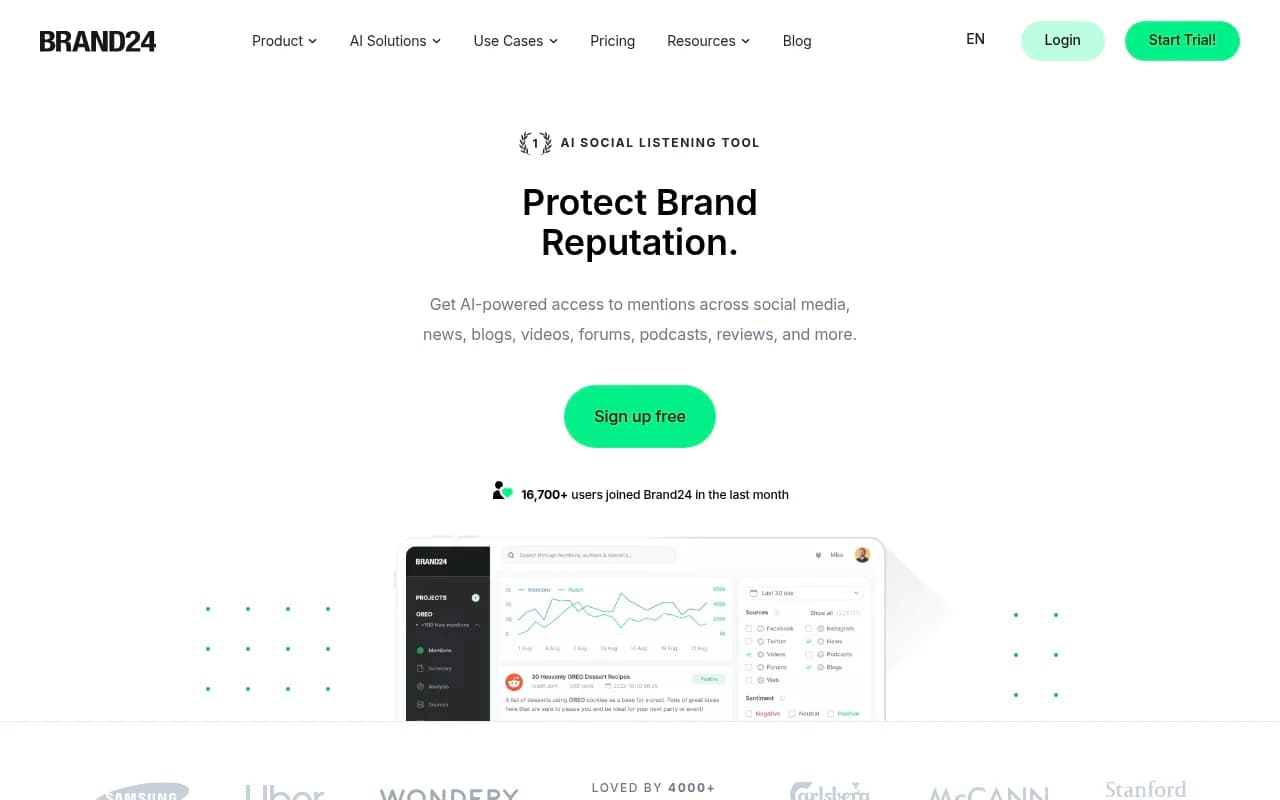
| Social and forum listening | Brand24, Meltwater | Catches mentions before they harden into narrative |
For wider browsing, the GEO software directory lists more options.
What I would do first
Check whether you have a profile on the one or two review sites that dominate your category. If not, fix that this week, because the Seer data says the cost is small and the downside of absence is real. Then pull the list of third-party pages ChatGPT cites for your top commercial prompts and start pitching. Treat Reddit and YouTube as engine-specific bets, and re-check the numbers every month, since the 2026 data has already changed more than once.