Key takeaways
- G2's March 2026 survey of 1,076 B2B software buyers found 51% start research with an AI chatbot more often than Google, and 69% picked a different vendor than planned because of chatbot guidance.
- AI descriptions are not neutral. 85% of buyers think more highly of a vendor an AI chatbot mentions, yet 64% often run into inaccurate recommendations.
- When a buyer names your brand in a prompt, ChatGPT often cites only a handful of sources, so review sites and forums shape the description disproportionately.
- You cannot edit what AI says directly. You can change the pages and third-party sources it reads, and you can measure the result.
- A one-off "describe my brand" prompt is an anecdote. Audit across many prompts, models and personas, then repeat it.
Why the AI description matters before anyone visits your site
Your homepage used to be the first impression. Then it was your Google ranking. Now a lot of buyers meet your brand as two or three sentences in a chat window, written by a model they trust more than they trust you.
I think the uncomfortable part is the invisibility. A lost deal from a bad sales call shows up in your CRM. A lost deal because ChatGPT called your pricing "complex" or left you off the shortlist shows up nowhere. The buyer just never arrives.
The numbers back this up. G2's "The Answer Economy" report (press release dated April 15, 2026, survey fielded March 2026 with 1,076 B2B software buyers) found:
- 51% of buyers start software research with an AI chatbot more often than with Google, up from 29% in April 2025.
- 71% rely on AI chatbots somewhere in software research, up from 60% seven months earlier.
- AI chatbots are the number one source influencing vendor shortlists.
- ChatGPT is the dominant chatbot for this research, used by 63%.
This is B2B software data. I could not find solid consumer purchase data, so treat the percentages as a strong signal for considered purchases, not a universal truth for every category.
What buyers actually do after AI describes a brand
The behavior after the description is where the money moves. Based on the G2 data, the pattern looks like this.
They shortlist from the answer
Buyers use chatbots mainly to compare vendor strengths and weaknesses (41% say this is their top use). That means the answer is not a list of links. It is a verdict. If your strengths are described accurately and your weaknesses are stale, you are being judged on a version of your company that may be two years old.
They switch vendors
69% chose a different vendor than they had planned because of chatbot guidance, and 33% bought from a vendor they had never heard of before. Read that second number twice. Brand awareness is no longer a prerequisite for winning a deal, and no longer protects you from losing one.
They get more confident, faster
80% say AI accelerated their decision and 83% feel more confident in their final choice. 85% think more highly of a vendor when a chatbot mentions it in a recommendation. A mention is a trust transfer. An omission is the opposite.
They verify, but not on your site
Here is the part that helps you. 64% of buyers often or very often encounter inaccurate AI recommendations. When AI conflicts with a brand they trust, 24% turn to peer reviews next. And 45% say citations from software review sites are the most confidence-inspiring signal in an AI answer. Review sites are the only source besides chatbots whose influence grows deeper in the funnel, from 40% at discovery to 47% at retention.
So the buyer's loop is: ask AI, notice a claim, check a review site or peer, decide. Your own homepage is often not in that loop at all.
How AI forms its picture of your brand
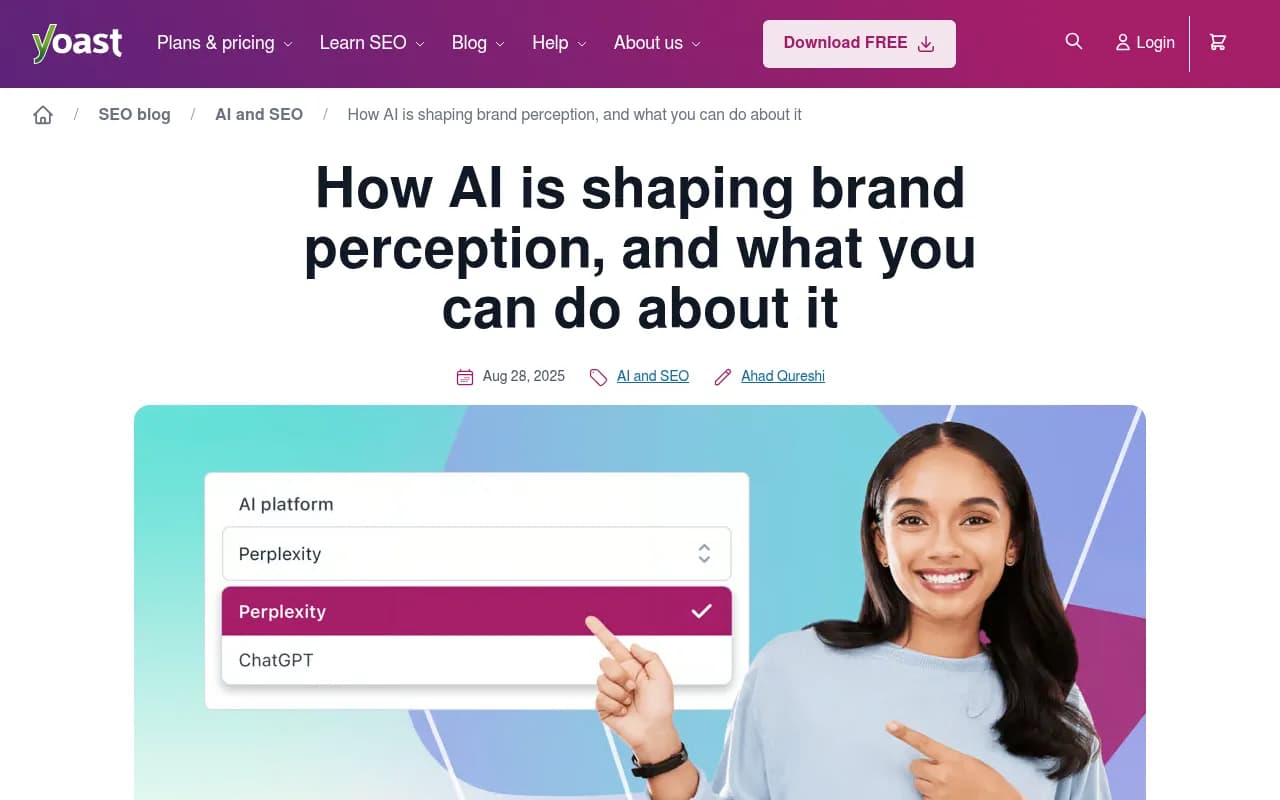
Models do not know your brand the way a person does. As Yoast puts it, they learn it from the web, structured data, citations, reviews, and the context across your digital touchpoints. Knowledge graphs, entity linking, relationship mapping and sentiment analysis all feed in. And AI tends to weigh what the world says about you more heavily than what you say about yourself.
Dharmesh Shah's test with HubSpot in his Simple AI newsletter makes this concrete. ChatGPT described HubSpot as having limited customization, complex pricing, and fewer integrations than it actually has. It also mapped each vendor to a buyer persona: HubSpot for the SMB marketing manager wanting all-in-one, Salesforce for the enterprise buyer wanting heavy customization. Whatever HubSpot thinks of those claims, that is what the buyer reads.
Which sources carry the description
Promptwatch Data gives a useful lens here. In Promptwatch's report on unique domains per ChatGPT response (Sep 28 to Oct 4, 2026), responses to brand-specific prompts, where one brand is named, were much narrower than organic ones:
| Prompt type | Share citing 10+ domains | Notes |
|---|---|---|
| Organic (no brand named) | 52.5% | 71.8% cite at least 8 domains |
| Competitor comparison | 49.1% | Only 0.35% cite a single domain |
| Brand-specific | 21.3% | Most common count is 5 domains (14.9%); 40.7% cite 5 or fewer |
With a short source list, every review site and forum on it carries real weight in how ChatGPT describes you. One bad third-party page can be a large share of the evidence.
The content-type data points the same way. In Promptwatch's ChatGPT citation share by content type report for the same week, branded prompts like "is HubSpot good for startups" cited product pages (23.3%) and landing pages (22.8%) most, but reviews hit 5.6%, more than three times their share across all prompts, and social posts reached 3.0%, almost four times their overall share. Your own site matters most for branded questions, and reviews matter far more than they do elsewhere.
For commercial prompts like "best CRM for small businesses", product pages (26.0%), landing pages (20.6%), listicles (15.0%) and comparisons (7.9%) together make up almost 70% of citations. That is where the shortlist gets built.
How to audit what AI says about you
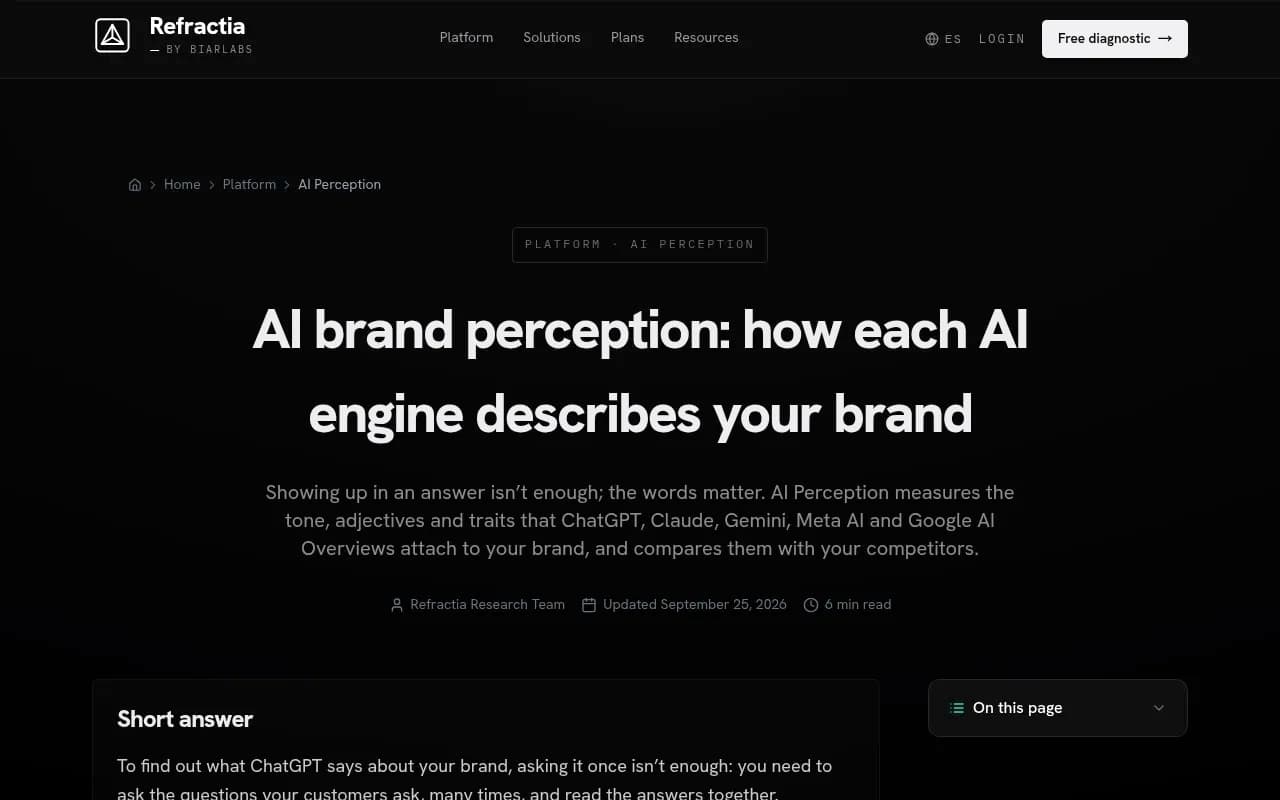
Asking ChatGPT "describe [brand]" once is a start, not an audit. Refractia's guidance is right on this point: a single question is an anecdote. You need the questions your customers ask, in different phrasings, repeated, and read together.
A manual audit you can do this week
- Write 20 to 30 prompts across three types: organic category prompts ("best X for Y"), brand prompts ("is [brand] good for Z", "[brand] pricing"), and comparison prompts ("[brand] vs [competitor]").
- Run each several times in ChatGPT, Gemini, Perplexity and Google AI Overviews. Answers vary between runs.
- Log three things: are you mentioned, where in the answer, and what claims are made about you.
- Mark each claim accurate, outdated or wrong.
- For the wrong ones, note which cited source the claim came from.
- Repeat quarterly. Monthly if you are launching or repositioning.
Step 5 is the one people skip and it is the one that tells you what to fix. A claim without a source is a training-data problem you mostly wait out. A claim with a source is a page you can go change or influence.
What to measure
The useful metrics are separable. Low share of mentions across category prompts is a coverage problem. Being mentioned last is a prominence problem. Being mentioned but never cited is a content or crawlability problem. Poor tone is a reputation problem. Mixing them up leads to fixing the wrong thing. Refractia, for instance, scores sentiment 0 to 100 and splits chat models from Google AI Overviews, since an engine summarizing live search results needs a different fix than a model answering from memory.
Tools that automate the audit
Doing this by hand across models gets old fast. The category is crowded, so here is how I would sort it.
Promptwatch is the one I would look at first if you want to go past monitoring. It runs prompts against the real interfaces of ChatGPT, Gemini, Perplexity, Google AI Overviews and others, scores visibility and sentiment, and its Brand Narrative feature pulls out the individual claims AI makes about you and groups them by theme (pricing, features, support, reputation). Fact Check on the Business plan lets you mark a claim inaccurate and then finds the pages on your site that state it. Then it connects to fixing: the Action Board, content gap analysis, and a Content Agent that publishes to WordPress, Webflow or Framer. Pricing starts at $95/month for Essential; confirm current plans at promptwatch.com/pricing. There is also a free AI visibility report if you just want a first look.

Other tools worth knowing, mostly monitoring-focused:



| Tool | Strongest at | Typical gap |
|---|---|---|
| Promptwatch | Claims-level narrative, crawler logs, content creation and publishing, traffic attribution | More than a small team may need if you only want a score |
| Profound | Enterprise monitoring across AI engines | Higher price, less execution |
| Peec AI | Multi-language prompt tracking | Tracking only |
| Otterly.AI | Affordable monitoring | No content or crawler layer |
| AthenaHQ | Tracking across many engines | Monitoring-led |
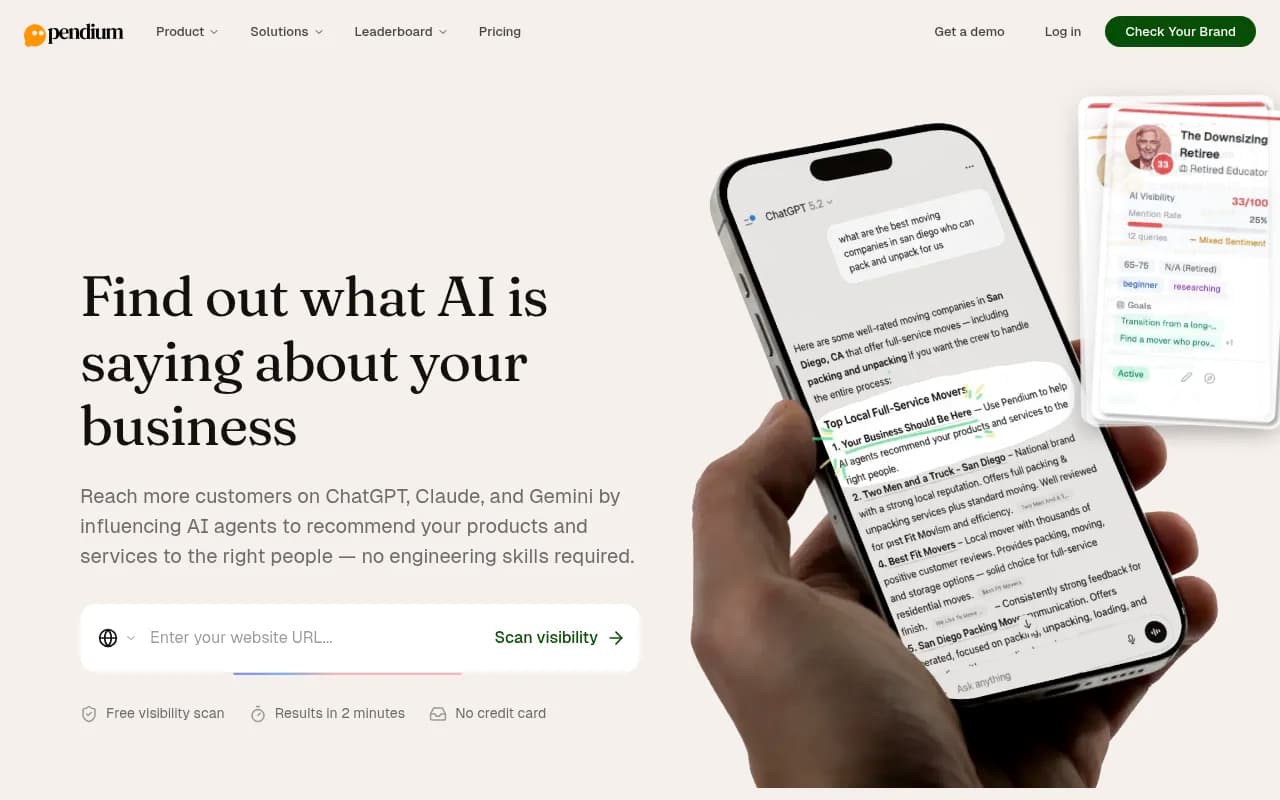
| Pendium.ai | How AI agents perceive a brand | Narrower scope |
For more options, the GEO software directory at bestgeosoftware.com lists dozens of trackers side by side.
How to change the description
There is no button for this. What you can change is what AI reads. Here is what works in practice, in rough priority order.
Fix the anchor pages first
Your pricing, features, who-it's-for and about pages are the highest-leverage content. Promptwatch's own recommendation for branded prompts is to make your site answer pricing, features and who the product is for, in plain language. If ChatGPT says your pricing is complex, publish a page that states it simply. Add a plain-language FAQ.
Freshness matters unevenly. In Promptwatch's content half-life report, landing pages and docs stayed cited for months while news lost half its pages within about 36 days. Put your durable claims on durable page types.
Win the review sites
Given the G2 finding that 45% of buyers trust review-site citations most, and that brand-prompt answers cite so few domains, review profiles are not a vanity project. Get recent, specific reviews on the sites that appear in your cited sources, especially around the traits where AI currently misdescribes you. Ask happy customers to mention the exact thing AI gets wrong, such as integrations or flexibility.
Publish your own comparisons and use cases
Competitor comparison prompts pull in many domains, so third-party comparison pages will exist whether you write one or not. Publish your own honest comparison pages, and check that third-party pages describe you accurately. Specific customer stories counter generic claims better than adjectives do.
Check that AI can read you
If the crawler cannot reach the page that states the correct fact, nothing else matters. Look at your robots.txt, your CDN rules and your server logs for AI bots. Promptwatch's AI crawler logs show which bots hit which pages and where they fail, and its free Agentic Readiness Check tests basic access. Free is fine to start.
Close the loop
After a change, rerun the same prompt set in a few weeks. Pair it with analytics: tag AI referrals and watch conversion. Note that ChatGPT stopped sending a referrer on October 8, 2026, so some of its traffic now lands as direct unless links carry utm_source=chatgpt.com. For more on this, see the Promptwatch guide to attributing AI traffic.
What not to do
- Do not stuff pages with keyword-heavy descriptors hoping to steer the model. Shah's HubSpot piece is explicit that gaming rarely lasts and that substantive changes are what move recommendations.
- Do not treat a single run as truth. Responses vary.
- Do not obsess over mentions alone. Where and how you are described matters as much as whether you appear.
- Do not ignore Google AI Overviews because ChatGPT looks better. The two behave differently. Promptwatch's social media citation data for Sep 28 to Oct 4, 2026 shows AI Overviews drew 12.2% of citations from social platforms while ChatGPT drew 0.46%, so the sources feeding each description differ.
A simple quarterly routine
| Step | Time | Output |
|---|---|---|
| Run prompt set across models | 1 to 2 hours manual, minutes with a tool | Mentions, position, claims |
| Classify claims accurate, outdated, wrong | 1 hour | Fix list |
| Trace wrong claims to sources | 1 hour | Pages to update or review sites to work |
| Ship page, review and FAQ changes | Ongoing | Updated anchor content |
| Re-measure | Next quarter | Before and after comparison |
If you would rather hand the work to specialists, an agency with GEO experience can run this loop for you. 1001 SEO Media does this kind of AI visibility work and uses Promptwatch for it.
The bottom line
Buyers already treat AI's description of your brand as a recommendation, and most of them act on it before they ever speak to you. You cannot rewrite the answer, but you can rewrite the evidence. Start by running 20 prompts this week, writing down every claim, and tracing the wrong ones to a source page.