Key takeaways
- Gauge (withgauge.com) is an AI visibility platform that tracks prompts across AI engines and pairs the data with a content engine. It is not the same as Gauge Agents, a separate product for coding-agent evaluations.
- Growth costs $599/mo for 600 daily prompts on 3 platforms (ChatGPT, Google AI Mode, Microsoft Copilot), 18 articles a month and 3 seats. Google AI Overviews, Gemini and Perplexity are Enterprise-only.
- The limits show up quickly: a prompt cap, a single location, no sentiment or exports below Enterprise, and drafts that still need a human.
- Gauge's claim of about three ChatGPT searches per query is higher than what Promptwatch Data has measured, so treat fan-out numbers with care.
- It suits teams that want tracking and content in one place and can live with narrow engine coverage. Teams that need broader coverage, crawler data or traffic attribution should compare alternatives.
Which Gauge are we talking about?
There are two products with the name. This review covers Gauge the AI visibility platform. Gauge also sells Gauge Agents, which evaluates coding agents and has a free hosted plan, paid plans from $499/mo and an open-source local CLI. If you landed here from a prompt-evaluation search (Braintrust, Confident AI, PromptLayer territory), that is a different job: testing prompts inside your own LLM app. Gauge the visibility tool tests none of that. It asks how AI engines talk about your brand when real users ask questions.
That distinction matters because the search results for "prompt" anything are a mess. Performance-review prompt lists, teacher prompt packs and prompt-engineering ladders have nothing to do with this. Here, "prompt-level intelligence" means tracking specific questions people ask AI engines and seeing whether your brand shows up, where, and with which sources.
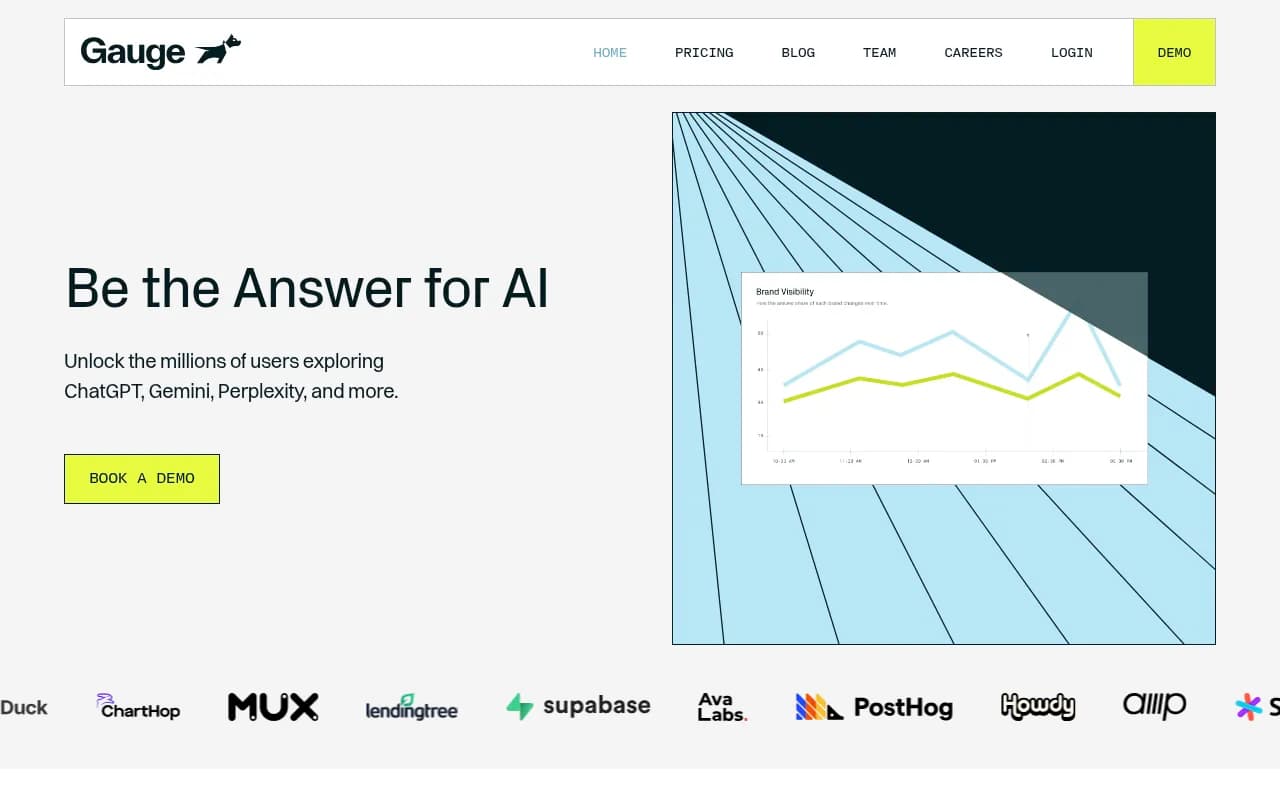
What Gauge does
Based on its pricing page and comparison pages, the product has a few layers:
- Prompt tracking: you define prompts, and Gauge runs them daily across the supported engines.
- Ask Gauge: an agent chat over your data, unlimited on Growth.
- Action Center: recommendations on what to fix or publish.
- Content engine: publish-ready articles, 18 a month on Growth, with CMS publishing to Webflow, Framer, Sanity and GitHub.
- Query Fan Out: it shows the Google searches ChatGPT runs behind a prompt.
- Integrations: GA4, Search Console, DataForSEO, Slack and MCP access.
I could not find an independent hands-on review with accuracy benchmarks, and I did not verify the Action Center or Content Engine beyond the pricing page and one third-party summary. So the capabilities below are what the vendor lists, not what I stress-tested.
Where it does well
The pitch is tight: track, get told what to do, ship content, all in one login. A lot of AI visibility tools stop at a dashboard. Gauge includes drafts and CMS connections on its standard plan, which puts it closer to an action tool than a pure monitor. Unlimited domains and competitors on Growth is also generous when pricing is otherwise metered.
The cost math is transparent too. Gauge says Growth works out to about a penny per answer: 600 prompts x 3 platforms x 30 days is 54,000 answers a month. At $599 that is roughly $11.09 per 1,000 answers, which is the figure Gauge uses in its Profound comparison. It is a vendor number, but the arithmetic checks out.
The data also feeds from Search Console and GA4, so you are not looking at AI mentions in isolation.
Pricing and what is actually included
| Plan | Price | Platforms | Prompts | Other limits |
|---|---|---|---|---|
| Growth | $599/mo | ChatGPT, Google AI Mode, Microsoft Copilot | 600 daily | 18 articles/mo, 3 seats, 1 location |
| Enterprise | Custom | ChatGPT, AI Mode, Copilot, AI Overviews, Gemini, Perplexity | Custom | Sentiment, exports, custom articles, seats, locations, strategy sessions |
| Claude / Grok | Optional | Your own API keys | n/a | Provider bills you directly |
There is a conflict worth flagging. A third-party review dated September 2026 says Growth covers six platforms and 10 seats. Gauge's own pricing page says three platforms and three seats, and its comparison pages also say three models on the paid plan. The six-platform tier looks like Enterprise only. Confirm on the pricing page before you buy.
One more detail: the pricing page carries a customer quote from a VP of Marketing at Compt calling Gauge "the most expensive tool we have." Gauge printed it, which is either confident or mischievous, and it tells you the value case has to be about outcomes, not sticker price.
Where teams hit limits
1. The prompt cap
Six hundred prompts sounds like plenty until you map a real query universe. A B2B SaaS brand with five product lines, three personas and a handful of regions burns through that fast. Because pricing is metered by prompt, you end up tracking a slice and guessing about the rest. That is a sampling problem, and sampling bias is easy to miss when the dashboard looks tidy.
2. Three engines on the standard plan
Growth leaves out Google AI Overviews, Gemini and Perplexity. That matters. According to Promptwatch Data on average sources per response, Google AI Overviews cites about 10 sources per answer and Perplexity cites almost exactly 10 every day, while ChatGPT cites about 5 on answers where web search is triggered. Citation slots differ by engine, so your visibility in ChatGPT does not predict your visibility in Perplexity. Missing two of the larger citing engines is a real blind spot.
The same report shows Copilot swinging from under 2 to nearly 17 sources before settling low. Copilot is the noisiest of the three engines Gauge includes, so judge it on monthly trends, not daily moves.
3. Logged-out scraping
Per a competitor's summary of Gauge's features page, Gauge collects answers by front-end scraping with logged-out sessions. That is a reasonable way to avoid API-versus-UI mismatch, but logged-out sessions may not reflect personalized or logged-in answers, and your buyers are often logged in. This is not unique to Gauge. Ask any vendor how it collects data and from which session type. Promptwatch, for example, describes its collection as real UI monitoring across each country and language.
4. Fan-out numbers that don't match
Gauge's Query Fan Out feature says ChatGPT typically runs around three Google searches per user query and scans 50 to 60 results per search. That is not what Promptwatch has measured. In Promptwatch's ChatGPT query fanout data, average distinct web searches per response fell from 2.15 in early December 2025 to about 1.84 by early March 2026, and the data showed 1.0 per response in April. Average fanout query length also fell, from about 117 characters to roughly 53.
The page also says a single prompt can trigger 3 to 8+ searches, but that is the ceiling, not the average. The practical point holds either way: ChatGPT is not searching for your user's prompt verbatim. It rewrites it into short queries. So a prompt-level tool is only half the story, and you want headings and copy that match the fanout queries, re-audited after ChatGPT updates. ChatGPT changed behavior sharply on August 8, 2026, when it started using the site: operator at scale, jumping from about 0.4% to about 17% of all fanout queries overnight.
5. Content throughput and review
Eighteen articles a month on Growth is a hard cap on long-tail coverage. And the drafts still need human review, approval and publishing. That is how it should be, honestly, but if the pitch is "autopilot" you will be disappointed. Budget editor time.
6. Locations, sentiment, exports
Growth is single-location. Sentiment analysis and exports are Enterprise only. For agencies and multi-market brands that is awkward: you cannot report on tone or pull data into your own BI tool without upgrading. Agency Mode is listed at $300 per client per month, per a competitor's blog, so verify that figure with Gauge directly.
How Gauge stacks up against alternatives
The comparison pages on Gauge's own site are vendor-authored, so treat the numbers as directional.
| Tool | Entry price | Models at entry | Content generation | Notes |
|---|---|---|---|---|
| Gauge | $599/mo | 3 | Yes, 18 articles | Single location on Growth |
| Semrush AI Toolkit | $99/mo per domain | 2 | Limited | 25 prompts, 1,500 answers per Gauge's math |
| Peec AI | $95/mo | 3 | No | Analytics only, 50 prompts |
| Rank Prompt | $49/mo | Varies | Yes | 7-day trial |
| Promptwatch | $95/mo (Essential) | All supported models | Business plan and up | Crawler logs and visitor analytics on every plan tier noted below |
Gauge's Profound page lists $11.09 per 1,000 answers for Gauge, and says some customers were quoted over $3,000/mo by Profound. That second claim is an unverified anecdote. Its Semrush page computes $66 per 1,000 answers for Semrush's entry tier and cites a LedgerUp case study with 33% of AI answers citing the brand.


What the comparison hides
Cost per answer is a useful number, but it ignores coverage and what you do afterward. A cheap answer from an engine nobody asks is worthless, and a tracker with no way to see whether AI crawlers can read your pages leaves a whole diagnostic layer missing. Gauge's integrations list GA4 and Search Console, but I did not see AI crawler logs or IP-verified bot data described on its pricing page.
When Gauge is a good fit
- You want tracking and article drafts from one vendor, and ChatGPT, AI Mode and Copilot cover most of your audience.
- You publish to Webflow, Framer, Sanity or GitHub and want drafts to land there.
- You have an editor to approve content and 600 prompts is enough for your core topics.
- Your market is a single location.
When to look elsewhere
- You need Google AI Overviews, Gemini and Perplexity without an Enterprise contract.
- You report on sentiment or need data exports on a mid-tier plan.
- You manage multiple locations or run local queries.
- You want to know whether AI bots can even read your site, and what traffic AI sends you.
For that last group, Promptwatch is the closest match. It tracks ChatGPT, Gemini, Perplexity, Google AI Overviews, Google AI Mode, Copilot and more from the real interfaces, and every plan includes all supported models. It adds IP-verified AI crawler logs, visitor analytics for AI-referred traffic, Brand Narrative, and a Content Agent that writes and publishes to WordPress, Webflow or Framer on Business. Pricing runs $95/mo for Essential, $245/mo for Professional and $579/mo for Business; confirm on the pricing page. Essential has no crawler logs or AEO articles, so those start on Professional and Business. There is a 7-day free trial on monthly billing and a free AI visibility report if you want a look before committing.

If you are shortlisting more broadly, the GEO software directory at bestgeosoftware.com lists many of the options.
Questions to ask before you sign
- Which platforms are in my plan, in writing? Given the six-versus-three conflict in third-party coverage, get it confirmed.
- Are answers collected from logged-in or logged-out sessions, and from which country?
- What happens when I exceed 600 prompts? Is it a plan upgrade?
- Can I export raw responses and citations on my tier?
- How does the content engine ground drafts? In my brand facts and the pages AI already cites, or generically?
- How do I tell whether a published article got crawled, cited and clicked?
The last one is where most tools go quiet. Tracking tells you the score; closing the loop tells you whether the work paid off.
Related reading: prompt evaluation is a different category
If your real need is testing prompts inside your product, skip visibility tools entirely. Braintrust, Confident AI and PromptLayer work on that side, with regression tests, LLM-as-judge scoring and versioning. Braintrust describes the shift as moving from "vibes to verified," which is fair, and the same logic applies to AI visibility: stop eyeballing a few ChatGPT answers and measure over time.

Verdict
Gauge is a reasonable pick for a small team that wants a tracker and a content drafter under one roof and is happy with three engines. The $599 price is steep for that scope, and the prompt cap, single location and Enterprise-gated sentiment and exports will push growing teams into a sales call. Test it against a tool with wider engine coverage and crawler data before you commit, and treat any vendor's fan-out and accuracy claims, including Gauge's, as claims until you have checked them against your own logs.