Key takeaways
- Sequence matters more than any single tactic. Build solution-aware pages first, then third-party citations, then problem-aware content.
- Promptwatch Data (Sep 28 to Oct 4, 2026) shows product pages, landing pages, listicles and comparisons make up almost 70% of ChatGPT citations on commercial prompts. Those are the pages to ship first.
- Reddit-heavy playbooks are out of date for ChatGPT. Its Reddit share collapsed in August 2026. Review sites, docs and your own pages matter more.
- Dutch SaaS companies sell in two languages, so track prompts in both English and Dutch. Each language can produce different answers and different sources.
- Measure AI-referred traffic and pipeline, not only mentions.
Why Dutch B2B SaaS companies have a specific problem
The Netherlands has a dense B2B software scene. RevenueBase lists around 80 B2B SaaS companies based in the country, from Amsterdam to Houten to Amstelveen, and most are small to mid-sized teams. Many sell to Dutch and Benelux buyers first, then to the rest of Europe in English.
That creates an awkward split. A buyer in Utrecht might ask ChatGPT "beste CRM voor kleine bedrijven" in the morning and "best CRM for a 50-person company" in the afternoon. The two answers can name different vendors and cite different pages. If your site is only strong in one language, you are invisible in half of those conversations.
A caveat before going further. The data I can cite is not Dutch-specific. Promptwatch Data has no published report splitting citations by language or country, so everything below about what AI cites comes from English-language, general reports. Treat the Dutch-language parts of this guide as a method to test, not as proven findings. I will flag where that applies.
Check your foundations first
Rock the Rankings, an agency that runs AI search programs only for B2B SaaS, describes three preconditions in its GEO Stack playbook. I think they are right, and they are worth stating bluntly.
- Your product survives honest comparison. AI assistants compare vendors without repeating your positioning. If you lose head to head on the criteria buyers care about, more visibility just puts that in front of more people.
- You can ship. New pages, structural edits and technical changes at a real cadence. If every change sits in a six-week approval queue, the program stalls.
- You have third-party presence. An empty G2 profile and zero editorial mentions means starting from a cold position.
Many Dutch SaaS teams are lean, with a handful of marketers and a developer who also owns the website. The second condition is usually the one that bites.
What AI actually cites for software
Promptwatch Data gives a useful picture. In its software citation report (Sep 28 to Oct 4, 2026, organic prompts), the top cited domains in ChatGPT were github.com (1.2% of software citations), learn.microsoft.com (0.98%), g2.com (0.73%), AWS docs, Google Cloud docs, gartner.com and capterra.com. By source type, docs and help centers earned 2.64%, vendor sites 2.01% and review sites and analysts 1.57%.
Vendor pages and docs together earn about three times the share of review sites. So your own domain is the biggest lever, with review profiles as a strong second.
The content type report for the same week splits it further:
| Content type | All prompts | Commercial prompts |
|---|---|---|
| Product pages | 22.4% | 26.0% |
| Landing pages | 16.8% | 20.6% |
| Listicles | 13.6% | 15.0% |
| Comparisons | 5.9% | 7.9% |
| How-to guides | 8.7% | not a top-four type |
| Documentation | 7.5% | not a top-four type |
On branded prompts (someone asking about you by name), product pages and landing pages are 23.3% and 22.8%, and reviews jump to 5.6%, more than three times their share across all prompts. People asking about your company see what reviewers say.
The three-layer sequence
The GEO Stack from Rock the Rankings gives a sensible order, and it lines up with the Promptwatch numbers above.
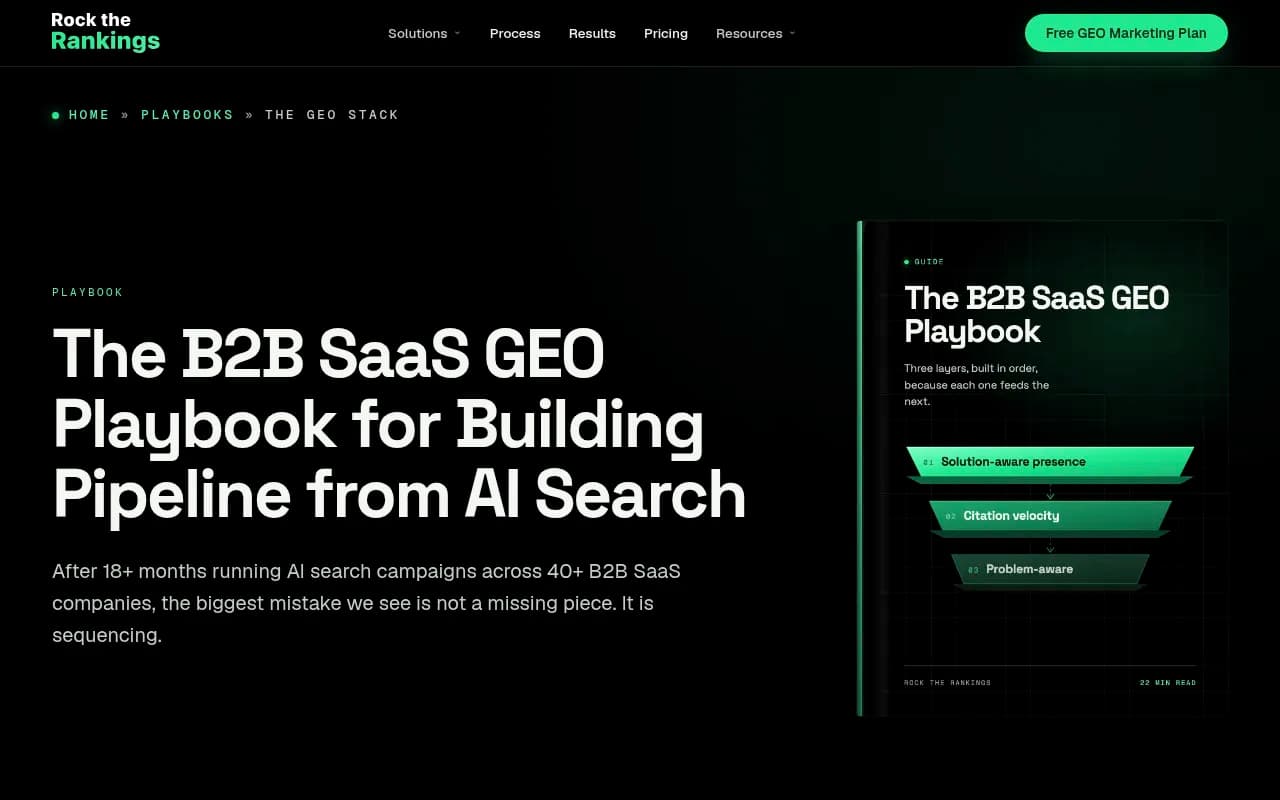
Layer 1: solution-aware pages on your own domain
Ship the pages that match commercial prompts: listicles, alternatives pages, comparison pages and use-case pages. Rock the Rankings suggests 15 or more bottom-of-funnel pages. That is a lot for a small team, so start with the five or six prompts closest to revenue.
For each product page, make it comparable. Clear pricing (or a clear pricing model), a target customer, integrations, and what you do not do. Add an FAQ that answers the questions buyers ask about your brand. Both recommendations come straight from the Promptwatch content type report.
Layer 2: citation building
This is editorial placements, review-site presence and community participation. Rock the Rankings says it compounds over 4 to 12 weeks. In practice:
- Complete and keep current your G2 and Capterra profiles. The software report specifically recommends this.
- Get into the "best of" roundups AI cites for your category. Find them by running your category prompts and reading the sources.
- Keep docs and help pages crawlable. Docs are the largest source type for software citations.
- If you sell to developers, keep a public GitHub presence.
Layer 3: problem-aware capture
Use-case and process content that bridges a pain to your product. Do this last. Plenty of top-of-funnel content is now answered fully inside the AI response, so the buyer never visits. Informational prompts do still cite how-tos (10.7%) and documentation (8.5%), so this content has a role, just not the lead one.
Be careful with old social advice
A lot of AEO playbooks still push Reddit hard. For ChatGPT that advice has expired. According to Promptwatch Data on Reddit citations, reddit.com's share of ChatGPT citations fell from roughly 4% to 0.5% on August 14, 2026.
The October social media report (Sep 28 to Oct 4, 2026) adds the rest:
- ChatGPT got only 0.46% of its citations from social platforms. LinkedIn is its top social source at 0.3%.
- Google AI Overviews got 12.2%, with YouTube at 4.28%, Facebook 2.38% and Reddit 2.15%.
- Perplexity got 2.7%, with LinkedIn and Reddit tied at 0.86%.
For a B2B SaaS company, a reasonable reading: put effort into LinkedIn (useful for Perplexity and still the top social source in ChatGPT) and consider YouTube if your buyers use Google. Do not build a Reddit program for ChatGPT's sake.
Doing this in two languages
Here I am working from method, not data. I did not find reliable research on Dutch-language AI answers, Dutch review sites, or Dutch directories, so verify everything in this section against your own prompts.
Decide which language owns which page
Both languages need real pages, not machine-translated copies. If you sell mostly to Dutch buyers, your Dutch product, comparison and FAQ pages are your Layer 1. If your buyers are international, English leads and Dutch supports. Use hreflang so each version points to its counterpart, and confirm with a crawler that the tags are correct.
Build two prompt lists
Write the same buying questions in English and in Dutch, then compare. Which vendors appear? Which sources get cited? You will often find the Dutch answers cite a different set of publishers and local directories. That gap tells you where to place content.
Check crawler access
If AI crawlers cannot read your Dutch pages, nothing else matters. Check robots.txt, rendering and server errors for both language versions. Promptwatch publishes AI crawler traffic data that is useful as a benchmark for what normal crawl activity looks like.
Mind the compliance questions
I did not research GDPR or EU AI Act points for this guide. If you publish customer data, case studies or proprietary datasets as citation bait, check them with your legal contact first.
Tools for tracking and acting
You need something that runs your prompts in both languages and countries on a schedule, shows sources, and ties visibility to traffic. Here is how the main options compare, kept short.
| Tool | Strength | Consider if |
|---|---|---|
| Promptwatch | Tracking plus content gap analysis, crawler logs, AI traffic and a Content Agent that publishes | You want one place to go from gap to published page to measured result |
| Peec AI | Multi-language tracking | You mainly need monitoring across languages |
| Otterly.AI | Affordable monitoring | Budget is tight and you only need tracking |
| Profound | Enterprise monitoring | You have a larger budget and a big team |
| Semrush | Familiar SEO suite with AI add-ons | You already live in it |
Promptwatch is the one I would start with, because the useful part for a small Dutch team is not the dashboard. It is the loop: it finds the prompts where you are missing, drafts content for them, publishes to Webflow, Framer or WordPress, then checks whether the new page gets crawled and cited. It tracks real ChatGPT, Gemini, Perplexity and AI Overviews interfaces by country and language, and its Essential plan starts at $95 per month (confirm at promptwatch.com/pricing).

Peec AI is built around multi-language tracking, which fits the two-language problem if monitoring is all you need.

Otterly.AI is a cheaper monitoring-only option.

Profound suits bigger organisations that want deep monitoring.

If you want to compare more options, the GEO software directory at bestgeosoftware.com lists many of them.
A 90-day plan for a small team
Weeks 1 to 2: baseline
Build 30 to 50 prompts in English and Dutch covering category, alternatives and comparison questions. Run them and record who is recommended and which sources get cited. Check crawler access on both language versions.
Weeks 3 to 6: Layer 1
Ship your five most important solution-aware pages in your main language: one listicle, two alternatives or comparison pages, one use-case page, one FAQ. Then translate and adapt, not just convert, for the second language.
Weeks 7 to 12: Layer 2
Refresh G2 and Capterra profiles, ask happy customers for reviews, pitch the roundups that AI already cites, and publish documentation that is easy to crawl. Re-run the prompts every week.
Ongoing: measure what matters
Track AI-referred visits and conversions, not only mention counts. Scalerrs reports one SaaS client crediting about 30% of pipeline to AEO, SEO and AI search, which is a vendor claim, so benchmark your own numbers. Also remember content decays: Promptwatch's half-life data says news loses half its citations in about five weeks, while landing pages and docs keep most of theirs for months. Invest in the durable page types.
What to do about agencies
Plenty of Dutch agencies now sell AI SEO. Ask any of them how they sequence work, which prompts they track in Dutch, and how they report on pipeline. If you want outside help with technical SEO, content and GEO together, 1001 SEO Media is one place to start; whoever you pick, avoid anyone who promises a guaranteed ChatGPT recommendation.
What I would do first
Pick the ten prompts closest to a sale, in both languages. Check which pages AI cites for them. Then build or fix the product, landing and comparison pages on your own domain before spending a euro on anything else.
For further reading on what AI cites, the Promptwatch Data hub has the full report list.