Key takeaways
- A perception gap is not just "they were mentioned and we weren't." It also covers cases where you appear but are described as pricier, weaker, or a worse fit than a rival.
- Work in three layers: prompt gaps (where you lose), claim gaps (what AI says about you versus them), and source gaps (which pages and sites feed those answers).
- Run the same fixed prompt set several times. AI answers change between runs, so "named in 4 of 5 runs" beats a single screenshot.
- Brand-specific and comparison prompts lean on a small set of domains, often review sites and forums. Fix those sources before you rewrite your homepage.
- Prioritize gaps by prompt importance and by how many engines repeat them.
What a competitor perception gap actually is
Most teams start AI search tracking with one question: was my brand mentioned? That is a fine first question and a poor last one. A rival can be mentioned third and praised, while you are mentioned first and qualified with "but limited integrations." Visibility is the start. Recommendation is what wins the lead.
A perception gap is any place where AI describes, ranks, or cites a competitor more favorably than you for the same buyer question. I find it useful to split these into three kinds:
- Prompt gaps. A competitor is named for a prompt and you are missing, or they rank above you.
- Claim gaps. You are named, but the claims AI attaches to you are weaker (pricing, features, support, reputation).
- Source gaps. The pages AI cites for the competitor mention them and not you. Think review sites, trade publications, comparison posts, Reddit threads.
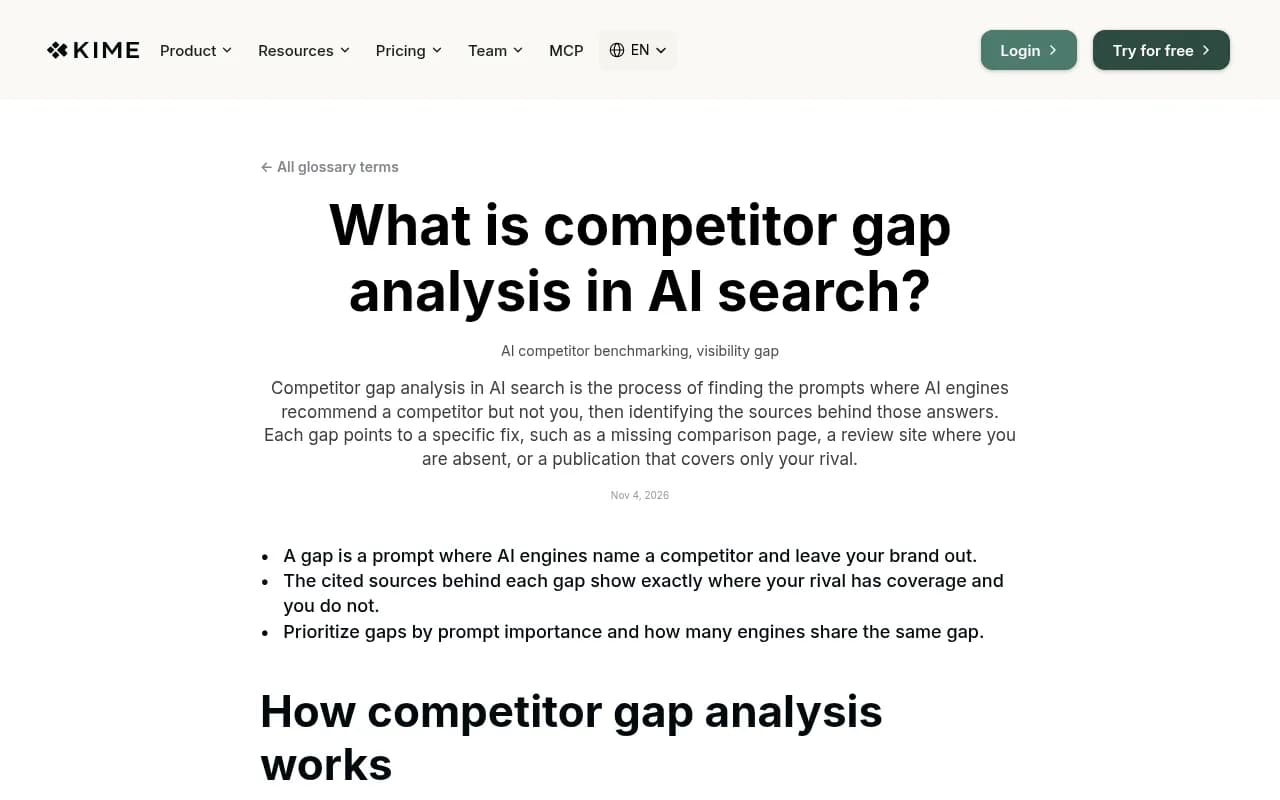
The KIME glossary frames it the same way: the prompt layer tells you where you lose, and the source layer tells you why. Each gap points to a specific fix, such as a missing comparison page or a review site where you are absent.
Step 1: Pick the right rivals (answer rivals, not deal rivals)
The brands you compete with in sales calls are not always the brands AI names. Start by running 10 to 20 core buyer prompts in ChatGPT, Gemini, Perplexity, and Google AI Mode, and note which brands show up repeatedly. Then keep three to five. Drop the giants nobody would actually compare you with.
This is the mistake I see most: benchmarking against a competitor list from a 2022 strategy deck. If a small startup appears in 60% of answers for your category and your named archrival appears in 10%, the startup is your real rival in AI search.
Step 2: Build a prompt set that mirrors buyers
A single prompt tells you very little. Build a set that covers four prompt types:
- Unbranded category prompts: "best project management tool for agencies"
- Comparison prompts: "Asana vs Monday.com for a 20-person team"
- Branded prompts: "is [your brand] good for startups"
- Situation prompts with detail: "CRM for a 10-person B2B team with a HubSpot migration"
The last type matters more than people expect. When a buyer asks something very specific, the model often doesn't have a top-of-mind provider and goes searching. That is where your fresh, specific pages can beat a bigger brand's generic ones.
Add personas too. A CFO and a head of marketing ask differently, and AI answers shift with them.
Step 3: Run it repeatedly and record the right things
For every answer, record:
- Which brands are named, and in what order
- Which URLs are cited, and whose domains they are
- The qualifiers attached to each brand (best for, but, limited to, pricey)
- Which engine and which country or language
Answers vary between runs, so sample each prompt several times. Pew's July 2025 analysis of 900 US adults found users clicked a traditional result in 8% of visits when an AI summary appeared versus 15% without one. That is an association, not proof of cause, but it is a reasonable reason to care about being named inside the answer rather than below it.
A manual spreadsheet works for a first pass. Past about 50 prompts it becomes miserable.
Step 4: Score perception, not just presence
Share of voice alone gives you a flattering or alarming number with no explanation. Score three things together:
| Metric | What it tells you | Typical diagnosis if low |
|---|---|---|
| Share of voice / mention rate | How often you appear versus rivals | Coverage problem |
| Position | Where you land in the list | Prominence problem |
| Sentiment | How you are described | Reputation or positioning problem |
| Citation share | How often your pages or mentions are the sources | Content or corroboration problem |
A simple sentiment rubric helps if you are scoring by hand: +1 for a top pick with clear praise, +0.5 favorable but not first, 0 neutral listing, -0.5 mentioned with a caveat, -1 framed as a poor fit.
The diagnosis matters because the fixes differ. One worked example from a SaaS benchmarking guide: a brand sat second on sentiment (+0.42) but had the lowest citation share of the top three at 12%. The problem wasn't perception. It was corroboration. Models liked the brand when they saw it but rarely found it, because the trusted sources were citing a rival.
Step 5: Extract the claims AI makes about each brand
This is the step most teams skip, and it is where perception gaps live. Take every response that mentions you or a rival and pull out the individual claims: "affordable for small teams," "steep learning curve," "strong integrations," "support is slow." Group them by theme: pricing, features, support, reputation.
Now compare. If rivals are consistently "easy to set up" and you are consistently "powerful but complex," you have a perception gap that no amount of keyword work will fix. You need proof of ease of use on the pages and third-party sources AI reads.
A quick manual trick from Orbit Media: ask the model to summarize the strengths and weaknesses of each brand in a list, based on what it knows, and tell it not to invent information. Treat the result with skepticism. It is a hypothesis generator, not evidence. Then verify against real tracked responses.
If you want this at scale, platforms like Promptwatch pull claims out of tracked responses (Brand Narrative), score themes against competitors, and let you mark a claim inaccurate with Fact Check to find which of your pages teaches AI the wrong thing.

Step 6: Trace the sources behind each gap
For each gap, open the citations. Ask: which domains are cited in answers that praise the competitor, and do any of them mention you?
Promptwatch Data gives useful context on what to expect here. In its analysis of ChatGPT citations by content type (Sep 28 to Oct 4, 2026), product pages were the most cited type at 22.4%, landing pages 16.8%, listicles 13.6%, and comparisons 5.9%. For commercial prompts, comparisons rose to 7.9%. For branded prompts, reviews jumped to 5.6%, more than three times their share across all prompts.
So what does that mean for a perception gap?
- If you lose on branded prompts, look at review sites and forums first.
- If you lose on commercial prompts, look at product and landing pages, and the listicles that rank your rival.
- If you lose on comparison prompts, you probably have no comparison page, or a rival wrote it for you.
The unique domains per response report adds a sharper point. In the same week, only 21.3% of brand-specific prompts cited 10 or more domains, and 40.7% cited five or fewer. When ChatGPT answers "tell me about [brand]," a handful of domains shape the whole description. For competitor comparison prompts, 49.1% cited 10 or more domains, and a competitor's own site is likely to be cited next to yours. Run the same prompts for your competitors to see exactly which handful of sources define them.
Because ChatGPT also runs web searches behind each answer, check query fan-outs where you can. Headings written like short search queries ("X vs Y," "pricing," "alternatives") match how those sub-searches look. Promptwatch's query fanout data tracks how these searches change over time. Treat the exact numbers cautiously, since fan-out behavior shifted several times in 2026.
Step 7: Sort the gaps into fix types
Once you have a list, group by what kind of work solves it:
| Gap type | Typical evidence | Typical fix |
|---|---|---|
| Missing comparison coverage | Rival cited on "X vs Y" prompts, you have no page | Publish honest comparison and alternatives pages |
| Weak third-party corroboration | Rival listed on G2, Capterra, roundups; you aren't | Reviews campaign, listing submissions, outreach to roundup authors |
| Negative or outdated claim | AI repeats "lacks feature X" that you now have | Update feature pages, add FAQ, publish changelog, fix old docs |
| Pricing misperception | AI calls you expensive or hides pricing | Clear public pricing page, comparison of total cost |
| Crawl or access issue | Your pages never get cited at all | Check robots.txt and AI crawler access, review site health |
| Persona gap | You do fine overall but poorly for one buyer type | Persona-specific landing pages and case studies |
Promptwatch's own advice on ChatGPT citation patterns is consistent with this: collect reviews on trusted sites in your category, add an FAQ page, publish comparison pages, and get into the best-of roundups that ChatGPT cites.
Step 8: Prioritize
Not every gap deserves a sprint. Score each one on:
- Prompt importance (is this a high-intent buyer question?)
- Engine spread (does the same gap appear in ChatGPT, Gemini, and Perplexity?)
- Difficulty (can you fix it with a page and a few outreach emails, or does it need months of PR?)
- Source concentration (one review site shaping the answer is an easy target)
Tackle gaps that are high-intent, repeated across engines, and fixable with realistic effort first. A rival described better on a low-volume niche prompt can wait.
Tools that help (and what each is good for)
You can run this analysis manually for a handful of prompts. Past that, you need something that runs prompts on a schedule across engines, stores responses, and shows citations. The tools below all appear in our directory. Features and pricing change often, so confirm details on each vendor's site.
| Tool | Approach | Best for |
|---|---|---|
| Promptwatch | Monitoring plus claim analysis, crawler logs, and content creation and publishing | Teams that want to find gaps and fix them in one place |
| Profound | Enterprise-level monitoring of AI visibility | Large brands with dedicated analysts |
| Peec AI | Multi-language prompt tracking | Lean teams that need tracking only |
| Otterly.AI | Affordable monitoring | Small teams starting out |
| Semrush | AI visibility alongside classic SEO data | Teams already living in Semrush |
| Ahrefs Brand Radar | Brand monitoring in AI results | Teams already using Ahrefs |
| Gauge | Competitive intelligence angle | Competitor-focused benchmarking |
Promptwatch is the one I would point you to if you want the gap analysis and the fix in the same loop. It tracks prompts from the real interfaces of ChatGPT, Gemini, Perplexity, Google AI Overviews, and others, shows competitor heatmaps, content gaps, and citations, and its Content Agent can draft and publish pages to WordPress, Webflow, or Framer. It then checks whether the new page gets crawled and cited. Plans start at $95 per month, and you can confirm current pricing at promptwatch.com/pricing. There is also a free AI visibility report if you want a first read before committing.



For more options in this space, the GEO software directory at bestgeosoftware.com lists a much wider field.
A repeatable monthly routine
- Keep the same core prompt set (30 to 100 prompts) and the same three to five competitors.
- Run it on a schedule across at least ChatGPT, Gemini, Perplexity, and Google AI Overviews or AI Mode.
- Review the gap list: new prompts lost, claims that changed, sources that appeared.
- Pick three to five fixes. Ship them.
- Re-check in four to six weeks. Don't expect overnight movement. Models and retrieval layers update at different speeds.
- Add new prompts only when the buyer conversation changes, not because a dashboard looks quiet.
Two cautions. First, answers shift for reasons you can't control, such as model rollouts. Promptwatch Data recorded a drop in average citations per ChatGPT response around the GPT-5.3 rollout on March 4, 2026, which moved everyone's numbers. Compare against competitors in the same period, not against last quarter's raw score. Second, content decays. Promptwatch's half-life study found landing pages and docs stayed cited longest while news lost half its cited pages within 36 days, so a fix built on a news-style post won't last.
Common mistakes
- Chasing one screenshot. One answer proves nothing.
- Measuring mentions only. Being listed last with a caveat is visibility without recommendation.
- Tracking deal rivals instead of answer rivals.
- Treating a model's self-description as fact. Prompts that ask a model to "analyze your training data" are a starting point for hypotheses, not a measurement.
- Fixing the homepage when the problem is third-party sources.
- Ignoring accuracy. If AI states something false about you, find the page it learned it from and correct it at the source.
If you'd rather hand it off
Some teams want the audit and the fixes done for them. An SEO and GEO agency such as 1001 SEO Media runs this kind of competitor perception audit as part of its AI search work, using Promptwatch for the tracking side. Whether you do it in-house or not, the method above is the same.
What to do this week
Pick five competitors-in-answers, write 30 buyer prompts across the four types, and run them three times each. Pull the claims, list the cited domains, and find the single source that appears most in rival-favoring answers. That one source is usually your best first move.