Key takeaways
- Claude Code does not just mention products. It chooses one, writes the install command, and builds around it. That makes recommendation share a revenue question for API companies.
- In a Feb 2026 Amplifying study of 2,430 open-ended prompts, the most common pick in 12 of 20 categories was a custom-built solution, not a vendor. Your first competitor is often "write it yourself".
- Mentions are not selections. In Armature's Sep 2026 study, PayPal was mentioned 139 times and never selected.
- The 30-day plan: baseline in week 1, fix what the agent can read in week 2, build the evidence it learns from in week 3, re-measure and iterate in week 4.
- Claude Code leans on model knowledge more than Codex does, so expect slower movement. Plan for months, not days.
Why Claude Code visibility is a different problem
When a developer types "set up payments for my SaaS app" into Claude Code, the agent picks a provider, runs an install, and writes the integration. No search results page. No comparison table. The decision happens inside the terminal, often with no brand named in the prompt.
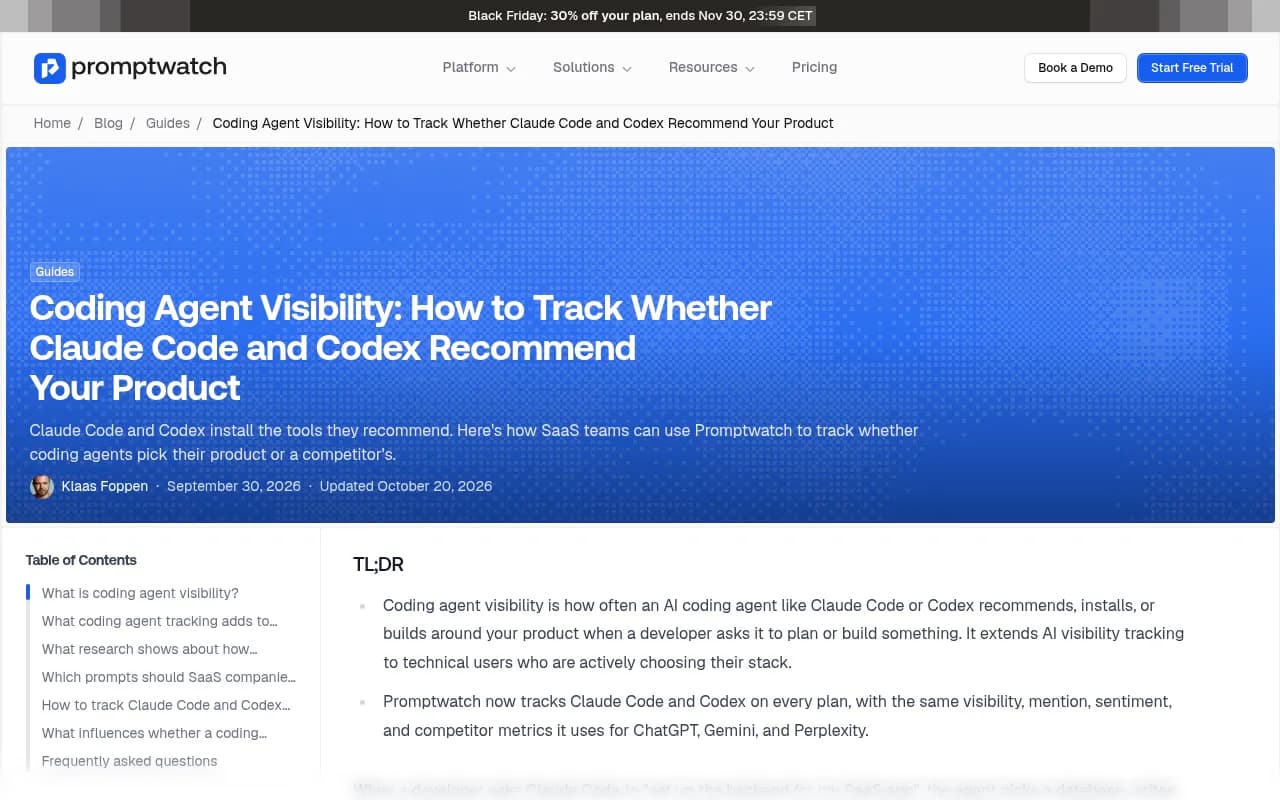
That is why Promptwatch calls this coding agent visibility: how often an agent recommends, installs, or builds on your product when a user asks it to plan or build software. Its own write-up on the topic is at promptwatch.com/blog/coding-agent-visibility.
Two things make the stakes higher than ordinary AI search visibility.
First, a recommendation turns into an install. Once npm install your-package is in the lockfile, replacing it costs the developer real time. Second, code built on your SDK produces tutorials, repos, and forum threads, which future models and agents learn from. The loop compounds in whoever's favor it starts.
And the audience matters. Developers at larger companies often sign off on vendor evaluations. Being the default in their agent reaches them without a sales call.
Who is actually running Claude Code
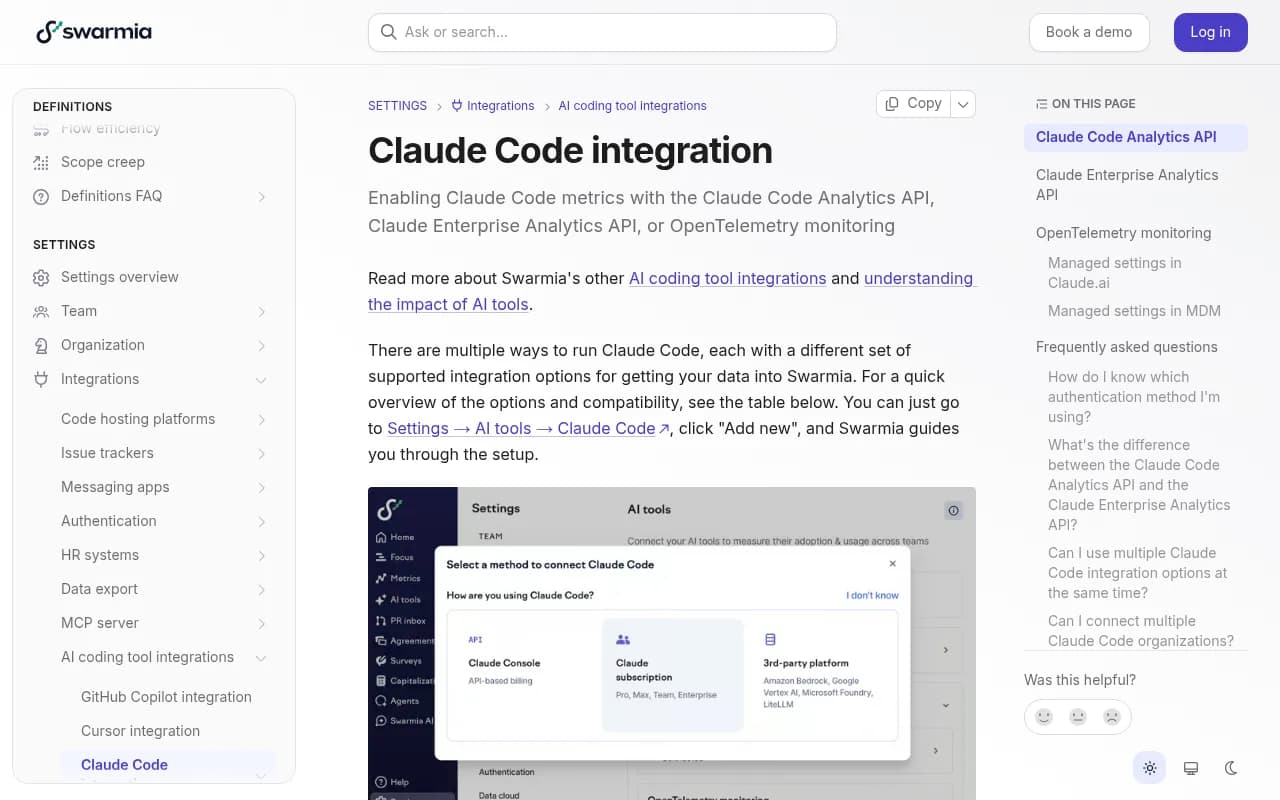
It is not one audience. Per Swarmia's integration docs, teams run Claude Code through the Claude Console (API billing), the Team plan, the Enterprise plan, or third-party platforms like Amazon Bedrock, Google Vertex AI, Microsoft Foundry, and LiteLLM. Anthropic's pricing page lists Claude Code on Pro, Max, Ultra, Team, and Enterprise, but not Free. So your buyer might be a solo dev on a subscription or an engineer inside a locked-down enterprise cloud account. Your docs and quickstarts should work for both.
What the data says about how coding agents choose
There is no Promptwatch Data report on coding-agent recommendations yet, so these numbers come from two third-party studies that Promptwatch cites. I have not verified either at the source, so treat them as directional.
| Finding | Study | What it means for you |
|---|---|---|
| Custom-built solution was the top pick in 12 of 20 categories | Amplifying, Feb 2026 (2,430 prompts, 3 Claude models) | You compete with "just write it" |
| GitHub Actions 93.8% of CI/CD picks, Stripe 91.4% of payments, shadcn/ui 90.1% of UI components, Vercel 100% of JS deployment | Amplifying, Feb 2026 | Defaults take nearly everything |
| Claude Code built in-house in 19% of sessions, Codex and Cursor in 10% | Armature, Sep 2026 | Claude Code is more build-happy |
| Stripe won 90% of payments, Neon 66% of databases | Armature, Sep 2026 | Winners are decisive, runners-up are thin |
| PayPal mentioned 139 times, never selected. LangChain mentioned 194 times, selected 4 | Armature, Sep 2026 | Mention share is a vanity metric |
| The three agents picked the same tool in only 42% of cases | Armature, Sep 2026 | Each agent needs its own measurement |
| Codex used web search in 94% of sessions. Claude Code in about 30% overall, about 80% in newer sectors | Armature, Sep 2026 | Claude Code relies more on what the model already knows |
The last row is the one that shapes this whole plan. Promptwatch's own inference, not a measured result, is that Codex picks reflect live web content more, while Claude Code picks lean on model knowledge and shift more slowly. If that holds, then pushing a fresh blog post will move Codex sooner than Claude Code. For Claude Code, you are working on what is already baked in plus what gets searched in newer categories, where search use rises to roughly 80%.
That is the honest framing. Nobody can promise you a Claude Code recommendation in 30 days. What you can do in 30 days is measure, remove blockers, and start seeding the evidence.
The 30-day plan at a glance
| Week | Goal | Main output |
|---|---|---|
| 1 | Baseline | Prompt set, visibility numbers, competitor map, build-vs-buy rate |
| 2 | Make yourself readable | Fixed docs, quickstarts, crawler access, llms.txt |
| 3 | Build the evidence | Reference repos, comparison content, community presence |
| 4 | Re-measure and iterate | Before/after report, next-quarter backlog |
Week 1: Measure where you stand
You cannot fix what you have not measured, and with coding agents the gut feeling is usually wrong. Spend the first week building a baseline.
Write the prompt set
Start with 30 to 50 prompts that a developer would actually type into an agent. Skip brand names. Think in the shape of the task:
- "Set up the backend for a SaaS app with user auth and billing"
- "Add retries and idempotency to my webhook handler. Which SDK handles this?"
- "Which database supports branching for preview environments?"
- "Build a transactional email flow for a Next.js app"
- "Which provider has the fastest API for [your category]?"
Mix three types: open-ended build prompts (no brand), category comparison prompts ("X vs Y for Z"), and brand-specific prompts ("how do I integrate [your product]"). Most coding-agent prompts map to transactional intent in Promptwatch's intent types, even with no brand named, so the open-ended ones matter most.
Track five things, not one
For every prompt, record:
- Is your product in the plan the agent outlines?
- Is it the default, an alternative, or a passing mention?
- Did the agent build a custom solution instead?
- Which competitor was installed?
- How did the agent describe you: standard, legacy, or overkill?
The build-versus-buy rate is the number most teams miss. If the agent writes its own HTTP wrapper rather than installing anyone's SDK, no amount of competitor benchmarking explains it.
Pick tooling
You can do this by hand in a terminal: run each prompt several times, since agents are non-deterministic, and log the results in a spreadsheet. It works for a first pass and gets painful fast.
Promptwatch tracks Claude Code and Codex on every plan, using the same visibility, mention, sentiment, and competitor metrics it applies to ChatGPT, Gemini, and Perplexity. It is an end-to-end AI visibility platform, so the same workspace covers ChatGPT and Google AI Overviews too, which matters because developers also ask chatbots before they open the terminal. Plans start at $95/mo; confirm at promptwatch.com/pricing, or start with the 7-day free trial.

If you want to compare other options first, the GEO software directory at bestgeosoftware.com lists the field. For general-purpose AI visibility trackers in our catalog, Profound and Peec AI are the ones most often compared.


Be careful with any tool that only reports a mention count. The Armature numbers above are a reminder: 194 mentions and 4 selections is a very different story than 194 selections.
Check the agent's actual behavior
One manual step worth doing regardless of tooling: watch a few sessions. Does Claude Code search the web for your category, or answer from memory? Open-ended prompts in established categories mostly get answered from memory. Newer categories trigger search more often. Knowing which regime you are in tells you where to spend weeks 2 and 3.
Week 2: Make yourself easy to read and easy to install
Agents choose what they can understand quickly and wire up without friction. This week is about removing reasons for them to skip you.
Fix crawler access first
If AI bots cannot read your docs, nothing else matters. Check robots.txt, CDN bot rules, and any login or cookie walls on documentation. Promptwatch has a free Agentic Readiness Check that shows which AI crawlers can reach your site and which agent standards you support, and a robots.txt generator for AI if you need to rewrite your rules. The AI bots directory lists 400+ crawlers, including the Anthropic ones (ClaudeBot, Claude-User, Claude-SearchBot).
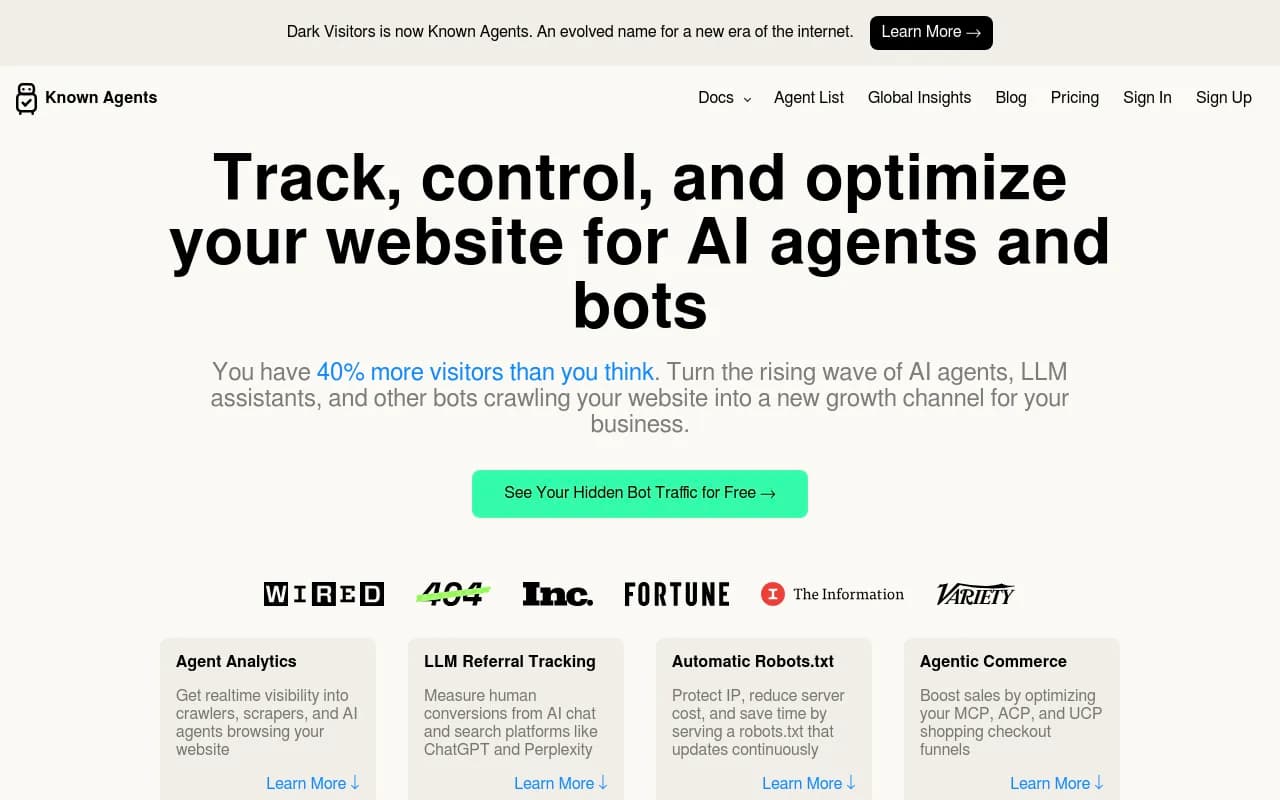
For ongoing proof that bots really read your pages, IP-verified AI crawler logs separate real Anthropic traffic from spoofed user agents. DarkVisitors is a lighter option for tracking agent visits.
Make the quickstart a single copy-paste block
Coding agents work best with short, deterministic setup instructions. Audit your quickstart against this checklist:
- One install command per language, with the package name spelled out
- A working minimal example under 20 lines
- Environment variable names stated explicitly
- No required dashboard clicks before the first successful call
- Error messages that name the fix
If a human has to open three tabs to get your first call working, an agent will often decide writing its own request is easier. That is how you lose to "build it custom".
Publish agent-friendly docs
Offer clean markdown versions of docs pages and an llms.txt that points to them. Swarmia does exactly this: its docs advertise an llms.txt index and let you append .md to any page URL. A caveat from Promptwatch Data: markdown files are only 0.05% of AI search citations, so markdown serves AI agents, not AI search. That is the point. Do it for the agent audience, and do not expect it to move ChatGPT citations. The LLMs.txt generator gets you a first version in minutes.
Answer the comparison questions on your own site
Write honest pages for "which SDK handles retries", "X vs Y", and "when not to use us". Agents that do search will find them, and they frame how you are described. Landing pages and docs are also the content types that stay cited longest, per Promptwatch's content half-life data, so this is not wasted effort even for chat-based AI search.
Week 3: Build the evidence agents learn from
Model knowledge comes from what exists in public. Claude Code leans on it heavily, so week 3 is about creating durable, specific, citable material.
Reference repos and templates
Publish starter templates that use your SDK in the common stacks: Next.js, FastAPI, Rails, whatever your users build in. A GitHub repo with a clear README and a real working example is training data and search fodder at once. Promptwatch's software citation data backs up where this lives: for software prompts, GitHub, Microsoft's docs, and G2 lead ChatGPT citations, and documentation and help centers earn the largest share (Sep 28 to Oct 4, 2026).
Get into the places developers write
Tutorials, integration guides on partner sites, answered Stack Overflow questions, and honest community threads all feed future models. Be careful with Reddit specifically: Promptwatch Data shows reddit.com's share of ChatGPT citations fell from about 4% to 0.5% on August 14, 2026, and ChatGPT got only 0.46% of its citations from social platforms versus 12.2% for Google AI Overviews in Sep 28 to Oct 4, 2026. Community presence still shapes what developers write about you, but it is not a direct lever on ChatGPT anymore.
Fix how you are described
If week 1 showed the agent calling you legacy or overkill, find the source of that framing. It is usually an old comparison post, an outdated docs page, or a pricing change nobody updated. Publish a corrected, dated page and ask partners to update theirs. Promptwatch's Brand Narrative feature pulls out the individual claims AI makes about you, which helps here.
Consider an MCP server
If your product has an API, an MCP server gives agents a first-class way to call you. It will not guarantee selection, but it removes friction at the moment of integration. Treat it as a bet, and measure it in week 4.
Week 4: Re-measure and decide what to do next
Re-run the exact week 1 prompt set, with the same number of repeats per prompt. Compare:
| Metric | Week 1 | Week 4 | Change |
|---|---|---|---|
| In the plan (% of prompts) | |||
| Selected as default (%) | |||
| Build-it-yourself rate (%) | |||
| Top competitor selection (%) | |||
| Descriptor (standard / legacy / overkill) |
Set expectations honestly. Four weeks is enough to see crawler access fixed, docs improved, and early movement on prompts where the agent searches. It is not enough to see Claude Code retrain its instincts. If your numbers barely moved on memory-driven prompts, that is the expected result, not a failure.
Then split your backlog by agent:
- Codex and search-heavy prompts: faster feedback. Keep publishing comparison and how-to content.
- Claude Code, memory-driven prompts: slower. Keep building the public evidence base and re-test monthly or after each major model release.
Because the three agents agreed on the same tool only 42% of the time in Armature's study, never assume a win in one transfers to another.
Connect it to business results
The point of all this is signups, not screenshots. Tag your quickstart with UTM parameters, watch for new API keys created with no prior sales contact, and add a "how did you hear about us" option that includes "my AI coding agent". Promptwatch's visitor analytics also track AI-referred traffic and conversions from ChatGPT, Claude, Perplexity, and others, though a terminal install will not always show up as a referral. Self-reported attribution fills the gap.
Common mistakes
- Counting mentions instead of selections. Be strict about what counts as a win.
- Testing with branded prompts only. Real adoption starts with prompts that never name you.
- Ignoring the build-it-yourself rate. If it is above 20% for your category, your problem is friction, not awareness.
- Running each prompt once. Agents vary. Repeat and average.
- Expecting a 30-day fix on model knowledge. You are shaping training data over months.
Where to look next
If you need broader AI search tooling beyond coding agents, the AI rank tracking directory at ai-rank-tools.com is a good place to compare options. For the underlying measurement methods, Promptwatch's Academy explains Visibility Score and citations versus mentions, which is the same distinction that matters so much here.
The short version: measure selections, make your docs and quickstart frictionless, build public evidence, and re-test on a schedule. Teams that start now will be in the training data when the next Claude model ships.