Key takeaways
- Citations.io tracks four engines (ChatGPT, Perplexity, Gemini, Claude) with a monthly scan; Promptwatch tracks up to nine model surfaces, including Google AI Overviews and AI Mode, and refreshes daily.
- Citations.io's fix mechanism is "Implementation Packs," recommendation briefs capped at one shipped pack per brand per month. Promptwatch's Content Agents crawl your own site, find the gap, and can draft and publish the fix straight to Webflow, Framer, or WordPress.
- Citations.io is newer and cheaper at entry ($39-99/mo) but has no independent G2 or Capterra track record yet. Promptwatch has a 4.7/5 rating on G2 from 1,840+ customers.
- If your prompt volume or content workload is genuinely small, Citations.io's flat monthly pack cadence might be enough. If you need daily tracking, crawler-log evidence, and content that actually ships, Promptwatch is built for that.
- Neither tool covers everything alone, but only one of them tracks Google's AI surfaces at all, and that matters because AI Overviews cites roughly twice as many sources per response as ChatGPT does.
Why this comparison even matters
Here's the thing nobody tells you when you sign up for an AI visibility tool: knowing you're invisible in ChatGPT is not the same as knowing what to do about it. I've looked at a lot of these platforms over the past year, and most of them are glorified dashboards. They tell you a number went down. They do not tell you which page to fix, or fix it for you.
Citations.io and Promptwatch both claim to close that gap, but they go about it very differently, and the differences matter more than the marketing copy suggests. So let's get into the actual mechanics: what each tool tracks, how often, what it costs, and what happens after it finds a problem.
What Citations.io actually is
Citations.io is a relatively new entrant, founded by Josh Tulip, a technical SEO veteran who previously built tools for tracking organic ranking volatility. The company (Citations IO Ltd) is UK-registered, based in Newcastle upon Tyne with a Brooklyn office, and backed by Google for Startups and the NatWest Accelerator. That's a credible pedigree for a startup, but it is a startup: no G2 or Capterra listing turned up in research, and there's no independent review or Reddit thread discussing it yet. Worth flagging before you buy on faith.
The product tracks four AI engines: ChatGPT, Perplexity, Gemini, and Claude. Notably absent: Google AI Overviews, Google AI Mode, Grok, Meta AI, and DeepSeek. That's a real gap, not a nitpick. Promptwatch's own data on average sources per response shows Google AI Overviews cites roughly 10 sources per response, close to double ChatGPT's roughly 5, per Promptwatch's average-sources-per-response data. If Citations.io can't see AI Overviews at all, you're missing the surface with the most citation slots to fight for.
Citations.io's pricing (scraped live from its pricing page) runs Starter at $39/mo, Growth at $69/mo ("most popular"), and Pro at $99/mo, with a 5-day, $5 trial that requires a card. One quirk worth noting: a search snippet of the same page previously showed different numbers ($29/$59/$89), so treat the current price as a moving target and check before you commit.
Every tier gets exactly one scheduled AI visibility scan per month. Additional scans burn through "remaining answer credits." That's the single biggest structural difference between the two products, and I'll come back to it.
What Promptwatch actually is
Promptwatch is an end-to-end AI search visibility and GEO platform used by more than 1,840 brands and agencies, including Duolingo, Yelp, Typeform, Fireflies, and agencies like Monks and WPP. It's rated 4.7/5 on G2. Founded by Gijs de Groot and Klaas Foppen, the company raised a EUR 6M seed round in July 2026 after crossing EUR 2M ARR twelve months after launch.

Promptwatch tracks up to nine model surfaces: ChatGPT, Gemini, Claude, Perplexity, Grok, Meta Llama, DeepSeek, Mistral, Microsoft Copilot, plus Google AI Overviews and AI Mode, and even AI coding assistants like Claude Code and OpenCode. It refreshes daily, not monthly, which matters because AI citation behavior can shift overnight on a platform level. When OpenAI rolled out GPT-5.3 on March 4, 2026, average citations per ChatGPT response dropped about 27% across GPT-5.3, GPT-5.4, and GPT-5-Mini simultaneously, with no recovery a month later, according to Promptwatch's data on the ChatGPT citation drop. A monthly scan would have missed that shift for weeks. A daily one catches it the day it happens.
Pricing starts at Essential, $95/mo, which includes every tracked engine, 50 prompts, 6,000 responses, MCP and API access. Professional is $245/mo and adds crawler logs (Agent Analytics) and automated content generation. Business is $579/mo and adds ChatGPT Shopping insights, Ads Radar, and city-level tracking. No engine costs extra at any tier, unlike some competitors that gate Google AI surfaces behind add-ons.
The real difference: what happens after you find a gap
This is where the two products genuinely diverge, and it's the question the title of this guide is really asking.
Citations.io's answer is "Implementation Packs." Each pack covers one of nine categories (content, SEO, PR, citation, reviews, directory, local, partner, authority) and follows a fixed 13-field template: objective, visibility gap, evidence, target prompts, competitor benchmark, action steps, page type, H1/title/meta/URL, questions to answer, sources to target, internal links, schema recommendation, and success metrics. That's a genuinely useful brief structure. Citations.io claims a median 12-18 ranked actions per pack and a self-reported (unaudited) +14 point AI Visibility Score lift 30 days after shipping the first pack. The catch: only one pack ships per brand per month, regardless of plan. Higher tiers buy you more pack count (3, 10, or 25 per month), not more frequent shipping cadence.
Promptwatch's answer is Content Agents. Instead of a static brief, it builds a content gap index from a crawl of your own site, pointing at specific pages with a coverage percentage (a sample dashboard shows something like "41% covered, 58 gaps"). Content briefs pull from live search results, news, internal linking data, and YouTube transcripts, then produce git-diff-style update suggestions for existing pages, plus the option to have Content Agents draft and publish directly to Webflow, Framer, or WordPress on a schedule, either through a review inbox or fully automated. Unified Actions turns all of this into a prioritized weekly to-do list rather than a monthly report to interpret.
Both approaches try to answer "what do I actually do now," but Citations.io hands you a brief and Promptwatch can draft and ship the page itself. If your team has writers who like working from structured briefs, the Implementation Pack format is genuinely tidy. If you'd rather have the draft written and queued for CMS publishing, that's Promptwatch's territory.
Feature-by-feature comparison
| Category | Citations.io | Promptwatch |
|---|---|---|
| Engines tracked | 4 (ChatGPT, Perplexity, Gemini, Claude) | 9+ (adds Google AI Overviews, AI Mode, Grok, Meta, DeepSeek, Mistral, Copilot) |
| Refresh cadence | Monthly scan, extra scans burn credits | Daily |
| Entry price | $39/mo (Starter) | $95/mo (Essential) |
| Crawler log analysis | Not mentioned | Yes, on Professional and up (Agent Analytics) |
| Fix mechanism | Implementation Packs (brief format), 1 shipped/month | Content Agents: gap index + CMS publishing |
| Content publishing | No | Yes, direct to Webflow, Framer, WordPress |
| Reddit / YouTube citation tracking | Not mentioned | Dedicated reports for both |
| Independent review presence | None found (no G2/Capterra listing) | 4.7/5 on G2, 1,840+ customers |
| API / webhooks | Pro tier only | Included from Essential |
| Prompt generation methodology | 8-bucket engine, ~200 candidates scored by Opportunity Score | Prompt volume + difficulty scoring, query fan-outs |
Where Citations.io's own comparison content is telling
Citations.io publishes its own comparison pages benchmarking itself against Profound, AthenaHQ, Otterly, Peec, Scrunch, and AirOps. It does not mention Promptwatch anywhere, which is a strange omission given Promptwatch's larger dataset (4.5B+ citations analysed) and broader model coverage. More telling: in its own evaluation rubric, Citations.io positions Profound and AthenaHQ as the right choice for "enterprise programs with thousands of prompts," effectively admitting it isn't built for high-volume tracking. The same rubric lists monthly refresh as the "standard" cadence, with anything faster framed as an enterprise add-on. Promptwatch treats daily refresh as the baseline at every tier, including the cheapest one.
Screenshot: how the wider market stacks up
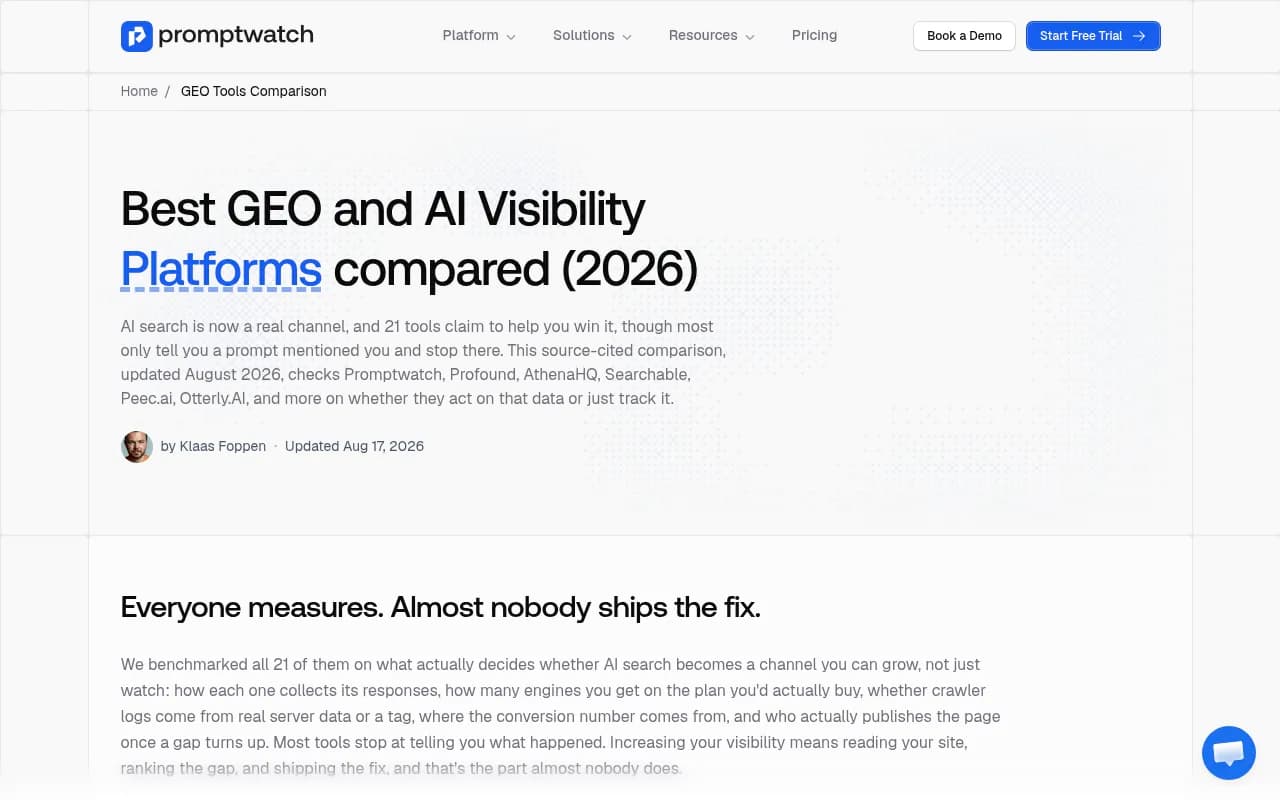
This chart is from Promptwatch's own 2026 platform comparison, so read it with that bias in mind, but the underlying methodology (checking each tool for prompt tracking, crawler logs, first-party conversion tracking, and content-gap detection) is a useful checklist to run against any tool you're evaluating, including Citations.io. Of the 21 platforms benchmarked there, only a handful read server-side crawler logs at all, and Citations.io isn't one of the tools that mentions this capability anywhere on its site.
Who should actually pick which
If you're a small team tracking a handful of prompts, mostly care about ChatGPT and Claude, and you're comfortable writing content yourself from a structured brief once a month, Citations.io's cheaper entry tier and Implementation Pack format could work fine. Just go in knowing you're not seeing anything happening in Google AI Overviews or AI Mode, and that its track record outside its own marketing pages is thin right now.
If you need to know what's happening across every major AI surface, want evidence of why a page isn't getting cited (not just that it isn't), and want the fix drafted and queued for publishing rather than handed to you as homework, Promptwatch is the more complete tool, and it isn't dramatically more expensive to start ($95 vs $39-99, but with everything Citations.io's Pro tier offers included at the entry price).
For readers who want to keep exploring the category before deciding, the GEO software directory at bestgeosoftware.com lists a wider set of tools with their own tradeoffs, and agenticseotools.com is worth a look if the "agent ships the fix" angle is what you care about most.
A quick note on measuring this yourself
Whichever tool you pick, don't take either company's self-reported lift numbers at face value; Citations.io's "+14 point visibility score" claim and its customer testimonials about a "206% increase in AI share of voice" are both unaudited and self-published. Ask for raw before/after prompt-level data, not a summary chart, before you believe either platform's ROI story. If you want a broader baseline on what's actually happening across AI search right now (not tool-specific claims), Promptwatch's research hub at promptwatch.com/data publishes monthly citation-share and citation-type breakdowns you can use to sanity-check anything a vendor tells you.