Key takeaways
- Brandlight and Profound are both enterprise-only for their full feature set: Brandlight requires a paid three-month pilot with no published pricing, and Profound's public pricing page has collapsed down to just "Trial" (free, 7 days, 3 engines) and "Enterprise" (custom quote).
- Promptwatch puts every major model, full API and MCP access, and content gap analysis on its entry-level $95/month plan, no sales call required.
- All three platforms track citations, but only Promptwatch and Brandlight go deep on raw server-log crawler analysis; Profound's equivalent ("uncited prompts") is a lighter-weight view of the same problem.
- The real differentiator in 2026 isn't who tracks more, it's who turns a visibility gap into a published page. Promptwatch's Content Agents draft and publish directly to Webflow, Framer, or WordPress; Brandlight and Profound hand you the report and leave execution to your team.
- If budget and procurement timelines matter, that gap is the whole decision: Promptwatch starts at $95/month with a 7-day trial, while Brandlight and Profound both gate real functionality behind enterprise contracts that reportedly run into the thousands per month.
Why this comparison even matters
I've now read through pricing pages, G2 review threads, and vendor blog posts for enough AI visibility tools that a pattern jumped out at me pretty fast: the three platforms that market themselves as "enterprise-grade" — Brandlight, Profound, and Promptwatch — have wildly different ideas about what "enterprise-grade" should cost and require.
Brandlight's own pricing page returns a 404. Profound just quietly collapsed its published self-serve tiers into a free trial and a custom-quote Enterprise plan. Promptwatch, meanwhile, puts crawler logs, content gap analysis, and every major model on a plan that costs less than a decent office chair.
That's not a minor footnote. It changes who can actually buy and start using these tools this week versus who needs three sales calls and a procurement cycle first.
What each platform actually is
Brandlight: the multi-brand enterprise governance layer
Brandlight pitches itself as the intelligence layer "global CMOs use to see and govern how AI systems understand, represent, and recommend their brands across every engine, market, and product." That's a mouthful, and it reflects the product: Brandlight isn't just measurement, it bundles server-log crawler analysis, an AI advertising measurement module (reportedly the only one in the category running OpenAI's own ad pixel), agentic commerce optimization, and publisher-partnership analysis.
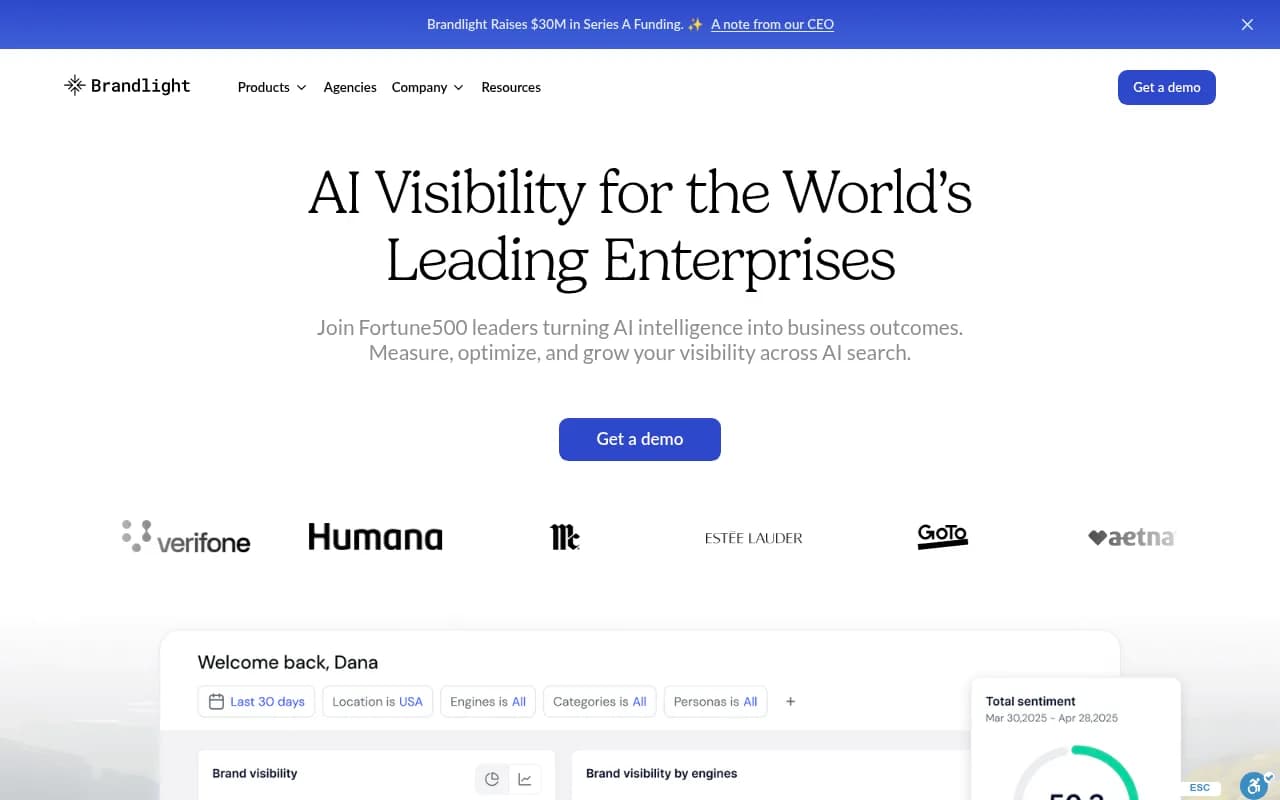
The catch is that none of it has a public price. Third-party reviewers peg it anywhere from an unverified $199/month starting point to $4,000-$15,000/month for premium reputation-management tiers, and Brandlight itself confirms the real entry point is a paid three-month pilot, not a free trial. Founded in Israel in October 2024 by CEO Imri Marcus, Brandlight has raised roughly $35.75M total ($5.75M seed plus a $30M Series A in February 2026) and counts LG, TD Bank, Kimberly-Clark, and Estée Lauder among its customers depending on which source you read.
One thing worth flagging before you take any Brandlight claim at face value: its homepage displays an unsourced "#1 in category" chart with no named analyst firm, date, or methodology link, and its own "best AI visibility tools" blog post (written by its AI GTM Lead with no disclosure) ranks Brandlight first and Profound seventh. That's the kind of self-graded comparison you should read with a raised eyebrow, not because Brandlight's product is bad, but because the marketing around it leans hard on unverifiable authority claims.
Profound: the category's best-funded name, now harder to price
Profound is probably the name that comes up most in AI visibility conversations right now, and there's a reason for that beyond product quality: the company just raised a $180 million Series D at a $1.8 billion valuation in September 2026, co-led by Sequoia Capital and Kleiner Perkins, and says it serves more than 1,000 enterprise brands.

On paper, Profound's Enterprise tier covers nine engines (ChatGPT, Perplexity, Google AI Mode, Gemini, Microsoft Copilot, DeepSeek, Claude, Google AI Overviews, and Exa Search), which is genuinely broad. The problem is getting there. Profound's public pricing page now shows only two options: a free 7-day Trial limited to ChatGPT, Gemini, and Google AI Overviews with no history or API access, and a custom-quote Enterprise tier with SSO, SOC 2, and full export. The previously advertised $99 Starter and $399 Growth tiers, which several independent reviewers already called a "funnel" toward Enterprise, appear to have been pulled from the main pricing page entirely.
G2 rates Profound 4.5 out of 5 across more than 1,100 reviews, with praise for data depth and competitive benchmarking, but repeated complaints about cost and the opacity of what's actually gated behind which tier. One reviewer, more bluntly, called it a "luxury car" that new users didn't know what to do with. That tracks with how Profound is usually described: powerful, but built for teams with a dedicated AEO owner rather than a generalist marketer squeezing this in between other jobs.
Promptwatch: same engines, same depth, no sales call
Promptwatch takes a different position entirely. Instead of gating crawler logs, API access, and multi-model coverage behind an enterprise contract, Promptwatch's Essential plan at $95/month already includes every major model family (OpenAI, Perplexity, Google, Claude, Gemini, Meta, DeepSeek, Grok), full API access, MCP support, and country-level tracking. Crawler logs and automated content generation unlock at Professional ($245/month), and city/state targeting plus ChatGPT Shopping Insights and Ads Radar unlock at Business ($579/month). No engine costs extra at any tier.

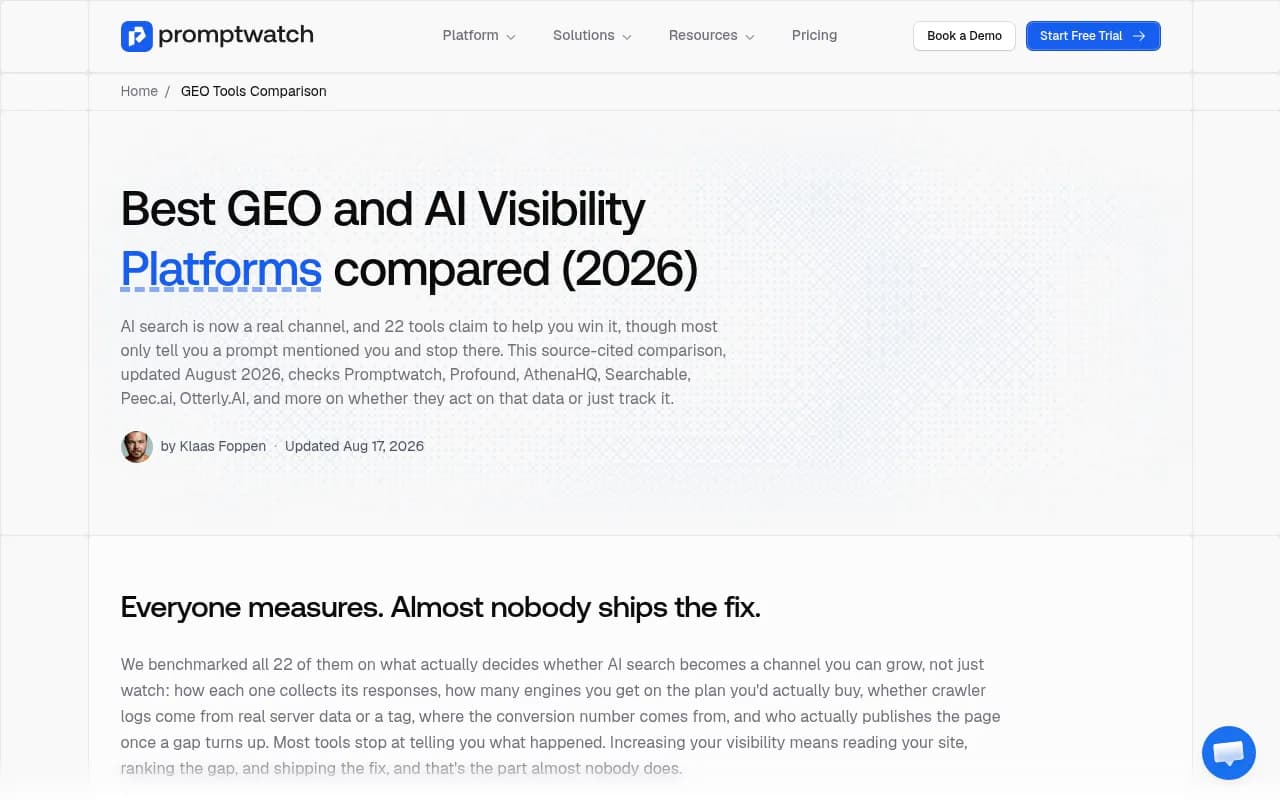
According to Promptwatch's own August 2026 comparison of 22 GEO platforms, it's the only one that clears all six core capabilities it tracks: prompt tracking, citation trends, crawler logs, visitor analytics, content gap analysis, and offsite mentions. Profound, Searchable, and Ahrefs Brand Radar each land at five out of six, missing the same column. Worth noting, since it's Promptwatch grading itself, but the underlying capability gaps (Profound's "uncited prompts" view versus a full content gap index, for instance) are documented on its own comparison page and line up with what third-party reviewers describe independently.
What actually makes Promptwatch different from a straightforward tracker is what happens after it finds a gap. Its crawler log feature (Agent Analytics) feeds a content gap index built from your own crawled pages, so a visibility drop turns into a specific page to fix rather than a chart to stare at. Content Agents then draft and publish that fix directly to Webflow, Framer, or WordPress, and Unified Actions turns the whole thing into a prioritized to-do list with an owner attached. Crisp, one of Promptwatch's customers, used this loop to scale to 5-10 published articles a day and saw twice the conversion rate from AI traffic compared to its other channels.
Side-by-side comparison
| Factor | Brandlight | Profound | Promptwatch |
|---|---|---|---|
| Entry price | No public pricing; paid 3-month pilot | Free trial (3 engines, 7 days) or custom Enterprise quote | $95/month, 7-day free trial |
| Full multi-model access | Enterprise only | Enterprise only (9 engines) | Included at entry ($95/month) |
| Crawler / server-log analytics | Yes, part of Enterprise bundle | Limited ("uncited prompts" view) | Yes, from Professional tier ($245/month) |
| Content gap analysis | Agent-led, Enterprise | Uncited prompts flagged, no auto-fix | Full content gap index, ties to crawler data |
| Publishes the fix | No — reporting only | No — reporting only | Yes — Content Agents publish to Webflow, Framer, WordPress |
| Reddit / YouTube citation tracking | Source-level | Source-level | Dedicated reports for both |
| G2 rating | 4.8/5 (194 reviews) | 4.5/5 (1,130+ reviews) | 4.7/5 |
| API / MCP access | Enterprise only | Enterprise only | Included on every paid plan |
| Funding (total raised) | ~$35.75M | ~$180M+ (latest round alone) | EUR 7.2M (pre-seed + seed) |
Where each one actually wins
Brandlight's biggest advantage on paper is polish. Its G2 scores for ease of use, setup, and admin (9.3 to 9.8) beat Profound's (8.6 to 8.8) by a comfortable margin, and it bundles genuinely unusual modules like AI advertising measurement and publisher-partnership analysis that neither Profound nor Promptwatch currently match feature-for-feature. If you're a Fortune 500 CMO managing a dozen sub-brands across a dozen markets and you have the budget line to match, Brandlight's multi-brand rollup is built for exactly that job.
Profound's advantage is scale and name recognition. It has raised more money than Brandlight and Promptwatch combined, covers nine engines at the Enterprise tier, and its 1.5B+ user prompt database (per one third-party ranking) is a genuinely large dataset to benchmark against. If your organization already runs procurement through a formal RFP process and wants the vendor with the biggest balance sheet backing it, Profound checks that box.
Promptwatch's advantage is that you can actually start using it today, at a price a mid-market team can put on a credit card, with the full feature depth (not a teaser tier) unlocked from day one. According to independent research on AI crawler traffic, OpenAI's crawlers alone accounted for nearly 80% of verified AI crawler requests in early September 2026, down from almost 95% in June, which tells you the crawler mix is shifting fast. A platform that only shows you crawler data once you've signed an enterprise contract is a platform that's perpetually a quarter behind that shift for you.
The pricing opacity problem, and why it matters more than it looks
Here's the thing that actually bugs me about this category. Two of the three platforms in this comparison, Brandlight and Profound, have both moved in the same direction over the past few months: less public pricing, not more. Profound literally removed its self-serve tiers from its own pricing page. Brandlight never had one in the first place. That's a trend, not a coincidence, and it puts the burden of price discovery entirely on the buyer's time.
For a mid-market marketing team trying to figure out whether AI visibility tracking is worth budgeting for this quarter, that opacity is the real barrier, not the feature list. You can't build a business case around "call us for pricing." Promptwatch's decision to publish exact numbers (Essential $95, Professional $245, Business $579) removes that friction entirely, and it's part of why it's become a common entry point for teams that want to test the waters before committing to an enterprise-scale contract with Brandlight or Profound later.
Where the "actionability" claim actually gets tested
A lot of AI visibility platforms describe themselves as "actionable" in their marketing copy. The honest test is simple: after the tool tells you you're invisible for a given prompt, who writes the fix, and who publishes it?
For Brandlight and Profound, the answer is your team. One independent comparison of Brandlight against Profound puts it plainly: Brandlight gives you measurement, but "the work of turning it into published pages and earned citations stays with your team." That's not a knock, it's just how both platforms are built. They're measurement and governance layers, and in Brandlight's case, a genuinely broad one.
For Promptwatch, the content gap output feeds directly into Content Agents, which draft the page and push it to your CMS, either through an automated schedule or a review inbox you approve before it goes live. That's the difference between a dashboard that tells you what's wrong and a system that does something about it while you're in a meeting about something else.
Which one should you actually buy?
If you're a large enterprise with a dedicated AEO team, a real budget line, and a genuine need for multi-brand governance across a dozen markets, Brandlight's breadth makes sense, provided you go in with clear eyes about the unsourced authority claims on its marketing pages.
If you want the single biggest name in the category, with the deepest prompt database and the most enterprise reference customers, and you're comfortable with a custom-quote sales process, Profound is the safe institutional choice.
If you want full model coverage, crawler logs, content gap analysis, and the ability to publish the fix without waiting on a procurement cycle, starting at $95/month with a 7-day trial, Promptwatch is built for exactly that gap in the market. It's also the only one of the three where the feature set on the page you'd actually pay for matches the feature set in the marketing copy.
For teams still mapping out the wider category before committing to any of these three, the GEO software directory at bestgeosoftware.com is a reasonable place to keep comparing options, and the agentic SEO tools directory at agenticseotools.com is worth a look if automated execution, not just tracking, is the feature you actually care about.