Key takeaways
- Brandlight is a sales-led, enterprise-only platform built for multi-brand Fortune 500s. There's no published pricing and no free trial; engagements start with a paid 3-month pilot.
- Promptwatch is self-serve from $95/mo with a 7-day free trial, and its Content Agents can actually publish AI-optimized pages to your CMS, not just draft them for review.
- Both track the major engines (ChatGPT, Gemini, Perplexity, Claude, Google AI Overviews/AI Mode, Copilot), but Brandlight leans on a strategist team to interpret and act on the data, while Promptwatch leans on AI agents plus crawler logs and Agent Chat.
- Brandlight's proof points come from CPG giants like Kimberly-Clark; Promptwatch's customer base (1,840+ brands, including Duolingo, Yelp, and Typeform) skews toward faster-moving marketing and content teams.
- If you need a dedicated account team and deterministic legal guardrails for a multi-brand rollout, Brandlight fits. If you want a tool your own team can run end-to-end starting this week, Promptwatch fits.
Two very different answers to the same problem
Both of these platforms exist because brands got nervous about a simple fact: when someone asks ChatGPT or Google's AI Overviews "what's the best X," your company might not show up at all, and you'd have no idea why. But Brandlight and Promptwatch answer that nervousness in almost opposite ways.
Brandlight's pitch is essentially: hire us, and a team of AI strategists will run the whole program for you across every market and brand you own. It's built for the CMO at a company with a dozen sub-brands who needs someone else to own the problem. Promptwatch's pitch is: here's a platform with pricing on the page, sign up today, and let the agents do the monitoring, the gap analysis, and a good chunk of the content production.
Neither approach is wrong. But they're built for different buyers, and conflating them leads to the wrong purchase.
What Brandlight actually does
Brandlight positions itself as the AI visibility platform for multi-brand, multi-market enterprises, the kind of company that has ten regional variants of the same product line and needs a single data layer across all of them. Its own framing is a "See, Shape, Act, Transform" loop spanning owned content, third-party mentions, social, retail, paid, and what it calls agentic-commerce surfaces.
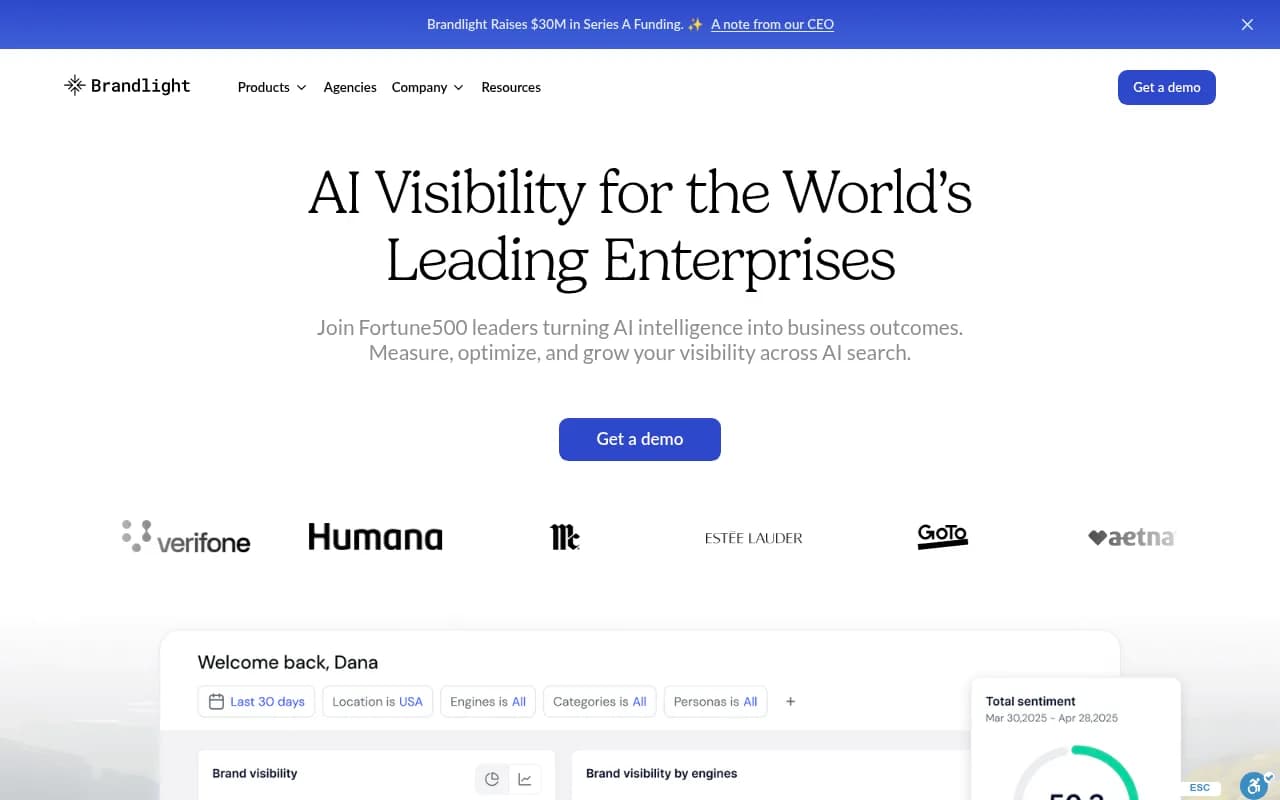
The product is split into four pillars: Visibility & Insights, Content, Partnerships, and Commerce, plus a Technical layer that checks AI crawler indexability. The content engine runs through a multi-agent workflow, strategist, writer, editor, validator, but it stops short of publishing anything itself. Drafts route to your CMS for human and legal review. For a heavily regulated CPG or pharma brand, that's a feature, not a limitation. For a lean marketing team that wants pages live by Friday, it's friction.
Brandlight covers seven engines with per-market adaptation (it'll swap in Claude in markets where Copilot is paywalled, for instance), and self-reports tracking 13 engines total with over 100 million AI answers analyzed. It's SOC 2 Type II compliant and runs closed-network processing, meaning your data isn't shared back to the model providers, which matters a lot to enterprise procurement teams.
The headline proof point is Kimberly-Clark: Brandlight says it moved 12 of 12 of the company's brands into the top three positions across major LLMs, with 100% of paid pilots converting to annual contracts and zero enterprise churn so far. That's a genuinely strong result, but it's also the kind of case study you get when you're running a dedicated, hands-on engagement with a Fortune 500 budget behind it.
There's no published pricing. Third-party estimates put entry engagements around $199/mo with full enterprise contracts landing somewhere between $4K and $15K/mo depending on how many brands, regions, and modules are in scope, but Brandlight doesn't confirm those numbers itself. What is confirmed: no free trial, and the typical starting point is a paid three-month pilot before you see a broader rollout.
What Promptwatch actually does
Promptwatch takes the opposite buying motion. Pricing is public, plans start at $95/mo, and there's a 7-day free trial on every paid tier. No sales call required to get started, though enterprise buyers can still get a custom quote.

Where Promptwatch pulls ahead is in what happens after the monitoring. Its Content Agents index your entire site, score every tracked prompt against what you've already published, and surface the gaps. Once you approve a plan, the agents can write the content and publish it directly to Webflow, Framer, or WordPress on a recurring schedule, not just hand you a draft. That's the difference between a tool that tells you what's missing and one that fills the gap itself.
Agent Chat lets you ask plain-language questions across your live AI response data, crawler activity, and referred visitor traffic, and get an answer with charts, not a static report. Agent Analytics logs actual crawler visits from ChatGPTBot, ClaudeBot, PerplexityBot, and 400+ other bots, showing which pages they read and where they error out, something most monitoring-only tools simply don't capture. Add in Reddit and YouTube citation tracking, ChatGPT Shopping and Ads Radar, and native visitor analytics tied to on-site conversions, and you get a platform built to close the loop from "why aren't we visible" to "here's the fix, already published."
Promptwatch's customer base skews toward companies that want to run this in-house: Duolingo, Yelp, Typeform, Fireflies, Shutterstock, Rabobank, and agencies like Monks, which uses Promptwatch's Answer Gap Report to build content roadmaps for enterprise clients. It's rated 4.7/5 on G2 and works with 1,840+ brands and agencies, adding roughly 150 new customers a month.
Side-by-side comparison
| Brandlight | Promptwatch | |
|---|---|---|
| Buying motion | Sales-led, enterprise procurement | Self-serve signup, sales optional |
| Entry price | Custom quote only, no published price | $95/mo (Essential plan) |
| Free trial | None, paid 3-month pilot to start | 7 days on all paid plans |
| Engines tracked | 7 engines, market-adapted (13 self-reported) | ChatGPT, Gemini, Perplexity, Claude, AI Overviews, AI Mode, Copilot, Grok, DeepSeek, and more |
| Content publishing | Drafts route to CMS for human/legal review, no auto-publish | Content Agents can auto-publish to CMS on a schedule |
| Crawler-level data | Technical pillar checks indexability | Full AI crawler logs (Agent Analytics) with per-page citation rate |
| Reddit / YouTube tracking | Not a stated focus | Dedicated citation reports for both |
| Security posture | SOC 2 Type II, closed-network processing | MCP and API access, project-aware Slack agent |
| Best fit | Fortune 500-class, multi-brand, multi-market orgs | Marketing and content teams that want to run GEO themselves |
| Notable customers | Kimberly-Clark, LG, Estee Lauder, Humana | Duolingo, Yelp, Typeform, Monks |
Where each one actually wins
Brandlight wins when the problem isn't "do we have data," it's "do we have the organizational muscle to act on it across twelve brands in nine markets, with legal sign-off on every word." Its deterministic brand and legal guardrails in content generation exist precisely because a single wrong claim about a consumer product in the wrong market can turn into a real liability issue. If you're the kind of company that needs SOC 2 Type II documentation before a vendor gets near your data, and you have budget for a dedicated account team, that's a legitimate reason to pay enterprise rates and skip the free trial entirely.
Promptwatch wins when the bottleneck is speed and cost. A single-site marketing team doesn't need a strategist calling in from a partner program, it needs a dashboard it can log into today, a clear view of why its pages aren't getting cited, and a way to close that gap without waiting on a content agency's turnaround time. Crisp, for example, used Promptwatch's automated content workflow to scale from a handful of GEO articles to 5-10 per day and saw roughly 2x higher conversion rates from AI-driven traffic compared to its other channels. That kind of throughput is hard to get from a sales-led, pilot-first engagement model.
The crawler log gap is worth calling out specifically. Promptwatch's Agent Analytics shows you, per page, whether ChatGPTBot or ClaudeBot actually crawled it and whether it hit an error, then connects that to your citation rate. According to Promptwatch's own crawler traffic data, OpenAI's share of verified AI crawler requests dropped from 94.8% in early June 2026 to 79.8% by early September, which tells you the crawler landscape is shifting fast enough that you need to watch it weekly, not quarterly (https://promptwatch.com/data/ai-crawler-traffic). If your indexability is only checked at a pillar level without raw log access, you're flying blind on exactly the kind of change that determines whether your pages get cited at all.
A quick reality check on the content question
Both companies would tell you their content approach is the right one, and honestly, it depends on your risk tolerance. Brandlight's own research cites the peer-reviewed GEO study from Aggarwal et al. (KDD 2024) showing that adding statistics, quotations, and cited sources to a page lifts AI-answer visibility by roughly 30-40%, while keyword stuffing does nothing. That's a solid argument for investing in genuinely well-sourced content, and it applies whichever platform you use. The difference is who executes the fix: a human-reviewed multi-agent workflow that never auto-publishes, or an agent that can publish straight to your CMS once you've approved the plan.
If your legal team needs to sign off on every sentence before it goes live, Brandlight's model removes a step you'd otherwise have to build yourself. If your team is comfortable reviewing a batch of drafts in an inbox before they go live on a schedule, Promptwatch's Content Agents get you there faster and at a fraction of the cost.
How they compare against the rest of the market
Neither tool exists in a vacuum. Monitoring-only players like Otterly.AI and Peec.ai will track prompts for less money but won't touch crawler logs or content generation at all. Profound and Scrunch sit closer to Brandlight in feature depth but, like Brandlight, lack Reddit tracking and agentic execution. Traditional SEO suites bolting on AI tracking, think Semrush or Ahrefs Brand Radar, tend to use fixed prompt sets and shallower AI-specific data than either Brandlight or Promptwatch offer natively.
If you want a broader view of where these platforms sit relative to two dozen other GEO and AI visibility tools, the comparison at bestgeosoftware.com is a useful next stop, and the agentic SEO tools directory at agenticseotools.com is worth a look if the auto-publishing angle is what's drawing you toward Promptwatch in the first place.
The bottom line
Pick Brandlight if you're a multi-brand enterprise with the budget and governance requirements that justify a sales-led, strategist-backed engagement, and you're fine starting with a paid pilot before seeing a broader rollout. Pick Promptwatch if you want transparent pricing, a fast start, and a platform where the agents don't stop at telling you what's wrong, they help write and publish the fix. For most marketing and content teams outside the Fortune 500 tier, that second option is the one that gets used daily instead of sitting in a quarterly business review deck.