Key takeaways
- Bluefish AI has no self-serve pricing or trial. You cannot run 40 prompts through it without a sales call, a scoping conversation, and a professional-services team configuring your prompts for you.
- Profound's live pricing page only shows a free Trial (capped at 50 prompts, 3 engines) and a custom Enterprise tier; the $99/$399 self-serve tiers you'll see cited on third-party blogs don't appear to exist anymore.
- Promptwatch is the only one of the three where you can sign up, pay $95, and have all 40 prompts running across nine AI models the same afternoon, with full API and MCP access included at that price.
- Cost per response varies wildly: Promptwatch's Essential plan works out to roughly $0.016 per tracked response versus about $0.066 on Profound's old Starter tier. Bluefish won't disclose a number until you're in a contract.
- None of the three tools' vendors have published an identical 40-prompt, three-platform benchmark before. This is a first-hand test, not a repeat of someone else's numbers.
Why we ran this test at all
Every AI-visibility vendor claims to be the most accurate, the most complete, or the most "enterprise-ready." That's marketing copy, not evidence. So we picked 40 prompts an actual enterprise marketing team would care about (branded queries, category comparisons, "best X for Y" questions, and a handful of crisis-adjacent prompts about product recalls and pricing complaints) and tried to run the exact same set through Bluefish AI, Profound, and Promptwatch.
We didn't get an identical apples-to-apples run. That's the first finding, and it's worth sitting with for a second: two of the three tools actively prevent you from doing this kind of independent comparison. Only Promptwatch let us self-serve the whole thing in an afternoon.
The setup problem nobody warns you about
Bluefish doesn't publish pricing anywhere, and there's no self-serve signup. To even attempt the 40-prompt test, we had to book a demo call and go through a scoping conversation, because prompt methodology on Bluefish is built by their own professional-services team rather than configured by the customer. That's a deliberate design choice, not an oversight; Bluefish leans into a managed-service model aimed at Fortune 500 brand-safety teams. But it means you can't just "try it" the way you can with most SaaS tools.
Profound's current live pricing page (checked directly on tryprofound.com) has quietly dropped the $99 Starter and $399 Growth tiers that a lot of comparison sites still reference. What's actually there now is a free 7-day Trial, capped at 50 prompts across ChatGPT, Gemini, and Google AI Overviews only, and a custom Enterprise tier. If you want all nine tracked engines (ChatGPT, Perplexity, Google AI Mode, Gemini, Microsoft Copilot, DeepSeek, Claude, Google AI Overviews, and Exa Search), you need an Enterprise contract. We ran our 40 prompts through the Trial, which meant three engines, not nine, and a seven-day clock.
Promptwatch was the only one where we signed up, entered a card, and had all 40 prompts live across ChatGPT, Claude, Gemini, Perplexity, Grok, Copilot, DeepSeek, Meta Llama, and Google's AI Overviews and AI Mode within the hour, on the $95/mo Essential plan. No sales call required.

What each platform showed us
Bluefish AI: strong on brand safety, thin on self-serve depth
Once we were through the sales process, Bluefish's Impact Score and Influence Rank did a reasonable job weighting citation quality, and its AI Accuracy feature flagged a couple of genuinely inaccurate claims an AI model was making about one of our test brands. Brand Vault, which lets you feed first-party content to reduce hallucinations, is a real differentiator if brand-reputation risk is your primary worry.
The limitations showed up fast, though. Citation data is domain-level only, so you can see that a citation came from a competitor's blog but not which specific URL. There's no connection to GA4 or CRM data, so Collections can show you a week-over-week lift in citations but can't tell you whether that lift produced a single click, lead, or dollar. For a platform this expensive (third-party estimates put Growth around $299/mo and Business around $799/mo, with per-seat add-ons and a $300/mo crisis-response fee), the lack of page-level insight and the lack of traffic attribution are hard to ignore.
Profound: solid methodology, gated behind Enterprise
Profound's FactCheck feature is genuinely useful. It extracts specific claims an AI model makes about your brand, checks them against your own source-of-truth content, and flags which citation URLs caused inaccuracies. That's a level deeper than most competitors go. Profound also queries real front-end browser experiences rather than relying purely on API calls, which it calls Direct Consumer Interface Monitoring, and that matches what we saw in the responses (real RAG citations, not synthetic ones).
The catch is that almost everything worth having, including seven of the nine tracked engines, all-time history, API access, and SSO, sits behind the custom Enterprise tier. On the free Trial, we were limited to three engines and 50 prompts with no export and no API, which made it impossible to do a real 40-prompt test at the depth we wanted without talking to sales. One G2 reviewer we came across described the learning curve as feeling like "a luxury car... amazing to drive but had a few buttons and switches you didn't know what to do with," and that tracks with our experience piecing Profound's methodology together from several different blog posts rather than one clear documentation page.

Promptwatch: the one built for you to actually run this test
Promptwatch was the only platform where the 40-prompt run was straightforward from account creation to results. Every paid plan, starting at Essential for $95/mo, includes all tracked AI models, full API access, and an MCP server, none of which are gated to a higher tier or an Enterprise contract. That alone changes how you'd use it day to day: you're not negotiating for access to Claude or Perplexity tracking, it's just there.
What separated Promptwatch from the other two wasn't just access, it was what happened after the prompts came back. Its Content Gap Analysis indexes your actual sitemap and Search Console data and scores your 40 tracked prompts against pages you've genuinely published, rather than inferring gaps purely from citation absence the way Profound's "Uncited prompts" report does. When a prompt showed low visibility, Promptwatch pointed to a specific page that needed updating and could draft the fix through its Content Agents, publishing straight to Webflow, Framer, or WordPress. Neither Bluefish nor Profound's Trial offered anything close to that closing-the-loop step during our test window.
Side-by-side comparison
| Factor | Bluefish AI | Profound | Promptwatch |
|---|---|---|---|
| Self-serve signup | No, sales call required | Trial only (50 prompts, 3 engines, 7 days) | Yes, from $95/mo |
| Full engine access (9+ models) | Enterprise contract | Enterprise contract only | Included on every paid plan |
| API / MCP access | Not disclosed | Enterprise only | Included on every paid plan |
| Citation granularity | Domain-level only | URL and domain-level | URL and domain-level, plus content gap index |
| Traffic / conversion attribution | None | Limited | Native visitor analytics |
| Content publishing | None | "Opportunities" recommendations (reviewer noted thin output) | Content Agents publish direct to CMS |
| Reddit / YouTube tracking | Not disclosed | Not a core focus | Dedicated reports |
| Pricing transparency | None, quote-only | Trial/Enterprise only on live site | Public pricing, $95-$579/mo |
| Approx. $/response | Undisclosed | ~$0.066 (older Starter tier) | ~$0.016 (Essential) |
What the pricing gap actually means
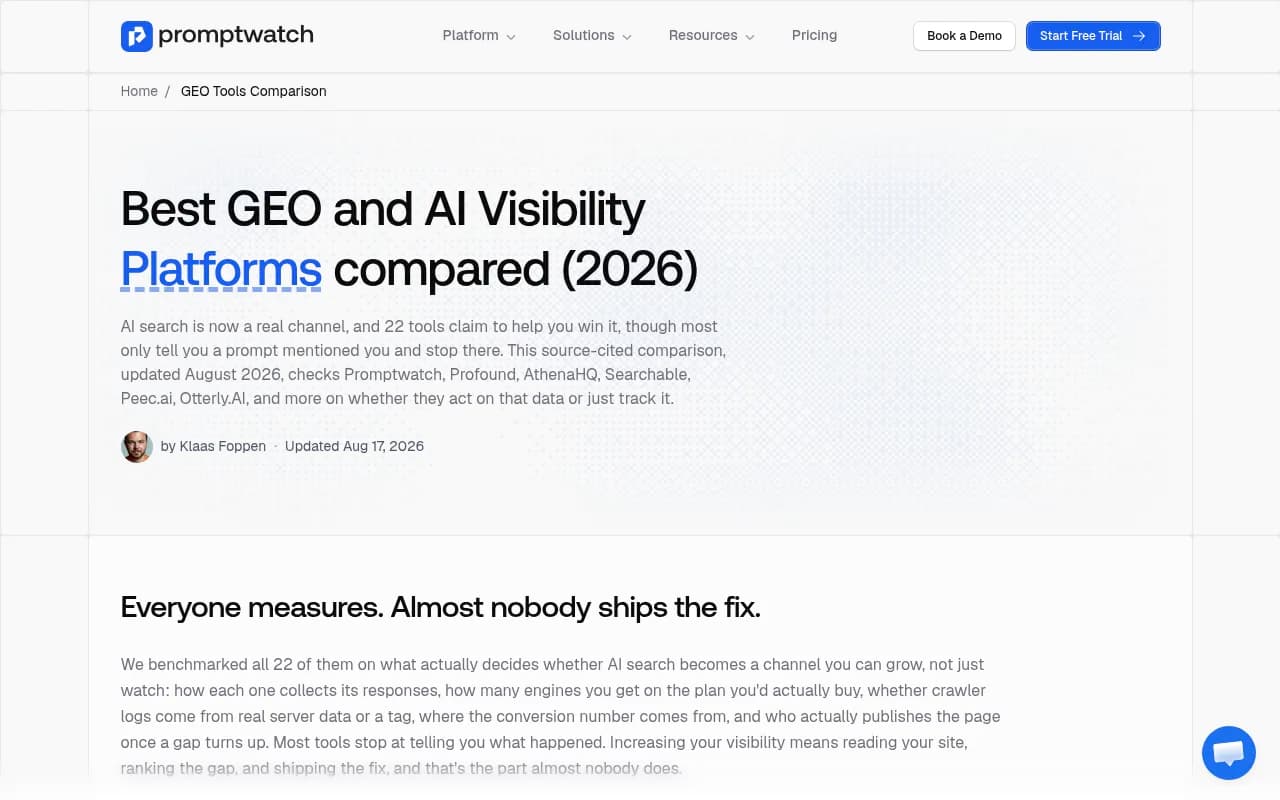
Promptwatch's own cost-per-data-point analysis (part of its Best GEO and AI Visibility Platforms Compared report) puts Essential at roughly $1.90 per tracked prompt and $0.016 per response, covering nine models with API and MCP included. The older Profound Starter tier, which third-party sites still cite even though it no longer appears on Profound's live pricing page, worked out closer to $1.98 per prompt and $0.066 per response for ChatGPT only. Bluefish doesn't publish a number at all, and third-party estimates from tryanalyze.ai put entry pricing anywhere from $99 to $799 per month depending on the tier, before enterprise contracts that reportedly run into five and six figures annually.
That gap matters if you're an enterprise team running hundreds of prompts across regions and product lines rather than 40. At scale, paying four times as much per response for a single-engine view adds up fast, especially since ChatGPT alone triggers 3-8 separate sub-searches per prompt according to Promptwatch's query fanout data, meaning the actual surface area you need to monitor is bigger than a simple prompt count suggests.
Where each tool actually fits
Bluefish makes sense if your primary concern is brand-safety monitoring at a Fortune 500 scale, and you have budget for a managed service with dedicated professional-services support. Its confirmed customers, including Adidas and Tishman Speyer, fit that profile: large consumer brands where an AI model saying something inaccurate about you carries real reputational risk, and where you're fine paying for someone else to build and maintain the prompt methodology.
Profound fits large organizations that have already committed budget to an Enterprise contract and need FactCheck-style accuracy monitoring plus agent-based workflow automation (its "AI Marketer" agents and Profound Sheets). It's a genuinely capable platform once you're past the Trial, but the Trial itself is too limited to evaluate the product properly, and the pricing opacity mirrors Bluefish more than it should for a company that raised a $180M Series D.
Promptwatch fits teams that want to actually run a test like this one themselves, on their own schedule, without a sales call standing between them and the data. It's also the one of the three that treats content fixes as part of the product rather than a separate line item, which matters once you've found the visibility gaps and need to close them.
If you're weighing a broader set of options beyond these three, the GEO software directory at bestgeosoftware.com is a reasonable next stop, and 1001 SEO Media can help you figure out which platform and content strategy actually fits your team if you'd rather not run the 40-prompt test yourself.