Key takeaways
- Nonprofit and public affairs teams need two layers: an AI visibility tracker that shows what ChatGPT, Gemini, and Perplexity say about you, and a media-monitoring layer that shows the coverage feeding those answers.
- Monitoring alone is not enough. Pick at least one tool that helps you act on the findings, whether through content, crawler fixes, or earned-media outreach.
- Budgets matter. Entry-level trackers start around $29 to $95 a month, while platforms with content agents and crawler logs run $245 and up. Confirm pricing on vendor sites, because it changes often.
- Different AI engines cite different sources. Google AI Overviews leans on YouTube and social posts, ChatGPT barely touches social, and Perplexity favors Reddit and LinkedIn.
- I found no tool built specifically for public affairs work such as legislative or policy monitoring. Expect to combine a GEO tool with a media-intelligence platform.
Why communications teams at nonprofits should care about AI answers
Someone asks ChatGPT which organizations are doing the most on food insecurity in their city. Your nonprofit is either in that answer or it is not. There is no page two.
Public affairs teams have a second version of the same problem. A journalist, a staffer, or a donor asks an AI assistant what your organization stands for, and the answer is assembled from whatever it found: your site, news coverage, a Reddit thread, a three-year-old press release. You do not control the output, but you can influence the inputs.
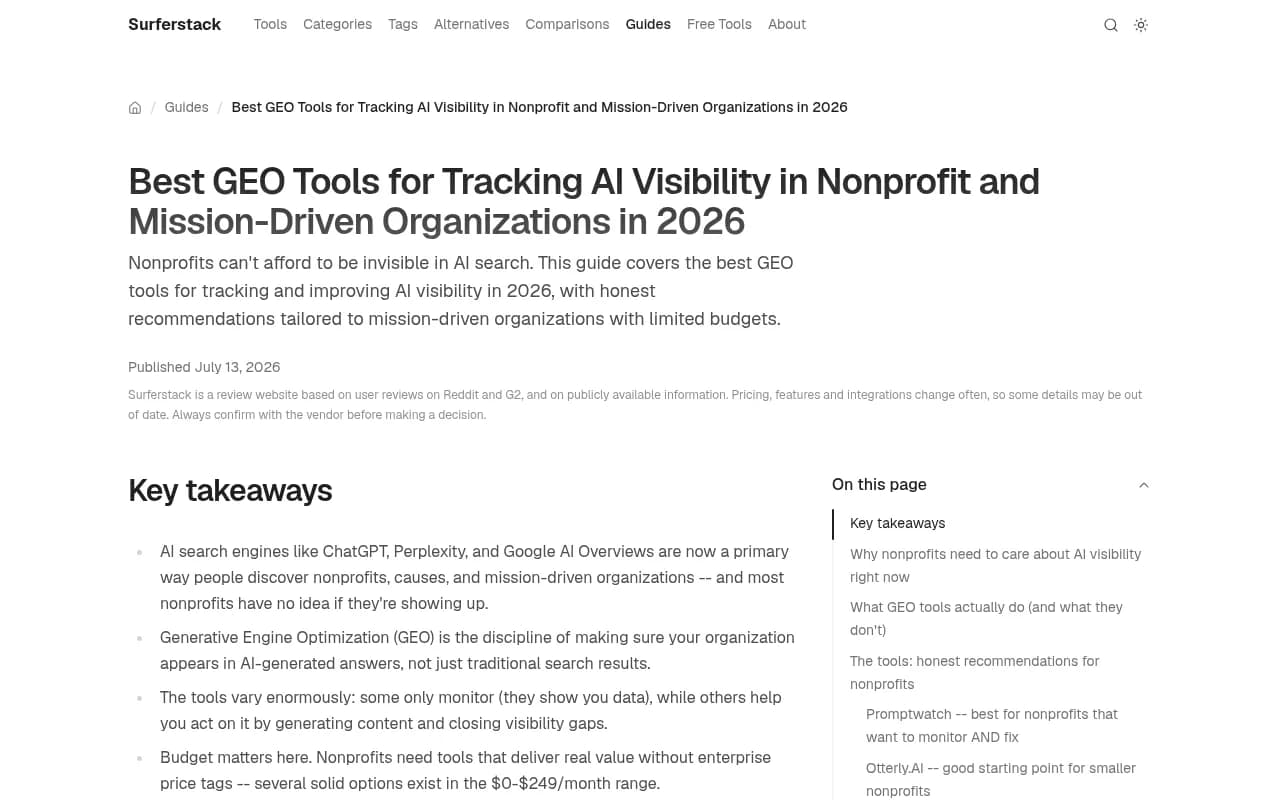
Surferstack's nonprofit GEO guide cites SparkToro/Similarweb data that about 68% of Google searches now end without a click, and puts ChatGPT at roughly 900 million weekly users in early 2026. Treat those as third-party figures, but the direction is clear. The answer is increasingly the destination.
What comms teams actually need from a GEO tool
Most comparison articles rank tools on engine count and dashboard polish. For a nonprofit or public affairs team I would weigh five things instead.
Reputation and narrative, not only rankings
You care about what AI says about you: your mission, your funding, your positions, your controversies. A tool that only reports whether your name appeared gives you a thin picture. Look for sentiment scoring and, better, tools that extract the individual claims AI makes about you so you can spot an inaccurate one.
Source tracing
AI answers are built from citations. Muck Rack's May 2026 study, quoted in a BrandMentions comparison, analyzed more than 25 million cited links and found 84% were earned media, including 27% from journalism, while paid and advertorial content was 0.3%. That is vendor-reported, but it matches what comms people already suspect: press coverage and third-party pages matter more than your own press release page.
Different engines, different sources
Promptwatch Data's social media citations report for Oct 11 to Nov 9, 2026 shows how uneven this is. Social platforms made up 13.16% of Google AI Overviews citations, 1.94% of Perplexity's, and 0.64% of ChatGPT's. Within AI Overviews, YouTube alone was 6.71%. For Perplexity, Reddit (0.82%) and LinkedIn (0.66%) led. The report's takeaway for ChatGPT is to invest in your own site rather than social posts. One caveat: the earlier October report covered 7 days and this one covers 30, so month-to-month changes are not like for like.
For a nonprofit that means a short video explainer might help in Google, while a clear, well-structured page about your programs matters more for ChatGPT.
Authority sources in your cause area
If you work in health, the Promptwatch Data healthcare report (Sep 9 to Oct 8, 2026) is a useful template. NIH led ChatGPT healthcare citations at 5.46%, followed by PubMed Central (2.38%), PubMed (2.33%), the FDA (1.76%), and the NHS (1.1%). Government and public health sites together earned 7.06%. Notably, the American Society of Plastic Surgeons and the American Academy of Dermatology out-earned Mayo Clinic and Cleveland Clinic. Specialty associations can beat famous brands.
The lesson for advocacy groups: find out which authority sources AI cites in your issue area, then make sure your pages cite and align with them. The same audit works for environmental, housing, education, or civil rights topics.
Budget and staff time
Most nonprofit comms teams are one to four people. A tool that needs a data analyst to interpret it will sit unused. Surferstack frames the nonprofit budget range as $0 to $249 a month, which is a reasonable ceiling for many teams. Larger public affairs shops and associations can go higher.
The two-layer stack
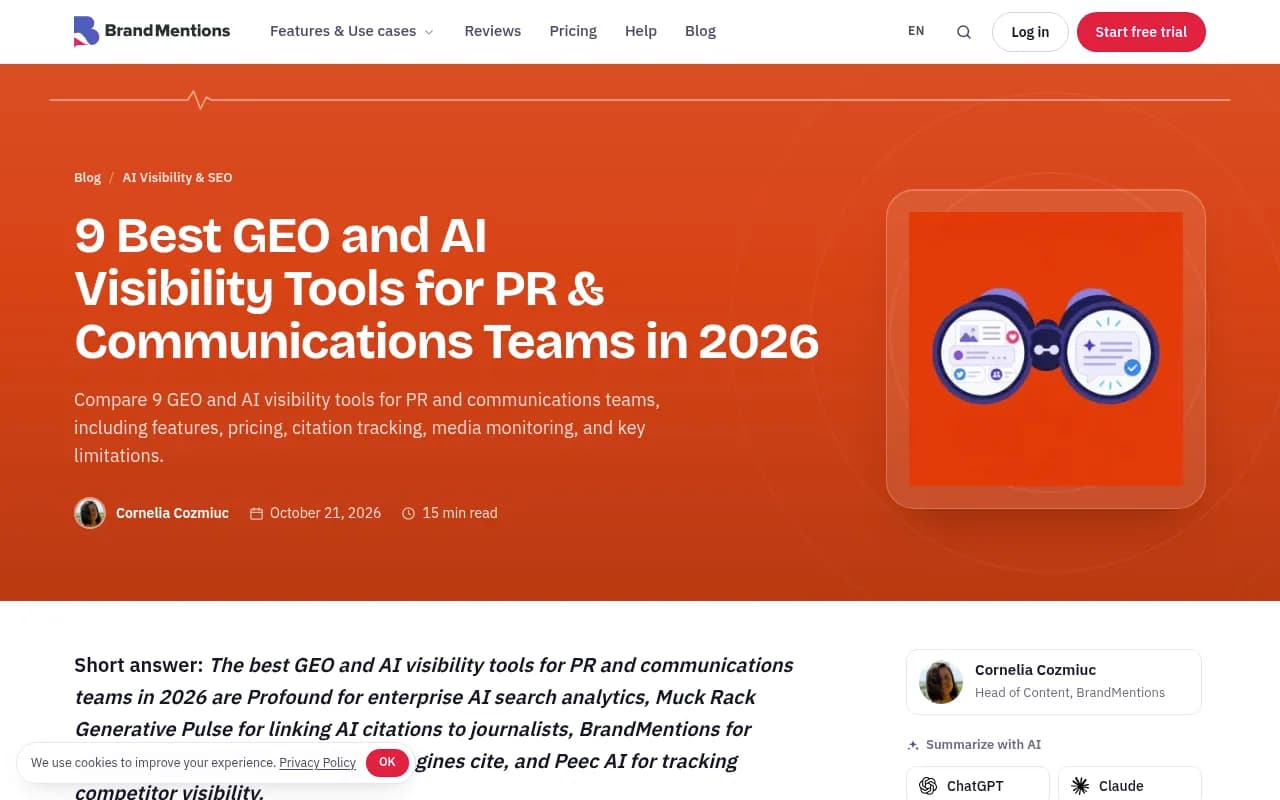
BrandMentions argues that the best setup is a pair: one prompt-level tracker to see what the engines say, and one media-intelligence layer to watch the coverage feeding those answers. Their piece is vendor-published, so read the rankings with suspicion, but the pairing logic holds up. One tool reports the symptom, the other shows the cause.
Quick comparison
| Tool | Type | Best for | Starting price (verify) |
|---|---|---|---|
| Promptwatch | AI visibility and optimization platform | Teams that want to track and fix | $95/mo Essential, $245/mo Professional |
| Otterly.AI | Monitoring | Non-technical staff, tight budgets | About $29/mo |
| Peec AI | Monitoring | Competitor and peer benchmarking | About $95/mo |
| Profound | Enterprise analytics | Large associations and big public affairs shops | Custom |
| Scrunch AI | Monitoring with persona depth | Audience-segment analysis | About $250/mo |
| Meltwater | Media intelligence | Press and coverage monitoring | Custom |
| Brand24 | Mention monitoring | Small-team coverage alerts | Plan-based |
| CisionOne | PR intelligence | Established PR workflows | Custom |
Prices come from vendor pages and third-party comparisons and may be out of date. Always confirm before buying.
Best GEO tools for nonprofit and public affairs teams
Promptwatch: best for tracking and fixing
Promptwatch is an end-to-end AI visibility platform, which matters for small teams because it covers the full loop rather than leaving you with a dashboard and a to-do list. It monitors ChatGPT, Google AI Overviews, Google AI Mode, Gemini, Perplexity, Copilot, Claude, and others from the real interfaces, by country and language. That is useful if you run programs across several markets.
For comms work, the more interesting parts are Brand Narrative, which pulls out the specific claims AI makes about your organization and groups them by theme (reputation, funding, programs), and Fact Check on higher plans, which helps you find the page AI is learning a wrong claim from. Persona prompting lets you query the way donors, volunteers, or policymakers might. Crawler logs show whether AI bots can even read your site, which is a surprisingly common failure for nonprofits on older CMS setups.
On the action side, the Action Board gives a prioritized to-do list, and the Content Agent (Business plan) drafts and publishes pages to WordPress, Webflow, or Framer. Essential is $95 a month and Professional is $245, with a 7-day free trial on monthly billing. Check promptwatch.com/pricing for current numbers. The free AI visibility report is a no-login way to see where you stand before paying anything.
It is not the cheapest entry point, and the Content Agent sits on a higher tier than most small nonprofits will buy. Essential or Professional plus manual writing is a realistic starting setup.

Otterly.AI: cheapest way to start
Otterly.AI is monitoring-only. It tracks ChatGPT, Perplexity, and AI Overviews, and non-technical comms staff tend to find it easy. One source lists it at $29 a month. If your goal this quarter is simply to learn whether and how you appear, it is a fine first step. You will need to figure out the fixes yourself.

Peec AI: competitor and peer benchmarking
Peec AI is a mid-tier tracker with solid competitor comparison. For public affairs teams, benchmarking against peer organizations or coalition rivals is often the question leadership asks first. BrandMentions lists it at $95 a month.

Profound: enterprise depth
Profound has the widest engine coverage and the deepest prompt-level analytics in most roundups, and it appeared most often in BrandMentions' own 336-response test (157 responses). It is priced for custom enterprise contracts, so it fits national associations and large policy shops more than a local nonprofit.

Scrunch: audience and persona work
Scrunch AI is about $250 a month in the comparison I reviewed and leans toward persona and journey analysis. That can help if you serve very different audiences, such as beneficiaries, funders, and legislators.
Media intelligence: Meltwater, Brand24, CisionOne
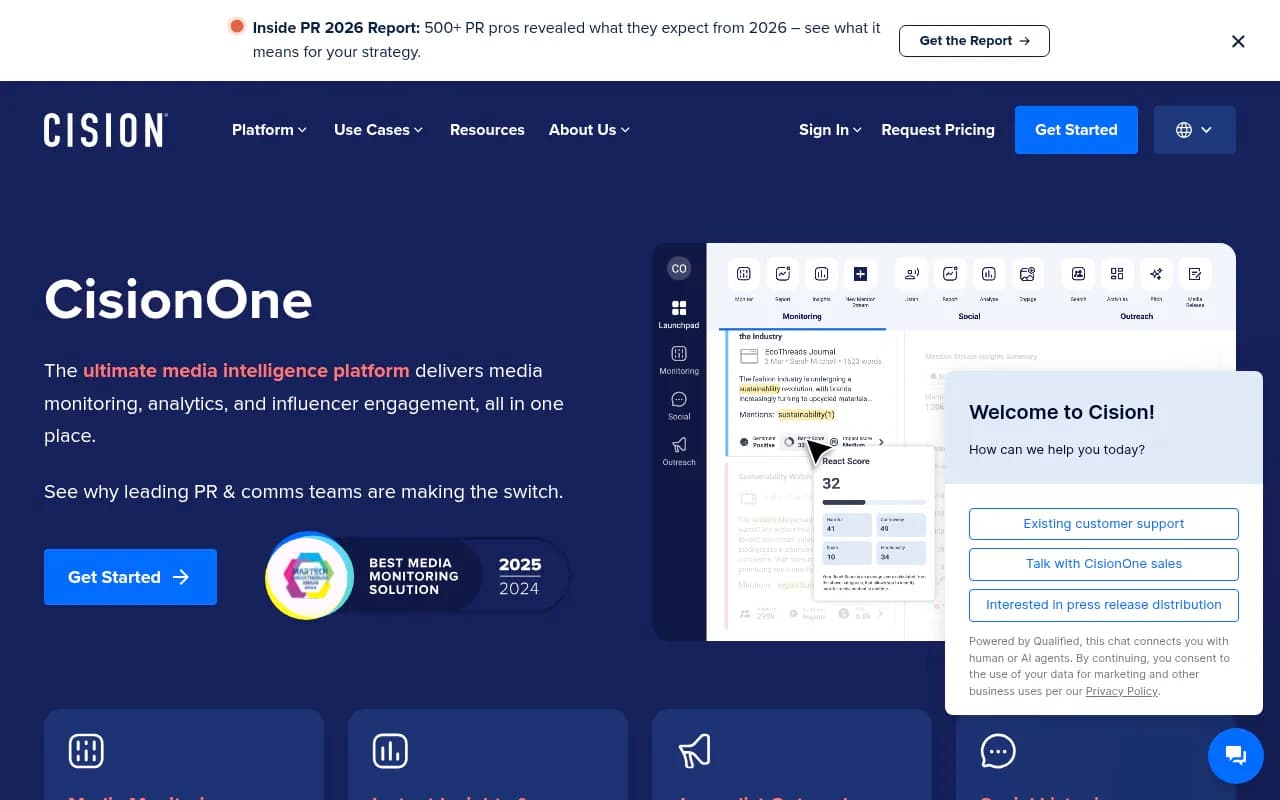
These are not GEO tools, but they cover the other half of the stack. If press coverage drives AI answers, you need to see that coverage. Meltwater and CisionOne are established PR platforms with enterprise pricing. Brand24 is lighter and better for small teams that want mention alerts.
Muck Rack Generative Pulse, which links AI citations to specific journalists, is also worth a look if your team already uses Muck Rack. It is not in our catalog, so I am only noting it from the BrandMentions and Shadow comparisons.
For more options, the GEO software directory lists dozens of trackers beyond these.
Recommendations by team type
| Team | Suggested setup |
|---|---|
| Solo comms manager, under $100/mo | Free AI visibility report, then Otterly.AI or Promptwatch Essential |
| Small team that publishes regularly | Promptwatch Professional, plus Brand24 for mentions |
| Public affairs team with press focus | A GEO tracker plus Meltwater or CisionOne |
| National association or large coalition | Profound or Promptwatch Business, plus enterprise media monitoring |
| Agency serving several nonprofits | Agency plans such as Promptwatch's Kick-off, Growth, or Scale |
A 30-day starting plan
- Week one: run a free scan and write 20 to 30 prompts donors, volunteers, journalists, and policymakers might ask. Include branded, category, and comparison prompts.
- Week two: check which sources get cited. Note which ones are earned media, which are your own pages, and which are inaccurate or outdated.
- Week three: fix access and facts. Make sure AI crawlers can read your site, update the pages that carry wrong claims, and add clear, quotable pages on your programs, impact numbers, and positions.
- Week four: pitch the sources. If a few outlets or directories keep getting cited, that is your earned-media target list.
Then repeat monthly. Single-day numbers are noise, since answers shift by prompt wording, engine, location, and model updates.
What to watch for
Promptwatch Data's ChatGPT content type report found product pages, landing pages, and listicles lead ChatGPT citations for Sep 28 to Oct 4, 2026. For a nonprofit, the equivalent is a clear program page with specifics, not a blog post buried in your news archive. The content half-life report found news pages lost half their cited pages within 36 days, while landing pages and docs lasted longest. Evergreen pages beat news posts for staying power.
One gap to be upfront about: none of the sources I reviewed tested GEO tools for legislative monitoring or advocacy campaigns specifically. Most comparisons are also vendor-published, so their rankings lean toward their own products. Run a trial, use your own prompts, and judge by whether the tool tells you something you can act on.
Bottom line
Start free, start small, and pick a tool you will open weekly. For most nonprofit comms teams, a lower-cost tracker or Promptwatch Essential plus a mention-monitoring tool covers the basics. Larger public affairs operations should add a media-intelligence platform and a tool that acts on the findings. Monitoring without action is just a more expensive way to worry.