Key takeaways
- OpenAI's Ads Manager reports only on your own campaigns. It never shows you which competitors are buying ads on your buyers' prompts.
- To see competitor ads you need a third-party tool that captures real ChatGPT responses repeatedly. Promptwatch's Ads Radar is the one I would start with, because it puts paid placements next to organic visibility on the same prompts.
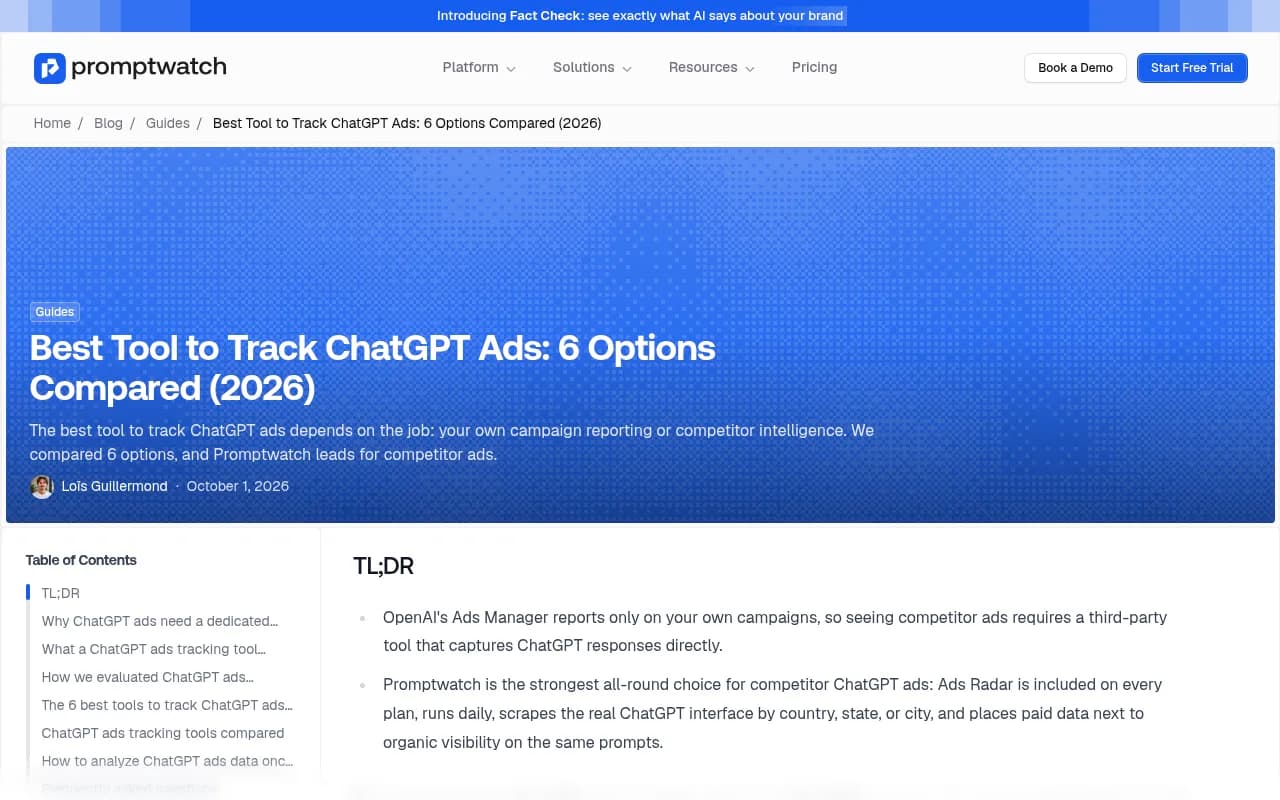
- The headline claim that only Promptwatch and Profound show the ads is too strong. Other products, including Rankshift, GrowByData, Adthena and Similarweb, also market ChatGPT ad monitoring. I could not verify Profound's ad coverage from public sources, so check it in a demo.
- Ad volume is large enough to matter. Promptwatch Data measured ads on 1.69% of search-powered responses on May 27, 2026, and a 30-day average of 29.6% by mid-August.
- Manual spot checks do not work. Ads attach to a single response, vary by market, and are hidden from Plus, Pro and Business accounts.
About that headline
Let me be upfront. The title promises that only two tools still show ChatGPT ads. My research does not support the word "only." Several products market ChatGPT ad monitoring, and I cover them below. What I can say is that Promptwatch has a documented, shipped ad-tracking feature, and Profound is a major enterprise AI visibility platform worth asking about. I could not confirm Profound's ad capabilities from public material, so treat that as a question for their sales team, not a fact.
The more useful framing: there are two jobs here, and different tools do each.
- Reporting on your own paid campaigns. That is OpenAI's Ads Manager, full stop.
- Watching what competitors run on the prompts your buyers ask. That needs an outside tool.
Why ChatGPT ads need their own tracking
ChatGPT ads are sponsored cards attached to individual responses. Each shows an advertiser name, a title, a description, an image and a landing page. OpenAI began a US pilot in February 2026, added Canada, Australia and New Zealand in March, then expanded in August 2026 to the UK, Mexico, Brazil, Japan, South Korea and 31 European countries.
The volume jumped fast. According to Promptwatch's ChatGPT ads data (May 20 to Aug 17, 2026):
- ChatGPT showed no ads until May 27, 2026, when they appeared in 1.69% of responses.
- The 90-day daily average was 20.1%, and the 30-day average was 29.6%, up 22.6% on the prior 30 days.
- The peak single-day rate was 43.9%.
- Of ad-bearing responses over the past 7 days, 73.3% were organic prompts, 18.0% brand-specific and 8.6% competitor comparison.
That last split reflects prompt volume, not how likely each prompt type is to trigger an ad. Promptwatch itself says to look across several days before drawing conclusions, since a single run can land on an outlier day.
Why you cannot just check by hand
Three things break manual checking:
- ChatGPT does not show ads to Plus, Pro or Business accounts, or to users under 18. If you pay for ChatGPT, you will not see what your customers see.
- Ads attach to a single response. The same prompt can show an ad on one run and nothing on the next.
- Ads render by market and language, so a check from one country says little about another.
Also worth knowing: advertisers cannot pick prompts. They supply context hints and OpenAI matches ads to the conversation. So competitor tracking is observational. You are sampling what appears, not reading anyone's targeting list.
What to look for in a ChatGPT ad tracker
Before comparing products, decide which of these matter to you.
- Real interface capture. API outputs and what users see in the chat window can differ, and ads only exist in the user-facing product.
- Frequency. Daily capture beats weekly, because ad presence is noisy.
- Geo scope. Country at minimum. State or city if you sell locally.
- Creative detail. Advertiser, domain, headline, copy and landing page, not just a yes or no.
- Organic context. Knowing a rival is paying on a prompt where you already rank organically is a different decision from knowing they are paying where you are absent.
- Export. API or MCP access so ad data flows into your own reporting.
Comparison table
| Tool | Competitor ads in ChatGPT | Your own campaign data | Organic visibility on same prompts | Local targeting | Notes |
|---|---|---|---|---|---|
| OpenAI Ads Manager | No | Yes | No | n/a | Required if you run campaigns |
| Promptwatch (Ads Radar) | Yes, daily | No, use Ads Manager | Yes | Country, US state, city | Business plan from $579/mo |
| Profound | Not verified | Not verified | Yes (AI visibility) | Ask vendor | Starter $99/mo, Growth $399/mo billed yearly (third-party listing) |
| Rankshift | Yes (ChatGPT only; AI Mode and AI Overviews marked coming soon) | Not stated | Yes | Not stated | Marketed for ad tracking |
| GrowByData Compass | Marketed | Not stated | Not stated | Not stated | Listed in its own roundup |
| Adthena | Marketed | Not stated | Not stated | Not stated | Paid search heritage |
| Similarweb AI Ads | Marketed | Not stated | Not stated | Not stated | Traffic intelligence suite |
A caution on that table: where I wrote "Not stated" or "Marketed," I am relying on vendor-published roundups and could not inspect the products. Verify before you buy.
Promptwatch: the one I would test first
Promptwatch is an end-to-end AI visibility platform, and its Ads Radar is built specifically for this problem.

Here is what it does, per Promptwatch's own documentation:
- It scrapes the live ChatGPT interface, not an API. Monitors can be scoped by country and language, and optionally by US state or city, using a geo-located residential proxy with a matching browser locale and timezone.
- It records the ad creative and headline, ad copy, model, advertiser and domain, and the date seen.
- The dashboard shows ads per day, a ranking of top advertisers by frequency, and a table you can view by ad or by prompt, with filters for advertiser domain, ad type and date range.
- Ads are stored as a separate data type, so your Visibility Score still reflects organic answers only. That keeps the paid noise out of your core metric.
- Monitors refresh daily by default, and every prompt is tagged by type (organic, brand-specific, competitor comparison) and intent.
- Ads data is available through the REST API and MCP, so you can pull it into your own reports.
The part I like most is the pairing. Seeing that a competitor ran ads on 40 of your tracked prompts is mildly interesting. Seeing that alongside your own organic position and citations on those same prompts tells you whether to bid, defend, or fix content instead.
Plan gating, and why to confirm it
Promptwatch's own materials are slightly inconsistent here. One summary line says Ads Radar is included on every plan, while the body of the same comparison and the plan breakdown say it starts on Business. Business is $579/mo (Essential is $95/mo and Professional is $245/mo). Agency plans (Kick-off $199/mo, Growth $399/mo, Scale $799/mo) also include Ads Radar. Confirm current gating at promptwatch.com/pricing before you commit.
If you want to try it, there is a 7-day free trial on monthly billing, plus a free AI visibility report that is a gentle way to see how ChatGPT talks about your brand first. For comparison against the other big player, see Promptwatch vs Profound.
Profound: ask before you assume
Profound is an enterprise-leaning answer engine visibility platform with prompt volumes and multi-engine monitoring. A third-party pricing listing puts Starter at $99/month and Growth at $399/month billed yearly, with Enterprise custom.

I have no verified source saying how deeply Profound tracks ChatGPT ads, which is the honest reason this section is short. If you are already evaluating Profound for broader AI visibility, put three direct questions to them:
- Do you capture sponsored placements inside ChatGPT responses?
- At what frequency, and by which geographies?
- Can I see advertiser, copy and landing page, and export it?
A clear yes on all three makes it a legitimate second contender. A vague answer tells you what you need to know.
Other tools that market ChatGPT ad monitoring
Rankshift
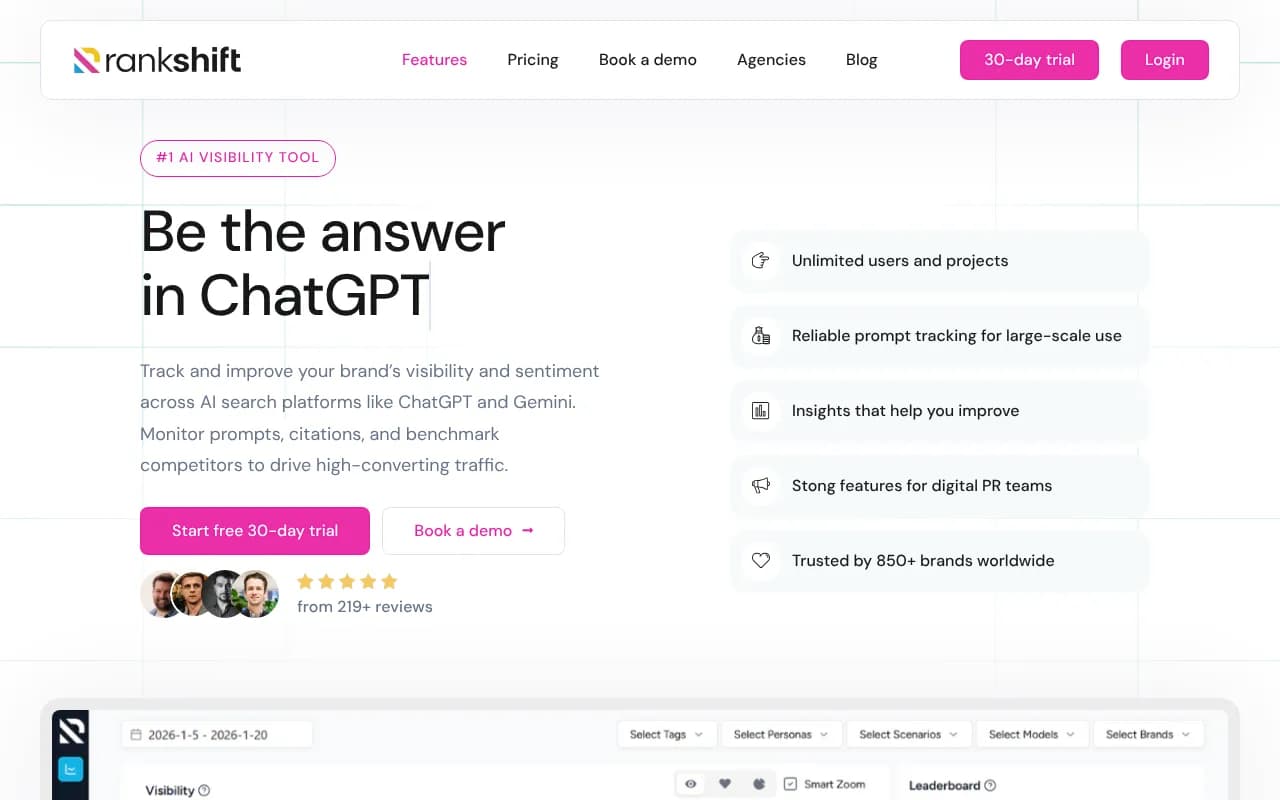
Rankshift publishes a dedicated ChatGPT ads tracking page. Per its own roundup, ad detection currently covers ChatGPT only, with Google AI Mode and AI Overviews labeled coming soon. If ChatGPT is your only concern, that limit may not matter.
GrowByData, Adthena and Similarweb
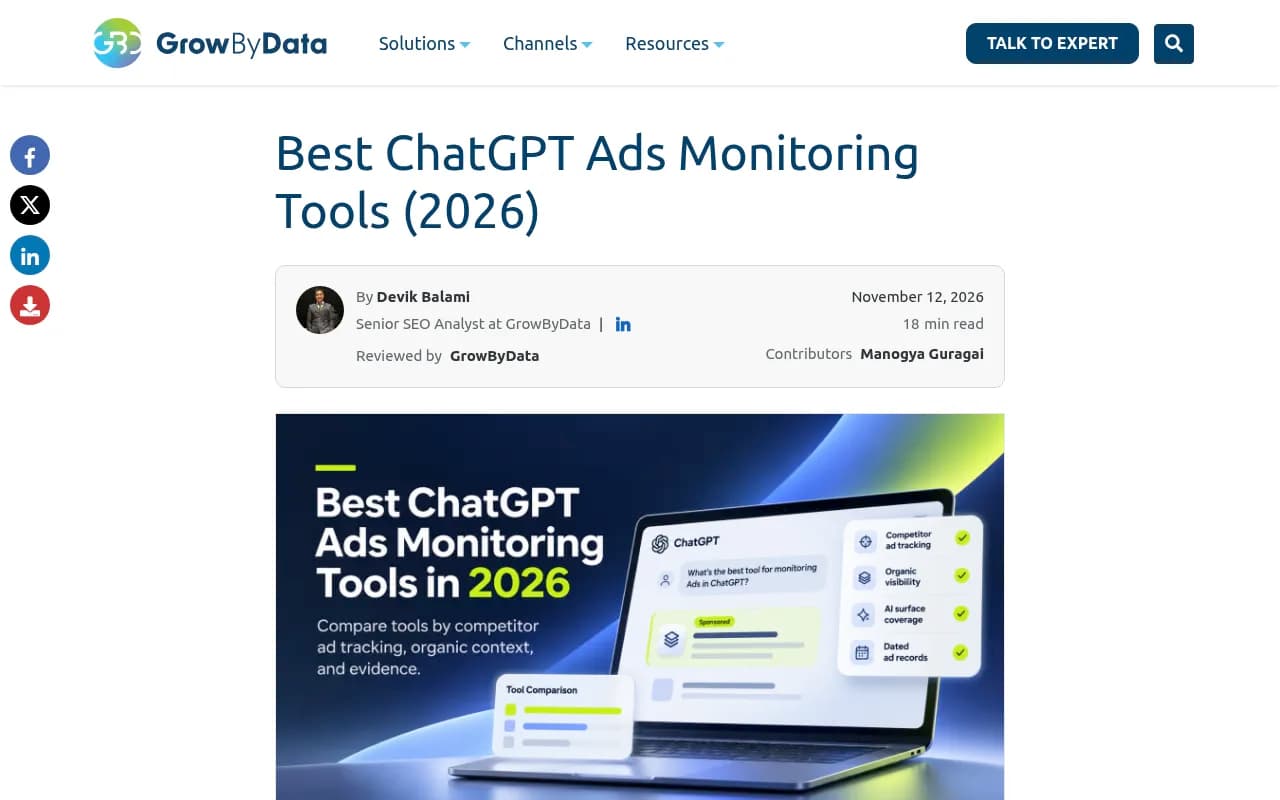
GrowByData's roundup of eight tools lists GrowByData Compass, Adthena, Promptwatch and Similarweb AI Ads among the options. These come from the paid search and competitive intelligence world, which can suit teams that already live in those suites. I did not get hands-on detail on their ChatGPT coverage, so evaluate them with the same three questions above.
Note the conflict of interest in vendor-written roundups. Every one of these lists, including Promptwatch's own, ranks its author well. Cross-reference at least two.
Tracking your own campaigns
If you buy ads, OpenAI's Ads Manager is non-negotiable. According to Improvado's measurement guide, it reports impressions, clicks, spend, CTR, CPC, CPM, conversions and ROAS from attributed orders. No outside tool replaces that. What the outside tools add is the competitor view and the organic context.
For attribution beyond Ads Manager, general marketing attribution platforms in the catalog such as Northbeam or Triple Whale may help tie ChatGPT clicks to revenue, though I have not tested ChatGPT-specific setups.
Two cautions on traffic. ChatGPT stopped sending a referrer on October 8, 2026, so tagging links with utm_source=chatgpt.com matters. Promptwatch's visitor analytics has an optional setting that counts those tagged visits as ChatGPT traffic. The attributing AI traffic guide walks through the setup.
A practical workflow
Here is how I would run this over the first month.
- Build a prompt panel of 30 to 50 prompts your buyers actually ask: category queries, competitor comparisons and a few branded ones.
- Pick the countries and, if relevant, cities where you sell. Remember ads vary by market.
- Run daily capture for at least two weeks. One day tells you nothing.
- Rank advertisers by frequency, then open the landing pages of the top five.
- Cross-check against your organic position on the same prompts. Where a rival pays and you rank poorly, that is a content gap. Where a rival pays and you already rank well, that is a defend-or-ignore call.
- Review weekly, and feed the findings to whoever buys media.
And a note for the organic side: ads sit on top of answers that still cite pages. Promptwatch Data shows that almost half of ChatGPT responses cite 10 or more unique domains (unique domains per response, Sep 28 to Oct 4, 2026), so earning citations stays worth the effort even as ads grow.
Which tool for which team
| If you are... | Start with |
|---|---|
| A brand wanting competitor ads next to organic visibility, with local scope | Promptwatch Ads Radar |
| An agency monitoring many clients | Promptwatch agency plans, which include Ads Radar |
| An enterprise already evaluating Profound | Profound, after confirming ad coverage |
| A team that only needs ChatGPT ad detection | Rankshift |
| A paid search team in an existing suite | Adthena or Similarweb, after a demo |
| Running your own campaigns | OpenAI Ads Manager, plus any of the above |
If you are still comparing the wider market, the GEO software directory at bestgeosoftware.com lists more AI visibility platforms by category.
Bottom line
The claim in the title is not quite true, and I would rather say so. Several vendors now sell ChatGPT ad monitoring. But the list of products that capture real ChatGPT interface responses daily, by city, and join the results to organic visibility is short, and Promptwatch is the one with that documented end to end. Start with a trial, track a panel for two weeks, and make the decision on what the data shows you.
If you want help deciding whether paid or organic AI visibility deserves your budget, 1001 SEO Media runs GEO work for clients and uses Promptwatch for its own AI visibility tracking.