Key takeaways
- Google AI Mode now surfaces brands in roughly 90% of responses, compared to 43% for traditional AI Overviews -- making AI visibility tracking a genuine priority, not a nice-to-have.
- Most tools on this list are monitoring dashboards. A few go further and help you act on what you find. That distinction matters more than any other feature comparison.
- The right tool depends heavily on your team size, budget, and whether you need raw data or guided workflows.
- Promptwatch is the only platform in this comparison rated as a "Leader" across all categories -- and the only one that closes the loop from gap detection to content creation to traffic attribution.
- Free trials are available for most tools, so testing before committing is worth doing.
Why Google AI Mode changes the tracking problem
Google AI Mode isn't just another feature update. It's a fundamentally different way the search engine presents information -- synthesizing answers from multiple sources rather than listing blue links. For brands, this means your traditional rank tracking tells you almost nothing about whether you're actually influencing the user.
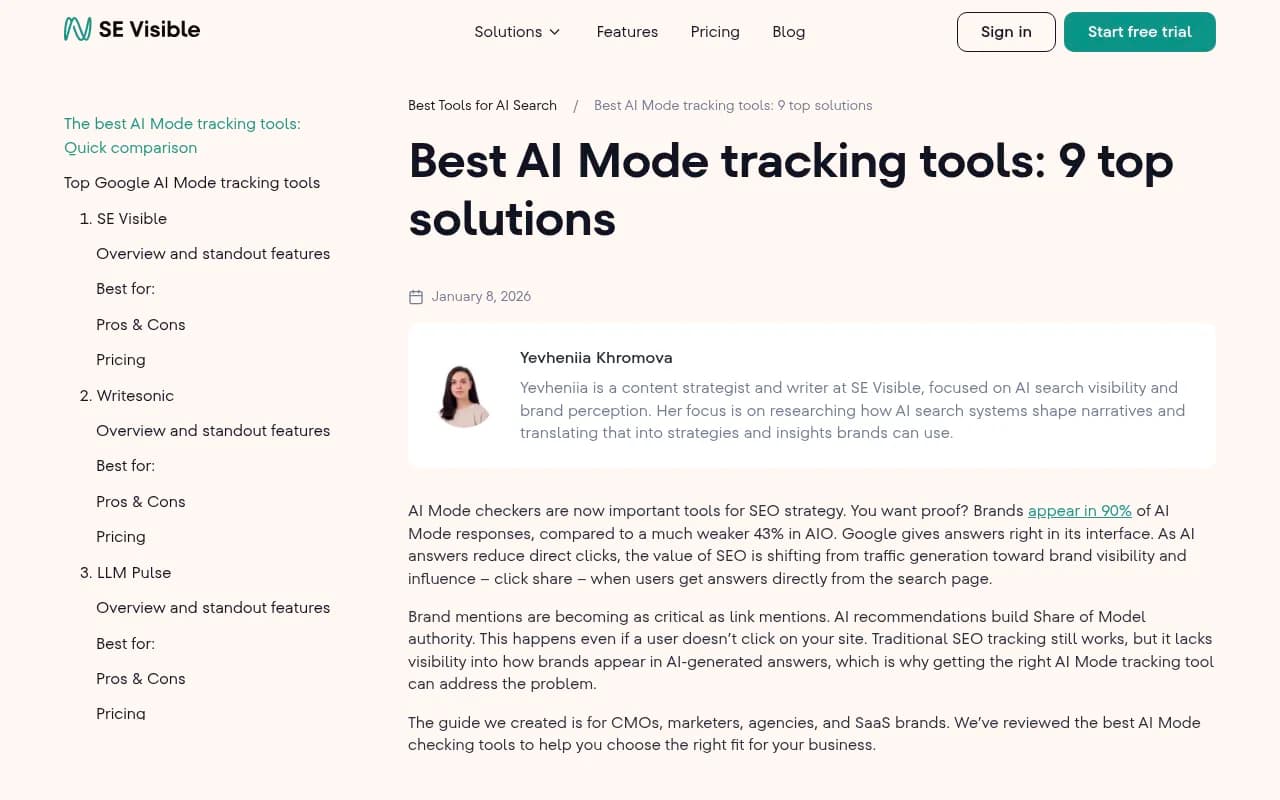
The stat worth knowing: brands appear in about 90% of Google AI Mode responses, according to a Search Engine Land analysis of AI Mode behavior. That sounds encouraging until you realize the question isn't whether brands appear at all -- it's which brands appear, how they're described, and whether your competitors are consistently getting cited while you're invisible.
Traditional SEO tools weren't built for this. They track keyword positions in the classic SERP. They don't tell you if ChatGPT recommends your product, if Perplexity cites your blog, or if Google AI Mode describes your competitor as the category leader while ignoring you entirely.
That's the gap these tools are trying to fill.
How to read this comparison
The 8 tools below cover a wide range of approaches: pure monitoring, content optimization, enterprise analytics, and full-cycle optimization. I've organized them by what they're actually best at, because a tool that's perfect for a solo SEO consultant is probably wrong for a 50-person marketing team at a global brand.
A few things I weighed:
- Does it specifically track Google AI Mode (not just AI Overviews or ChatGPT)?
- Does it show you why competitors are cited, or just that they are?
- Can you act on the data inside the tool, or do you have to export and figure it out yourself?
- Is the pricing realistic for the team size it targets?
The top 8 tools compared
| Tool | Best for | Google AI Mode | Content generation | Starting price |
|---|---|---|---|---|
| Promptwatch | Full-cycle optimization | Yes | Yes (AI writing agent) | $99/mo |
| SE Visible | Agency monitoring | Yes | No | $189/mo |
| Profound | Enterprise analytics | Yes | Limited | $99/mo |
| Otterly.AI | Budget monitoring | Yes | No | $29/mo |
| Peec AI | B2B/SaaS tracking | Yes | No | €89/mo |
| Nightwatch | SEO + AI combo | Yes (add-on) | No | $39/mo |
| Semrush | Integrated SEO/AI | Yes | Via ContentShake | $139/mo |
| SE Ranking | All-in-one SEO | Yes | Limited | $65/mo |
1. Promptwatch -- best for closing the loop between visibility and revenue
Most AI visibility tools show you a dashboard. Promptwatch shows you a dashboard and then helps you fix what's wrong.
The core difference is what the team calls the "action loop": find the prompts where competitors are visible but you're not, generate content engineered to get cited by AI models, then track whether your visibility scores actually improve. That cycle -- gap detection, content creation, result tracking -- is what separates Promptwatch from the monitoring-only tools that dominate this list.
For Google AI Mode specifically, Promptwatch tracks responses across 10 AI platforms including Google AI Overviews and Google AI Mode, with page-level attribution showing exactly which of your pages are being cited and how often. The AI crawler logs feature is genuinely useful here: you can see when Google's AI crawler visits your site, which pages it reads, and whether it's encountering errors that might explain why you're not being cited.
The Answer Gap Analysis is where most teams start. It surfaces the specific prompts where your competitors appear in AI responses but you don't -- not just categories, but the actual questions and topics. The built-in writing agent then generates content grounded in citation data from 880M+ analyzed citations, which means it's not producing generic SEO filler. It's producing content that matches the patterns AI models actually cite.
Pricing runs from $99/month (Essential, 1 site, 50 prompts) to $579/month (Business, 5 sites, 350 prompts). Agency and enterprise pricing is available separately.

2. SE Visible -- best for agencies that want clean AI Mode reporting
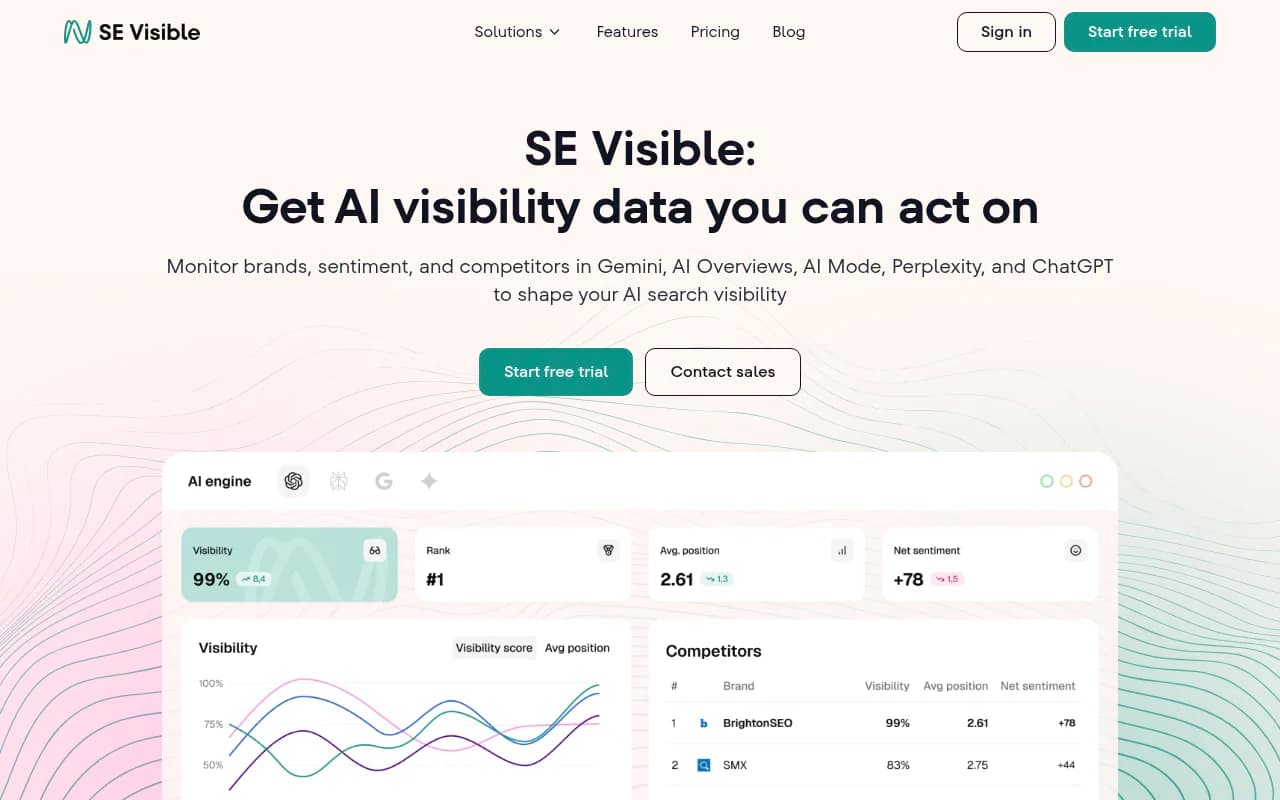
SE Visible is built by the SE Ranking team and focuses specifically on AI visibility without the complexity of a full SEO suite. For agencies managing multiple clients, the reporting is clean and the onboarding is fast.
It tracks Google AI Mode, AI Overviews, ChatGPT, Perplexity, and Gemini. The brand mention tracking shows whether your client appears, how they're positioned relative to competitors, and how that changes over time. The interface is genuinely easier to navigate than most enterprise tools.
What it doesn't do: there's no content generation, no gap analysis that tells you what to write, and no traffic attribution. You get the monitoring layer, and then you're on your own to act on it. For agencies that have their own content workflows, that's fine. For teams that need the full picture, it's a gap.
Starting price is $189/month.
3. Profound -- best for enterprise teams that want raw data and API access
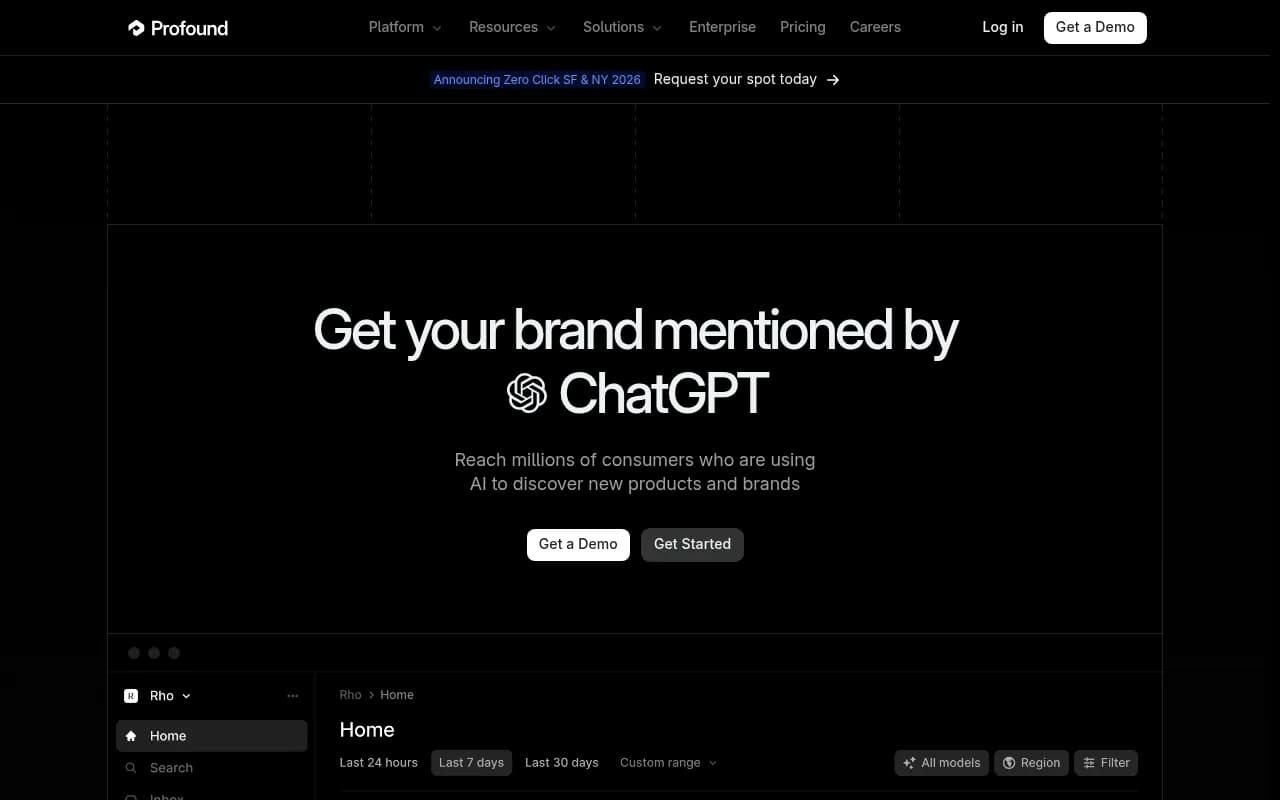
Profound is built for large organizations with dedicated analytics teams. The platform offers near real-time monitoring, API access, and deep segmentation across AI platforms. If you have analysts who want to build custom dashboards or integrate AI visibility data into existing BI tools, Profound gives you the data infrastructure to do that.
The trade-off is that Profound is very much a "bring your own workflow" tool. It surfaces data well but doesn't guide you toward action. There's no built-in content generation, no answer gap analysis that produces a prioritized to-do list, and the interface assumes you know what you're looking for.
For a Fortune 500 brand with a data team, that's a reasonable trade-off. For a mid-market marketing team that needs the tool to do more of the thinking, it's probably not the right fit.
Starting price is $99/month, though enterprise tiers scale significantly.
4. Otterly.AI -- best for small teams on a tight budget
Otterly.AI tracks six platforms: ChatGPT, Google AI Overviews, Perplexity, Google AI Mode, Gemini, and Microsoft Copilot. At $29/month, it's the most accessible entry point for teams that just want to start monitoring without a major budget commitment.
The platform uses API-based querying, which means results are consistent and reproducible. You can set up prompt monitoring, track competitor mentions, and see how your visibility changes over time. The GEO audit feature gives you a basic sense of where you're missing coverage.
The limitations are real: no crawler logs, no traffic attribution, no content generation, and the analytics depth is limited compared to the tools above it on this list. But for a solo SEO or a small startup that wants to understand the basics of their AI visibility before investing in something more powerful, Otterly.AI is a reasonable starting point.

5. Peec AI -- best for B2B and SaaS brands tracking conversational queries
Peec AI focuses on the kind of conversational prompts that B2B buyers actually use when researching software and services. The platform tracks prompt visibility, rankings, and citations across AI platforms, with a dashboard that's genuinely easy to read without a lot of setup.
The competitor benchmarking is one of the stronger features: you can see how your brand's AI visibility compares to specific competitors across the prompts that matter to your category. For SaaS companies trying to understand whether they're winning or losing the AI recommendation game, that's useful context.
Multi-language support is available, which matters for European B2B brands. Starting price is €89/month.

6. Nightwatch -- best for agencies that want AI tracking alongside traditional rank tracking
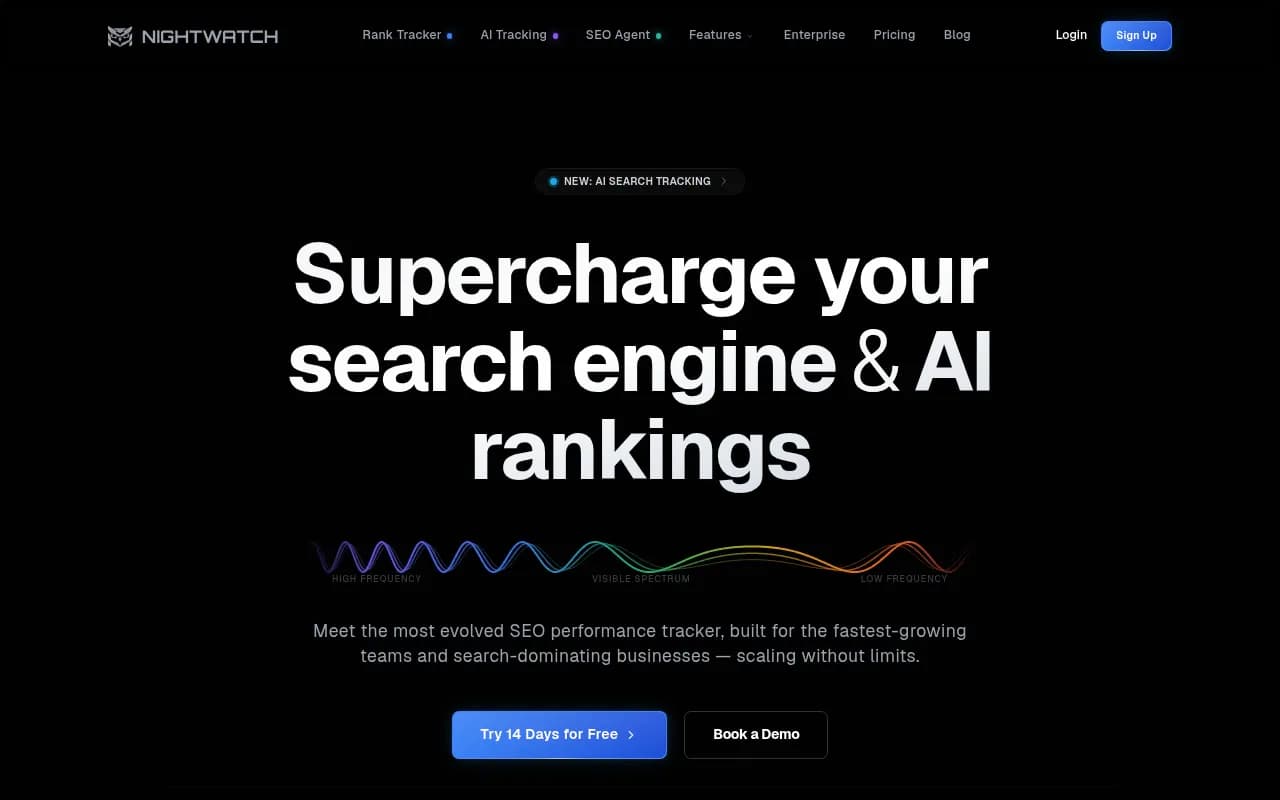
Nightwatch is primarily a rank tracking tool that has added AI search monitoring as an add-on. If you're already using Nightwatch for traditional SEO and want to layer in AI Mode tracking without switching platforms, it's a sensible option.
The AI tracking covers Google AI Mode and AI Overviews, with geo-level data that's useful for local SEO work. The precision of the rank tracking is one of Nightwatch's genuine strengths -- it's known for accuracy in traditional SERP tracking, and that carries over to the AI monitoring features.
The base price starts at $39/month, with the AI add-on priced separately. For agencies doing local SEO work that now needs to account for AI responses, this combination is worth considering.
7. Semrush -- best for teams already invested in the Semrush ecosystem
Semrush has added AI visibility tracking to its platform, and for teams already paying for Semrush's broader SEO suite, it's the path of least resistance. The AI Visibility Toolkit shows brand mentions in AI-generated answers, tracks competitor visibility, and integrates with the rest of Semrush's keyword and content tools.
The honest limitation: Semrush's AI tracking uses fixed prompts rather than custom ones, which means you're monitoring a predefined set of queries rather than the specific questions your customers are actually asking. For a brand in a niche category, that's a real constraint. The tool is also better suited to mid-market teams than enterprises that need deep segmentation.
ContentShake AI handles the content generation side, though it's a separate product rather than a tightly integrated workflow.
Starting price for Semrush is $139/month, though AI features may require higher tiers.
8. SE Ranking -- best for teams that want an affordable all-in-one SEO platform with AI monitoring
SE Ranking added AI visibility tracking to its all-in-one SEO platform, making it a reasonable option for teams that want keyword research, site audits, rank tracking, and AI monitoring without managing multiple subscriptions.
The AI tracking covers Google AI Overviews and AI Mode, with brand mention detection and competitor comparison. It's not the deepest AI visibility tool on this list, but it's competent, and the integration with traditional SEO data is genuinely useful for teams that want to see AI visibility alongside organic performance in one place.
Starting price is $65/month.
What most tools get wrong
Looking across all eight tools, a pattern is clear: most of them stop at monitoring. They show you that you're invisible in AI responses. They show you that a competitor is getting cited. And then they leave you to figure out what to do about it.
That's not nothing -- knowing you have a problem is the first step. But for most marketing teams, the bottleneck isn't awareness. It's execution. What content do I need to write? Which prompts should I prioritize? How do I know if the content I published is actually working?
The tools that answer those questions -- Promptwatch being the clearest example -- are genuinely more useful than the monitoring-only dashboards, even if the monitoring-only dashboards are cheaper.
How to choose the right tool for your situation
A few honest recommendations based on team type:
Solo SEO or small startup: Start with Otterly.AI at $29/month to understand the basics. Upgrade when you need to act on the data, not just see it.
Mid-market marketing team: Promptwatch at $99-249/month gives you the full picture -- monitoring, gap analysis, content generation, and traffic attribution. It's the tool that lets you actually move the needle rather than just report on it.
Agency managing multiple clients: SE Visible or Nightwatch (if you're already doing traditional rank tracking) are clean options. Promptwatch's agency pricing is worth exploring if your clients want to see results, not just reports.
Enterprise with a data team: Profound gives you the raw data and API access to build custom workflows. Semrush AIO handles scale and automation if you're already in that ecosystem.
B2B/SaaS brand: Peec AI's focus on conversational queries and competitor benchmarking is well-suited to the category.
The one thing I'd say regardless of team size: don't pick a tool based on the monitoring features alone. Pick it based on what happens after you see the data. That's where most tools fall short, and it's where the gap between "interesting dashboard" and "actual business impact" lives.
Final thoughts
Google AI Mode is not going away, and the brands that figure out how to appear consistently in AI-generated answers will have a real advantage over those still optimizing purely for blue links. The tools in this guide give you different entry points into that problem.
If you're starting from scratch, Otterly.AI or Peec AI get you monitoring quickly and cheaply. If you're ready to turn visibility data into content that actually gets cited, Promptwatch is the platform built for that. And if you're an enterprise with complex data needs, Profound or Semrush AIO are worth a serious look.
The market for these tools is moving fast. Most of what you see here didn't exist two years ago. Test before you commit, and prioritize tools that help you act, not just observe.