Key takeaways
- Most AI visibility tools focus on ChatGPT and Perplexity. Grok and DeepSeek coverage is genuinely rare — and often locked behind higher pricing tiers.
- Tracking these models matters: Grok's user base skews heavily toward tech-savvy, high-income audiences, and DeepSeek has grown into a major player across Asia and global B2B markets.
- The best platforms don't just show you where you're mentioned — they help you understand why competitors appear and what content you need to close the gap.
- Promptwatch is the only platform in this comparison rated as a "Leader" across all evaluation categories, and one of the few that combines Grok/DeepSeek monitoring with content gap analysis and AI-native content generation.
Grok launched as xAI's answer to ChatGPT, and within months it became one of the fastest-growing LLMs in the B2C space. DeepSeek came out of China and surprised everyone with performance benchmarks that rivaled GPT-4 at a fraction of the cost. Both now handle millions of queries daily. Both are shaping purchase decisions. And both are almost completely invisible to most brand monitoring setups.
If your AI visibility strategy only covers ChatGPT and Perplexity, you have a real blind spot. This guide covers the 12 best tools for tracking brand mentions specifically in Grok and DeepSeek, with honest notes on what each one actually does well (and where it falls short).
Why Grok and DeepSeek deserve their own attention
Most AI visibility tools were built when ChatGPT was the only game in town. That made sense in 2023. It doesn't in 2026.
Grok's integration with X (formerly Twitter) gives it a unique data advantage: it pulls from real-time social conversations that other LLMs can't access. That makes it particularly influential for brand sentiment, trending topics, and anything where recency matters. The demographic skew toward tech-savvy, higher-income users also makes Grok disproportionately valuable for B2B and SaaS brands.
DeepSeek's growth has been quieter but arguably more significant for global brands. It's widely used across Asia-Pacific markets and has become a default AI assistant for many enterprise users outside the US. If you sell internationally, ignoring DeepSeek means ignoring a substantial portion of your potential buyers' AI interactions.
The challenge: Grok tracking is expensive. According to EWR Digital's comparison, Grok analytics typically start at $64/month and can run to $499/month depending on the platform. DeepSeek coverage is even rarer — most tools added it as an afterthought, if at all.
The 12 best tools for Grok and DeepSeek tracking
1. Promptwatch
Promptwatch monitors 10 AI models including Grok, DeepSeek, ChatGPT, Claude, Gemini, Perplexity, Google AI Overviews, Meta AI, Copilot, and Mistral. That breadth is genuinely rare — most competitors cover 3-5 models and treat anything beyond ChatGPT as a premium add-on.
What separates Promptwatch from the rest isn't just the model coverage. It's what you can do after you find a gap. The Answer Gap Analysis shows exactly which prompts competitors rank for in Grok or DeepSeek that you don't — and the built-in AI writing agent generates content specifically engineered to get cited by those models. You're not just watching your visibility score; you're actively improving it.
The crawler logs feature is worth calling out specifically for Grok and DeepSeek tracking: you can see when these models' crawlers visit your site, which pages they read, and whether they encounter errors. That's the kind of technical detail that most monitoring-only tools simply don't surface.
Pricing starts at $99/month (Essential), with Grok and DeepSeek coverage available across plans.

2. Profound
Profound covers 10+ AI platforms including Grok, DeepSeek, ChatGPT, Perplexity, Claude, Gemini, Copilot, Meta AI, and Google AI Overviews. It's one of the more established enterprise-focused platforms in this space, with solid prompt volume data and share-of-voice tracking.
The main limitation is that Profound is primarily a monitoring platform. It shows you where you stand but doesn't help you create content to improve your position. For teams that already have strong content operations and just need reliable data, that's fine. For teams that need the full loop from insight to execution, it's a gap.
Pricing starts at $99/month.

3. Brandlight
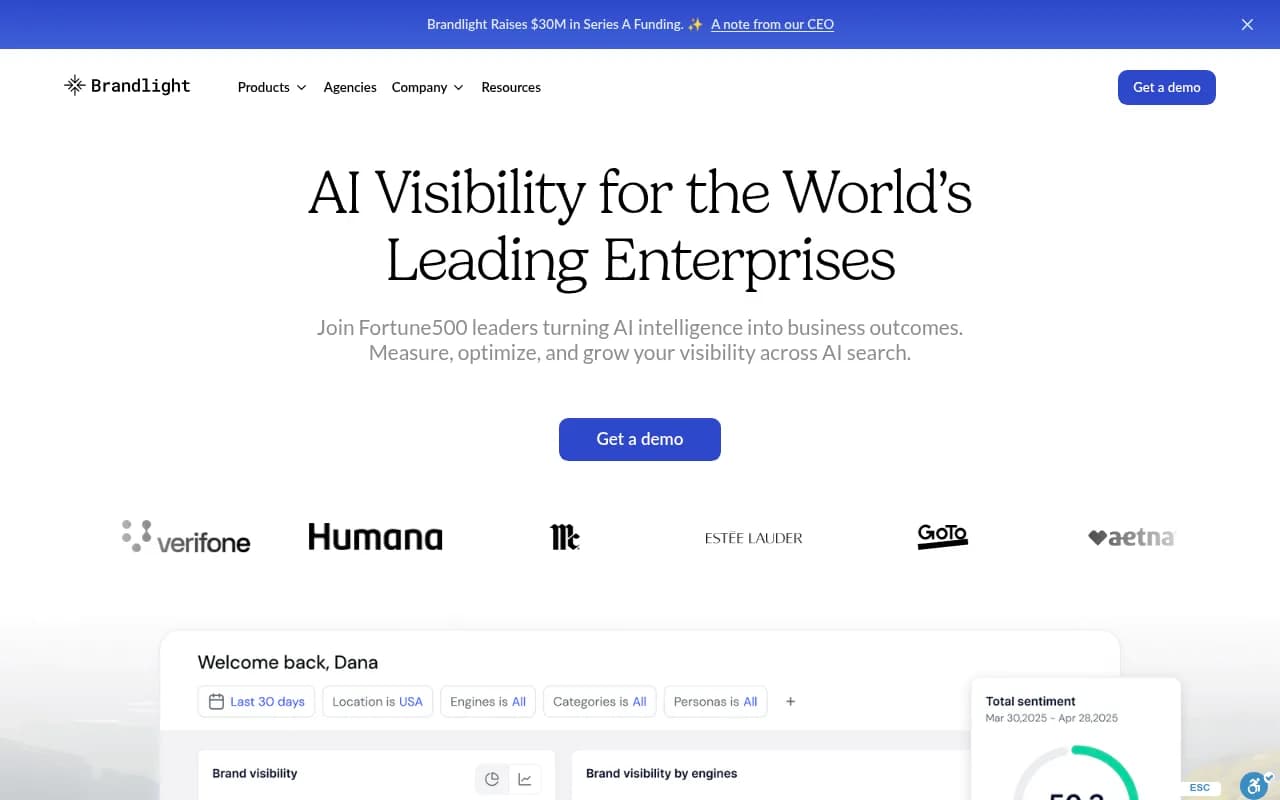
Brandlight covers 11+ AI platforms including Grok, DeepSeek, ChatGPT, Perplexity, Gemini, Claude, Copilot, Llama, and Google AI Overviews. CB Insights ranked it #1 in its category, and it has a strong enterprise feature set focused on agentic commerce and brand narrative tracking.
The catch is pricing: Brandlight is custom-only, which typically means enterprise budgets. If you're a mid-market brand or agency, you'll likely find it out of reach without a serious procurement process.
4. AthenaHQ
AthenaHQ covers 8 AI platforms including Grok, ChatGPT, Perplexity, Google AI Overviews, Google AI Mode, Gemini, Claude, and Copilot. It's YC-backed and has some genuinely impressive case studies. The interface is clean and the data quality is solid.
DeepSeek coverage is not listed as a tracked platform, which is a notable gap if that market matters to you. Like most competitors, AthenaHQ is monitoring-focused — it doesn't include content generation or gap-filling capabilities.
Pricing starts at $95/month (annual billing).

5. Peec AI
Peec AI covers ChatGPT, Perplexity, and Google AI Overviews by default, with Claude, Gemini, and others available as paid add-ons at roughly €20-30/month each. Grok and DeepSeek coverage exists but requires checking current plan availability — the modular pricing model means costs can add up quickly if you want full coverage.
The accuracy focus is real: Peec AI has a reputation for precise citation tracking, which matters when you're trying to understand exactly how often you appear versus competitors. It's used by brands like Wix and Glide.
Pricing starts at $89/month.

6. Otterly.AI
Otterly.AI is one of the more affordable options in this space, with a clean interface and straightforward monitoring across several AI platforms. It's a good starting point for teams new to AI visibility tracking.
The honest limitation: Otterly.AI is monitoring-only. No crawler logs, no content generation, no gap analysis. For Grok and DeepSeek specifically, coverage availability varies by plan. If you need basic visibility data without a large budget, it works. If you need to act on what you find, you'll hit a ceiling quickly.

7. Scrunch AI
Scrunch AI offers AI search visibility monitoring with a focus on brand narrative and how AI models describe your company. It covers several major platforms and has a reasonable feature set for mid-market brands.
Grok and DeepSeek coverage is available, though the platform is stronger on monitoring than optimization. Worth evaluating if you're specifically interested in how AI models characterize your brand (tone, positioning, accuracy) rather than just citation frequency.
8. SE Ranking (AI Visibility Toolkit)
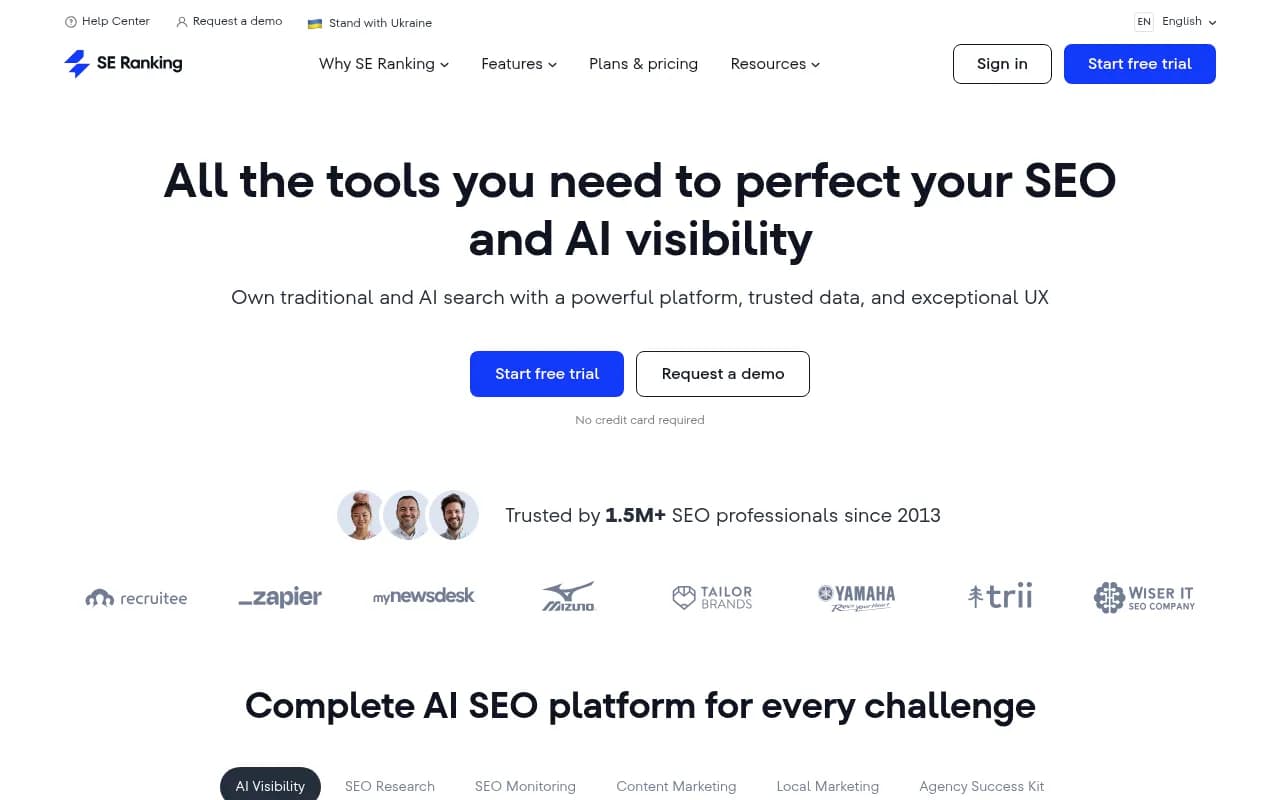
SE Ranking is primarily an SEO platform that has added AI visibility tracking as part of its broader toolkit. The advantage is consolidation: if you're already using SE Ranking for traditional SEO, adding AI visibility monitoring doesn't require a separate tool or login.
The depth of Grok and DeepSeek tracking is more limited than dedicated GEO platforms. It's a reasonable option for teams that want AI visibility as one feature among many rather than a primary focus.
9. Rankshift
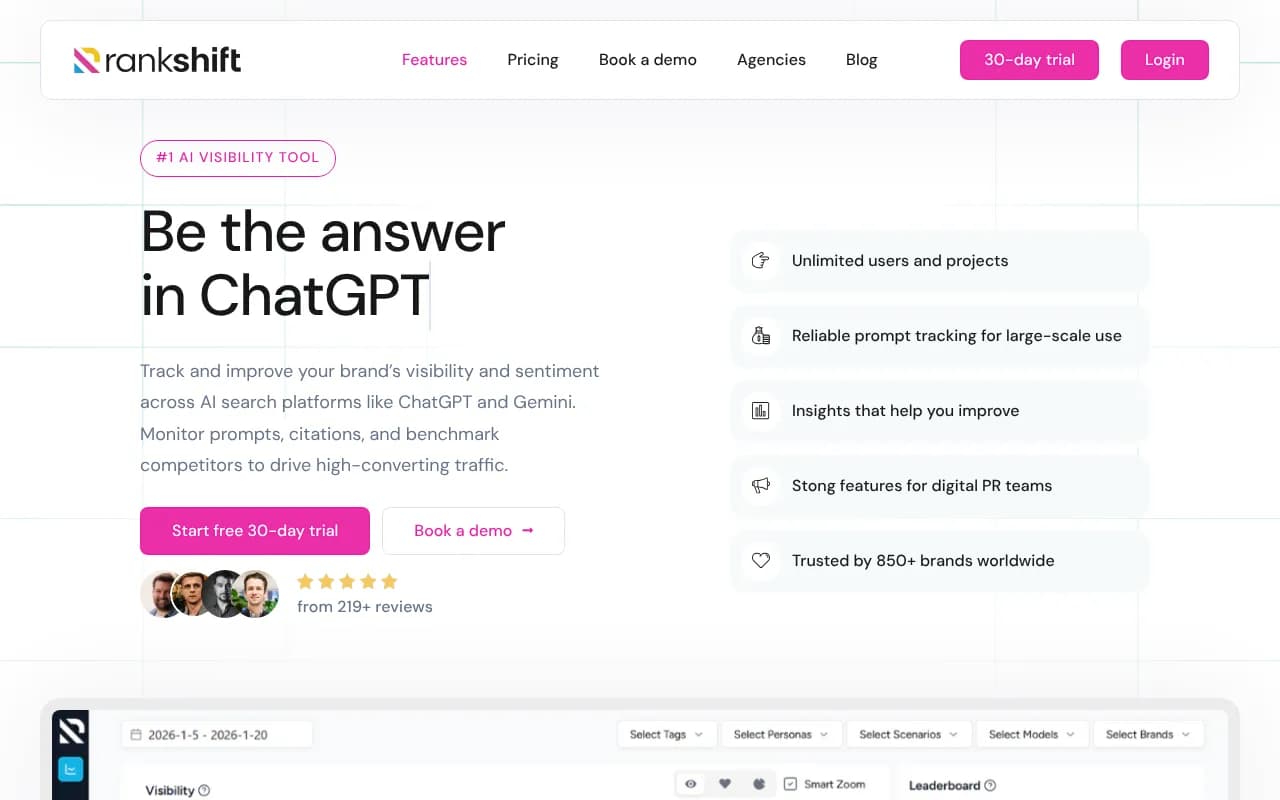
Rankshift is a dedicated LLM tracking tool built for GEO and AI visibility. It covers multiple AI models and provides citation tracking with competitive benchmarking. The platform is newer than some competitors but has been adding model coverage quickly.
For Grok and DeepSeek specifically, Rankshift offers tracking with prompt-level granularity — you can see which specific questions trigger mentions of your brand versus competitors. That level of detail is useful for content strategy.
10. Semrush
Semrush added AI visibility features to its platform, including some tracking across AI models. The advantage is obvious: if you're already a Semrush customer, you have access to AI monitoring without switching tools.
The limitation is depth. Semrush uses fixed prompts rather than custom prompt sets, which means you're tracking a predetermined list of questions rather than the specific queries your customers actually ask. Grok and DeepSeek coverage is more limited than dedicated platforms. For serious AI visibility work, most teams end up using Semrush alongside a dedicated GEO tool rather than instead of one.
11. Ahrefs Brand Radar
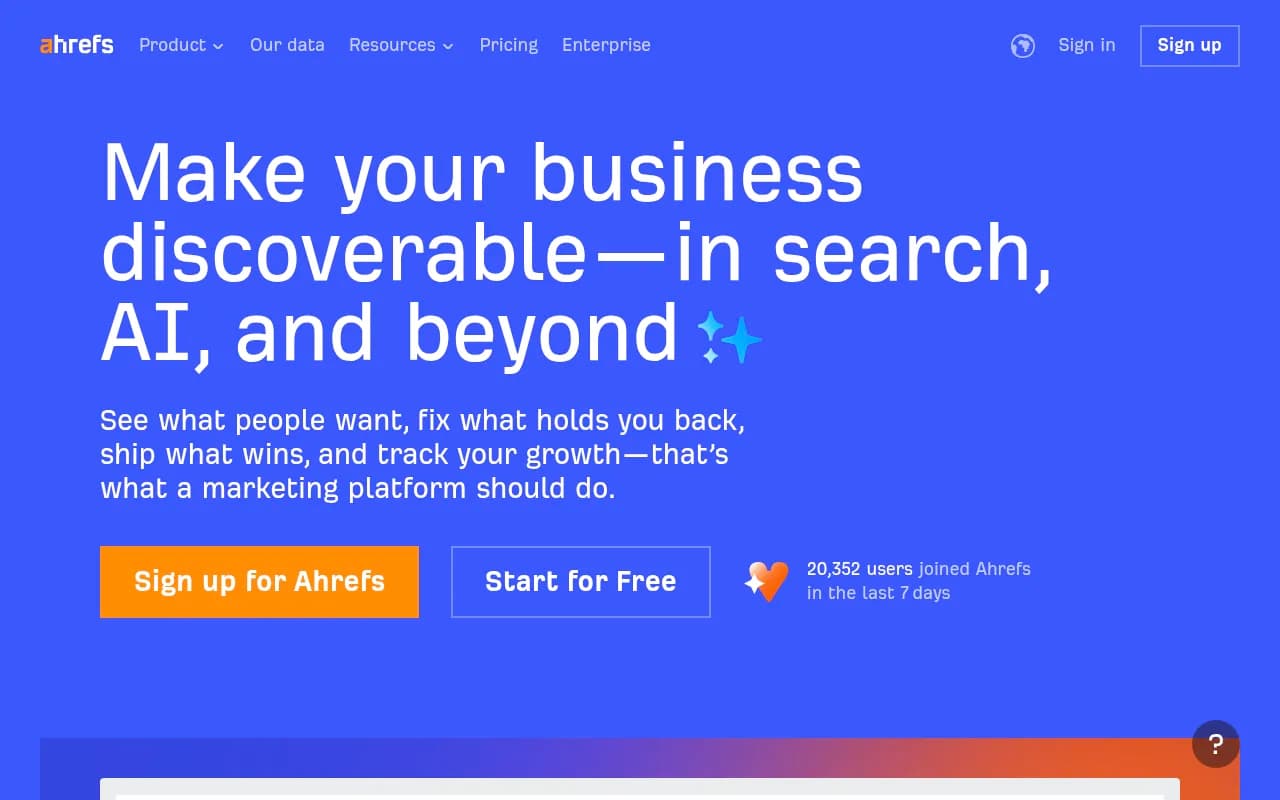
Ahrefs Brand Radar is the AI visibility component of the Ahrefs platform. Like Semrush, it benefits from being part of a well-established SEO suite that many teams already use.
The fixed prompt limitation applies here too — you can't customize the prompts being tracked, which limits how precisely you can monitor your specific competitive landscape. No AI traffic attribution is available, so connecting AI visibility to actual revenue requires external tooling. Grok and DeepSeek coverage is more limited than dedicated platforms.
12. Nightwatch
Nightwatch is primarily an SEO rank tracker that has added AI search monitoring capabilities. It covers several AI platforms and is particularly well-suited for agencies managing multiple clients.
For Grok and DeepSeek tracking specifically, Nightwatch is more limited than dedicated GEO platforms. It's worth considering if you need AI monitoring as part of a broader rank tracking workflow, but not as a primary tool for deep AI visibility analysis.
Platform comparison table
| Platform | Grok tracking | DeepSeek tracking | Content generation | Crawler logs | Starting price |
|---|---|---|---|---|---|
| Promptwatch | Yes | Yes | Yes (AI writing agent) | Yes | $99/mo |
| Profound | Yes | Yes | No | No | $99/mo |
| Brandlight | Yes | Yes | No | No | Custom |
| AthenaHQ | Yes | No | No | No | $95/mo (annual) |
| Peec AI | Add-on | Add-on | No | No | $89/mo |
| Otterly.AI | Limited | Limited | No | No | Free tier available |
| Scrunch AI | Yes | Limited | No | No | Custom |
| SE Ranking | Limited | Limited | No | No | ~$65/mo |
| Rankshift | Yes | Yes | No | No | Varies |
| Semrush | Limited | No | No | No | $139/mo |
| Ahrefs Brand Radar | Limited | No | No | No | Bundled |
| Nightwatch | Limited | No | No | No | $39/mo |
What to actually look for when choosing
Model coverage isn't enough on its own
Every tool in this list claims to track AI models. The real question is how they track them. Some platforms run queries against live model APIs on a scheduled basis. Others use cached or sampled data. The frequency matters: a tool that checks Grok once a week gives you very different signal than one that checks daily.
Ask vendors specifically: how often do you query Grok and DeepSeek? What's the sample size? Are prompts customizable or fixed?
The gap between monitoring and optimization
This is the most important distinction in the market right now. Most tools show you a dashboard with visibility scores and citation rates. That's useful data. But it doesn't tell you what to do next.
The platforms that go further -- like Promptwatch -- show you which specific prompts competitors appear for that you don't, and then help you create content to close those gaps. That's the difference between knowing you have a problem and being able to fix it.
Prompt customization
Fixed-prompt platforms track a predetermined set of questions. That's fine for benchmarking but limited for strategy. If your customers ask "what's the best [your specific category] for [your specific use case]," you need to be able to track that exact prompt -- not a generic approximation of it.
Traffic attribution
Knowing you're mentioned in Grok is one thing. Knowing that those mentions drove 340 visits and 12 trial signups last month is another. Very few platforms close this loop. Promptwatch does it via a code snippet, Google Search Console integration, or server log analysis. Most competitors don't offer traffic attribution at all.
The Grok tracking cost problem
One thing worth being direct about: Grok tracking is expensive relative to ChatGPT or Perplexity tracking. According to EWR Digital's analysis of the market, Grok analytics start at $64/month on the cheapest platforms and can reach $499/month on power-user plans like AIClicks.
This isn't arbitrary pricing -- Grok's API access costs more, and the real-time social data integration adds complexity. But it does mean you need to be intentional about whether Grok is worth the premium for your specific audience. If your customers are primarily enterprise B2B buyers in North America, Grok's demographics make it very relevant. If you're targeting SMBs in markets where Grok has limited penetration, the ROI calculation looks different.
DeepSeek tracking is less expensive where it's available, but coverage is genuinely sparse. Most platforms added it as a checkbox feature rather than a deeply integrated capability.
The bottom line
If you're serious about tracking brand mentions in Grok and DeepSeek -- not just ChatGPT -- your options narrow quickly. Most platforms either don't cover these models, treat them as expensive add-ons, or offer surface-level monitoring without the depth to act on what you find.
Promptwatch covers both models as part of its standard platform, pairs that monitoring with content gap analysis and AI content generation, and adds crawler logs so you can see how Grok and DeepSeek actually crawl your site. For teams that want to move from "we know we're invisible" to "we fixed it," that combination is hard to match.
For enterprise teams with custom budgets, Brandlight and Profound are worth evaluating. For teams already deep in the Semrush or Ahrefs ecosystem, the built-in AI features are a reasonable starting point -- just go in knowing the limitations.
The market is moving fast. Tools that didn't cover Grok six months ago now do. The question is whether they cover it well enough to be useful, or whether it's just a checkbox on a feature list.