Key takeaways
- AI perception tracking is about more than mentions. You want to know how ChatGPT, Gemini, Claude and Perplexity describe you, what they cite, and what you can change.
- Most tools in this category are monitors. A smaller group also helps you publish fixes and measure whether the fix worked.
- Pendium is a newer platform that positions itself around how AI agents perceive a business, with a free first audit and a guarantee on its Pro plan.
- Promptwatch is the most complete option if you want monitoring, crawler logs, traffic attribution and content creation in one product.
- Check how a vendor collects data (real interfaces or APIs), how often prompts run, and whether you can export everything before you commit.
What AI perception tracking actually means
"AI visibility" asks whether your brand shows up. "AI perception" asks what the model says once it does. Those are different problems. A brand can be mentioned in 60% of answers and still be described as expensive, outdated or only good for small teams. If you only count mentions, you miss that.
A useful perception tool covers four things:
- Which prompts your buyers ask, and whether you appear in the answers
- Where you sit in the answer (first recommendation or an afterthought)
- The tone and specific claims the model makes about you
- Which sources the model leans on to say those things
The last one matters most. If ChatGPT calls your product "limited on integrations" because it read one stale comparison page, you fix the page or the source. You do not fix it by staring at a dashboard.
How AI answers differ by engine
Perception is not uniform. Promptwatch Data's average sources per response report shows that ChatGPT cites about 5 sources per web-search answer, while Google AI Overviews and Perplexity cite about 10. Copilot's average swung from under 2 to nearly 17 within a few weeks. The report carries a September 2025 byline and no explicit date range, so treat the exact figures as a guide to the pattern rather than a current benchmark.
The practical consequence: a tool that checks one engine tells you very little. You also want to know whether the vendor tests the real user interface or an API. Answers and citations can differ between the two. Promptwatch says its data comes from the real interfaces of ChatGPT, Gemini, Perplexity, Claude and AI Overviews.
Citation behavior also shifts quickly. Promptwatch Data found ChatGPT's share of citations from reddit.com fell from about 4% to 0.5% on August 14, 2026 (Reddit citations are dropping in ChatGPT). If your perception strategy leaned on Reddit threads, that change matters. A tool that only reports a score would not tell you why your numbers moved.
What to look for before you buy
This checklist is based on the criteria used in several 2026 comparisons, including the one from Sight AI, plus a few I would add.
- Engine coverage: ChatGPT, Gemini, Claude, Perplexity, AI Overviews and AI Mode at minimum.
- Prompt-level tracking you control, re-run on a schedule, since answers vary between runs.
- Position and sentiment, not just a yes or no on mentions.
- Competitor share of voice on the same prompts.
- Citation and source data, so you know which URLs shape the answer.
- A path to action: content, indexing or recommendations.
- Evidence that your site is actually readable by AI crawlers.
- Traffic attribution, so you can tie AI answers to visits and conversions.
Most tools do the first five reasonably well. The last three separate the serious platforms from the dashboards.
The tools compared
Here is the short version before the detail.
| Tool | Core focus | Acts on gaps | Crawler logs | Best for |
|---|---|---|---|---|
| Promptwatch | Monitor, trace, act, measure | Yes (Content Agent, Action Board) | Yes | Teams that want one end-to-end platform |
| Pendium | AI perception audits and improvement | Managed help on higher tier | Not confirmed | Brands that want a guided, hands-on service |
| Sight AI | Tracking plus content and indexing | Yes (content agents, IndexNow) | Not confirmed | Content-heavy teams |
| Profound | Enterprise monitoring | Limited | Yes | Large enterprises |
| Peec AI | Share-of-voice tracking | Limited | No | Teams used to SoV reporting |
| Otterly.AI | Affordable monitoring | Limited | Beta | Small teams starting out |
| AthenaHQ | Monitoring across 8+ engines | Limited | No | Teams needing broad engine coverage |
The crawler log and action columns for competitors come from public comparison pages and the vendors' own descriptions, so confirm them in a demo before you buy.
Promptwatch
Promptwatch is the platform I would start with if the question is "what do AIs say about us and how do we change it." It covers the monitoring side (ChatGPT, Gemini, Claude, Perplexity, Google AI Overviews, AI Mode, Copilot and more, in each country and language you pick), and it is built around a loop: monitor, trace where answers come from, act on the gaps, then measure.

For perception specifically, the useful piece is Brand Narrative. It pulls the individual claims AI makes about you and your competitors out of every tracked response, groups repeated claims, and files them under themes such as Pricing, Features, Support or Reputation, each with a 0-100 score. Fact Check then lets you mark a claim as inaccurate and finds the pages on your own site that state it or its opposite, so you know where the model might be learning the wrong thing. Fact Check is on the Business plan and above.
Beyond that, Promptwatch adds IP-verified AI crawler logs (so you can tell whether bots read a page at all), visitor analytics for AI-referred traffic, a Content Agent that writes and publishes to WordPress, Webflow or Framer, and an Action Board that prioritizes what to do next. Sentiment is scored independently of visibility, which helps when you are mentioned often but described badly.
Pricing, per promptwatch.com/pricing: Essential is $95/mo (50 prompts), Professional is $245/mo (150 prompts), and Business is $579/mo (350 prompts, Content Agent, Fact Check, hourly tracking option). Agency plans start at $199/mo. There is a 7-day free trial on monthly billing, and a free AI visibility report if you just want a first read. Always confirm current prices on the pricing page. Some third-party roundups quote older figures.
The tradeoff: it is a bigger product than a simple tracker, so a team that only wants a weekly mention count will use a fraction of it. If you are comparing it against specific rivals, the Promptwatch vs Profound and Promptwatch vs Peec pages go through the differences line by line.
Pendium
Pendium describes itself as an AI visibility (GEO/AEO) platform that monitors, explains and improves how ChatGPT, Claude, Gemini and other AI agents perceive a business. The word "perceive" is doing deliberate work there. It is the closest match to the perception framing of this article.
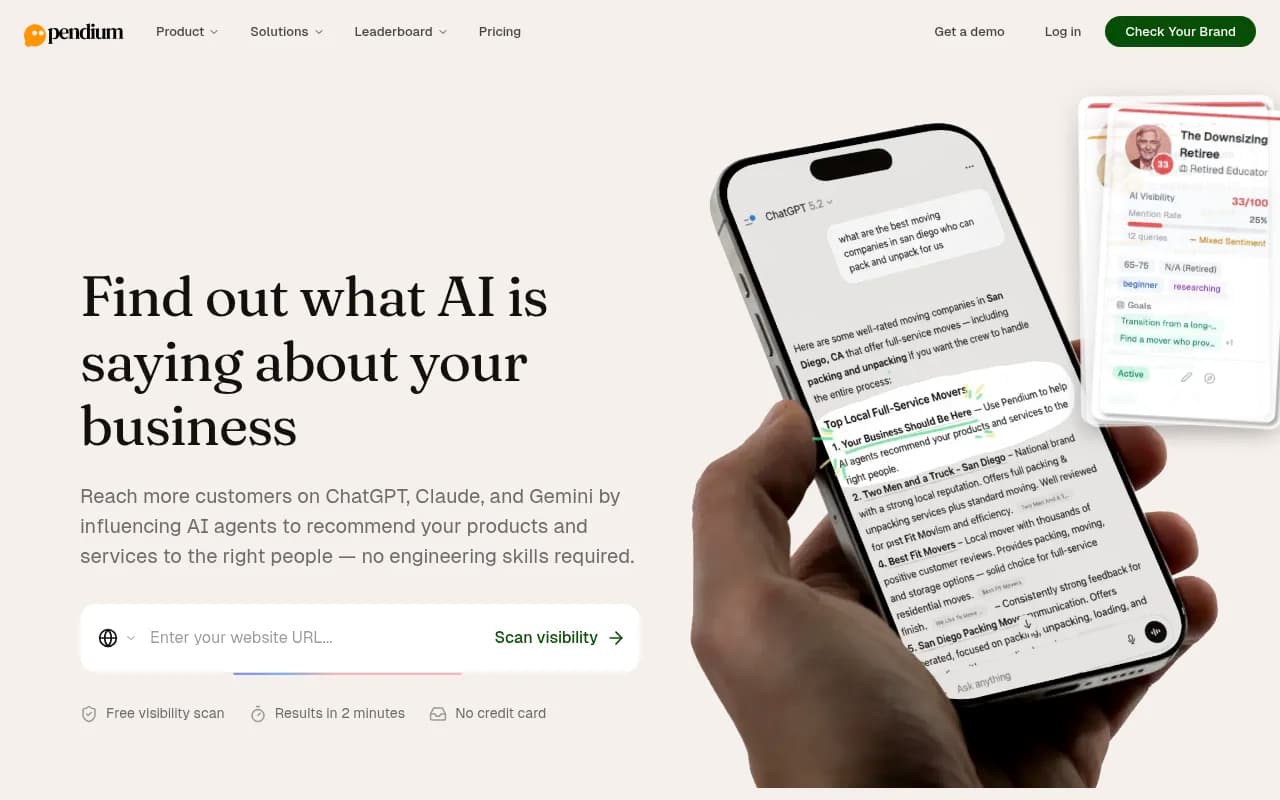
From its public pricing page: there is a 7-day free trial (card required, nothing charged until day 8), Pro is $350/mo and tracks 40 questions per brand (160 tracked prompts), and Starter tracks 25 questions (100 prompts). I could not confirm the Starter price. Yearly billing gives two months free. Pendium also offers a guarantee: if it does not name you more often, your next three months of Pro are free. A higher tier is priced by number of brands, category competitiveness and how much work Pendium's team does for you.
That last detail tells you something. Pendium leans toward a guided service, which suits a brand that does not want to run the program itself. It also means the cost is less predictable at the top end. I have not tested the product, and I could not verify details such as crawler logging or traffic attribution, so ask about those in a demo.
Sight AI
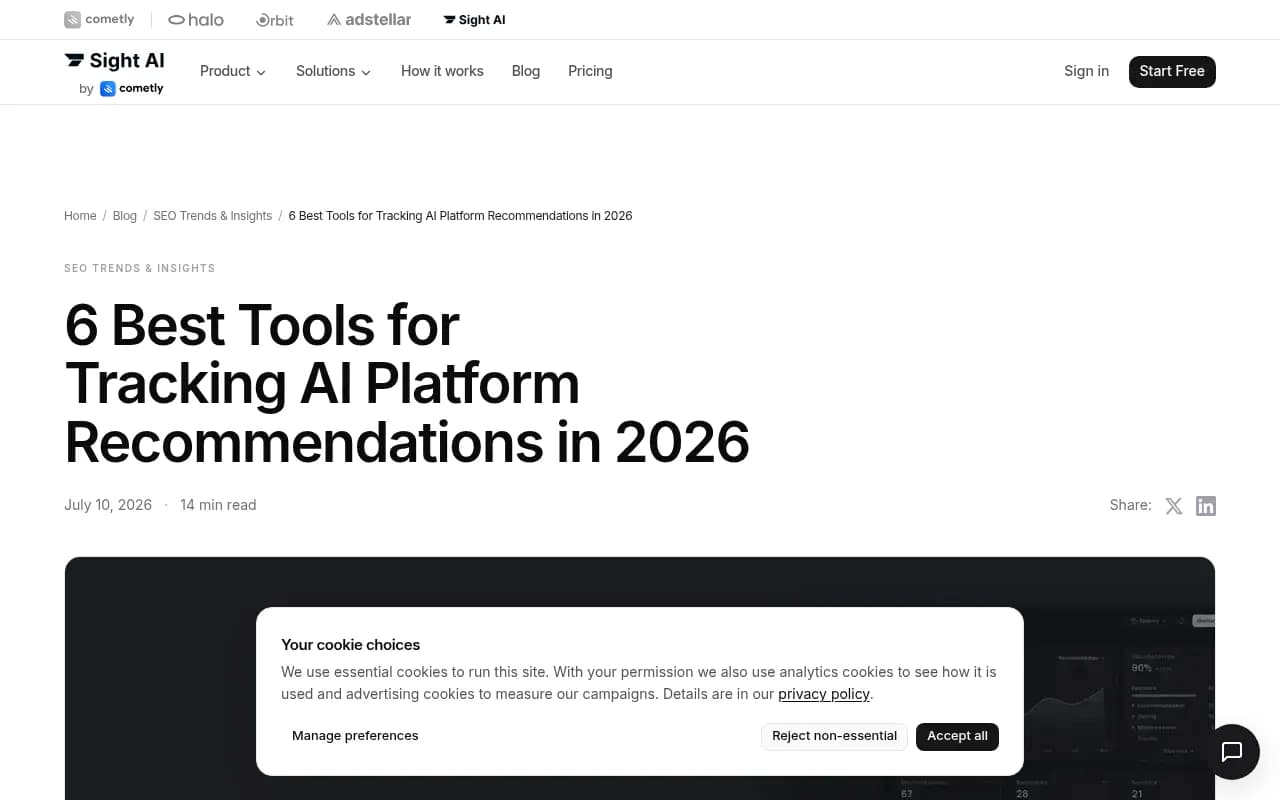
Sight AI (also listed as Sight in some directories) tracks brand mentions across 6+ AI models and pairs that with content generation and auto-indexing via IndexNow. Its own comparison article describes 13+ specialized content agents and an Autopilot Mode.
Take that source with the obvious caveat: it is a comparison published by Sight AI that ranks Sight AI first. The claim that it is "the only tool on this list" to track gaps and close them in one workflow is not accurate across the whole market, since several platforms (Promptwatch included) also do both. Still, it is a reasonable fit for content-heavy teams that want monitoring wired into production. I found no public pricing.
Profound
Profound is the enterprise name most people mention first. It has strong monitoring, crawler logs and analytics, and it is priced accordingly. Compared with Promptwatch, it lacks Reddit tracking, ChatGPT Shopping and agentic execution.

Good fit for large organizations that want competitive intelligence and have a team to act on it.
Peec AI
Peec is a clean share-of-voice tracker with multi-language support. It does the monitoring job well and suggests content, but it has no crawler logs or visitor analytics.

Choose it if your reporting culture is built around share of voice and you plan to do the fixing elsewhere.
Otterly.AI and AthenaHQ
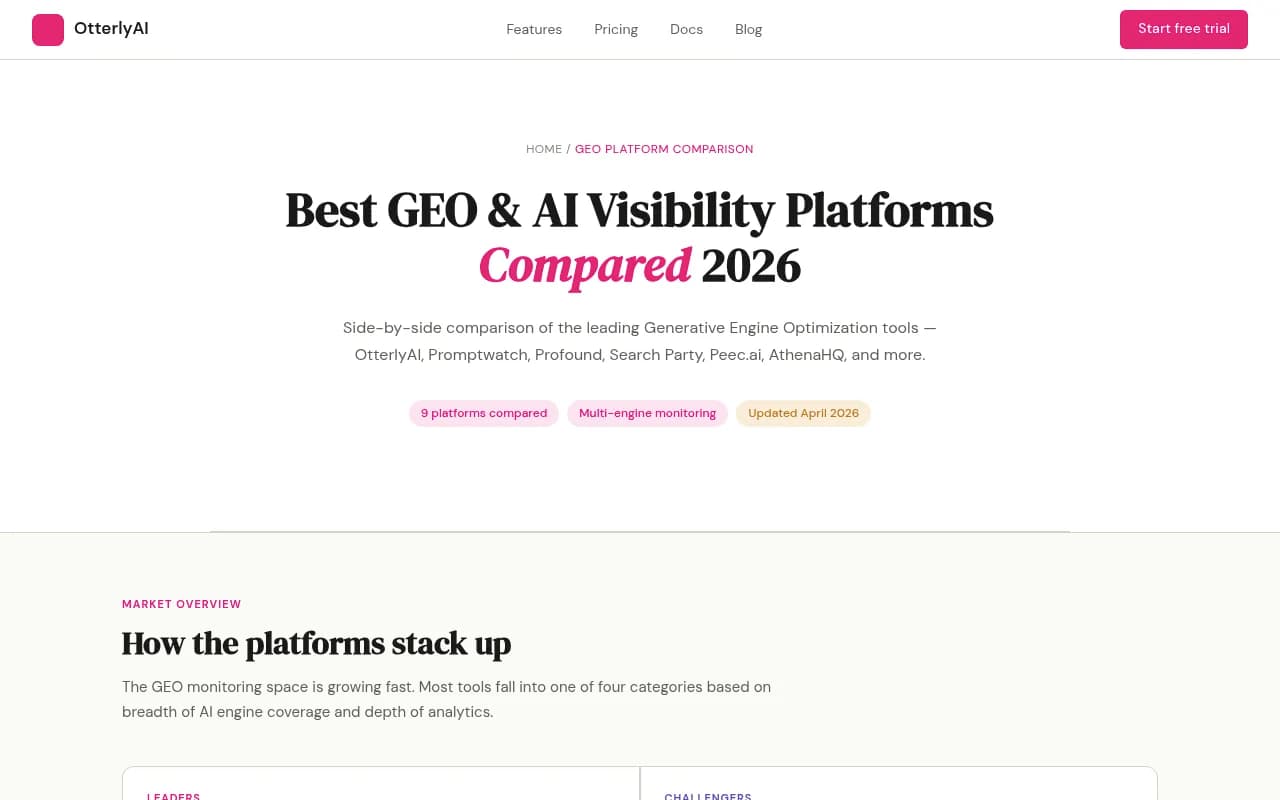
Otterly.AI is an affordable monitor with citation analysis and an MCP server. AthenaHQ tracks across 8+ AI engines.

Both are monitoring-focused. They are sensible for small teams that need to get a baseline before investing in content. Note that the widely shared "Best GEO platforms compared" page that ranks Otterly first was published by Otterly, so read its ranking with that in mind.
Semrush and Ahrefs Brand Radar
Both bolt AI tracking onto a traditional SEO suite. That is convenient if you already live in those tools, but prompt sets are often fixed and AI-specific depth is thinner, with no crawler logs or AI traffic attribution.

How to choose
Start from what you need to do after you see the data.
- If you only need to know where you stand, a lighter tracker (Otterly, Peec, AthenaHQ) is enough.
- If you want someone to run it with you, Pendium's service-heavy model is worth a demo.
- If you want tracking tied to content production, look at Sight AI or Promptwatch.
- If you need to prove AI search drives revenue, you need crawler logs and visitor analytics, which narrows the field quickly.
- If you manage many clients, check agency pricing and per-client response limits. Agency cost analyses such as Kime's show how fast low-tier plans run out at 25 prompts on three engines tracked daily.
For wider lists, the GEO software directory at bestgeosoftware.com and the AI rank tracking tools directory cover far more vendors than a single article can.
Questions to ask in a demo
- Do you test the real interface of each AI engine, or an API?
- How often do prompts run, and can I raise the frequency for a launch?
- Can I see the individual claims the model makes about us, not only a sentiment score?
- Can I trace a bad claim to the source page?
- Do you log AI crawler visits to my site, verified by IP?
- Can I export prompts, responses and citations?
- What happens to my data and pricing if I add brands or markets?
Any vendor that cannot answer numbers 3 to 5 clearly is a monitor, whatever the marketing says.
A simple way to start
Run a free scan first. The free AI visibility report from Promptwatch and Pendium's free first audit both give you a baseline without a contract. Compare what each says about your brand. Where they disagree is where you should dig, because it usually points to a prompt set or engine you were not watching.
Then pick one market, 20 to 50 prompts that reflect real buyer questions, and track them daily for a month. Look at position and sentiment, not only mentions. Fix the two or three claims that appear most often and are wrong, then check whether they changed. That one loop teaches you more about which tool you need than any comparison table, including this one.
If you would rather hand the strategy to people, 1001 SEO Media publishes this site and runs GEO work for brands using Promptwatch as its visibility platform.