Key takeaways
- Surfer SEO is the most proven option for on-page optimization, with real data showing content scoring 80+ consistently outperforms lower-scored pages in Google rankings.
- AirOps is built for content operations at scale, not individual page optimization -- it's a workflow engine, not an SEO suite.
- Junia AI and Outranking sit in the middle: they generate content and offer some optimization signals, but their ranking feedback loops are thin compared to dedicated SEO platforms.
- None of these four tools track AI search visibility (ChatGPT, Perplexity, Gemini) in any meaningful depth -- a growing blind spot as AI search takes real traffic share.
- If tracking whether your content appears in AI-generated answers matters to you, that's a separate category of tool entirely.
Here's the uncomfortable truth about content platforms in 2026: most of them are very good at helping you write content, and much less good at telling you whether that content actually worked.
You get a content score. You get keyword suggestions. You get a green checkmark. And then... silence. Did the article rank? Did it get cited by Perplexity? Did anyone read it? The platform doesn't know, or doesn't tell you.
This guide looks at four platforms -- AirOps, Junia AI, Outranking, and Surfer SEO -- through a specific lens: how well do they close the loop between content creation and ranking results? Not just "can they write content" but "can they show you whether it worked?"
What we're actually comparing
Before getting into each tool, it's worth being clear about what "tracking whether articles rank" means in 2026. There are two separate questions:
- Does the platform track traditional Google rankings for the content it helps you create?
- Does it track AI search visibility -- whether your content gets cited in ChatGPT, Perplexity, Google AI Overviews, etc.?
These used to be the same question. They're not anymore. Surfer SEO's own data reportedly shows that 25% of its new customers now come through AI assistants like ChatGPT and Perplexity. That's not a rounding error -- that's a meaningful share of discovery happening outside traditional SERPs.
So when we ask "does this platform track rankings," we need to ask both questions.
Surfer SEO
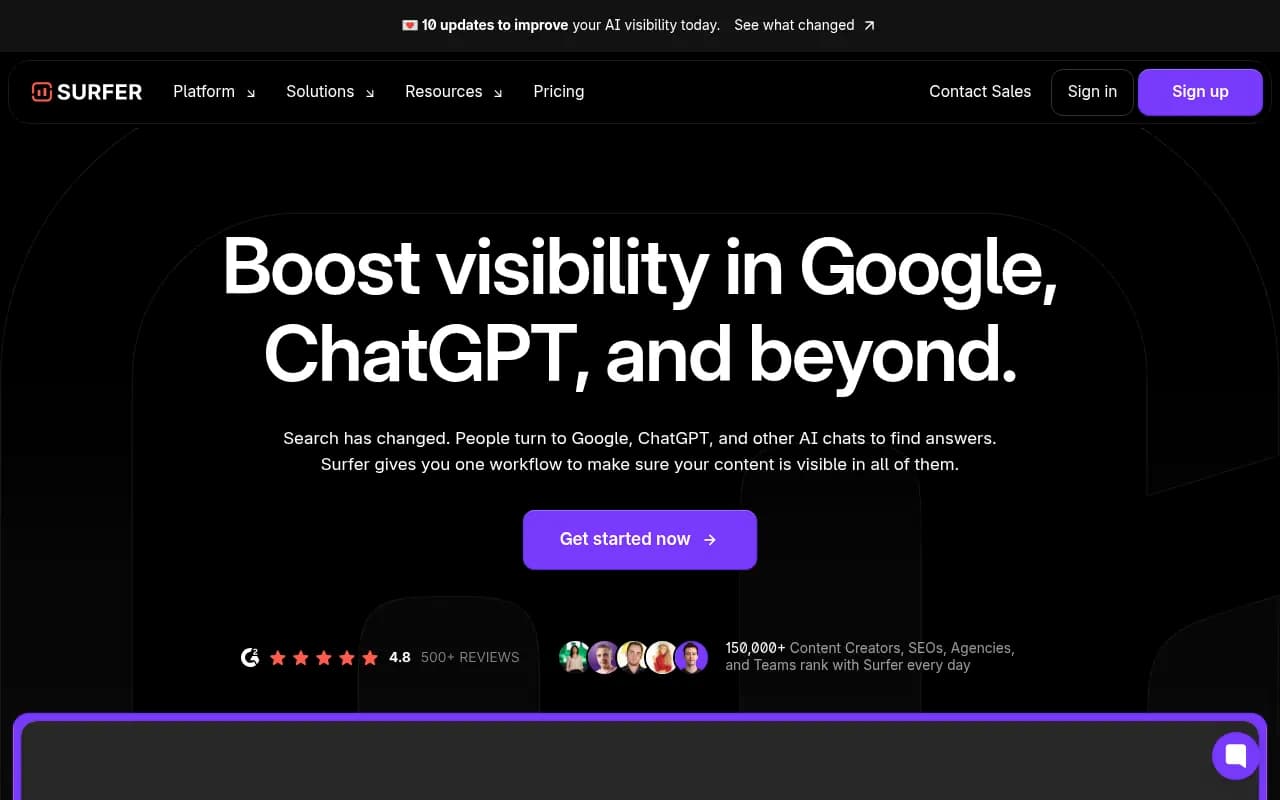
Surfer is the most battle-tested of the four. It built its reputation on one core idea: analyze what the top-ranking pages actually look like, then tell you how to match them. The Content Score is the output of that analysis -- a number from 0 to 100 that reflects how well your article aligns with what's ranking.
Does it work? Independent testing published on Indie Hackers in 2026 found that Surfer-optimized content ranked highest after 25 days of testing across multiple tools, though not by a dramatic margin. Content scoring 80+ consistently outperformed lower-scored pages. That's not a marketing claim -- that's someone who spent $900 and six weeks testing this stuff.

The 2026 version of Surfer has added a few things worth noting: an AI Tracker (which monitors AI search visibility, though it's not the platform's main focus), an AI Humanizer, and a redesigned sidebar that makes the workflow feel less cluttered. The Rank Tracker is there for traditional SERP monitoring.
Where Surfer falls short is scale. It's built around individual page optimization. If you're managing hundreds of URLs and need bulk workflows, you'll hit friction fast. The credit-based pricing model compounds this -- refreshing or republishing at volume gets expensive.
On the AI visibility question: Surfer has added AI tracking features, but this is clearly a secondary capability. The platform's DNA is Google SERP optimization, and that's still where it does its best work.
Surfer SEO fits writer-led teams, solo operators, and agencies that need fast, guided optimization with real-time content scoring.
AirOps
AirOps is a fundamentally different kind of tool. It's not an SEO suite -- it's a workflow engine that happens to connect to SEO and AI visibility data. The distinction matters.
Where Surfer asks "how do I optimize this page?", AirOps asks "how do I run a content operation across hundreds of pages, with repeatable workflows, governed AI outputs, and visibility tracking baked in?"
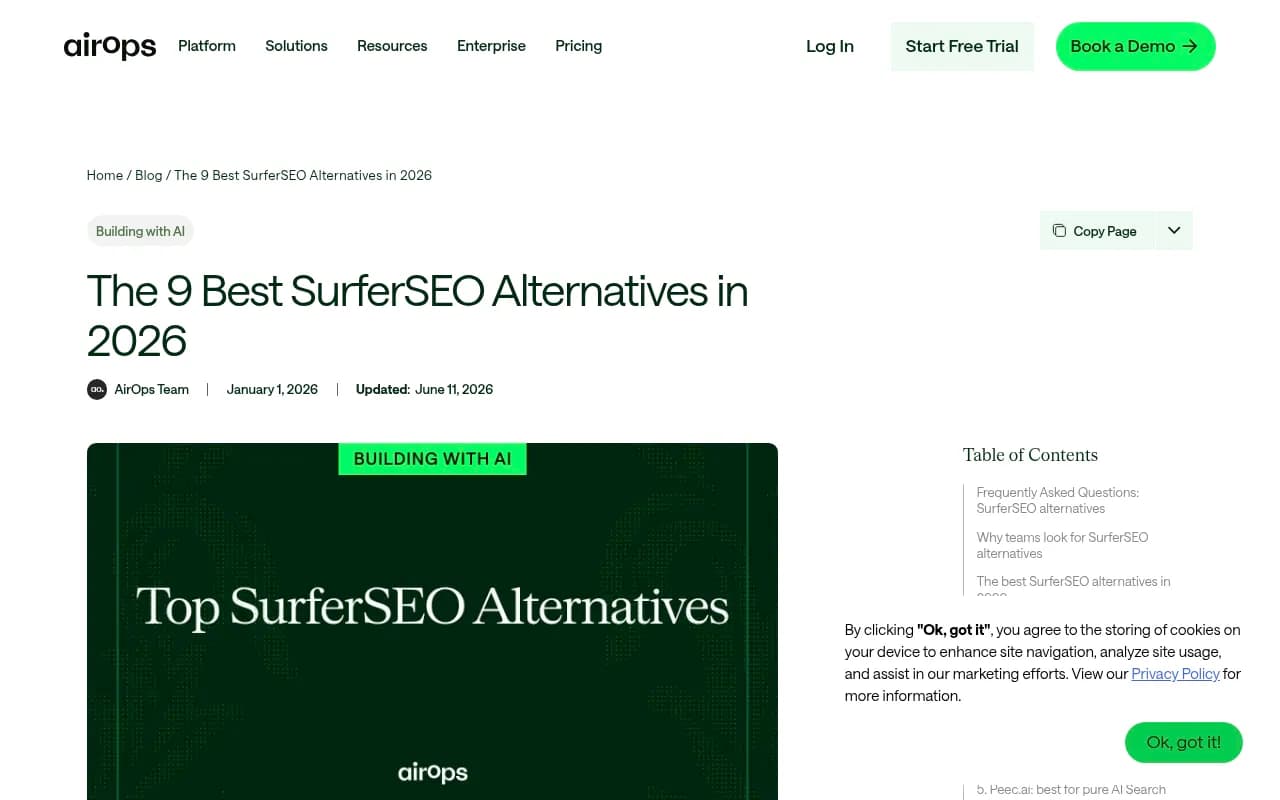
AirOps connects SEO data, AI search citation tracking, and bulk publishing in one system. It tracks share-of-voice and citations in AI search results -- not just Google rankings. For teams that need to understand whether their content is showing up in ChatGPT or Perplexity answers, that's a real differentiator over Surfer.
The trade-off is complexity. AirOps requires you to build workflows. Surfer gives you a pre-built optimization experience. If you're a solo writer or a small team, AirOps will feel like overkill -- you're configuring a system when you just wanted to write an article. If you're running a content operation at scale, that configurability is exactly what you need.
Pricing is less transparent than Surfer's -- AirOps mixes free entry points with team-oriented custom pricing, which makes it harder to evaluate without a sales conversation.
AirOps fits content ops teams and larger in-house programs that need multi-step AI workflows and visibility tracking across research, creation, and optimization.
Junia AI
Junia AI sits in a different tier. It's primarily an AI writing tool with SEO features layered on top -- think content generation first, optimization second.
The platform generates long-form articles, handles internal linking suggestions, and offers some keyword optimization guidance. For teams that need volume -- lots of articles, quickly -- Junia AI is genuinely useful. The writing quality is solid for AI-generated content, and the SEO guidance is enough to avoid obvious mistakes.
But "tracking whether articles rank" is where Junia AI gets thin. The platform doesn't have a native rank tracker. It doesn't monitor AI search citations. It helps you produce content that should rank, based on keyword targeting and basic optimization signals, but it doesn't close the loop by showing you what actually happened after you hit publish.
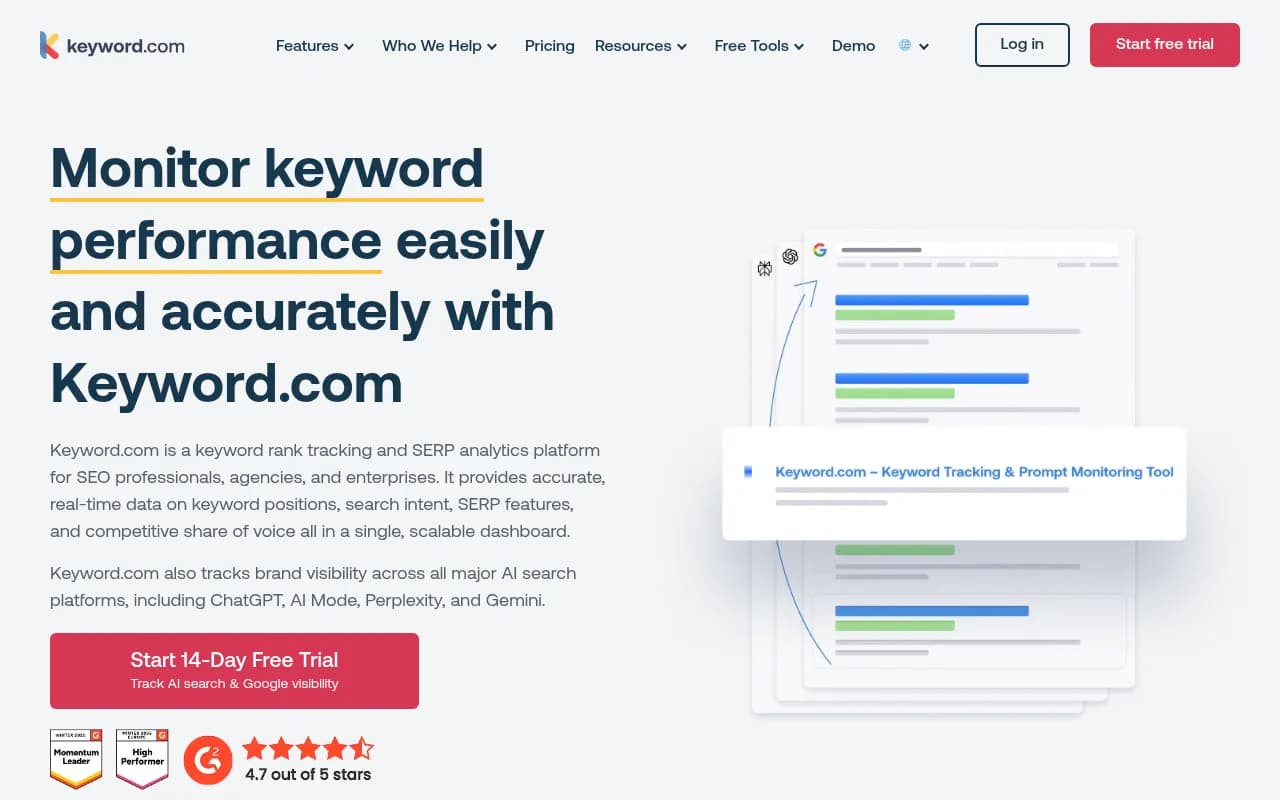
This isn't necessarily a dealbreaker. If you're using Junia AI alongside a dedicated rank tracker (Ahrefs, Semrush, or something like Keyword.com), the gap is manageable.
But if you want a single platform that writes content and then tells you whether it worked, Junia AI isn't that. It's a content production tool, not a content performance platform.
Outranking
Outranking occupies a similar space to Junia AI but with a stronger emphasis on SEO structure. It generates content briefs, writes drafts, and scores content against competitor pages -- closer to Surfer's approach than Junia AI's.
The platform's strength is in its research and brief-generation workflow. It pulls SERP data, identifies semantic gaps, and structures content around what's ranking. For teams that want a more guided writing experience than Junia AI but don't need Surfer's depth of on-page analysis, Outranking is a reasonable middle ground.
On ranking feedback: Outranking has added some tracking features, but they're basic. You can monitor keyword positions for content you've created, which is more than Junia AI offers. AI search visibility tracking is minimal -- the platform is built around Google SERP performance, and that's where its data lives.
The honest assessment is that Outranking is a solid content creation and brief-generation tool that happens to have some ranking tracking bolted on. It's not a monitoring platform, and it doesn't pretend to be.
Head-to-head comparison
| Surfer SEO | AirOps | Junia AI | Outranking | |
|---|---|---|---|---|
| Primary use case | On-page optimization | Workflow orchestration | AI content generation | Content briefs + drafts |
| Content scoring | Yes (core feature) | Via integrations | Basic | Yes |
| Google rank tracking | Yes (native) | Yes (via integrations) | No (needs external tool) | Basic |
| AI search visibility | Limited (AI Tracker) | Yes (citations, share-of-voice) | No | No |
| Bulk content workflows | Limited | Yes (core feature) | Yes | Moderate |
| Best for | Writers, agencies, solo SEOs | Content ops teams, enterprise | High-volume content production | Mid-size teams, agencies |
| Pricing transparency | High (clear plan tiers) | Low (custom pricing) | Medium | Medium |
| Learning curve | Low | High | Low | Medium |
The ranking feedback gap
Here's what's worth saying plainly: none of these four tools does a great job of closing the full loop between content creation and ranking results -- especially for AI search.
Surfer comes closest for traditional Google rankings. AirOps comes closest for AI search citations. But even AirOps's AI visibility tracking is a secondary feature, not the core product.
The reason this matters is that the traffic picture in 2026 is genuinely split. AI assistants are driving discovery for a growing share of queries. If your content platform only tracks Google rankings, you're flying blind on an increasingly important channel.
For teams that want to seriously track AI search visibility -- which prompts your content appears in, which AI models cite you, how your visibility compares to competitors -- that's a separate category of tool. Platforms like Promptwatch are built specifically for this: tracking citations across ChatGPT, Perplexity, Gemini, Claude, and others, then helping you identify gaps and create content to fill them.

The distinction is worth understanding. Content creation platforms (Surfer, AirOps, Junia AI, Outranking) help you produce content. AI visibility platforms track whether that content is being cited by AI engines. In 2026, you probably need both.
Which tool should you actually use?
The right answer depends on what problem you're actually trying to solve.
If you're a writer or small agency that needs to optimize individual pages for Google, Surfer SEO is the most proven option. The content scoring works, the workflow is fast, and the rank tracker gives you feedback without needing to bolt on another tool.
If you're running a content operation at scale -- dozens of articles a month, multiple writers, complex workflows -- AirOps is worth the setup investment. It's not plug-and-play, but it's built for the kind of systematic content production that Surfer can't handle efficiently.
If you need high-volume AI content generation and you're comfortable tracking rankings separately, Junia AI is a reasonable choice. Just pair it with a dedicated rank tracker.
If you want a middle ground between brief generation and content scoring, Outranking works for mid-size teams that don't need the depth of Surfer or the complexity of AirOps.
And if you care about AI search visibility -- which you probably should -- none of these four tools is the right primary choice for that job. That's a different category, and it's worth treating it as one.
A note on the AI search shift
The platforms in this guide were all built primarily for Google. That's not a criticism -- Google still drives the majority of search traffic. But the shift is real and accelerating.
Surfer's own data showing 25% of new customers arriving via AI assistants is a useful data point. It suggests that even for a tool built around Google optimization, AI search is already a meaningful acquisition channel. For the brands those customers represent, being visible in AI answers isn't optional -- it's where discovery is happening.
The content platforms in this guide are adapting, but slowly. AirOps is furthest along on AI visibility tracking. Surfer has added an AI Tracker. Junia AI and Outranking haven't moved much in this direction.
If you're building a content strategy for 2026 and beyond, the question isn't just "will this content rank on Google?" It's "will this content get cited when someone asks ChatGPT or Perplexity about my category?" Those are different questions, and right now, most content platforms only answer the first one.
Tools built specifically for AI search visibility -- tracking citations, identifying prompt gaps, monitoring which AI models mention your brand -- are worth adding to your stack alongside whichever content creation platform you choose.



The content creation and AI visibility categories are converging, but they haven't merged yet. In 2026, the teams doing this well are using both.