Key takeaways
- Data freshness varies wildly across AEO platforms -- some re-query AI models daily, others cache results for a week or longer, meaning you could be making decisions based on outdated AI responses.
- Tools that query AI models through APIs can return different answers than what real users see in browser interfaces, creating a meaningful accuracy gap.
- Monitoring-only tools can't tell you why your visibility dropped or what to do about it -- they just show you the number.
- Smaller brands and niche markets consistently see lower data accuracy across most platforms, according to G2 user reviews.
- The most reliable platforms combine high query frequency, real-UI monitoring (not just API calls), and transparent methodology about how they collect data.
If you spent any time in 2025 trying to track your brand's visibility in AI search, you probably ran into a frustrating problem: different tools showed you different things. One platform said you were cited in 40% of relevant ChatGPT responses. Another said 12%. A third showed you a screenshot from three weeks ago.
This wasn't a minor discrepancy. It was a sign that the AEO tool category was -- and to some extent still is -- figuring out what "accurate data" even means when your subject matter changes every time a model gets updated.
This guide breaks down what actually caused those accuracy gaps in 2025, which types of platforms handled it better, and what to look for now that the category has matured a bit heading into 2026.
Why AEO data accuracy is harder than it sounds
Traditional rank tracking is relatively straightforward: you query Google for a keyword, record the position, repeat. The data is deterministic. The same query returns the same SERP (mostly).
AI search doesn't work that way. LLMs are probabilistic. Ask ChatGPT the same question twice and you might get two different answers with two different citations. Ask it from a different location, with a different persona, or after a model update, and the response can shift substantially.
This creates three distinct accuracy problems for AEO tools:
Query freshness. If a tool only re-queries AI models once a week, the data you're looking at might reflect how an older version of GPT-4o responded to a prompt before a significant update. You could be optimizing for a reality that no longer exists.
API vs. real UI. Most AEO tools query AI models through their APIs, which is faster and cheaper. But the answers users actually see in ChatGPT's browser interface, Perplexity's web app, or Google's AI Overviews can differ from what the API returns. Shopping recommendations especially tend to diverge. If a tool only uses API calls, it's showing you a proxy for user experience, not the real thing.
Prompt design. The way a tool phrases a query matters enormously. "What's the best project management software?" and "What project management tools do you recommend?" can produce completely different citation sets. Tools that use generic, fixed prompts may miss how your actual customers are asking questions.
The data freshness problem in practice
This was probably the biggest complaint about AEO tools in 2025. G2 reviews across multiple platforms flagged "data accuracy" issues, particularly for smaller websites and niche markets. The underlying cause was usually stale data, not bad methodology.
Here's how the refresh cadences broke down across the category:
| Platform type | Typical refresh cadence | Real-UI monitoring | Custom prompts |
|---|---|---|---|
| Enterprise platforms (Profound, Conductor, BrightEdge) | Daily to near-real-time | Partial | Yes |
| Mid-market trackers (Otterly.AI, Peec AI, SE Ranking) | 2-7 days | No (API only) | Limited |
| Budget/entry tools (Peasy, Airefs, LLM Pulse) | Weekly or on-demand | No | Basic |
| Full-stack GEO platforms (Promptwatch) | Daily, real-UI + API | Yes | Yes |
The practical consequence: if you were tracking a competitive prompt in a fast-moving category like AI software or fintech, a weekly refresh cadence meant you were always one model update behind. Brands that made content decisions based on stale data sometimes optimized for citations that had already disappeared.
Which platforms handled accuracy better
Enterprise platforms with dedicated infrastructure
Profound and Conductor both invested heavily in query infrastructure in 2025. Profound in particular built out what it calls "Answer Engine Insights" with higher refresh rates and broader LLM coverage. The tradeoff is cost -- these platforms are priced for enterprise teams, and the entry point reflects that.

BrightEdge took a similar approach from its existing enterprise SEO base, adding AI visibility modules that benefit from the same crawl infrastructure it already ran for traditional search. The accuracy is generally solid, though the platform's roots in traditional SEO mean the AI-specific features sometimes feel bolted on rather than native.
Platforms that monitor real user interfaces
This is where the gap between "good enough" and "actually reliable" becomes clearest. A handful of platforms in 2025 moved beyond pure API querying to monitor what users actually see in AI interfaces.
Promptwatch is one of the few platforms that explicitly tracks how AI search engines behave in real user interfaces, not just through APIs. This matters because ChatGPT's shopping recommendations, Perplexity's citation panels, and Google's AI Overviews can all differ from what the underlying API returns. For brands in e-commerce or local services, this distinction is significant.

The platform also logs AI crawler activity directly -- which pages ChatGPT, Claude, and Perplexity are actually reading on your site, how often they return, and when a crawled page moves to a cited page. That's a level of transparency most monitoring-only tools don't offer.
Mid-market tools: useful but with known limitations
Otterly.AI and Peec AI both introduced lower-tier plans in late 2025, making basic AI visibility monitoring accessible for under $30/month. For solo marketers or small teams that just want a directional sense of their AI presence, these tools are fine.
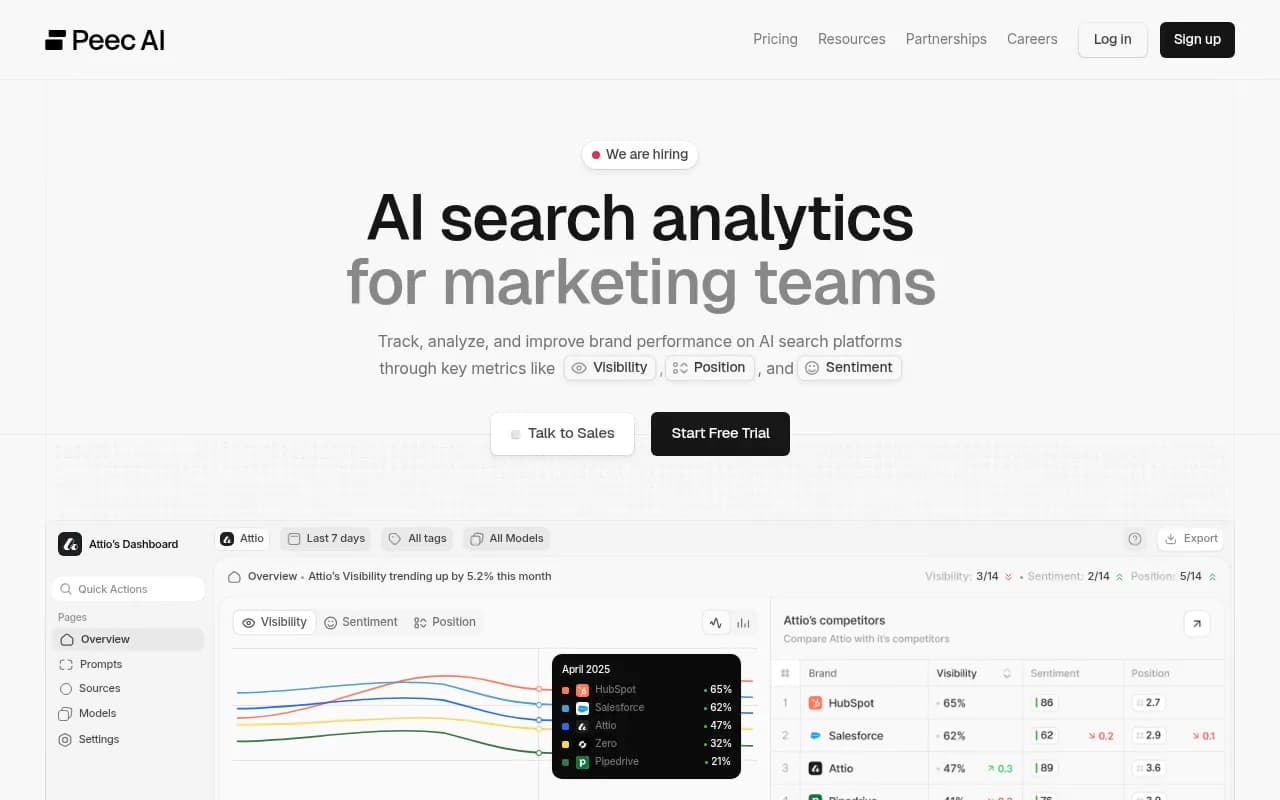
The accuracy limitations are real, though. Both rely primarily on API queries, refresh on the slower end of the spectrum, and have limited prompt customization. If you're in a niche market or tracking a specific regional audience, the data can be noticeably off.
SE Ranking sits in a similar position -- a capable all-in-one SEO platform that added AI visibility features, but where the AI tracking is secondary to the core product. The data is usable, but it's not the platform's main focus.
The prompt design problem
One accuracy issue that got less attention in 2025 than it deserved: most tools let you set up prompts, but few helped you figure out which prompts actually matter.
If you're tracking "best CRM software" but your customers are actually asking "what CRM should a 10-person sales team use," you're measuring the wrong thing. The visibility score you see is accurate for the prompt you set up -- it just doesn't reflect how your brand actually gets discovered.
Tools that addressed this in 2025 did it through prompt volume data and query fan-outs. The idea is that a single parent prompt branches into dozens of sub-queries, and understanding that structure helps you prioritize which prompts are worth tracking and which content gaps are worth filling.
Promptwatch built this into its Prompt Intelligence feature -- volume estimates, difficulty scores, and query fan-outs that show how one prompt branches into related sub-queries. A few other platforms offered basic volume estimates, but the fan-out analysis was rare.
AthenaHQ focused on prompt tracking across multiple AI engines with reasonable coverage, though it stayed in monitoring territory without the optimization layer.
Stale data and the "outdated mention" problem
A specific accuracy issue that came up repeatedly in 2025: tools surfacing citations that no longer existed.
AI models update their training data, change their citation behavior, and sometimes stop citing sources they previously favored. If an AEO tool cached a screenshot showing your brand cited in a Perplexity response, but that response had since changed, you'd be looking at a ghost.
The better platforms handled this by re-querying prompts frequently and flagging when citation patterns changed. Some, like Profound, built explicit "stale mention" detection into their workflow -- the idea being that you want to know when an AI model used to cite you but stopped, not just whether you're cited right now.
This is actually one of the more useful things an AEO tool can do: show you where you lost visibility, not just where you have it. Most monitoring-only dashboards don't surface this clearly.
Accuracy by AI model: not all engines are equal
Another dimension that affected accuracy in 2025: different AI models behave very differently, and tools that treated them as interchangeable produced misleading aggregate scores.
Google AI Overviews, for example, are heavily influenced by traditional SEO signals -- domain authority, structured data, E-E-A-T. A brand with strong traditional SEO tends to do well there. ChatGPT's citations are more influenced by what's in its training data and what gets crawled by its web browsing tool. Perplexity is more real-time and citation-heavy. Claude tends to be more conservative about citing specific brands.
A tool that averages your visibility across all these models into a single "AI visibility score" is obscuring more than it reveals. The better platforms break this down by model, which lets you understand why you're visible or invisible in each engine and what to do about it.
| AI engine | Primary citation driver | Update frequency | Key accuracy challenge |
|---|---|---|---|
| ChatGPT | Training data + web browsing | Model updates (irregular) | API vs. real UI divergence |
| Perplexity | Real-time web search | Near-real-time | High volatility, hard to cache |
| Google AI Overviews | Traditional SEO signals + Gemini | Daily | Personalization varies by user |
| Claude | Training data | Model updates (irregular) | Conservative citation behavior |
| Gemini | Google's index + training data | Frequent | Overlap with AI Overviews confuses tracking |
What to look for in an AEO tool in 2026
Based on what separated accurate platforms from inaccurate ones in 2025, here's what actually matters:
Query frequency. Ask the vendor directly: how often do you re-query each prompt? Daily is the minimum for competitive categories. Weekly is too slow.
Real UI vs. API only. If a tool only uses API calls, understand that you're seeing a proxy for user experience. For most brand tracking this is acceptable, but for shopping, local, or highly visual AI responses, it can miss important behavior.
Per-model breakdowns. Aggregate "AI visibility" scores hide more than they show. You want to see your performance broken down by ChatGPT, Perplexity, Gemini, Claude, and others separately.
Prompt customization and volume data. Fixed prompt libraries are a starting point, not a solution. You need to be able to track the prompts your actual customers use, and ideally understand which prompts have enough volume to be worth optimizing for.
Crawler and citation logs. The most transparent platforms show you which AI crawlers are visiting your site, which pages they're reading, and when those pages start getting cited. This closes the loop between your content and your visibility data.
Action layer. Monitoring tells you where you stand. Optimization tells you what to do about it. Tools that stop at the dashboard leave you with data but no path forward.
The monitoring-only trap
This is worth saying plainly: a lot of AEO tools in 2025 were dashboards dressed up as optimization platforms. They showed you a visibility score, maybe a competitor comparison, and left you to figure out the rest.
That's not nothing -- knowing you're invisible in Perplexity for a key prompt is useful information. But it doesn't tell you which pages to update, which content gaps to fill, or what angle to take to get cited.
The platforms that delivered the most value in 2025 were the ones that connected the monitoring data to an action: here's the gap, here's the content that would fill it, here's what happened after you published it.
Promptwatch built this as its core loop -- Answer Gap Analysis to find what competitors are cited for that you're not, Content Agents to generate content targeting those gaps, and page-level tracking to show what happened after publication. Most competitors stop at step one.
Profound has a similar philosophy with its Agents feature, though at a higher price point aimed at enterprise teams.
Scrunch AI and AthenaHQ both offer solid monitoring but have less developed optimization layers.
Bottom line
AEO tool accuracy in 2025 was genuinely uneven. The category was growing fast, funding was flowing in, and a lot of platforms launched with monitoring capabilities before they had the infrastructure to keep data fresh.
The platforms that got it right shared a few things: high query frequency, transparency about methodology, per-model breakdowns, and some path from data to action. The ones that fell short tended to cache data too long, aggregate across models in misleading ways, or rely entirely on API calls that didn't reflect real user experiences.
Heading into 2026, the category has matured enough that you can ask vendors direct questions about refresh cadence and data collection methodology and expect real answers. If a vendor can't tell you how often they re-query prompts or whether they monitor real UI behavior, that's a signal worth taking seriously.
The tools worth your time are the ones that treat accuracy as a feature, not an afterthought.