Key takeaways
- LinkedIn is the most-cited domain for professional queries across major AI search engines, according to Profound's research -- but only if your content is structured for AI consumption.
- Generic, opinion-heavy, or engagement-bait posts rarely get cited. Educational content with original data and clear expertise does.
- AI models don't just read your website. They read your LinkedIn articles, company pages, and employee posts -- and they reward credibility signals over virality.
- Most brands are making the same fixable mistakes: thin content, no author authority signals, missing context, and posting formats that AI crawlers can't parse.
- Tracking which LinkedIn content actually drives AI citations requires a dedicated tool -- not just LinkedIn analytics.
LinkedIn has quietly become one of the most powerful surfaces for AI visibility. Profound's research found it's the most-cited domain for professional queries across major AI search engines. That's a remarkable fact that most marketing teams are still sleeping on.
The implication is real: when someone asks ChatGPT "what's the best B2B marketing automation platform" or Perplexity "which companies are leading in sustainable logistics," the answers are often shaped by what's been published on LinkedIn. Not just your website. LinkedIn.
But here's the catch: not all LinkedIn content gets cited. In fact, most of it doesn't. AI models are selective. They're looking for specific signals -- credibility, depth, originality, structure -- and if your content doesn't have them, it gets ignored no matter how many likes it gets.
Below are the ten mistakes that are quietly keeping your brand out of AI-generated answers, and what to do about each one.
Mistake 1: Posting opinions instead of education
The most common LinkedIn content type -- "here's my hot take on X" -- is also the least likely to get cited by AI models.
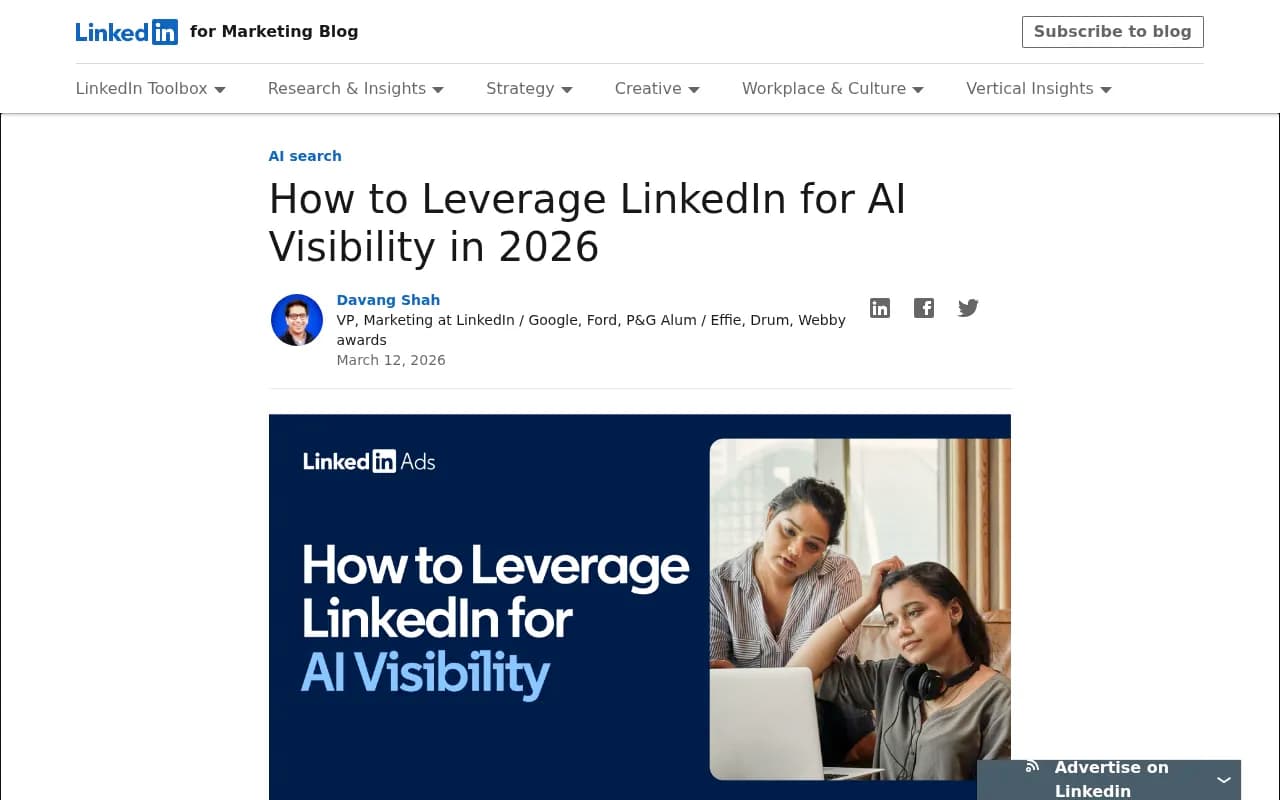
LinkedIn's own VP of Marketing, Davang Shah, put it plainly in a March 2026 post: AI models crave depth of information far more than opinion pieces or personal updates. Both LinkedIn's internal data and Semrush's external research point in the same direction. Educational content wins.
What does educational mean in this context? It means content that teaches something specific: a process, a framework, a data point, a comparison. "Why I think AI is changing marketing" is an opinion. "How we reduced our cost-per-lead by 34% using AI-generated content briefs" is education. One of those gets cited. The other gets scrolled past.
The fix is straightforward: before you post, ask whether someone could learn something concrete and actionable from it. If the answer is no, rewrite it.
Mistake 2: Ignoring author credibility signals
AI models don't just evaluate content in isolation. They evaluate who wrote it.
A post from a verified expert with a complete profile, a clear job title, years of consistent posting in a specific domain, and external mentions elsewhere carries more weight than the same post from a sparse profile with no history.
This is what LinkedIn calls "Buyability" -- the shift from visibility to credibility. AI models are making the same judgment call a human researcher would: is this person actually an expert, or are they just posting?
The practical implication: your company page alone isn't enough. You need employees, founders, and subject matter experts posting under their own names, with complete profiles, in a consistent niche. A VP of Product who posts regularly about product-led growth is a credibility signal. A company page that reposts press releases is not.
Mistake 3: Publishing thin content without original data
Short-form posts have their place on LinkedIn, but they rarely get cited by AI models. A 150-word post with a vague observation and three bullet points doesn't give an AI model much to work with.
What gets cited is content with substance: original research, proprietary data, case studies with specific numbers, or detailed breakdowns of a process. The more specific and verifiable the claim, the more useful it is to an AI model trying to answer a question accurately.
If you have internal data -- customer survey results, product usage stats, campaign performance benchmarks -- publish it on LinkedIn. Even a single original data point ("we analyzed 500 campaigns and found X") dramatically increases the chance of citation.
LinkedIn articles (the long-form format, not just posts) are particularly well-suited for this. They're indexed more thoroughly, they support more structure, and they signal that you're serious about the topic.
Mistake 4: Writing for the feed, not for the question
Most LinkedIn content is written to perform in the feed: hooks designed to stop the scroll, cliffhangers before "see more," engagement bait like "comment below." This is fine for reach, but it's the wrong frame for AI visibility.
AI models aren't scrolling a feed. They're answering questions. They're looking for content that directly addresses a specific query -- "what is X," "how does Y work," "what are the best Z for [use case]."
The fix is to write some of your LinkedIn content as direct answers to questions your audience is already asking. Think of it like FAQ content, but published as LinkedIn articles or posts. "What is generative engine optimization and why does it matter for B2B brands?" is a better frame for AI visibility than "5 thoughts on the future of search."
This doesn't mean every post needs to be a Wikipedia entry. But at least a portion of your LinkedIn publishing calendar should be explicitly structured around answering real questions.
Mistake 5: Posting inconsistently and letting content go stale
AI models weight freshness. Content from 2022 about a rapidly evolving topic carries less authority than content from last month. And a LinkedIn presence that went quiet for six months sends a signal that the account -- and the brand -- may not be actively engaged in the space.
Jasmin Alić, one of LinkedIn's most-followed content strategists, noted in a widely-shared post that the lifespan of LinkedIn posts has changed significantly. The platform now rewards consistent, sustained publishing over sporadic bursts.
For AI visibility purposes, consistency matters for two reasons. First, it builds a body of work that AI models can draw on when constructing answers. Second, it signals ongoing expertise -- that this person or brand is actively engaged in the topic, not just someone who wrote one good article three years ago.
A realistic cadence for most teams: two to three posts per week from key individuals, plus one longer-form article per month. That's enough to maintain presence without burning out.
Mistake 6: Keeping everything behind a login or restricted visibility
This one is easy to overlook. LinkedIn has various visibility settings, and some content -- particularly in groups or with restricted sharing settings -- isn't publicly accessible to AI crawlers.
If AI models can't read your content, they can't cite it. It's that simple.
Make sure your LinkedIn articles and posts are set to public visibility. Check that your company page is fully public. If you're publishing thought leadership content that you want AI models to pick up, it needs to be accessible without a login.
This also applies to PDF documents, slide decks, and other file formats shared on LinkedIn. These are often not parsed by AI crawlers at all. If the content matters, republish it as text in an article or post.
Mistake 7: Ignoring entity consistency across your brand
AI models build a mental model of your brand based on signals across the web. Your LinkedIn presence is one input, but it needs to be consistent with what's on your website, in press coverage, in third-party mentions, and in other social profiles.
If your LinkedIn company page describes you as a "B2B SaaS platform for supply chain teams" but your website says "enterprise logistics software" and your Crunchbase profile says "supply chain technology company," you've created ambiguity. AI models struggle with ambiguous entities. They may cite a competitor who has cleaner, more consistent entity signals instead.
Audit your brand description, category, and key claims across every platform where you have a presence. They don't need to be word-for-word identical, but they should be consistent in the core facts: what you do, who you serve, and what makes you different.
Mistake 8: Relying on company posts instead of personal authority
Company pages on LinkedIn have their place, but they're not where AI citations come from most often. Personal profiles from credible individuals carry more weight.
This is uncomfortable for some marketing teams because it means the brand's AI visibility is partly dependent on individual employees -- people who might leave, who have their own opinions, who don't always stay on message. But that's the reality of how AI models evaluate credibility.
The solution isn't to abandon company pages, but to invest in building genuine thought leadership from real people. That means giving your subject matter experts time to write, helping them develop a consistent publishing cadence, and treating their LinkedIn presence as a brand asset.
A useful frame: your company page is the official record. Individual employee posts are the credibility signals. You need both.
Mistake 9: Not linking LinkedIn content back to authoritative sources
AI models are more likely to cite content that itself cites credible sources. A LinkedIn article that references original research, links to a peer-reviewed study, or quotes a named expert is more trustworthy than one that makes claims without any backing.
This doesn't mean every post needs footnotes. But your longer-form LinkedIn articles should include links to the sources behind your claims. If you're citing a statistic, link to where it came from. If you're referencing a trend, name the report.
There's a secondary benefit here: linking to your own website's authoritative content creates a signal that connects your LinkedIn presence to your domain. When AI models encounter your LinkedIn article and follow the link to a well-structured page on your site, that reinforces the entity relationship between your LinkedIn profile and your brand.
Mistake 10: Measuring LinkedIn success only by engagement metrics
This is the meta-mistake that enables all the others. If you're optimizing LinkedIn for likes, comments, and follower growth, you'll naturally gravitate toward content that performs well in those metrics -- which is often the opinion-heavy, engagement-bait content that AI models ignore.
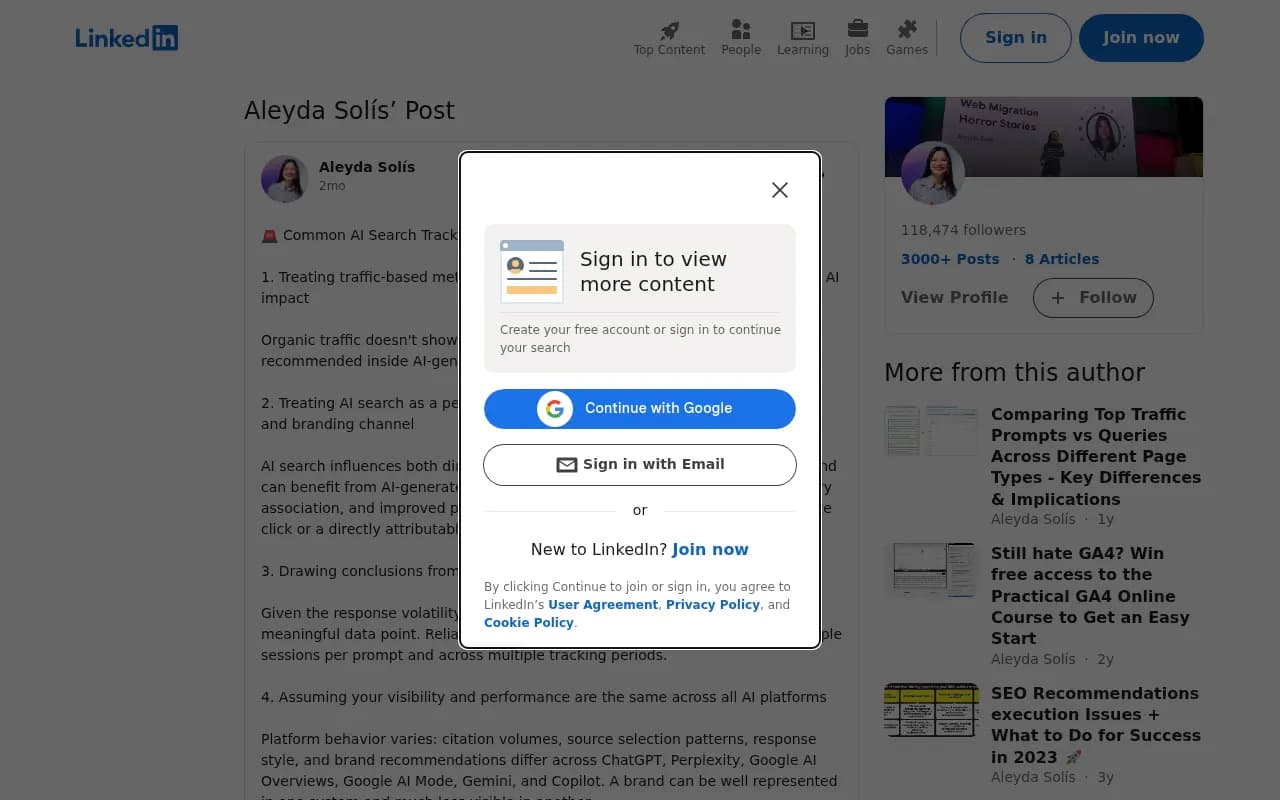
Aleyda Solís flagged a version of this problem in a widely-shared LinkedIn post: treating traffic-based metrics as a proxy for AI visibility is a fundamental tracking mistake. The same logic applies to engagement metrics. A post with 500 reactions might have zero AI citation value. A detailed article with 40 reactions might be cited in thousands of AI responses.
The fix is to track AI visibility separately. Tools like Promptwatch can show you which of your pages and content pieces are actually being cited by AI models like ChatGPT, Perplexity, and Gemini -- and which prompts your competitors are winning that you're not. That data should inform your LinkedIn content strategy, not just your engagement numbers.

How these mistakes compound
None of these mistakes is fatal on its own. The problem is that they compound. A brand that posts inconsistently, relies on company-page reposts, writes opinion-heavy content, and measures only engagement is essentially invisible to AI models -- even if they have a large LinkedIn following.
The good news is that the fixes are mostly about content strategy, not technical complexity. You don't need a developer to write better LinkedIn articles. You need a clearer understanding of what AI models are actually looking for.
Here's a quick reference for the mistakes and their fixes:
| Mistake | Why it hurts AI visibility | Fix |
|---|---|---|
| Opinions over education | AI models cite answers, not takes | Write content that teaches something specific |
| Weak author signals | AI evaluates credibility of the source | Build complete profiles with consistent expertise |
| Thin content, no data | Not enough substance to cite | Include original data, case studies, specific numbers |
| Writing for the feed | AI answers questions, not feeds | Structure some content as direct question answers |
| Inconsistent posting | Freshness and consistency matter | Maintain a realistic, sustained cadence |
| Restricted visibility | AI can't cite what it can't read | Set all thought leadership content to public |
| Inconsistent entity signals | Ambiguous brands get skipped | Audit and align brand descriptions across platforms |
| Company-only publishing | Personal authority outweighs brand pages | Invest in individual thought leadership |
| No source citations | Uncited claims carry less weight | Link to sources in longer-form articles |
| Measuring only engagement | Wrong metric drives wrong content | Track AI citations separately from social metrics |
What good LinkedIn content for AI visibility actually looks like
To make this concrete: imagine a VP of Operations at a logistics company who publishes a LinkedIn article titled "How we cut warehouse error rates by 22% using AI-assisted picking systems." The article includes the specific number, explains the process in detail, names the tools used, links to the vendor's research, and is written under a complete profile with 8 years of operations experience.
That article checks almost every box: educational, data-backed, authored by a credible expert, publicly accessible, linked to authoritative sources, and answering a specific question that buyers in that space are asking.
Compare that to a company page post that says "Excited to announce our new AI integration! The future of logistics is here." Zero citation value.
The difference isn't effort -- it's intent. One piece of content was written to demonstrate expertise. The other was written to announce something. AI models reward the former.
Tracking what's actually working
The hardest part of this is measurement. LinkedIn's native analytics tell you about reach and engagement. They don't tell you whether your content is being cited by AI models.
For that, you need a dedicated AI visibility platform. Promptwatch tracks citations across ChatGPT, Perplexity, Gemini, Claude, and seven other AI models -- including page-level data that shows exactly which content pieces are being cited and how often. Its Answer Gap Analysis can show you which prompts your competitors are winning that you're not, which is exactly the kind of data you need to prioritize your LinkedIn content calendar.
There are other tools worth knowing about in this space too:



The key is to stop treating LinkedIn as a social media channel and start treating it as a content surface that feeds AI models. The brands that figure this out first will have a significant advantage -- not because they gamed an algorithm, but because they actually published content worth citing.