Key takeaways
- Most AI visibility tools stop at monitoring -- they show you where you're invisible but don't help you do anything about it. Actionability is the real differentiator in 2026.
- Promptwatch is the only platform in this comparison rated as a "Leader" across all categories in a 2026 benchmark of 12 GEO platforms, largely because it closes the loop from gap detection to content creation to result tracking.
- Nightwatch is a solid choice if you're already using it for traditional SEO rank tracking and want to add basic AI monitoring without switching tools.
- Gauge focuses on competitive intelligence and strategic positioning -- useful for research-heavy teams, but light on optimization features.
- Searchable offers a middle ground with monitoring plus some content tools, but falls short of Promptwatch's depth on crawler logs, prompt intelligence, and content generation.
Picking an AI visibility platform in 2026 is harder than it should be. The category has exploded -- there are now well over 20 tools claiming to track your brand across ChatGPT, Perplexity, Gemini, and the rest. Most of them do roughly the same thing: run your prompts, count how often your brand appears, show you a share-of-voice chart.
That's fine. But it's not enough.
The question that actually matters for a marketing or SEO team isn't "how visible are we?" It's "what do we do about it?" This comparison focuses on four platforms that sit in the mid-market sweet spot -- not enterprise-only, not bare-bones -- and ranks them specifically on actionability: how far each tool goes from showing you data to helping you change it.
The four platforms: Promptwatch, Searchable, Nightwatch, and Gauge.
What "actionability" means in this context
Before getting into the tools, it's worth being precise about what we mean by actionable. A monitoring dashboard that shows your brand mention rate is useful. But actionability means:
- Identifying specific gaps -- which prompts your competitors rank for that you don't
- Telling you why -- what content or citations are driving their visibility
- Helping you create content that closes those gaps
- Tracking whether that content actually moved the needle
A tool that does steps 1-4 is an optimization platform. A tool that only does step 1 is a tracker. Most tools in this space are trackers. That distinction is the core of this comparison.
The four platforms at a glance
| Feature | Promptwatch | Searchable | Nightwatch | Gauge |
|---|---|---|---|---|
| AI models tracked | 10+ | Up to 7 | 4 | ~5 |
| Starting price | $99/mo | $50/mo | $32/mo + $99 AI add-on | Custom |
| Content gap analysis | Yes (deep) | Basic | No | No |
| AI content generation | Yes | Limited | No | No |
| Crawler / agent logs | Yes | No | No | No |
| Prompt volume & difficulty | Yes | No | No | No |
| Reddit & YouTube tracking | Yes | No | No | No |
| ChatGPT Shopping tracking | Yes | No | No | No |
| Traffic attribution | Yes | No | No | No |
| Competitor heatmaps | Yes | Partial | No | Yes |
| Best for | Full GEO optimization | Monitor + light content | SEO teams adding AI | Strategic competitive research |
Promptwatch
Promptwatch is the most complete platform in this comparison, and it's not particularly close. Where the others are primarily monitoring tools, Promptwatch is built around a three-step loop: find the gaps, create content that fills them, track the results.

The gap analysis is genuinely useful. Promptwatch's Answer Gap Analysis shows you the specific prompts your competitors are appearing for that you aren't -- not just "you're missing coverage in category X" but the actual questions, with prompt volume estimates and difficulty scores attached. That means you can prioritize. You're not guessing which gaps are worth closing; you're working from data on which prompts get asked most and which ones are actually winnable.
The content generation side is where Promptwatch separates itself most clearly from the field. Content Agents generate articles, comparisons, and listicles grounded in real prompt data and citation analysis -- not generic SEO filler. The briefs pull in brand guidance, competitor analysis, search results, and screenshots. The output is content engineered to answer the specific gaps AI models are already exposing.
A few capabilities that are easy to overlook but genuinely matter:
- AI Crawler Logs show you in real time which pages ChatGPT, Claude, Perplexity, and others are crawling, how often, and what errors they're hitting. Most competitors don't have this at all. It's the difference between wondering why a page isn't getting cited and actually diagnosing the problem.
- Query fan-outs show how a single prompt branches into sub-queries. This is important because AI engines don't just answer the literal question -- they expand it. Knowing the fan-out helps you build content that covers the full answer space.
- Traffic attribution connects AI visibility to actual revenue, which is the metric most marketing teams ultimately need to justify the investment.
Promptwatch monitors 10 AI models: ChatGPT, Perplexity, Google AI Overviews, Google AI Mode, Claude, Gemini, Meta/Llama, DeepSeek, Grok, and Mistral. It also tracks Reddit threads and YouTube videos that influence AI recommendations -- a channel most platforms ignore entirely.
Pricing: Essential at $99/mo (1 site, 50 prompts, 5 articles), Professional at $249/mo (2 sites, 150 prompts, 15 articles, crawler logs), Business at $579/mo (5 sites, 350 prompts, 30 articles). Free trial available.
The honest caveat: Promptwatch is more complex than the other tools here. There's more to configure, more data to interpret. Teams that just want a quick dashboard showing brand mention rate might find it more than they need. But for any team serious about actually improving their AI visibility -- not just measuring it -- the depth is the point.
Searchable
Searchable sits at the more accessible end of the mid-market. At $50/mo entry pricing and coverage of up to 7 AI models, it's positioned as a monitor-plus-create tool that doesn't require a large budget or a dedicated GEO specialist to operate.
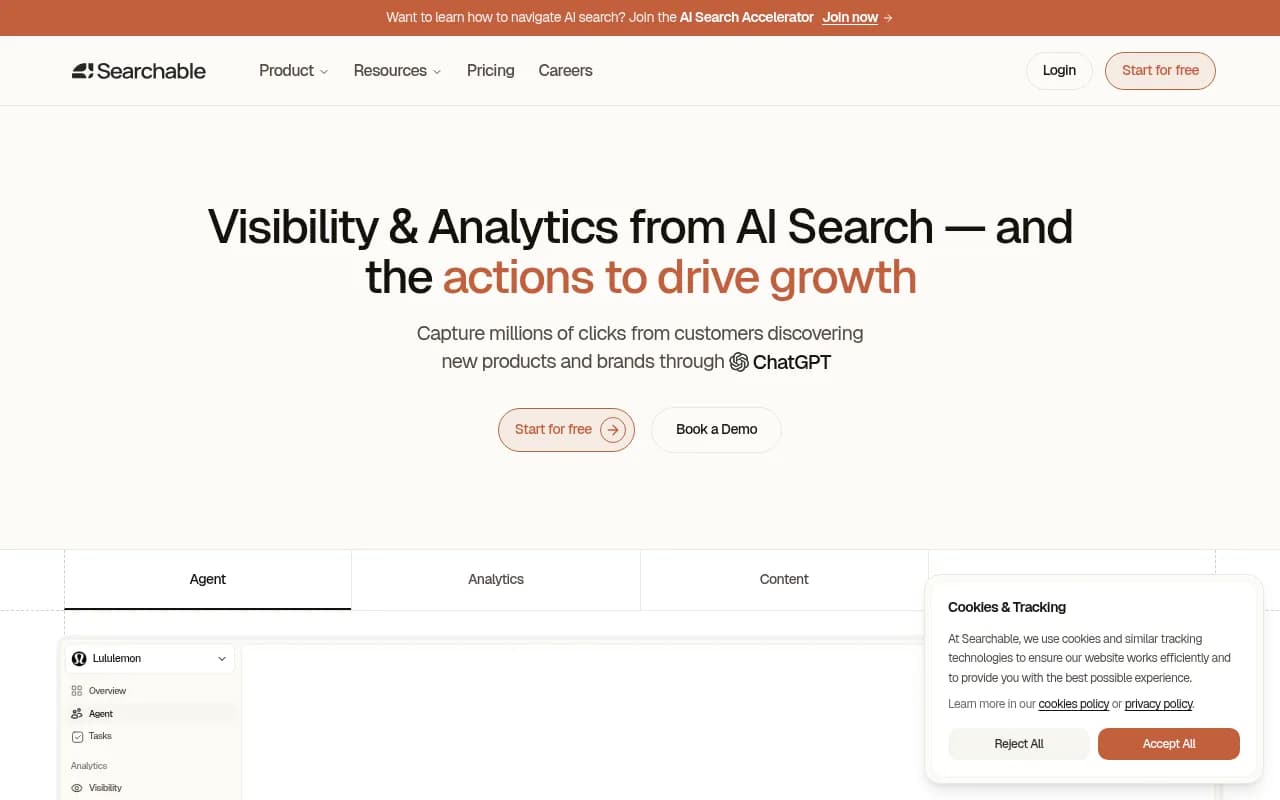
The monitoring side is solid. You get brand mention tracking, share of voice across AI engines, and basic competitor comparisons. The interface is clean and the onboarding is faster than Promptwatch's. For a small marketing team that needs to show stakeholders "here's how we're doing in AI search," Searchable gets you there quickly.
Where Searchable falls short is depth. The content tools are limited compared to Promptwatch -- you can get content suggestions, but there's no prompt volume data, no difficulty scoring, no crawler logs, and no traffic attribution. You can see that you're missing visibility for certain topics, but the path from "we're missing this" to "here's the content that will fix it, here's how to prioritize it, and here's proof it worked" is much less developed.
Searchable also doesn't track Reddit or YouTube, which matters more than it might seem. A significant portion of AI citations come from third-party sources -- forum threads, video transcripts, review sites -- and if you're not monitoring those, you're missing part of the picture.
Best fit: Teams that want to move beyond pure monitoring without committing to the complexity or cost of a full GEO platform. Good for early-stage AI visibility programs where the priority is establishing a baseline and getting some content wins.
Nightwatch
Nightwatch is primarily an SEO rank tracking tool that added AI search monitoring as a feature. That context matters for understanding both its strengths and its limits.
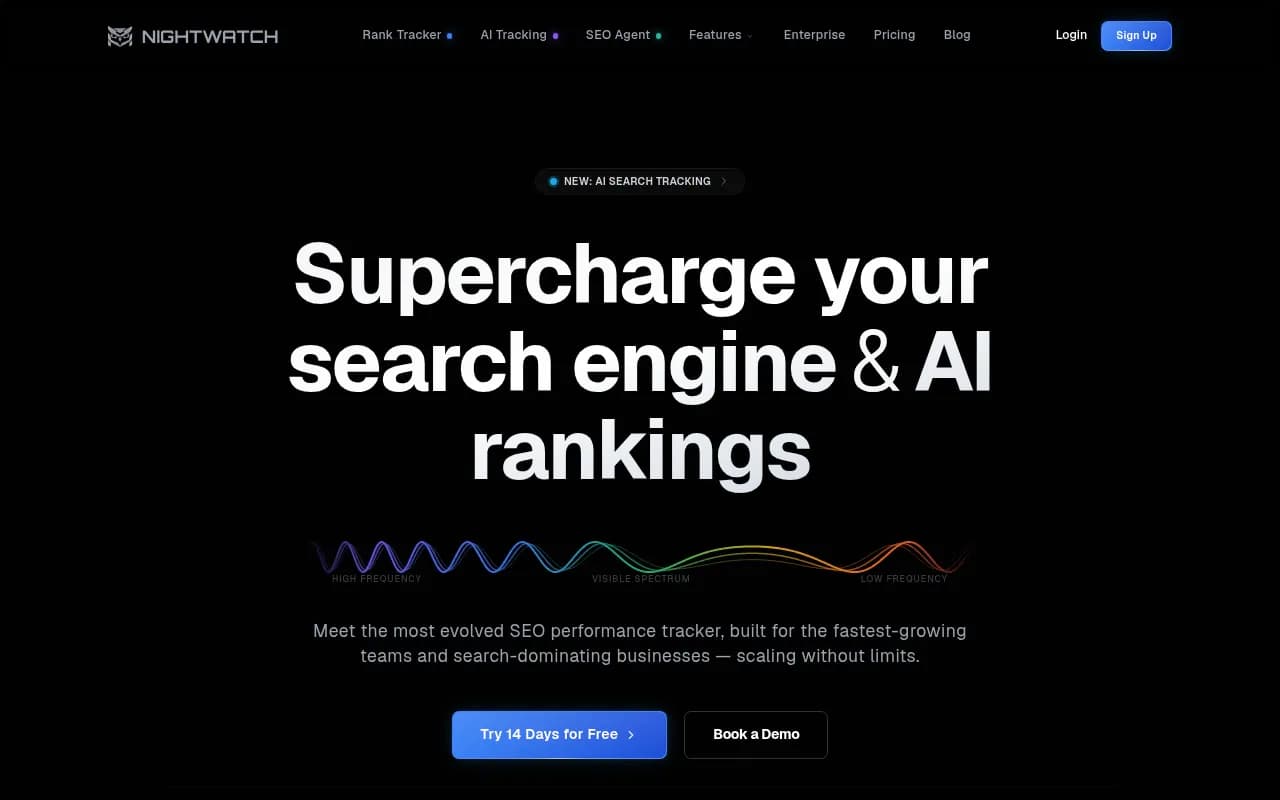
The base Nightwatch plan starts at $32/mo, but AI monitoring requires an additional $99/mo add-on. So you're looking at $131/mo minimum for the combined product -- more than Searchable, less than Promptwatch's Professional tier. The AI coverage is limited to 4 models, which is the smallest footprint in this comparison.
What Nightwatch does well is integration. If you're already using it for traditional rank tracking, adding AI monitoring means you're working in one dashboard instead of two. The reporting is clean, the data is reliable, and the learning curve is minimal for existing users. For an SEO team that wants to start tracking AI visibility without overhauling their stack, this is a reasonable path.
What Nightwatch doesn't do: content gap analysis, content generation, crawler logs, prompt intelligence, or traffic attribution. It's a monitoring tool, full stop. You'll see your brand mention rate across 4 AI engines and some competitive context, but the tool won't tell you what to do about what it finds.
There's also a coverage gap worth noting. Four AI models in 2026 -- when ChatGPT, Perplexity, Gemini, Claude, Grok, DeepSeek, and Copilot are all meaningfully used by different buyer segments -- means you're getting a partial picture. Missing DeepSeek or Grok might not matter for every brand, but for B2B or tech-adjacent audiences, it's a real blind spot.
Best fit: SEO teams already on Nightwatch who want to add AI monitoring as a supplementary signal without switching platforms. Not the right choice if AI visibility is a primary focus.
Gauge
Gauge takes a different angle than the other three. It's built around competitive intelligence -- understanding how your brand and your competitors are positioned in AI responses, what narratives are forming, and where strategic gaps exist.
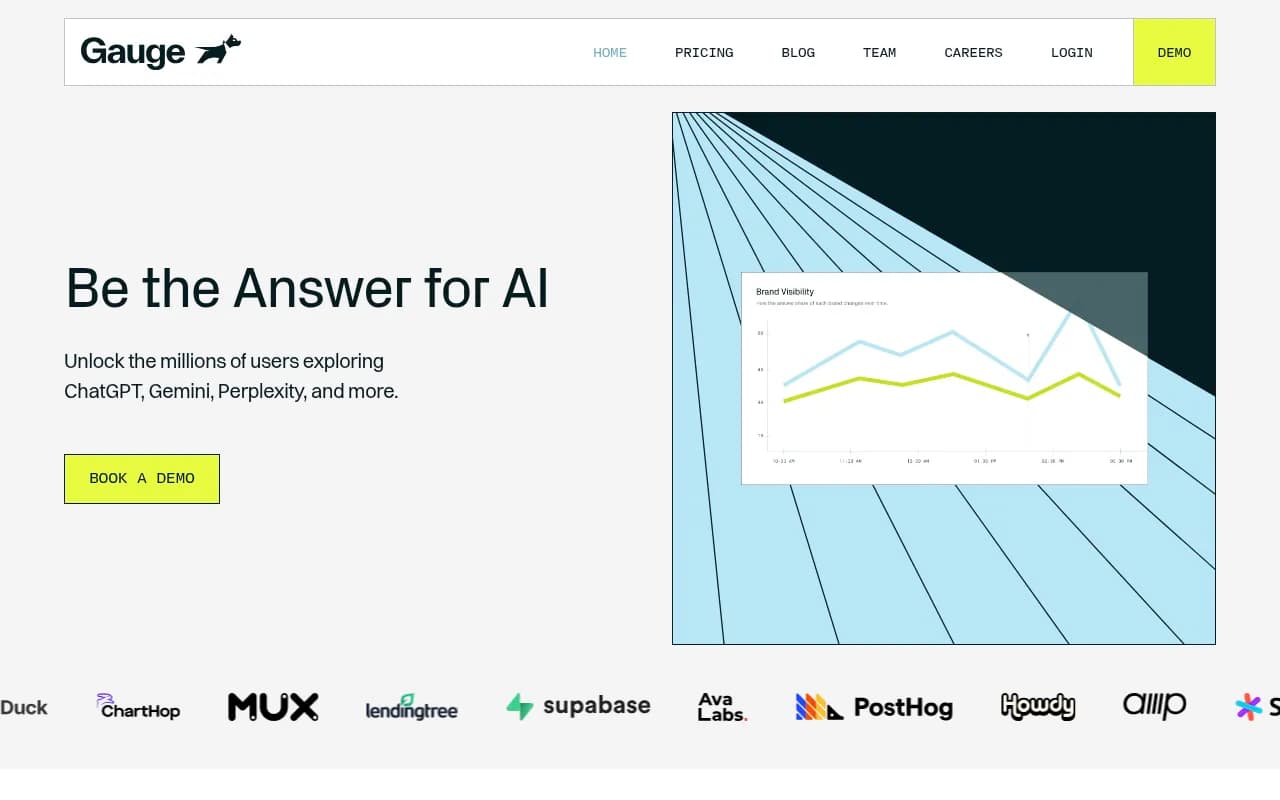
The competitive heatmaps are genuinely good. Gauge lets you see, across multiple AI engines and prompt categories, who's winning and by how much. For strategy teams or agencies doing quarterly competitive reviews, this kind of visualization is useful. It answers "where are we vs. them" more clearly than most tools.
The limitation is that Gauge is primarily an intelligence and research tool. It doesn't generate content, doesn't provide crawler logs, doesn't score prompts by volume or difficulty, and doesn't track traffic attribution. It tells you what's happening in the competitive landscape -- it doesn't help you change it.
Pricing is custom, which typically signals enterprise or agency positioning. That's a mismatch for mid-market teams who need both insight and action from a single tool.
Best fit: Strategy teams, consultants, or agencies that need to present competitive AI visibility analysis to clients or leadership. Less useful as an operational tool for teams actively trying to improve their rankings.
How to choose
The right tool depends on what you're actually trying to accomplish.
If you want to understand the competitive landscape and present findings to stakeholders, Gauge does that well. If you're an SEO team already on Nightwatch and want to add a basic AI signal without disrupting your workflow, the Nightwatch AI add-on is a reasonable incremental step. If you're starting an AI visibility program and want monitoring plus some content capability without a large budget, Searchable is a fair starting point.
But if the goal is to actually improve your AI visibility -- to find the specific gaps, create content that fills them, and prove the results -- Promptwatch is the only tool in this comparison built to do all of that. The crawler logs alone are a capability most competitors don't offer. The prompt volume and difficulty scoring means you're prioritizing intelligently. The content generation is grounded in real citation data, not generic SEO logic.
The broader pattern in this category is that most tools were built to monitor first and optimize later (or never). Promptwatch was built the other way around -- the monitoring exists to feed the optimization loop, not as the end goal.
That's the real differentiator in 2026. Data without action is just a dashboard.
Quick reference: who should use what
| If you are... | Best choice |
|---|---|
| A marketing team serious about GEO optimization | Promptwatch |
| An SEO team already using Nightwatch | Nightwatch AI add-on |
| A small team starting an AI visibility program | Searchable |
| A strategy team or agency doing competitive research | Gauge |
| An agency managing multiple brands with full optimization needs | Promptwatch (Business or Agency tier) |
Other tools worth knowing
This comparison focused on four platforms, but the mid-market AI visibility space has more options worth a look depending on your specific needs.

Otterly.AI is one of the most affordable entry points in the category at $29/mo, though it's monitoring-only with no content generation or crawler logs.

Peec AI offers flexible model selection and multi-language support, which matters for brands operating across markets.
Scrunch AI covers broad AI engine monitoring with clean reporting, though several reviews note it's stronger at showing what's happening than prescribing what to do next.

Profound is worth considering at the enterprise end -- strong on prompt research and governance, higher price point, no Reddit tracking.
The category is moving fast. Tools that were monitoring-only six months ago are adding optimization features. The gap between trackers and optimization platforms is narrowing, but it hasn't closed. For now, the actionability gap between Promptwatch and the rest of this comparison is real and meaningful.