Key takeaways
- AI search engines don't just retrieve content -- they filter it. Being indexed is not the same as being cited.
- Citation decisions are driven by three core signals: earned authority, entity clarity, and content usability as a reference.
- Organic CTR drops 61% when a Google AI Overview appears -- but jumps 35% above baseline when your brand is inside that overview.
- Technical accessibility matters as much as content quality. If AI crawlers can't read your pages, they won't cite them.
- Tracking which prompts trigger citations (and which don't) is now a core part of any serious search strategy.
For most of the internet's history, search worked the same way: you typed a query, got a list of links, and decided for yourself what to trust. Search engines organized information. You synthesized it.
That mental model still shapes how a lot of teams think about SEO. It's also increasingly wrong.
AI search engines -- ChatGPT, Perplexity, Google AI Overviews, Claude, Gemini -- don't hand you a list and step back. They read sources, synthesize an answer, and pick a handful of references to surface. The work of comparison and judgment has moved from the user to the model.
Which means the question isn't just "can Google find my page?" anymore. It's "would an AI model trust my page enough to cite it?"
Those are very different questions.
What's actually changed (and what hasn't)
AI systems haven't replaced traditional search indexing. They've added a layer on top of it -- a filtering and interpretation step that decides which sources are suitable to represent an answer.
Traditional search rewarded findability. AI search rewards referenceability.
The numbers make this concrete. According to data cited by Frase.io, organic CTR has dropped 61% for queries where a Google AI Overview appears. But when your brand is cited inside that overview, CTR runs 35% higher than traditional organic results. The stakes of being included versus excluded have never been higher.
AI-referred sessions jumped 527% between January and May 2025. ChatGPT alone processes an estimated 1 billion queries per day. These aren't edge cases -- they're the new mainstream of search behavior.
The three signals that drive citation decisions
Research from AuthorityTech identifies three factors that consistently predict whether AI systems will cite a source: earned authority, entity clarity, and citation architecture. These aren't arbitrary -- they map directly to what AI models need to generate reliable answers.
Earned authority
AI systems cross-reference claims against other trusted sources to validate credibility. This isn't just about backlinks (though those still matter). It's about whether your content appears to belong to a coherent, ongoing conversation in your field.
A page that contradicts established understanding without strong evidence will get filtered out. A page that aligns with -- and adds to -- what other trusted sources say will get cited.
Brand search volume is a surprisingly strong signal here. When people actively search for your brand name, it signals to AI systems that your entity has real-world recognition. This is one reason why PR, thought leadership, and brand-building work feeds directly into AI visibility, even though it feels disconnected from traditional SEO.
Entity clarity
AI models need to know who you are before they'll cite you. This sounds obvious, but a lot of websites fail this test.
Entity clarity means your brand, its products, its expertise, and its relationship to your industry are unambiguous -- both on your site and across the web. Inconsistent naming, vague "about" pages, and missing structured data all create confusion that makes AI models less likely to cite you.
Specific things that help:
- A clear, consistent brand name used the same way across your site, social profiles, Wikipedia (if applicable), and third-party mentions
- Structured data markup (Schema.org) that explicitly defines what your organization does
- Author pages with real credentials, not just a name
- Clear topical focus -- sites that cover everything tend to be cited for nothing
Citation architecture
This is about whether your content functions well as a reference. AI models need to be able to extract a clear, accurate answer from your page without heavy reinterpretation.
Content that works as a citation tends to:
- Answer a specific question directly and early
- Be summarizable without changing its meaning
- Avoid heavy promotional framing (AI systems favor clarity over persuasion)
- Fit into a broader body of knowledge rather than standing alone
A page optimized purely for conversion -- with vague claims, no specifics, and a lot of "contact us to learn more" -- is almost impossible for an AI to cite usefully.
Content formats AI models actually prefer
There's no magic template, but certain formats consistently meet the bar for citability.
Explanatory and educational content aligns naturally with what AI models do. Concept overviews, industry explainers, how-things-work guides -- these are the formats AI systems were built to synthesize. If your content explains what something is, why it matters, or how it works, it's in the right territory.
Specific, data-backed claims are highly citable. A page that says "our solution improves efficiency" is useless to an AI model. A page that says "companies using X approach reduced onboarding time by 40% in a 2024 study" gives the model something concrete to reference.
Structured, single-topic pages outperform sprawling content that tries to cover everything. AI models cite specific answers to specific questions. A page that thoroughly addresses one topic is more useful than a page that shallowly covers ten.
FAQ sections and direct question-answer formats map well to how AI models process queries. If someone asks "what is [X]?" and your page has a clear, direct answer to that exact question, you're a natural citation candidate.
Technical accessibility: the often-ignored factor
Content quality matters, but it's irrelevant if AI crawlers can't read your pages. This is an area where a lot of sites have silent problems they don't know about.
Key technical factors:
- Crawlability: Your
robots.txtand meta tags shouldn't block AI crawlers. Some sites accidentally block GPTBot, ClaudeBot, or PerplexityBot while trying to manage other crawler traffic. - Page speed: Slow pages get crawled less frequently and less completely.
- Clean HTML structure: AI crawlers struggle with JavaScript-heavy pages that require rendering to access content. If your key content only appears after JS execution, some crawlers may miss it.
- Structured data: Schema markup for articles, FAQs, how-tos, and organizations helps AI systems understand context and relationships.
One underrated resource here: AI crawler logs. Knowing which pages AI crawlers are actually visiting, how often, and whether they're encountering errors tells you a lot about where your technical accessibility gaps are.
Promptwatch provides real-time AI crawler logs that show exactly which pages ChatGPT, Claude, Perplexity, and other AI crawlers are hitting -- and which errors they're running into. Most teams have no visibility into this at all.

Where AI models actually find sources to cite
Understanding the mechanics of how AI models select sources helps you prioritize where to focus.
AI systems don't just crawl your website in isolation. They consider:
- Your own site's content -- pages that are crawlable, authoritative, and clearly relevant to the query
- Third-party mentions -- listicles, review sites, industry publications, and directories that reference your brand
- Community content -- Reddit discussions, YouTube videos, and forum threads that AI models weight heavily as signals of real-world credibility
- Structured knowledge sources -- Wikipedia, Wikidata, and similar sources that help AI models resolve entity information
This means your AI visibility strategy can't be limited to your own website. A brand that's well-represented in third-party sources -- cited in industry roundups, mentioned in relevant Reddit threads, featured in YouTube reviews -- has a structural advantage over a brand that only optimizes its own pages.
Conductor's 7-month analysis of AI citation patterns found that "AI engines cite sources that look like the sources they already trust." Before scaling content production, they recommend auditing the top-cited domains in your space to understand what those sources have in common.
How to identify the gaps in your current AI visibility
Most teams don't know which prompts they're being cited for, which prompts their competitors are winning, or what content is missing from their site that AI models are actively looking for.
This is the core problem with treating AI visibility as a passive outcome. You can't optimize what you can't see.
The practical approach:
- Map the prompts that matter to your business -- not just branded queries, but the category-level questions your customers ask before they even know your name exists
- Check which of those prompts currently cite you -- and which cite competitors instead
- Identify content gaps -- specific topics and questions that AI models want to answer but can't find on your site
- Create content that addresses those gaps -- not generic SEO filler, but content engineered around the specific questions AI models are already exposing
Tools worth knowing about
The GEO tracking space has grown fast. Here's a quick comparison of the main approaches:
| Tool | Monitoring | Content gaps | Content generation | Crawler logs | Best for |
|---|---|---|---|---|---|
| Promptwatch | Yes | Yes | Yes | Yes | Full-cycle GEO optimization |
| Profound | Yes | Partial | No | No | Enterprise monitoring |
| Otterly.AI | Yes | No | No | No | Basic tracking |
| Peec AI | Yes | No | No | No | Multi-language monitoring |
| AthenaHQ | Yes | No | No | No | Monitoring-focused teams |
| Frase | Yes | Yes | Yes | No | Content-focused teams |
| Conductor | Yes | Partial | No | No | Agency and enterprise |
A few tools worth exploring depending on your situation:
If you're just starting to track AI visibility and want something lightweight, Otterly.AI and Peec AI are accessible entry points.


For deeper competitive analysis and prompt-level tracking, Profound and AthenaHQ offer more structured monitoring.


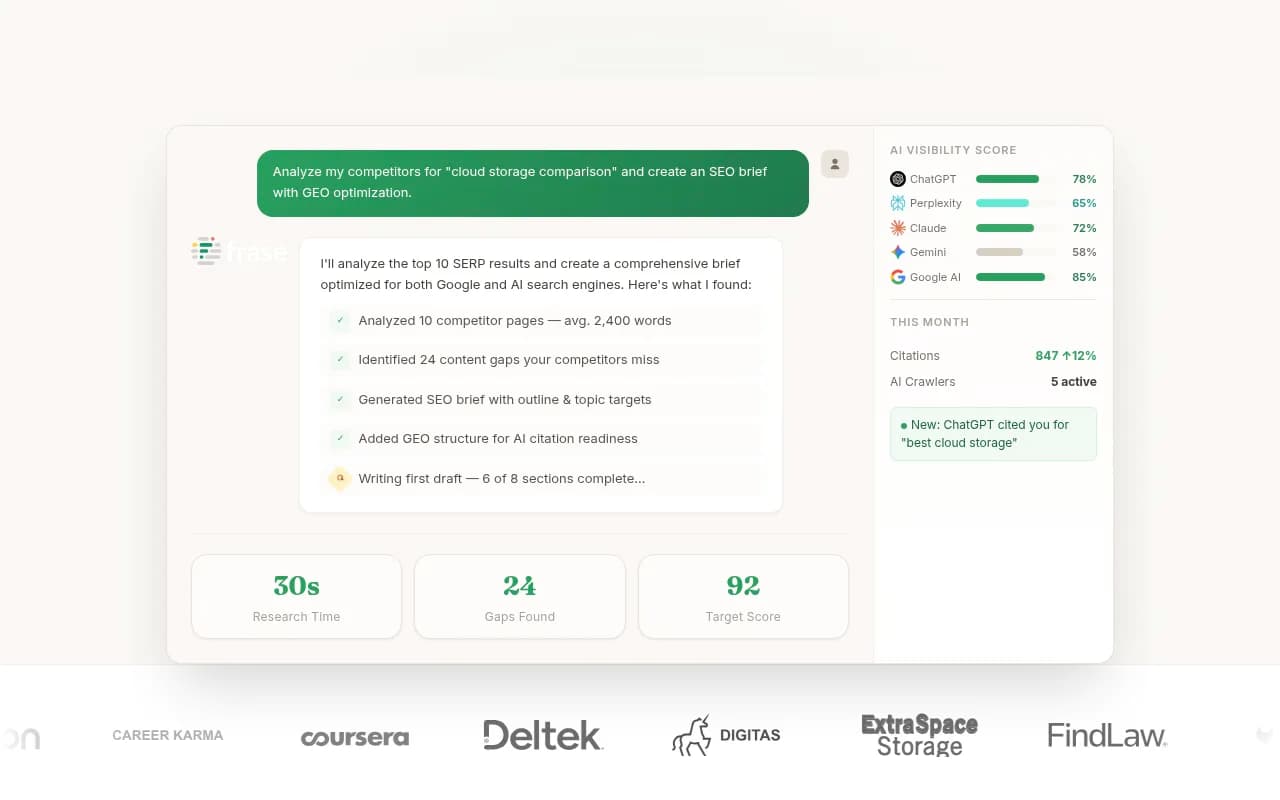
Frase is worth looking at if content creation is your main bottleneck -- it combines GEO research with content generation.
Conductor has done solid published research on AI citation patterns and is a reasonable option for larger teams.
For teams that want to go beyond monitoring into actual optimization -- finding gaps, generating content to fill them, and tracking the results -- Promptwatch covers the full cycle, including the crawler logs that most platforms don't offer.
A practical starting point
If you're trying to improve AI citation rates and don't know where to begin, here's a reasonable sequence:
Week 1: Audit your current state
- Check which AI models are crawling your site and which pages they're visiting (crawler logs or server logs)
- Run your key category prompts in ChatGPT, Perplexity, and Google AI Overviews -- note who gets cited and who doesn't
- Identify your top 10-20 target prompts
Week 2-3: Fix the technical foundations
- Verify AI crawlers aren't blocked in robots.txt
- Add or improve Schema markup for your key page types
- Ensure your most important pages load fast and have clean, accessible HTML
Week 4+: Content gap work
- For each target prompt where you're not cited, identify what the cited sources have that you don't
- Create or update content to directly answer those questions with specific, citable claims
- Build out entity clarity -- consistent brand information, author credentials, structured data
The cycle doesn't end there. AI models update their training data and retrieval behavior continuously. What gets cited today may shift next month. Ongoing tracking is the only way to know whether your content changes are actually moving the needle.
The underlying logic
It's worth stepping back to understand why AI models behave this way. They're not trying to reward SEO effort. They're trying to generate accurate, reliable answers that users will trust.
That means they favor sources that are:
- Specific enough to be useful
- Consistent with established knowledge
- Technically accessible to their crawlers
- Recognized as credible by other sources
The good news is that these criteria align pretty well with what makes content genuinely useful to humans. The brands that will win in AI search are mostly the ones building real expertise and communicating it clearly -- not the ones gaming signals.
The bad news is that "build real expertise" is a slow process, and most teams need to show results faster than that. The practical shortcut is to audit the specific gaps AI models are exposing right now and fill them with targeted, well-structured content. That's a much faster path to citation than waiting for general domain authority to accumulate.
Either way, the first step is the same: you need to know where you stand before you can improve it.