Key takeaways
- AIClicks is a purpose-built AI search visibility tracker you pay for directly, starting at $59/mo. Amplitude's AI Visibility is a free module bundled inside a much larger (and much pricier) product analytics platform.
- AIClicks tracks more AI engines on paper (11, including ChatGPT, Gemini, Perplexity, Claude, Copilot, Grok, Meta, DeepSeek, Mistral), though Starter plan users only get 3 of them active at once. Amplitude focuses mainly on ChatGPT and Google AI Overview.
- Amplitude's real advantage isn't visibility tracking itself, it's that AI-referred traffic connects natively to Session Replay, Experimentation, and revenue data you're already collecting. AIClicks has no equivalent downstream analytics.
- AIClicks pricing has documented inconsistencies across its own pricing page, comparison table, and llms.txt file (per an independent September 2026 review), so verify current terms before buying.
- If you're already running Amplitude for product analytics, the AI Visibility module is essentially free upside. If you're not, adopting the full Amplitude platform just to get AI visibility tracking is overkill and expensive (median annual spend around $64,724 according to Vendr).
- Neither tool is a dedicated GEO execution platform. Both are closer to monitoring and reporting than to content generation or fix-it workflows.
Overview
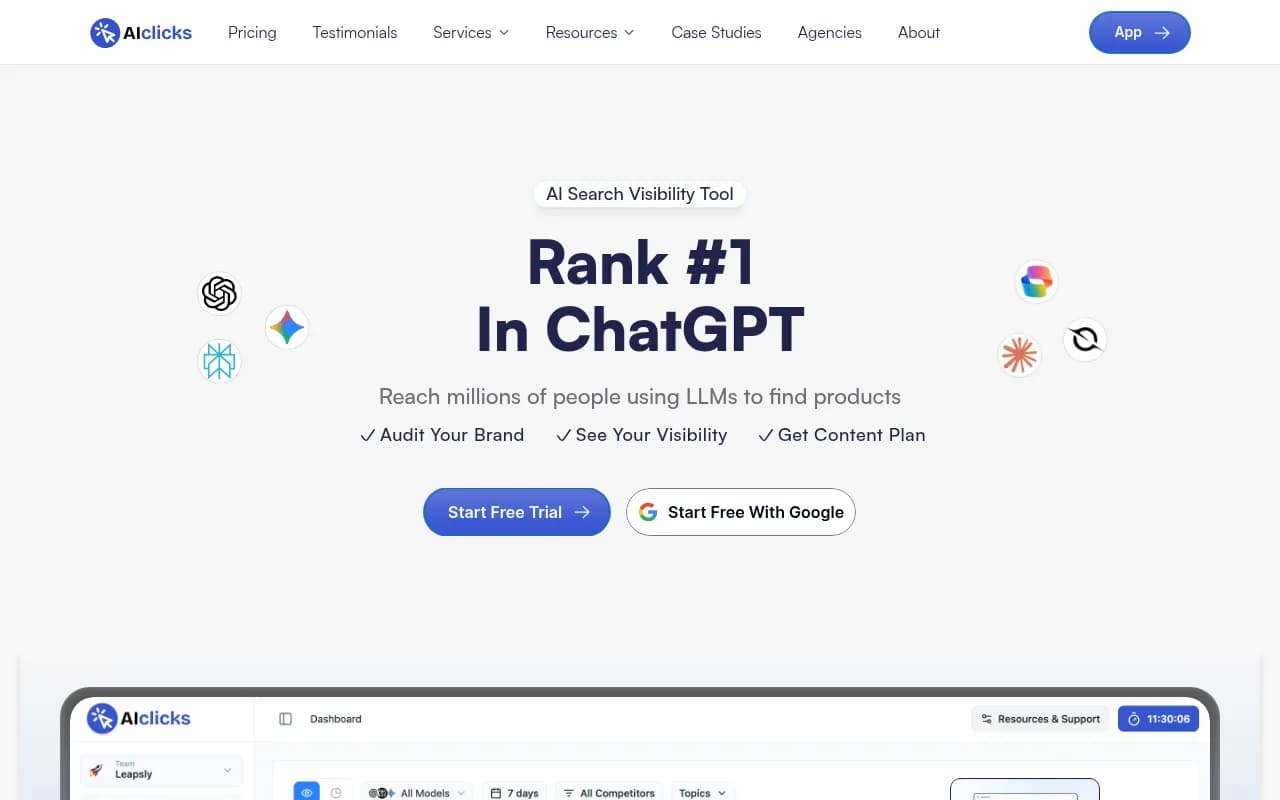
AIClicks is a standalone SaaS built specifically to track how brands show up in ChatGPT, Perplexity, Gemini, and other AI engines. It's the kind of tool an SEO or marketing team buys when the only job to be done is "where are we mentioned in AI answers, and what do we do about it." It covers prompt tracking, visibility scoring against competitors, and source analysis to show which domains are feeding AI citations. Pricing runs $59 to $499/mo depending on prompt volume and engine access, plus a 4.9/5 G2 rating and claims of 1,000+ brands and 400+ agencies using it.
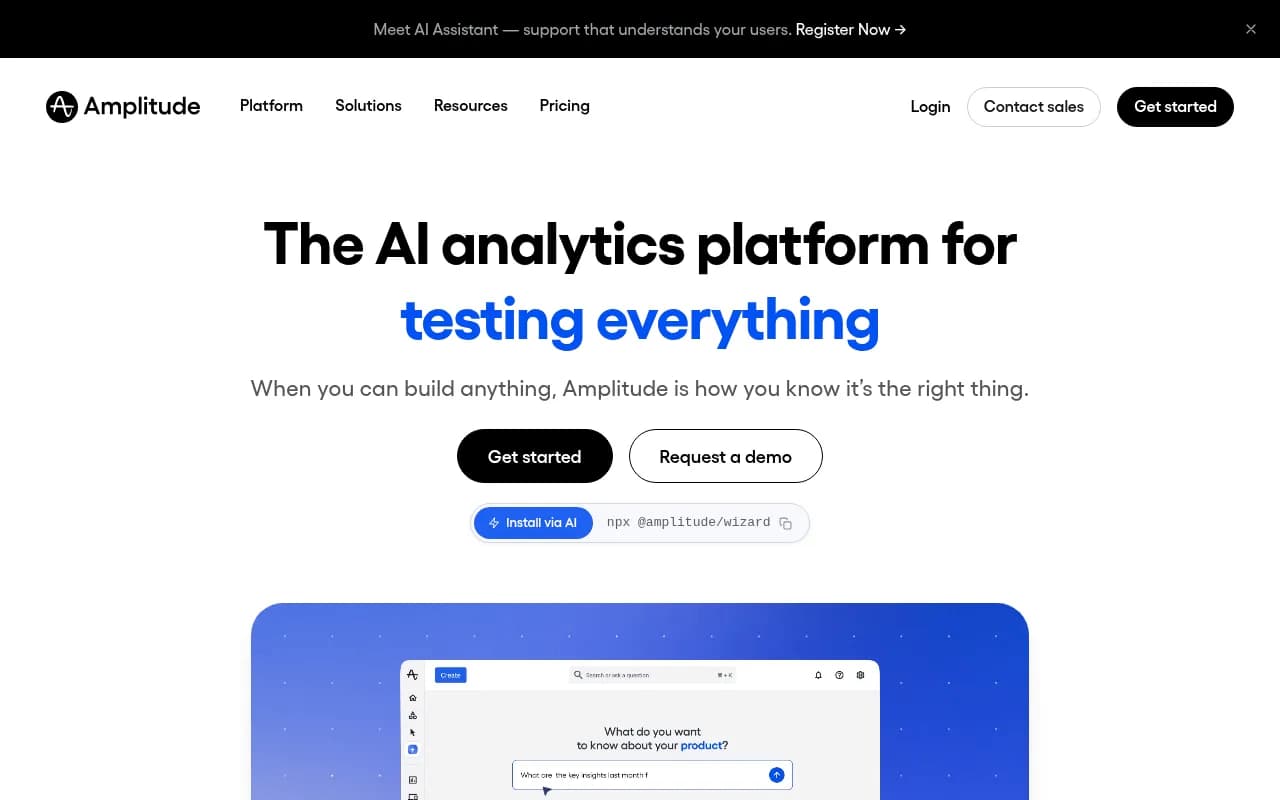
Amplitude is a full digital analytics platform, the kind of tool product and growth teams use for cohort analysis, session replay, A/B testing, and funnel breakdowns. In 2026 it added an AI Visibility module on top of that stack, tracking brand presence in AI search results and, crucially, tying it back to Amplitude's own behavioral and revenue data. It's free to try, with the core platform ranging from a generous free tier (2M events/month) up to custom enterprise pricing that in practice runs into the tens of thousands annually.
These two aren't natural rivals. One is a dedicated AEO point solution, the other is a broad analytics suite that happens to have grown an AI visibility feature. But plenty of teams end up weighing them against each other anyway, because both claim to answer the same basic question: are we showing up when people ask AI chatbots about our category.
Side-by-side comparison
| Feature | AIClicks | Amplitude |
|---|---|---|
| Primary purpose | Dedicated AI search visibility tracking (GEO/AEO) | Full product analytics platform, AI Visibility is a bundled feature |
| Pricing model | Paid-only, tiered by prompts and engines | Free tier available, AI Visibility included on every plan |
| Starting price | $59/mo (Starter) | $0 (2M events/month free forever) |
| AI engines tracked | 11 (ChatGPT, Gemini, Perplexity, Claude, Copilot, Grok, AI Mode, Meta, DeepSeek, Mistral, Google AI Overviews) | Primarily ChatGPT and Google AI Overview |
| Engine access on entry plan | Pick 3 of 11 on Starter | All covered engines included from day one |
| Competitor benchmarking | Yes, visibility score vs competitors | Yes, competitor rankings |
| Source/citation analysis | Yes, identifies domains driving citations | Yes, cites Wikipedia/Reddit/YouTube-type sources |
| Downstream traffic/revenue tie-in | No | Yes, native to Session Replay, Experimentation, Activation |
| Content generation or fixes | AI-optimized articles on some plans (counts disputed across its own pages) | Auto-generated content listed as "coming soon" |
| Free trial | 3 days (Starter/Pro); Business gets a demo instead | No trial needed, free plan available indefinitely |
| Reputation | 4.9/5 G2, 4.4/5 Trustpilot, some pricing-page inconsistencies flagged | Established analytics brand, AI Visibility too new for independent review consensus |
| Best fit | Teams that only want AI visibility monitoring | Teams already on Amplitude wanting AI visibility layered on top |
Pricing
AIClicks pricing
AIClicks runs a straightforward paid-tier model. Starter at $59/mo gets you 30 prompts and access to 3 of 11 supported engines. Pro at $189/mo bumps that to 150 prompts and 4 engines. Business at $499/mo opens up 300+ prompts and 6 engines. Enterprise is custom. Annual billing reportedly saves up to 29%, though a September 2026 review by Ryan Doser flagged real discrepancies on AIClicks' own site: the Starter plan card claims 1 website while the comparison table on the same page says 3, and the llms.txt file lists different article counts than the live pricing page. Worth checking directly before you commit a card number.
Amplitude pricing
Amplitude's core plans are Free (2M events/month, no credit card, AI Visibility included), Plus (usage-based scaling, starts effectively at $0 before ramping with volume), and Growth/Enterprise (both custom, sales-negotiated). The AI Visibility module itself costs nothing extra on any tier. But Amplitude as a whole is not a budget product. Vendr's dataset of 237 real Amplitude deals puts median annual spend at $64,724/year, and overage fees on exceeding your MTU or event tier can run 20-50% above contracted rates. Startups under $10M in funding and fewer than 20 employees can get a free year of Growth.
| Plan | AIClicks | Amplitude |
|---|---|---|
| Free tier | No (3-day trial only) | Yes, 2M events/month forever |
| Entry paid plan | $59/mo (Starter, 30 prompts, 3 engines) | $0 to start, usage-based scaling (Plus) |
| Mid tier | $189/mo (Pro, 150 prompts, 4 engines) | Custom (Growth) |
| Top tier | $499/mo (Business, 300+ prompts, 6 engines) | Custom (Enterprise) |
| Real-world median spend | Not publicly benchmarked | ~$64,724/year (Vendr data across 237 deals) |
| AI visibility cost specifically | Full product price | $0, bundled into any plan |
If you're comparing the cost of AI visibility tracking in isolation, Amplitude wins outright: it's free. But that framing only makes sense if you're also willing to adopt Amplitude as your analytics backbone, which is a much bigger commitment than $59/mo.
Head-to-head feature deep-dive
Engine coverage
AIClicks advertises 11 AI engines, which on paper beats almost anything bundled into a general analytics tool. The catch is that Starter plan customers only get 3 of those 11 active, meaning something like Google AI Overviews visibility might be locked out unless you upgrade. Amplitude's AI Visibility is narrower by design, focused mainly on ChatGPT and Google AI Overview, with Claude and Gemini mentioned on some marketing pages but not consistently verified as fully live features.
Verdict: AIClicks wins on raw breadth if you pay for it. Amplitude wins on simplicity if ChatGPT and AI Overviews are your two priority surfaces, which, given that Promptwatch's data on average sources per response shows ChatGPT cites only around 5 sources per answer versus roughly 10 for AI Overviews and Perplexity, covering just those two engines isn't as limiting as it sounds.
Competitor benchmarking and source analysis
Both tools do this. AIClicks shows a visibility score against named competitors and flags specific domains (Reddit threads, HubSpot blog posts, Product Hunt listings) driving citations in your category. Amplitude's version does something similar, citing source types like Wikipedia, Reddit, and YouTube feeding into AI answers. Neither tool publishes a methodology deep enough to fully trust the exact percentages, and reviewers have flagged AIClicks' own pricing and llms.txt pages as containing contradictory numbers, which is awkward given that those same pages are often what AI models cite when summarizing AIClicks itself.
Verdict: roughly a wash on features, but AIClicks has more documented credibility issues around its own published numbers.
Downstream traffic and revenue tie-in
This is where the two tools stop being comparable on equal footing. AIClicks tells you where you're mentioned and by whom. It doesn't tell you what that visibility is worth in actual site traffic or revenue, because it isn't connected to your analytics stack. Amplitude's AI Visibility, being native to the platform, can tie AI-referred visits directly to Session Replay, Experimentation results, and Activation cohorts. If a ChatGPT citation sends someone to your signup page, Amplitude can show you what that visitor did next.
Verdict: clear Amplitude win, but only valuable if you're already deep in the Amplitude ecosystem. A standalone AIClicks customer gets none of this.
Content and action recommendations
AIClicks includes AI-optimized article counts on some plans (5 or 15 per the live pricing page, though the llms.txt file says 10 and 20, another documented inconsistency). Amplitude lists auto-generated content and simulated changes as "coming soon" rather than shipped. Neither tool currently offers the kind of end-to-end monitor-to-publish workflow you'd get from a dedicated GEO execution platform. For teams that want visibility data to actually turn into published, optimized content on autopilot, Promptwatch is worth a look since it pairs crawler-log-level monitoring with Content Agents that write and publish directly to your CMS.

Verdict: both AIClicks and Amplitude are monitoring-first tools right now. Neither closes the loop to content execution the way a purpose-built GEO platform does.
Support and trust signals
AIClicks sits at 4.9/5 on G2 (reviewer counts vary between 55 and 64 across sources) and 4.4/5 on Trustpilot from a small sample of 10 reviews, with praise for responsive support and a clean dashboard, but recurring complaints about prompt limits running out fast on agency accounts and confusing tier structure. Amplitude is an established, much larger company with a long analytics track record, but its AI Visibility feature specifically is too new (2026 launch) to have an independent review consensus yet.
Verdict: AIClicks has more direct, feature-specific reviews. Amplitude has more brand trust overall but less scrutiny on this particular module.
Ease of adoption
AIClicks is a five-minute signup if you just need AI visibility tracking, nothing else to configure. Amplitude, even on the free plan, assumes you're setting up event tracking, which is a bigger lift if product analytics isn't already part of your stack.
Verdict: AIClicks wins for anyone who wants a narrow, fast setup.
Pros and cons
AIClicks
Pros:
- Purpose-built for AI visibility, no unrelated analytics overhead
- Broadest engine coverage on paper (11 platforms)
- Fast, focused onboarding
- Strong G2 rating (4.9/5)
Cons:
- No free tier, only a 3-day trial
- Documented inconsistencies across its own pricing page, comparison table, and llms.txt file
- Engine access gated by plan tier, Starter users get only 3 of 11
- Prompt limits reportedly run out fast for agencies managing multiple clients
- No connection to your actual site traffic or revenue data
Amplitude
Pros:
- AI Visibility included free on every plan, including the no-cost tier
- Ties AI-referred traffic directly to Session Replay, Experimentation, and revenue
- Backed by an established analytics platform with broad enterprise trust
- Free public version available without signup
Cons:
- Narrower AI engine coverage (mainly ChatGPT and Google AI Overview)
- Only genuinely useful if you adopt the full Amplitude platform
- Real-world cost for the broader platform is high, median spend around $64,724/year
- AI Visibility module is new enough that independent reviews are thin
- Content generation features listed as "coming soon," not yet shipped
Who should pick which tool
Pick AIClicks if you just need AI search visibility tracking and nothing else. It's the more direct purchase for SEO teams, brand managers, and smaller agencies who want multi-engine coverage without adopting a full analytics platform. Just read the pricing page carefully given the documented inconsistencies.
Pick Amplitude if you're already running (or planning to run) Amplitude for product analytics, session replay, or experimentation. The AI Visibility module is essentially a free bonus that becomes genuinely useful once you can connect AI citations to what visitors actually do on your site.
Don't pick either if you want visibility tracking that turns directly into published, optimized content with no manual work in between. That's a different category of tool entirely, and it's worth comparing options in the GEO software directory at bestgeosoftware.com before committing to a monitoring-only solution.
Final verdict
AIClicks and Amplitude solve different problems that happen to overlap on one feature. AIClicks is the better buy if AI visibility tracking is the whole job. Amplitude is the better buy if you want that tracking folded into a platform you're already using (or need) for deeper product analytics. Neither one will write and publish content for you, so budget for a second tool if execution, not just monitoring, is the actual goal.