Key takeaways
- Profound raised $155M and serves Fortune 500 brands -- but its enterprise pricing and analytics-first design leave most content teams without a practical fit
- The real gap isn't monitoring; it's the ability to act on what you find. Most alternatives stop at dashboards
- The five platforms below were chosen specifically for content teams: they either generate content, surface actionable gaps, or connect visibility data directly to a writing workflow
- If you want one platform that covers the full loop -- gap analysis, content generation, and citation tracking -- Promptwatch is the only tool in this category rated as a leader across all dimensions in 2026
- Pricing ranges from $29/month (Otterly.AI) to enterprise (AthenaHQ), so there's a realistic option at every budget
Why content teams keep outgrowing Profound
Profound is genuinely impressive. In February 2026, the company raised $96M at a $1B valuation, bringing total funding to $155M. Their customer list includes Target, Walmart, Figma, and Ramp. Over 10% of the Fortune 500 uses the platform.
But that positioning tells you exactly who Profound is built for: analytics teams at large enterprises with dedicated capacity to interpret dashboards and translate findings into action. If you're a content team of three trying to figure out why ChatGPT keeps recommending a competitor instead of you -- and then actually fix it -- Profound's operating model creates friction at every step.
The complaints that come up repeatedly from teams who've evaluated it:
- Sales-gated access means weeks before you can even test it
- Pricing is enterprise-tier, often requiring annual commitment
- The output is visibility data, not content direction. You still have to figure out what to write
That last point is the real issue. Knowing you're invisible in AI search is step one. Creating content that makes you visible is step two. Most platforms -- Profound included -- are very good at step one and leave you entirely on your own for step two.
The five alternatives below were chosen with content teams specifically in mind. Each one either generates content, surfaces specific gaps with enough context to act on them, or connects visibility data to a writing workflow in a meaningful way.
What to look for in a Profound alternative (for content teams)
Before the list, a quick framework. A visibility tracker is useful. A platform that helps you act on visibility data is what content teams actually need. Here's what separates the two:
- Gap analysis that goes beyond "you're not mentioned" to "here's the specific question AI models are answering for your competitor but not for you"
- Content generation or briefs grounded in real prompt data, not generic SEO templates
- Citation tracking at the page level, so you can see which articles are actually being cited and which aren't
- Prompt volume and difficulty scoring, so you can prioritize instead of guessing
- Coverage of the AI models your audience actually uses -- ChatGPT, Perplexity, Google AI Overviews, Claude, Gemini
With that in mind, here are the five platforms worth evaluating.
The top 5 Profound alternatives for content teams in 2026
1. Promptwatch -- best for the full content loop
Promptwatch is the most complete option on this list for content teams, and the one most directly designed to solve the problem Profound leaves open.

Where Profound shows you visibility data, Promptwatch is built around a three-step loop: find the gaps, create content to fill them, then track whether it worked. The Answer Gap Analysis shows exactly which prompts competitors are visible for but you're not -- not just "you're missing here" but the specific topics and questions AI models want answers to that your site doesn't currently provide.
From there, Content Agents generate articles, listicles, comparisons, and briefs grounded in that prompt data. This isn't a generic AI writer -- the output is shaped by real citation data, prompt volumes, persona targeting, competitor analysis, and brand guidance. The difference between content that gets cited by AI models and content that doesn't is specificity and relevance to the actual questions being asked. Promptwatch's content generation is built around that.
The platform also covers more AI models than most competitors: ChatGPT, Perplexity, Google AI Overviews, Google AI Mode, Claude, Gemini, Meta/Llama, DeepSeek, Grok, Mistral, and Copilot. Page-level citation tracking shows which articles are being picked up and by which models. AI Crawler Logs show when crawlers visit your pages, which errors they hit, and when a page moves from crawl to citation -- a feature most competitors don't have at all.
For content teams specifically, the prompt volume and difficulty scoring is genuinely useful. Instead of guessing which topics to prioritize, you can see which prompts have high volume and are winnable given your current authority.
Pricing starts at $99/month (Essential: 1 site, 50 prompts, 5 articles), $249/month for Professional (2 sites, 150 prompts, 15 articles, crawler logs), and $579/month for Business (5 sites, 350 prompts, 30 articles). A free trial is available.
2. Writesonic -- best for content-led teams that want GEO built in
Writesonic started as an AI writing platform and has added GEO features that make it a reasonable Profound alternative for teams whose primary job is content production.
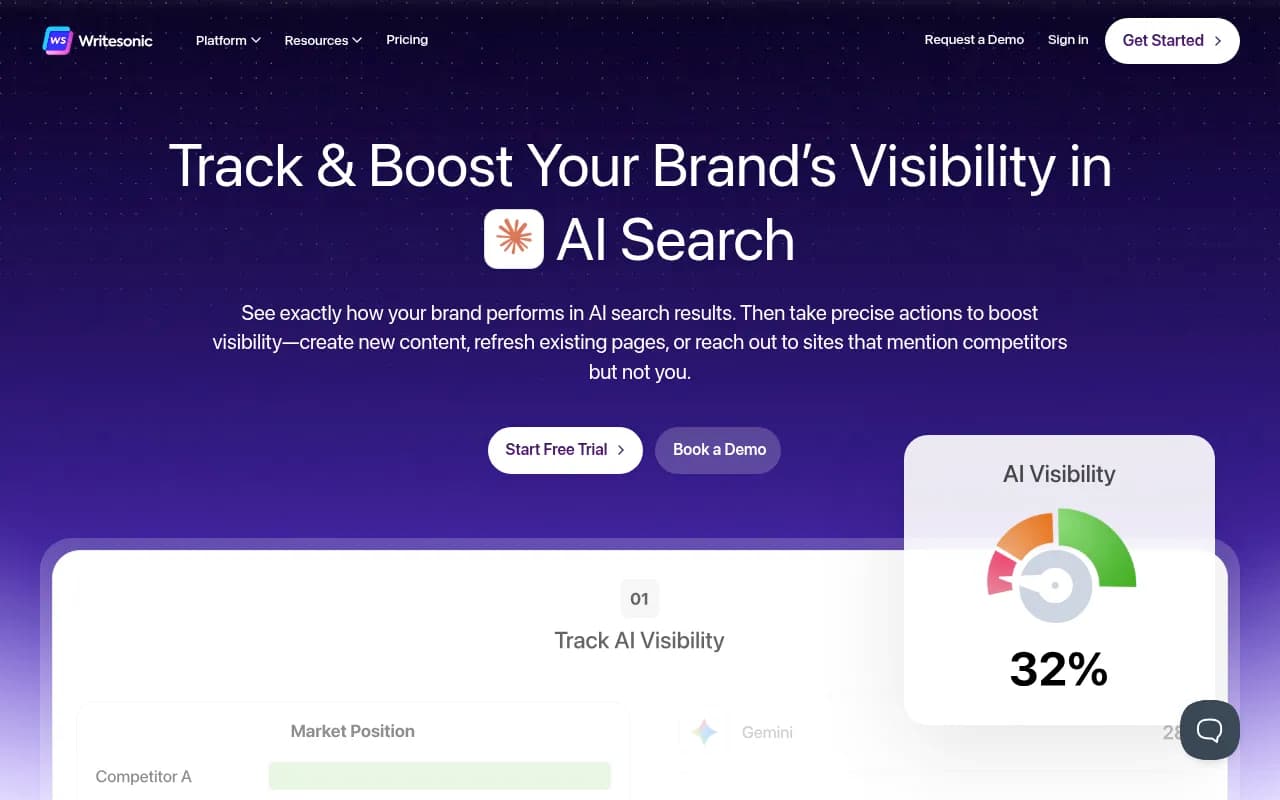
The appeal here is workflow integration. If your team is already using an AI writer, having visibility tracking built into the same tool removes a context-switching problem. Writesonic tracks AI search visibility and surfaces optimization suggestions alongside the writing environment, so the feedback loop between "what's missing" and "write something about it" is shorter.
The GEO features are less deep than dedicated platforms -- you won't get crawler logs or prompt-level difficulty scoring -- but for a content team that wants to start thinking about AI visibility without adopting an entirely new platform, it's a practical entry point.
Pricing varies by plan and usage. Check their current pricing page for specifics, as it's changed frequently in 2026.
3. AthenaHQ -- best for enterprise content teams that need Profound-level depth
If Profound's capability set is what you need but the sales process or pricing structure isn't working for you, AthenaHQ is the closest peer.

AthenaHQ is an enterprise GEO platform with multi-region support, automation features, and revenue attribution. It's monitoring-focused rather than content-generation-focused, so it won't write articles for you -- but it gives enterprise content teams the data infrastructure to make informed decisions about what to create and where.
The platform covers 8+ AI search engines and includes competitive heatmaps, prompt tracking, and brand sentiment analysis. For large content teams with dedicated SEO or analytics resources to translate data into briefs, it's a strong option.
It's worth being direct about the tradeoff: AthenaHQ is a sophisticated analytics platform, not a content tool. If your team needs the data and has the people to act on it, it fits. If you're looking for something that helps you produce content directly, look at Promptwatch or Writesonic instead.
4. Otterly.AI -- best for small teams that need affordable monitoring with content context
Otterly.AI is the most accessible entry point in this category at $29/month. It covers six AI engines and gives you brand monitoring, sentiment tracking, and visibility scores without requiring an enterprise commitment.

For small content teams or solo marketers who want to understand their AI search presence before investing in a heavier platform, Otterly is a sensible starting point. It won't generate content for you, and it doesn't have crawler logs or prompt volume data, but it answers the basic question -- "where do we appear in AI answers, and what's the sentiment?" -- at a price point that doesn't require budget approval.
The limitation is that it's a monitoring tool. You'll know what's missing; you'll need to figure out what to do about it yourself. For teams with the content production capacity to act on that data independently, that's fine. For teams that need more guidance, it's a stepping stone rather than a destination.
5. Peec AI -- best for multi-language content teams with an action orientation
Peec AI sits in the mid-market range at $89/month with unlimited seats, which makes it particularly attractive for agencies or content teams with multiple contributors.

The platform has a stronger action orientation than most monitoring tools -- it surfaces an "action roadmap" alongside visibility data, which gives content teams more direction than a raw dashboard. Multi-language support is a genuine differentiator for teams operating across markets; most platforms in this category are English-first by design.
Prompt-level analytics show which specific queries are driving AI responses, which helps content teams prioritize topics. The unlimited seat model also means you're not paying per user as your team grows, which matters for agencies running multiple client accounts.
Like Otterly, Peec AI doesn't generate content. But the action roadmap feature gets it closer to being useful for content teams than a pure monitoring dashboard.
Side-by-side comparison
| Platform | Content generation | Prompt volume data | Crawler logs | AI models covered | Starting price | Best for |
|---|---|---|---|---|---|---|
| Promptwatch | Yes (Content Agents) | Yes | Yes | 11 | $99/mo | Full content loop: gaps + generation + tracking |
| Writesonic | Yes (AI writer + GEO) | Limited | No | Varies | Varies | Content teams already using Writesonic |
| AthenaHQ | No | Yes | No | 8+ | Enterprise | Enterprise teams needing Profound-level depth |
| Otterly.AI | No | No | No | 6 | $29/mo | Small teams, budget-conscious entry point |
| Peec AI | No | Yes | No | Multiple | $89/mo | Multi-language teams, agencies, action roadmaps |
How to choose
The honest answer depends on what your content team's actual bottleneck is.
If you're producing content regularly but don't know why AI models aren't citing it, you need gap analysis and page-level citation tracking. Promptwatch covers both and adds content generation on top.
If you're already using Writesonic for content production and just want to layer in GEO awareness, staying in that ecosystem makes sense.
If you're at an enterprise with dedicated analytics resources and need Profound-level data without Profound's sales process, AthenaHQ is worth evaluating.
If you're a small team or agency testing the waters on AI visibility for the first time, Otterly.AI at $29/month lets you get oriented without a major commitment.
If you're running multilingual campaigns or managing multiple client accounts, Peec AI's unlimited seat model and action roadmap make it worth a look.
One thing worth saying plainly: most teams that switch from Profound to a cheaper monitoring tool end up frustrated within a few months. The data is useful, but data without action doesn't move the needle. The platforms that actually help content teams improve their AI search visibility are the ones that close the loop between "here's what's missing" and "here's what to create." That's a short list.
The monitoring-only trap
This is worth naming directly because it's the mistake most teams make when evaluating this category.
A visibility score going up is not the goal. Getting cited in AI answers that your potential customers are reading is the goal. Those are related but not the same thing.
Most platforms -- including several on this list -- show you the score. Fewer show you the specific content gaps driving that score. Almost none help you create content to fill those gaps and then track whether the new content gets picked up.
That full loop is what separates a GEO platform from a GEO dashboard. Before you commit to any Profound alternative, ask the vendor to show you specifically what happens after you identify a gap. If the answer is "you export the data and take it to your content team," that's a dashboard. If the answer is "here's how we help you create and track content that fills it," that's a platform.
The distinction matters more as AI search continues to take share from traditional search. Teams that can close the loop quickly will compound their visibility advantage. Teams that are still interpreting dashboards six months from now will still be interpreting dashboards.