Key takeaways
- Most AI visibility tools track brand mentions but stop there. Only a handful expose prompt volume, difficulty scores, or query fan-outs -- the data you actually need to prioritize your efforts.
- Prompt intelligence (volume + difficulty + fan-outs) is what separates optimization platforms from monitoring dashboards.
- Promptwatch is the only platform in this comparison rated as a leader across all prompt intelligence categories, including query fan-outs that show how one prompt branches into sub-queries.
- Tools like Profound, AthenaHQ, and SE Ranking offer solid prompt data but vary significantly in depth and price.
- If you're choosing a tool purely for monitoring, cheaper options exist. If you want to actually act on the data, you need prompt intelligence built in.
Why prompt intelligence is the metric that actually matters
Most AI visibility tools will tell you whether your brand appeared in a ChatGPT response. That's useful. But it doesn't tell you which prompts to target, how competitive those prompts are, or how a single question fans out into dozens of related sub-queries that AI models answer differently.
That's the gap prompt intelligence fills.
Think of it like keyword research for AI search. Traditional SEO tools give you search volume and keyword difficulty so you can prioritize. Prompt intelligence does the same thing for AI search -- showing you which prompts are asked most often, how hard they are to rank for, and how they branch into related questions. Without this data, you're essentially guessing what to optimize.
The three dimensions that matter:
- Prompt volume: How many users are asking this specific question across AI platforms? High-volume prompts are worth targeting. Low-volume niche prompts might be easier wins.
- Difficulty scoring: How competitive is this prompt? If the top brands in your space already dominate it, you need a different angle.
- Query fan-outs: When someone asks "what's the best CRM for small businesses," AI models don't just answer that one question. They pull from dozens of related sub-queries. Knowing how a prompt fans out tells you what content to create to capture the full cluster.
Most tools in this space offer one of these three. Very few offer all three. Let's look at how the top 12 stack up.
The 12 platforms ranked by prompt intelligence depth
1. Promptwatch
Promptwatch is the most complete prompt intelligence platform available right now. It's the only tool in this comparison that covers all three dimensions -- volume, difficulty, and query fan-outs -- in a single workflow.
The query fan-out feature is genuinely useful in a way that's hard to overstate. You put in one prompt, and the platform shows you how it branches into sub-queries across different AI models. That tells you not just "this prompt matters" but "here are the 15 related questions your content needs to answer to get cited consistently."
The Answer Gap Analysis then shows you which of those prompts competitors are visible for but you're not -- with specific content recommendations to close the gap. And there's a built-in AI writing agent that generates content grounded in 880M+ citations, not generic SEO filler.

2. Profound
Profound is one of the more serious enterprise options in this space. It tracks 10+ AI platforms and includes prompt volume data, which puts it ahead of most competitors on the intelligence side. The interface is clean and the data quality is solid.
Where it falls short: no query fan-outs, and the content optimization side is thinner than Promptwatch. You get good monitoring and decent prompt data, but the "now what do I do with this?" question is harder to answer. Pricing starts at $99/mo, which is reasonable for what you get.

3. AthenaHQ
AthenaHQ tracks 8 AI platforms and has built a strong reputation for data accuracy. It's YC-backed, which means it's had serious investment in getting the fundamentals right. Prompt difficulty scoring is available, and the competitive benchmarking is genuinely useful.
The limitation is that it's primarily a monitoring tool. There's no content generation, no query fan-out mapping, and the gap analysis is more basic than what Promptwatch offers. Starting at $95/mo on annual billing, it's priced for teams that want reliable data and are comfortable figuring out the optimization side themselves.

4. SE Ranking (AI Visibility Toolkit)
SE Ranking's AI Visibility Toolkit is worth mentioning because it sits inside a full SEO platform, which means you're getting traditional keyword data alongside AI prompt tracking. For teams that want one tool for both, that's a real advantage.
Prompt filtering by intent is available, and you can identify gaps where competitors appear but you don't. The prompt volume data is less granular than dedicated AI visibility tools, and there's no query fan-out feature. But the price-to-value ratio is strong, especially if you're already using SE Ranking for SEO.
5. Semrush One (AI Visibility Toolkit)
Semrush One bundles traditional SEO with AI visibility tracking across 5+ AI engines. The brand monitoring is solid, and the integration with existing Semrush workflows is seamless if you're already in that ecosystem.
The prompt intelligence side is more limited. Semrush uses fixed prompts rather than letting you define your own, which means you're working within their framework rather than your actual customer's language. No query fan-outs. No difficulty scoring at the prompt level. It's a good starting point for teams new to AI visibility, but not the deepest tool for prompt intelligence specifically.
6. Otterly.AI
Otterly is one of the more affordable options in the space and does basic AI visibility monitoring well. It tracks ChatGPT, AI Overviews, and a handful of other platforms. The interface is simple and the setup is fast.
For prompt intelligence, it's limited. You get mention tracking and some competitive benchmarking, but no volume data, no difficulty scoring, and no fan-outs. It's a monitoring dashboard, not an optimization tool. Fine for teams that just want to know if they're being cited. Not the right choice if you want to prioritize which prompts to target.

7. Peec AI
Peec AI has a reputation for accuracy, which matters more than people realize. If the tool is pulling AI responses incorrectly or sampling too infrequently, the data is misleading. Peec tracks ChatGPT, Perplexity, and AI Overviews at the base tier, with additional models available for extra cost.
Prompt intelligence is basic. You can track specific prompts and see your visibility, but volume estimates and difficulty scoring aren't core features. No fan-outs. It's a solid monitoring tool for teams that prioritize data accuracy over analytical depth.

8. Airefs
Airefs is the budget-friendly option that punches above its weight on source-level citation discovery. At $24/mo, it's the most accessible tool in this comparison. It also includes Reddit monitoring, which most competitors skip entirely.
Prompt intelligence is minimal. You're getting citation tracking and source analysis more than volume or difficulty data. For small teams or individuals who want to understand where AI models are pulling citations from without spending much, Airefs is a reasonable starting point.
9. Scrunch AI
Scrunch AI focuses on AI search visibility monitoring with a clean interface and decent competitive benchmarking. It's positioned more toward enterprise teams and includes content recommendations alongside tracking.
The prompt intelligence side is moderate -- better than pure monitoring tools, but not as deep as Promptwatch or Profound on volume and difficulty data. No query fan-outs. The content optimization features are a step in the right direction.
10. Rankscale
Rankscale is a focused AI search ranking and visibility platform that tracks how brands appear across AI engines. It's a newer entrant but has been building out its prompt tracking capabilities steadily.
Prompt volume data is available in some form, but difficulty scoring and fan-outs are not yet core features. Worth watching as the platform matures, but currently sits in the monitoring-first category.
11. Ahrefs Brand Radar
Ahrefs Brand Radar brings the credibility of the Ahrefs brand to AI visibility tracking, which means a lot of SEO teams will default to it simply because they're already in the Ahrefs ecosystem. The brand monitoring is competent and the data is reliable.
The prompt intelligence limitations are real, though. Fixed prompts mean you can't fully customize to your customer's actual language. No AI traffic attribution, no difficulty scoring at the prompt level, and no fan-outs. It's a reasonable add-on for existing Ahrefs users but not a primary prompt intelligence tool.
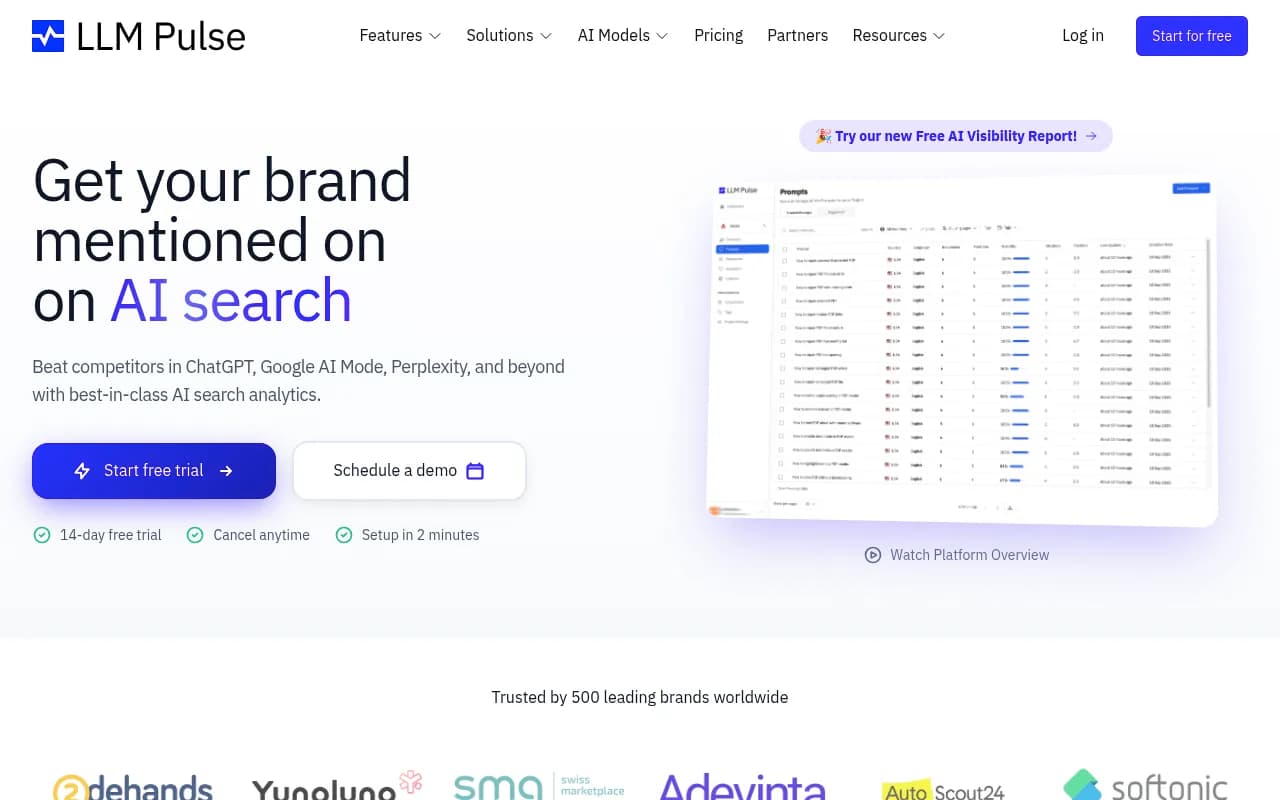
12. LLM Pulse
LLM Pulse is a comprehensive LLM response tracking tool that covers a wide range of AI platforms. It's solid for monitoring and has been building out its analytics capabilities.
Prompt intelligence features are developing. Some volume data is available, but the depth of difficulty scoring and fan-out mapping isn't at the level of the top-tier tools. Good for teams that want broad platform coverage with basic prompt tracking.
Comparison table: prompt intelligence features across all 12 tools
| Tool | Prompt volume | Difficulty scoring | Query fan-outs | Content generation | Starting price |
|---|---|---|---|---|---|
| Promptwatch | Yes | Yes | Yes | Yes (AI writing agent) | $99/mo |
| Profound | Yes | Partial | No | No | $99/mo |
| AthenaHQ | Partial | Yes | No | No | $95/mo (annual) |
| SE Ranking | Partial | No | No | No | Varies |
| Semrush One | No (fixed prompts) | No | No | No | Varies |
| Otterly.AI | No | No | No | No | ~$29/mo |
| Peec AI | No | No | No | No | $85/mo |
| Airefs | No | No | No | No | $24/mo |
| Scrunch AI | Partial | No | No | Partial | Custom |
| Rankscale | Partial | No | No | No | Varies |
| Ahrefs Brand Radar | No (fixed prompts) | No | No | No | Bundled |
| LLM Pulse | Partial | No | No | No | Varies |
What query fan-outs actually look like in practice
This is worth spending a moment on because it's the feature most people haven't seen before.
When a user types "best project management software for remote teams" into ChatGPT, the model doesn't just answer that one question. It draws on its training data and real-time retrieval to answer a cluster of related questions: What features matter for remote teams? Which tools have the best mobile apps? What do users say about pricing? Which tools integrate with Slack?
Each of those sub-questions is a separate opportunity to get cited. If your content only answers the top-level question, you might get cited once. If it answers the full fan-out, you get cited across the cluster.
Promptwatch's query fan-out feature maps this branching structure. You can see exactly which sub-queries are driving citations for your competitors and which ones your content isn't covering. That's the kind of data that turns a monitoring dashboard into an actual optimization workflow.
How to choose the right tool for your situation
The right tool depends on what you're actually trying to do.
If you want to know whether your brand is being cited at all, any of the monitoring tools in this list will work. Airefs at $24/mo is a reasonable starting point. Otterly.AI is similarly accessible.
If you want to understand which prompts to target and how competitive they are, you need prompt volume and difficulty data. Profound and AthenaHQ both offer this at the mid-tier price range.
If you want to understand the full prompt cluster around a topic -- the fan-outs, the sub-queries, the content gaps -- and then actually create content to fill those gaps, Promptwatch is the only platform that does all of this in one place. The combination of query fan-outs, Answer Gap Analysis, and the built-in AI writing agent means you're not just learning where you're invisible. You're fixing it.
For teams already deep in the Semrush or Ahrefs ecosystem, the Brand Radar and AI Visibility Toolkit add-ons are convenient but limited. They're better than nothing, but they're not built for prompt intelligence as a primary use case.
The monitoring-only trap
One pattern worth naming: a lot of teams buy an AI visibility tool, set up their prompts, watch their mention rate go up or down, and then... don't know what to do next.
This is the monitoring-only trap. You have data, but no clear path from data to action. Most tools in this space are built for the monitoring side. They show you where you stand. They don't show you what to do about it.
Prompt intelligence -- volume, difficulty, fan-outs -- is what breaks you out of that trap. It tells you which prompts are worth pursuing, how hard the competition is, and what content you need to create. That's the difference between a dashboard and a workflow.
The tools that offer this depth are fewer than you'd expect given how crowded the AI visibility space has become. But they exist, and the gap between them and the monitoring-only options is significant.
Final thoughts
The AI search visibility space has exploded in 2026. There are more tools than ever, and most of them do the basics competently. But prompt intelligence -- the ability to see volume, difficulty, and query fan-outs -- is still rare.
If you're evaluating tools right now, the comparison table above is a good starting point. But the real question to ask any vendor is: "Can you show me the query fan-outs for this prompt?" If they don't know what you're talking about, you have your answer.
The brands that win in AI search over the next two years won't be the ones with the best monitoring dashboards. They'll be the ones that understand the prompt landscape deeply enough to create content that gets cited consistently, across the full cluster of related questions their customers are asking.